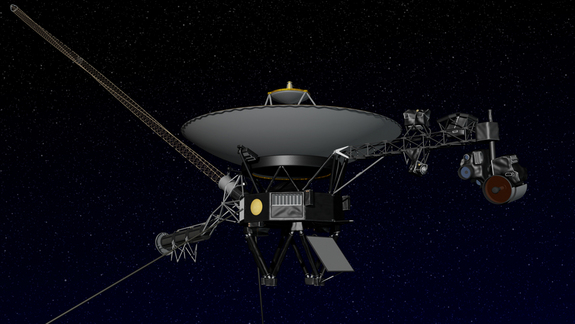
Showing posts with label Voyager. Show all posts

Thursday, August 7, 2014

Keck II telescope: Vast Stormy weather on Uranus

Massive storms on Uranus captured August 5 and 6, 2014 as seen by Keck II telescope

Both images were taken by Imke de Pater (UC Berkeley), Larry Sromovosky and Pat Fry (U. Wisconsin), and Heidi Hammel (AURA) using the near-infrared camera NIRC2 with adaptive optics on the 10-m Keck II telescope at a wavelength of 1.6 micron.

Weather on any planet can be quite unpredictable. As hurricanes threaten the Aloha State, astronomers working at W. M. Keck II telescope on the island of Hawaii were surprised by the appearance of gigantic swirling storm systems on the distant planet Uranus.

During the Voyager encounter with Uranus in 1986, only a scant handful of dim clouds were seen in its atmosphere.

When the planet approached equinox in 2007 (i.e., when the Sun stood high above its equator), large storms developed on the planet, yet most of these faded.

In the past few days, however, astronomers were surprised by a multitude of bright storms on the planet, including one monstrous feature.

"We are always anxious to see that first image of the night of any planet or satellite, as we never know what it might have in store for us," said Imke de Pater, professor at UC Berkeley and team leader.

"This extremely bright feature we saw on UT 6 August 2014 reminds me of a similarly bright storm we saw on Uranus's southern hemisphere during the years leading up to and at equinox".

"Even after years of observing, a new picture of Uranus from Keck II telescope can stop me in my tracks and make me say Wow!," said Heidi Hammel, a member of the observing team.

Since the 2007 equinox, Uranus's northern pole has been coming into view, and the south pole is no longer visible.

The bright feature de Pater refers to was known as the "Berg", because this feature was visible just below the polar haze, and resembled an iceberg peeled off an ice-shelf.

The Berg oscillated in latitude between southern latitudes of 32 and 36 degrees since 2000, and perhaps dated back to the Voyager era (1986).

In 2004 it became much brighter; in 2005 it started to migrate towards the equator and became a very powerful storm system.

In 2009, when it came to within a few degrees of the equator, it dissipated.

The present storm is even brighter than the Berg. Its morphology is rather similar, and the team expects it may also be tied to a vortex in the deeper atmosphere.

From near-infrared images taken at 2.2 micron, the team already determined that the storm must reach high altitudes; they will conduct calculations to determine the precise altitude, but based upon its brightness at those wavelengths the team expects it to reach altitudes near the tropopause (the boundary in Uranus's atmosphere between the troposphere and the stratosphere).

Monday, August 4, 2014

NASA IBEX and Voyager driving advances in outer heliosphere research

This image highlights the statically combined survival probability and C-G corrected maps, indicative of energetic neutral atom (ENA) fluxes in the outer heliosphere directed inward and before ionization losses. 

Credit: Southwest Research Institute (SrWI)

Scientists yesterday highlighted an impressive list of achievements in researching the outer heliosphere at the 40th International Committee on Space Research (COSPAR) Scientific Assembly in Moscow.

"Between NASA's Voyager and IBEX missions, it's an incredible time for outer heliospheric science," says Dr. Dave McComas, IBEX principal investigator and assistant vice president of the Space Science and Engineering Division at Southwest Research Institute, who also will be recognized with a 2014 COSPAR Space Science Award at the assembly.

"Ten years ago you could hardly find an outer heliosphere technical session. Now it's the hottest thing going."

The million-mile-per-hour solar wind pushed out by the Sun inflates a giant bubble in the interstellar medium called the heliosphere, which envelops the Earth and the other planets.

After the two Voyager spacecraft, launched in 1977, completed their mission to study Jupiter, Saturn, Uranus and Neptune, they continued on their journey to interstellar space.

IBEX
Another mission, the Interstellar Boundary Explorer (IBEX) launched in 2008, is designed to map and study the global interactions at the boundary between the heliosphere and interstellar space.

Together, the Voyagers and IBEX have helped advance an important area of research to provide insight to humankind's evolving home in the galaxy.

This image shows a selection of dominant ribbon ENA emission regions (red outlined areas in each map). 

The ribbon emissions are strongest at increasingly higher latitudes for higher energies, consistent with the latitude ordering of the solar wind around solar minimum. 

Vredit: Southwest Research Institute (SrWI)

Both Voyagers provide "point" measurements along their journey out of the solar system.

Those measurements offer important details about interactions occurring along their paths.

IBEX complements the Voyagers' measurements by imaging the interactions occurring at the edge of the heliosphere over all directions in space.

"It's a lot like the difference between a CT scan and associated biopsies."

"A biopsy provides specific information at the point it samples, while a CT scan provides the global images and context for the big picture of what's going on."

Dave McComas
The combination of point and global measurements is really dynamite," says McComas.

A ribbon of enhanced emissions snakes through the sky at the boundary between the heliosphere and interstellar space, right between the two Voyager spacecraft point measurements.

The ribbon went undetected until IBEX observed it in 2009.

IBEX creates images of energetic neutral atoms (ENAs) to make visible the invisible energetic interactions at the edge of the solar system. In the paper "IBEX:

The First Five Years (2009)," published this month by The Astrophysical Journal Supplement Series, the science team summarised its first five years of accomplishments, including the first five years of maps showing interactions at the edge of the solar system, a trove of data in multiple formats, and aspects of data analysis and the methods used to refine them.

Friday, May 2, 2014

NASA Black Brant XII: HYPE Sounding rocket to study interplanetary medium

A Black Brant XII launches from Wallops Flight Facility. 

Credit: NASA

NASA will conduct a sounding rocket mission in May 2014, carrying a payload designed to measure the nature of the interplanetary medium (IPM), characterizing the particles that fill our solar system.

The Hydrogen Polarimetric Explorer (HYPE), measures light reflected by interplanetary hydrogen that originally flows in from outside the galaxy.

Along its travels, the hydrogen crosses the boundaries of our heliosphere, the local bubble surrounding the sun and planets that is inflated by the solar wind.

Thus it can provide not only information about the nature of near space, but also of the galactic environment and how it interacts with the sun and heliosphere.

The sounding rocket measurements will provide important information on the size and shape of the heliosphere as well as information on the interstellar magnetic field at the boundary.

These results will be combined with NASA's Interstellar Boundary Explorer (IBEX), Voyager, and Hubble Space Telescope interplanetary hydrogen measurements to improve models of the heliospheric boundary and its interactions with the local interstellar medium.

The window for the HYPE launch opens on May 2, 2014.

HYPE will fly on a Terrier-Black Brant sounding rocket, launched from the White Sands Missile Range in New Mexico.

It is projected to fly to an altitude of about 185 miles during a nine-minute flight.

Walt Harris with the UC Davis is the mission principal investigator.

Thursday, February 13, 2014

Global map of Ganymede, Jupiter's biggest moon

Making the map of Ganymede was a long and complex task. 

Some of the scientists behind the map were graduate students and postdocs at Brown University when the Galileo data began to arrive in the 1990s. 

Image courtesy U.S. Geological Survey.

Scientists, including Brown University geologists and students, have completed the first global geological map of Ganymede, Jupiter's largest moon and the largest in the solar system.

With its varied terrain and possible underground ocean, Ganymede is considered a prime target in the search for habitable environments in the solar system, and the researchers hope this new map will aid in future exploration.

Geoffrey Collins
The work, led by Geoffrey Collins, a Ph.D. graduate of Brown now a professor at Wheaton College in Massachusetts, took years to complete.

"It is very rewarding to see the results of all of our efforts here at Brown come together into this integrated global compilation that will now be used to plan the next phase of scientific exploration of the Galilean satellites," said Jim Head, the Scherck Distinguished Professor of Geological Sciences at Brown and one of the map's co-authors.


The researchers combined images from the Voyager and Galileo spacecraft to put the map together. Voyager was the first mission to fly through the Jupiter satellite system and passed by the icy surface of Ganymede in 1979.

Those first images revealed a complex surface, segmented and fractured into dark and light terrain.

In 1995, the Galileo spacecraft was placed in orbit around Jupiter and began to return high-resolution images of the surface that help to understand many of the features seen at low-resolution by Voyager.

Jim Head
Head was a co-investigator on the Galileo's Solid State Imaging (SSI) experiment.

In that role, he and his team were responsible for planning the imaging sequences for Ganymede in order to identify and investigate the scientific targets of highest priority.

The team worked for several years to obtain the data necessary to make the global map.

"This was an amazing time," Head said. "Brown graduate and undergraduate students worked shoulder-to-shoulder in the Planetary Geosciences Laboratory in Lincoln Field Building, studying the newly acquired images and choosing new sites of scientific interest."

"The discoveries were daily and the adrenaline was surging as we rushed to collect our thoughts and plans, review them with the SSI Team, and get them uploaded to the spacecraft in time for the next encounter."

"I'm so glad all that work has paid off in the form of this detailed global map," Head said.

"It is equally rewarding to see that the Brown team has now moved on to positions of leadership in the planetary exploration research community."

The new geological map of Ganymede, published yesterday by the U.S. Geological Survey

Monday, December 2, 2013

New computer model may explain moon Europa's chaotic terrain

This rendering shows the temperature field in a simulation of Europa’s global ocean dynamics, where hot plumes (red) rise from the seafloor and cool fluid (blue) sinks downward from the ice-ocean interface. 

More heat is delivered to the ice shell near the equator where convection is more vigorous, consistent with the distribution of chaos terrains on Europa. 

Credit: Model image created by K. M. Soderlund with the image of Europa taken from NASA/JPL/University of Arizona

A team of researchers at the University of Texas with assistance from a computer modeler at the Max Planck Institute in Germany has put together a computer model that might just explain the peculiar surface of Jupiter's moon Europa.

In their paper published in the journal Nature Geoscience, the team suggests the odd surface terrain patterns likely come about due to convection. Jason Goodman of Wheaton College offers a perspective on the researchers' findings in a News & Views piece printed in the same journal.

The NASA space probe Voyager flew past Jupiter and its moons in 1979, and in so doing, set off a debate about the nature of the surface of one such moon, Europa, that has continued to this day—why is the surface so smooth, and why are there odd rough patches covering nearly 40 percent of its surface?

Scientists agree that the general smoothness is likely due to the existence of water beneath the icy surface—the lack of craters indicates a surface that is able to heal itself after impacts.

Less of a consensus has been found regarding the rough patches, however, which scientists call "chaotic terrain."

Galileo
In this new study, the researchers used data from hydro-systems here on Earth as well as data from both Voyager and the Galileo spacecraft (which detected a magnetic field) to create what they believe is a reasonable model of a convection process working beneath the icy shell of Europa's surface.

Some have suggested Europa's surface gets its unique features due to the pull of gravity from Jupiter—others have suggested the sun plays a role.

Such theories have not held much weight however, as there is little evidence to suggest that either could account for the chaotic terrain.

Instead, the modelers suggest, it's due to convection driven by heat from the interior of the moon itself.

Their model shows, they write that currents beneath the ice tend to deliver heat primarily to the equatorial regions of the surface which in turn causes constant heating, melting and refreezing—resulting they say, in the chaotic terrain that we are able to observe.

More information: Ocean-driven heating of Europa's icy shell at low latitudes, Nature Geoscience (2013) DOI: 10.1038/ngeo2021

Monday, August 5, 2013

The Sun's Heliosphere, the Bow Shock and Ripple effect

Image of sun courtesy of NASA.

A new study co-authored by Boston University astronomers indicates that a bow shock (a dynamic boundary between the Sun's heliosphere and the interstellar medium) is highly likely.

These findings challenge recent predictions that no such bow shock would be encountered.

The researchers base their expectation of finding a bow shock on a new magneto-hydrodynamic simulation that confirmed a theoretically expected slow bow shock (SBS) ahead of the heliosphere.

The new research supports the idea that the sun, like a boat moving through water, forms a crescent-shaped shockwave as it moves through interstellar gas.

The study, titled "A slow bow shock ahead of the heliosphere," was published recently in the journal Geophysical Research Letters.

Bertalan Zieger
In the current study, Bertalan Zieger, lead author and research scientist at BU's Center for Space Physics, and colleagues predict that a slow bow shock should exist ahead of the heliosphere.

This challenges some recent models that argued no bow shock at all would be found.

Those studies, which used the Interstellar Boundary Explorer (IBEX) satellite to measure the speed of interstellar particles entering the solar system near the edge of the heliosphere, suggested that the sun was moving too slowly through interstellar space (at 52,000 miles an hour) to create a bow shock.

However, the bow shock that they refer to is what is called a fast bow shock.

The new study shows that a slow type is possible: IBEX observations also indicate that the interstellar wind is slower than the fast and the intermediate wave, but faster than the slow wave.

Using these observations, the researchers conducted a magneto-hydrodynamic simulation that predicts a slow bow shock should exist in front of the heliosphere.

These projections could soon be confirmed by actual data: Voyager 1 is heading toward the slow bow shock, while Voyager 2 is not, which means that the two spacecraft are expected to encounter different interstellar plasma populations beyond the heliopause.

Confirmation of the existence of a bow shock could have important implications for our understanding of the nature of the interstellar magnetic field that the Voyagers will encounter ahead of the heliopshere, including whether the slow bow shock filters the influx of high-energy cosmic rays into the heliosphere.

More information: Geophysical Research Letters, Vol. 40, 1–6, doi: 10.1002/grl.50576, 2013

Friday, July 19, 2013

Self-replicating alien probes could already be here

Artist's concept of NASA's Voyager spacecraft. Credit: NASA/JPL-Caltech

Mathematicians in Scotland calculate that "self-replicating" alien probes could already have explored our solar system and may still be here but undetectable to our current technologies.

Drs Arwen Nicholson and Duncan H. Forgan from the University of Edinburgh had previously calculated that if a Voyager-sized probe passing through the galaxy picked up speed using slingshots around stars it could travel 100 times faster than otherwise.

The slingshot technique uses the gravitational field of stars or planets to "slingshot" a craft and boost its speed.

The Voyager 1and 2 probes launched by NASA in 1977 used slingshot maneuvers around the planets they passed to pick up speed, and Nicholson and Forgan calculated that interstellar probes could use the same technique around stars.

The new calculations, reported in the International Journal of Astrobiology this week, expanded on the previous work by using "self-replicating" probes in the computer models to see how the self-replication would affect the timescale.

The robotic probes could explore our galaxy and self-replicate themselves from interstellar dust and gas, after which the parent and child probes would each set off for a different star, where they would look for signs of life and then self-replicate themselves again. The probes would therefore disperse themselves radially across space.

In all the scenarios the scientists looked at, exploration timescales were reduced when the probes were self-replicating, and they concluded that a fleet of self-replicating probes could travel at only 10% of the speed of light and still explore the entire Galaxy in the relatively short time of 10 million years. This is a tiny fraction of the age of the Earth and the scientists say the results reinforce the idea of the "Fermi Paradox."

The Fermi Paradox, proposed in 1953 by physicist Enrico Fermi, suggests there is a contradiction between the high probability that civilizations exist elsewhere in the Universe and the fact that there has been no contact between ourselves and other civilizations.

Dr Forgan said that the fact that we have not detected or seen any evidence of alien probes in the solar system suggests there have been no probe-building civilizations in the Milky Way in the last few million years or that the probes are so hi-tech we are unable to detect them.

Another possibility is that probes could be programmed to make contact only with civilizations that pass a set measure of intelligence, which could be the ability to detect the probes.

Sunday, August 5, 2012

Signs Changing Fast: Voyager at Solar System Edge

Voyager 1, which launched on Sept. 5, 1977, is 11 billion miles (18 billion kilometers) from the sun. Voyager 2, which launched on Aug. 20, 1977, is close behind, at 9.3 billion miles (15 billion kilometers) from the sun.

Two of three key signs of changes expected to occur at the boundary of interstellar space have changed faster than at any other time in the last seven years, according to new data from NASA's Voyager 1 spacecraft.

For the last seven years, Voyager 1 has been exploring the outer layer of the bubble of charged particles the sun blows around itself. In one day, on July 28, data from Voyager 1's cosmic ray instrument showed the level of high-energy cosmic rays originating from outside our solar system jumped by five percent.

During the last half of that same day, the level of lower-energy particles originating from inside our solar system dropped by half. However, in three days, the levels had recovered to near their previous levels.

A third key sign is the direction of the magnetic field, and scientists are eagerly analyzing the data to see whether that has, indeed, changed direction. Scientists expect that all three of these signs will have changed when Voyager 1 has crossed into interstellar space. A preliminary analysis of the latest magnetic field data is expected to be available in the next month.

"These are thrilling times for the Voyager team as we try to understand the quickening pace of changes as Voyager 1 approaches the edge of interstellar space," said Edward Stone, the Voyager project scientist based at the California Institute of Technology, Pasadena, Calif.

"We are certainly in a new region at the edge of the solar system where things are changing rapidly. But we are not yet able to say that Voyager 1 has entered interstellar space."

The levels of high-energy cosmic ray particles have been increasing for years, but more slowly than they are now. The last jump - of five percent - took one week in May. The levels of lower-energy particles from inside our solar system have been slowly decreasing for the last two years.

Scientists expect that the lower-energy particles will drop close to zero when Voyager 1 finally crosses into interstellar space.

"The increase and the decrease are sharper than we've seen before, but that's also what we said about the May data," Stone said. "The data are changing in ways that we didn't expect, but Voyager has always surprised us with new discoveries."

Voyager 1, which launched on Sept. 5, 1977, is 11 billion miles (18 billion kilometers) from the sun. Voyager 2, which launched on Aug. 20, 1977, is close behind, at 9.3 billion miles (15 billion kilometers) from the sun.

"Our two veteran Voyager spacecraft are hale and healthy as they near the 35th anniversary of their launch," said Suzanne Dodd, Voyager project manager based at NASA's Jet Propulsion Laboratory, Pasadena. "We know they will cross into interstellar space. It's just a question of when."

Friday, June 15, 2012

NASA Voyager 1: Data points to breakthrough into an interstellar future

This artist's concept shows NASA's two Voyager spacecraft exploring a turbulent region of space known as the heliosheath, the outer shell of the bubble of charged particles around our sun. Credit: NASA/JPL-Caltech

Data from NASA's Voyager 1 spacecraft indicate that the venerable deep-space explorer has encountered a region in space where the intensity of charged particles from beyond our solar system has markedly increased.

Voyager scientists looking at this rapid rise draw closer to an inevitable but historic conclusion - that humanity's first emissary to interstellar space is on the edge of our solar system.


"The laws of physics say that someday Voyager will become the first human-made object to enter interstellar space, but we still do not know exactly when that someday will be," said Ed Stone, Voyager project scientist at the California Institute of Technology in Pasadena.

"The latest data indicate that we are clearly in a new region where things are changing more quickly. It is very exciting. We are approaching the solar system's frontier."

The data making the 16-hour-38 minute, 11.1-billion-mile (17.8-billion-kilometer), journey from Voyager 1 to antennas of NASA's Deep Space Network on Earth detail the number of charged particles measured by the two High Energy telescopes aboard the 34-year-old spacecraft.

These energetic particles were generated when stars in our cosmic neighborhood went supernova.

Artist's concept of NASA's Voyager spacecraft. Credit: NASA/JPL-Caltech

"From January 2009 to January 2012, there had been a gradual increase of about 25 percent in the amount of galactic cosmic rays Voyager was encountering," said Stone.

"More recently, we have seen very rapid escalation in that part of the energy spectrum.

Beginning on May 7, the cosmic ray hits have increased five percent in a week and nine percent in a month."

This marked increase is one of a triad of data sets which need to make significant swings of the needle to indicate a new era in space exploration.

The second important measure from the spacecraft's two telescopes is the intensity of energetic particles generated inside the heliosphere, the bubble of charged particles the sun blows around itself.

While there has been a slow decline in the measurements of these energetic particles, they have not dropped off precipitously, which could be expected when Voyager breaks through the solar boundary.

The final data set that Voyager scientists believe will reveal a major change is the measurement in the direction of the magnetic field lines surrounding the spacecraft.

While Voyager is still within the heliosphere, these field lines run east-west.

When it passes into interstellar space, the team expects Voyager will find that the magnetic field lines orient in a more north-south direction.

Such analysis will take weeks, and the Voyager team is currently crunching the numbers of its latest data set.

In 1972, Ed Stone became the Voyager Project Scientist. Twenty years later, both Voyager spacecraft were still operating, and this photo was taken in front of a full-scale model of the spacecraft, after Stone had been Director of JPL for about one year. 

"When the Voyagers launched in 1977, the space age was all of 20 years old," said Stone.

"Many of us on the team dreamed of reaching interstellar space, but we really had no way of knowing how long a journey it would be, or if these two vehicles that we invested so much time and energy in would operate long enough to reach it."

Launched in 1977, Voyager 1 and 2 are in good health. Voyager 2 is more than 9.1 billion miles (14.7 billion kilometers) away from the sun.

Both are operating as part of the Voyager Interstellar Mission, an extended mission to explore the solar system outside the neighborhood of the outer planets and beyond.

NASA's Voyagers are the two most distant active representatives of humanity and its desire to explore.

The Voyager spacecraft were built by NASA's Jet Propulsion Laboratory in Pasadena, Calif., which continues to operate both. JPL is a division of the California Institute of Technology.

The Voyager missions are a part of the NASA Heliophysics System Observatory, sponsored by the Heliophysics Division of the Science Mission Directorate in Washington.

Monday, June 11, 2012

Jupiter's Moons: Mapping Io's volcanic heat

The most active volcanic body in the Solar System is not playing ball with scientists, as new mysteries emerge surrounding the internal heating of the moon Io.

A new study on Jupiter’s moon Io has yielded a map of hot spots which show the range of heat being emitted by the highly active volcanic body.

The volcanic eruptions on Io are immense, and dwarf the volcanic activity seen on Earth.

The volcanic activity of Io gives it its yellow surface colour which is frozen sulphur.

Io’s extravagant volcanism comes as a result of tidal interactions with the giant planet Jupiter and a complex orbital interplay between Europa, Ganymede and the parent planet.

Io’s slightly elliptical orbit around Jupiter means that the direction of the tidal bulge is constantly changing, effectively stirring up the molten material within the moon.

"The fascinating thing about the distribution of the heat flow is that it is not in keeping with the current preferred model of tidal heating of Io at relatively shallow depths," said Ashley Davies from NASA’s Jet Propulsion Laboratory "Instead, the main thermal emission occurs about 40 degrees eastward of its expected positions."

Hot spots on Jupiter's moon Io. Larger spots correspond with greater areas of thermal emission. Credit: NASA/JPL-Caltech/Bear Fight Institute
 
The unusual pattern of the heat distribution suggests that there are complex heating processes deep within the Jovian moon.

"What we see indicates a mixture of both deep and shallow heating," said JPL’s Dennis Matson.

Another oddity that emerged from the study is that the volcanic activity only accounts for 60 per cent of the heat that emanates from Io.

"We are investigating the possibility that there are many smaller volcanoes that are hard, but not impossible, to detect," said Glenn Veeder of the Bear Fight Institute. "We are now puzzling over the observed pattern of heat flow."

Connecting the dots between Io’s internal heating and thermal emission will also help to further understand another Jovian moon, Europa, which could potentially harbour life in the oceans beneath its surface.

The study used data from NASA’s Voyager and Galileo missions, as well as using infrared telescopes on Earth. Galileo was a mission to Jupiter that launched in 1989 was the first to directly measure the gas giant’s atmosphere.

The Galileo probe was deliberately destroyed in Jupiter’s crushing atmosphere in 2003 to avoid a collision with the potentially life bearing moon Europa.

Thursday, January 19, 2012

Voyager Instrument Cooling Rapidly: Heater Turned off

To decisively reduce power consumption, mission managers have turned off a heater on part of NASA's Voyager 1 spacecraft, dropping the temperature of its ultraviolet spectrometer instrument more than 23 degrees Celsius (41 degrees Fahrenheit).

It is now operating at a temperature below minus 79 degrees Celsius (minus 110 degrees Fahrenheit), the coldest temperature that the instrument has ever endured.

This heater shut-off is a step in the careful management of the diminishing electrical power so that the Voyager spacecraft can continue to collect and transmit data through 2025.

At the moment, the spectrometer continues to collect and return data.

It was originally designed to operate at temperatures as low as minus 35 degrees Celsius (minus 31 degrees Fahrenheit), but it has continued to operate in ever chillier temperatures as heaters around it have been turned off over the last 17 years.

It was not known if the spectrometer would continue working, but since 2005, it has been operating at minus 56 degrees Celsius (69 degrees Fahrenheit.) So engineers are encouraged that the instrument has continued to operate, even after the nearby heater was turned off in December.

(The spectrometer is likely operating at a temperature somewhat lower than minus 79 degrees Celsius, or minus 110 degrees Fahrenheit, but the temperature detector does not go any lower.)

Scientists and mission managers will continue to monitor the spectrometer's performance.

It was very active during Voyager 1's encounters with Jupiter and Saturn, and since then an international team led by scientists in France has been analyzing the spectrometer's data.

This latest heater shut-off was actually part of the nearby infrared spectrometer, which itself has not been operational on Voyager 1 since 1998.

Sunday, December 4, 2011

NASA’s New Horizon Spacecraft sets new Proximity-to-Pluto Record

NASA New Horizons spacecraft has broken the 'closest approach to Pluto' limits, set by NASA's Voyager 1 in January 1986.

On Dec. 2, New Horizons, after 2,143 days of high speed flight of more than a million kilometers per day, broke the 1.58 billion kilometers set by Voyager 1.

"Although we're still a long way - 1.5 billion kilometers from Pluto - we're now in new territory as the closest any spacecraft has ever gotten to Pluto, and getting closer every day by over a million kilometers, says New Horizons principal investigator Alan Stern of the Southwest Research Institute.

As it approaches Pluto, New Horizons will continue to set proximity-to-Pluto records every day until its closest approach of about 7,767 miles (12,500 kilometers) from the planet on July 14, 2015.

At its current distance to Pluto, the planet remains just a faint point of light as seen from New Horizons. However, in mid-2015, the planet and its moons will be so close that the spacecraft's cameras will be able to spot small features of the planet.

"We've come a long way across the solar system," says Glen Fountain, New Horizons project manager at the Johns Hopkins University Applied Physics Laboratory.

"When we launched [on Jan. 19, 2006] it seemed like our 10-year journey would take forever, but those years have been passing us quickly. We're almost six years in flight, and it's just about three years until our encounter begins."

Currently, New Horizons is in hibernation with all but its most essential systems turned off and speeding away from the Sun at more than 55,500 kilometers per hour.

According to operators at the Applied Physics Lab, they will "wake" the spacecraft in January for a month of testing and maintenance activities.

Monday, November 7, 2011

Voyager 2 to Switch to Backup Thrusters

The thrusters involved in this switch have fired more than 318,000 times.

The backup pair has not been used in flight. Voyager 1 changed to the backup for this same component after 353,000 pulses in 2004 and is now using all three sets of its backup.

NASA's Deep Space Network personnel sent commands to the Voyager 2 spacecraft Nov. 4 to switch to the backup set of thrusters that controls the roll of the spacecraft.

Confirmation was received that the spacecraft accepted the commands.

The change will allow the 34-year-old spacecraft to reduce the amount of power it requires to operate and use previously unused thrusters as it continues its journey toward interstellar space, beyond our solar system.

Launched in 1977, Voyager 1 and Voyager 2 are each equipped with six sets, or pairs, of thrusters to control their movement.

These include three pairs of primary thrusters and three backup, or redundant, pairs. Voyager 2 is currently using the two pairs of backup thrusters that control the pitch and yaw motion of the spacecraft.

Switching to the backup thruster pair that controls roll motion will allow engineers to turn off the heater that keeps the fuel line to the primary thruster warm. This will save about 12 watts of power.

The spacecraft's power supply now provides about 270 watts of electricity. By reducing its power usage, the spacecraft can continue to operate for another decade even as its available power continues to decline.

The thrusters involved in this switch have fired more than 318,000 times. The backup pair has not been used in flight. Voyager 1 changed to the backup for this same component after 353,000 pulses in 2004 and is now using all three sets of its backup thrusters.

Voyager 2 will relay the results of the switch back to Earth on Nov. 13.

The signal will arrive on Earth on Nov. 14. Voyager 2 is currently located about 9 billion miles (14 billion kilometers) from Earth in the "heliosheath" - the outermost layer of the heliosphere where the solar wind, which streams out from the sun, is slowed by the pressure of interstellar gas.

The Voyagers were built by NASA's Jet Propulsion Laboratory in Pasadena, Calif., which continues to operate both spacecraft. JPL is a division of the California Institute of Technology in Pasadena. The Voyager missions are a part of the NASA Heliophysics System Observatory, sponsored by the Heliophysics Division of the Science Mission Directorate.

Monday, August 15, 2011

NASA Scientists Cook Up Jupiter's Atmosphere on Earth

Close-up of Jupiter's Great Red Spot as seen by a Voyager spacecraft.
CREDIT: NASA/JPL-Caltech


On a rooftop in downtown Atlanta, a group of scientists are cooking up alien atmospheres.

Their results will help astronomers understand the data that NASA's Juno spacecraft will send back from Jupiter in 2016.

Jupiter's cloudy bands and great red spot are visible with an amateur telescope but the elements that compose them are more challenging to detect.

The Juno spacecraft launched on Aug. 5, will spend the next five years journeying to Jupiter, the largest planet in the solar system.

Using myriad instruments, the craft is expected to help scientists come to a greater understanding of the origins and composition of the gas giant.

Photos: NASA's Juno Mission to Jupiter

Monday, July 25, 2011

Closing In On The Famous Pioneer Anomaly


"The recovery of Doppler and telemetry data and the entire effort in thermal analysis would not have happened without the Planetary Society," said Turyshev. "The members provided the money we needed to get started and demonstrated to NASA that the public was definitely interested in solving the mystery. Their interest and strong support made possible our work to solve the Pioneer Anomaly."

Scientists working with recovered data from the Pioneer 10 and 11 missions are closing in on a solution to the famous Pioneer Anomaly. Their just-published results show that the mysterious effect on the two spacecraft is not constant over time, probably indicating that no outside force is acting on the Pioneers, but rather, something inside the spacecraft is to blame.

Slava Turyshev and a team of researchers are publishing an upcoming issue of Physical Review Letters their analysis of radio transmission data from the spacecraft. (The article is available on-line.) Their work strengthens the case that the source of the anomaly lies in the spacecraft themselves, not in any mysterious outside force acting on them. The most likely cause is heat generated by spacecraft systems, producing a recoil force.

The Pioneer Anomaly was defined as "anomalous acceleration in the direction of the Sun" or, as seen from Earth, the spacecraft appeared to be slowing down. It was first detected in 1980 by John D. Anderson of the Jet Propulsion Laboratory through his analysis of the Doppler shift in the radio signal from the Pioneers 10 and 11 on their way out of the solar system, after becoming the first spacecraft to fly by Jupiter and Saturn.

Since its discovery, suggested solutions to the Pioneer Anomaly have ranged from such things as the gravity of as-yet undetected bodies in the solar system, dark matter or dark energy, the cosmic expansion, to some sort of New Physics, such as modifications to the theory of gravity. For over 20 years, scientists around the world have been seeking an explanation.

Friday, June 10, 2011

NASA's Voyager spacecraft on the edge of space

An artist's impression depicts the new view of the heliosphere in this image courtesy of NASA's Goddard Space Flight Centre.

Observations from NASA's Voyager spacecraft suggest the edge of our solar system may not be smooth, but filled with a turbulent sea of magnetic bubbles.

While using a new computer model to analyse Voyager data, scientists found the sun's distant magnetic field is made up of bubbles approximately 100 million miles wide. The bubbles are created when magnetic field lines reorganise.
Picture: REUTERS/NASA/Goddard Space Flight Centre

Voyagers surfs the 'magnetic bubbles'

Humankind's most distant emissaries are flying through a turbulent sea of magnetism as they seek to break free of our Solar System.

Nasa's Voyager probes, which were launched in 1977, are now approaching the very edge of our Sun's influence, more than 14 billion km from Earth; and they are still returning data.

That information has allowed scientists to build a better picture of what conditions are like in the zone where matter blown out from our star pushes up against interstellar space.

Computer modelling based on the Voyager insights suggests the edge of our Solar System is a froth of activity, like "an agitated jacuzzi", said Eugene Parker from the University of Chicago, US.

Magnetic field lines carried in the "wind" of material coming off our star are breaking and reconnecting.

This process is sculpting the wind into discrete bubbles that are many tens of millions of kilometres wide.

Researchers say this assessment has implications for our understanding of cosmic rays - the storm of high-energy particles that are accelerated in Earth's direction by exploded stars, black holes and other exotic locations in the galaxy.

Ray effects It is highly likely the mass of individual magnetic structures actually makes the Solar System more porous to cosmic rays.

"It's more like a membrane that is permeable to the galactic cosmic rays, so we expect the galactic cosmic rays to enter and slowly wander through this sea of magnetic bubbles until they can access field lines that connect back to the Sun and quickly escape," explained Professor Parker.

Monday, May 2, 2011

NASA's Voyager Probes to Leave Solar System by 2016

A long history of exploration
Voyager 2 was launched on Aug. 20, 1977, and its twin Voyager 1 blasted off a few weeks later, on Sept 5. Both spacecraft were tasked mainly with studying Jupiter, Saturn and their moons.

The spacecraft are also carrying so-called "golden records" containing the distilled essences of humanity, such as various musical offerings and greetings to the universe in 55 different languages. The goal is to teach alien civilizations a little about us, should they ever pluck the Voyagers out of the void. (SETI)

In their early years, the Voyagers made a series of important discoveries about the giant planets. For example, the mission detected active volcanoes on Jupiter's moon Io – the first time such features were found beyond Earth. The spacecraft also found evidence of a liquid-water ocean beneath the icy surface of Jupiter's moon Europa.

"Each of these discoveries changed the way we thought of other worlds," Stone said in a statement.

The Voyagers made it past Saturn, with the spacecraft examining Neptune and Uranus as well. And then they just kept on going, zooming toward the edge of the solar system in different directions and different planes.

Voyager 1 is now about 11 billion miles (17.7 billion kilometers) from Earth, while Voyager 2 is about 9 billion miles (14.5 billion km) away, Stone said. Voyager 1 is the most far-flung human-made object in the universe. [NASA's 10 Greatest Science Missions]

Probing the heliosheath
While the Voyagers have left the planets well behind, they're not beyond the solar system yet.

They're still within a huge bubble called the heliosphere, which is made of solar plasma and solar magnetic fields. This gigantic structure is about three times wider than the orbit of Pluto, researchers said.

Specifically, the Voyagers are plying the heliosphere's outer shell, a turbulent region called the heliosheath.

"We're smelling, we're touching the ionized matter in the heliosheath," said Merav Opher of Boston University, a Voyager guest investigator.

The Voyagers are helping scientists better understand the mysterious heliosphere. For example, measurements from the spacecraft revealed that the structure is distorted and asymmetric, yanked out of shape by the interstellar magnetic field, researchers said.

And in June 2010, Voyager 1 measured the outward velocity of the solar wind -- the million-mile-per-hour stream of charged particles coming from the sun -- to be zero in its location in the heliosheath. That surprising reading hasn't changed since.

Researchers don’t think the solar wind has stopped out there; they believe it may have just turned a corner. So they've recently started ordering Voyager 1 to do a series of acrobatic maneuvers, to point its instruments in different directions so the craft can pick up and track the puzzling solar breeze.

Breaking free
The heliosheath looks to be about 3 to 4 billion miles (4.8 to 6.4 billion km) thick, and the spacecraft are already well into it. Based on their speed, they should be out in about five years, Stone said.

That time frame is manageable. The Voyagers' radioisotope thermoelectric generators -- which convert the heat emitted by plutonium's radioactive decay into electricity -- can power their instruments until at least 2020. And the spacecraft have enough hydrazine fuel left to perform maneuvers for another 60 years, researchers said.

Of course, there are no signposts marking the start of interstellar space, where the Voyagers will escape the sun's wind and magnetic field only to be buffeted by those of other, far-flung stars. So astronomers will probably have a hard time knowing when the historic moment occurs.

"We are starting to talk about what we expect to see," Stone said. "I suspect, like in the past, we will be surprised, and we may in fact have a debate for a year or two before we finally decide, 'We have crossed the boundary.'"

NASA's Voyager 1 & 2 Spacecraft

NASA's twin Voyager probes were launched in the late 1970s to explore the outer planets in our solar system. But now, nearly 34 years later, the two spacecraft are on their way out of our cosmic neighborhood, knocking on the door of interstellar space.

The spacecraft, called Voyager 1 and Voyager 2, were built by NASA's Jet Propulsion Laboratory in Pasadena, Calif., which continues to operate both. Here are five facts about the two Voyager probes, the longest continuously operating spacecraft in deep space:

1. They're marathon runners
Voyager 2 launched on Aug. 20, 1977, and Voyager 1 launched about two weeks later, on Sept. 5. Since then, the spacecraft have been traveling along different flight paths and at different speeds.
Now about 10.8 billion miles (17.4 billion kilometers) from the sun and hurtling toward interstellar space, Voyager 1 is the farthest human-made object from Earth. Voyager 2 is about 8.8 billion miles (14.2 billion km) from the sun. [NASA's 10 Greatest Science Missions]

2. It takes a while to get ahold of them
Both spacecraft are still sending scientific information about their surroundings through NASA's Deep Space Network. A signal from the ground, traveling at the speed of light, takes about 13 hours one way to reach Voyager 2, and 16 hours to reach Voyager 1.

3. They started out on a grand planetary tour
The primary five-year mission of the Voyagers included the close-up exploration of Jupiter and Saturn, Saturn's rings and the larger moons of the two planets. The mission was extended after a succession of discoveries. [The Solar System Explained: From the Inside Out]

Between them, the two spacecraft have explored all the giant outer planets of our solar system -- Jupiter, Saturn, Uranus and Neptune -- as well as 49 moons, and the systems of rings and magnetic fields those planets possess.

The current mission, the Voyager Interstellar Mission, was planned to explore the outermost edge of our solar system and eventually leave our sun's sphere of influence to enter interstellar space -- the space between the stars.


4. They're carrying messages to aliens
Both Voyager spacecraft carry recorded messages from Earth on golden phonograph records -- 12-inch, gold-plated copper disks. A committee chaired by the late astronomer Carl Sagan (SETI) selected the contents of the records for NASA.

The records are cultural time capsules that the Voyagers bear with them to other star systems. They contain images and natural sounds, spoken greetings in 55 languages and musical selections from different cultures and eras.

5. The Voyagers are blazing new trails
Voyager 1 has reached a distant point at the edge of our solar system, where the outward motion of solar wind ceases. The event is the latest milestone in Voyager 1's passage through the heliosheath, the outer shell of the sun's sphere of influence, before entering interstellar space.

Interstellar space begins at the heliopause, and scientists estimate Voyager 1 will cross this frontier within the next five years.

Monday, December 20, 2010

Voyager Crosses Point Of Solar Stillness

The 33-year odyssey of NASA's Voyager 1 spacecraft has reached a distant point at the edge of our solar system where there is no outward motion of solar wind.

Now hurtling toward interstellar space some 17.4 billion kilometers (10.8 billion miles) from the Sun, Voyager 1 has crossed into an area where the velocity of the hot ionized gas, or plasma, emanating directly outward from the Sun has slowed to zero. 


Scientists suspect the solar wind has been turned sideways by the pressure from the interstellar wind in the region between stars.

The event is a major milestone in Voyager 1's passage through the heliosheath, the turbulent outer shell of the Sun's sphere of influence, and the spacecraft's upcoming departure from our solar system.

"The solar wind has turned the corner," said Ed Stone, Voyager project scientist based at the California Institute of Technology in Pasadena, Calif. "Voyager 1 is getting close to interstellar space."

Our sun gives off a stream of charged particles that form a bubble known as the heliosphere around our solar system. The solar wind travels at supersonic speed until it crosses a shockwave called the termination shock.

At this point, the solar wind dramatically slows down and heats up in the heliosheath.

Launched on Sept. 5, 1977, Voyager 1 crossed the termination shock in December 2004 into the heliosheath. Scientists have used data from Voyager 1's Low-Energy Charged Particle Instrument to deduce the solar wind's velocity.

When the speed of the charged particles hitting the outward face of Voyager 1 matched the spacecraft's speed, researchers knew that the net outward speed of the solar wind was zero.

This occurred in June, when Voyager 1 was about 17 billion kilometers (10.6 billion miles) from the Sun.
Because the velocities can fluctuate, scientists watched four more monthly readings before they were convinced the solar wind's outward speed actually had slowed to zero.

Analysis of the data shows the velocity of the solar wind has steadily slowed at a rate of about 20 kilometers per second each year (45,000 mph each year) since August 2007, when the solar wind was speeding outward at about 60 kilometers per second (130,000 mph). The outward speed has remained at zero since June.

The results were presented at the American Geophysical Union meeting in San Francisco.


Voyager Crosses Point Of Solar Stillness