Showing posts with label the Universe. Show all posts

Tuesday, August 12, 2014

The Universe Is Missing Some Light

New data from the Hubble Space Telescope and computer simulations have revealed that the universe has much less ultraviolet light than previously thought.

Credit: Ben Oppenheimer and Juna Kollmeier

An extraordinary amount of ultraviolet light appears to be missing from the universe, scientists have found.

One potential source of this missing light might be the mysterious dark matter that makes up most of the mass in the cosmos but a simpler explanation could be that ultra violet light escapes from galaxies more easily than is currently thought, according to the new research.

This puzzle begins with hydrogen, the most common element in the universe, which makes up about 75 percent of known matter. High-energy ultraviolet light can convert electrically neutral hydrogen atoms into electrically charged ions.

The two known sources for such ionizing rays are hot young stars and quasars, which are supermassive black holes more than a million times the mass of the sun that release extraordinarily large amounts of light as they rip apart stars and gobble matter.

Astronomers previously found that ionizing rays from hot young stars are nearly always absorbed by gas in their home galaxies. As such, they virtually never escape to affect intergalactic hydrogen.

Space Telescope Imaging Spectrograph
However, when scientists performed supercomputer simulations of the amount of intergalactic hydrogen that should exist and compared their results with observations from the Hubble Space Telescope's Cosmic Origins Spectrograph, they found the amount of light from known quasars is five times lower than what is needed to explain the amount of electrically neutral intergalactic hydrogen observed.

"It's as if you're in a big, brightly-lit room, but you look around and see only a few 40-watt lightbulbs," lead study author Juna Kollmeier, a theoretical astrophysicist at the Observatories of the Carnegie Institution of Washington in Pasadena, Calif., said in a statement.

"Where is all that light coming from? It's missing."

The researchers are calling this giant deficit of ultraviolet light "the photon underproduction crisis."

"In modern astrophysics, you very rarely find large mismatches like the one we are talking about here," Kollmeier told reporters.

"When you see one, you know that there is an opportunity to learn something new about the universe, and that's amazing."

"The great thing about a 400 percent discrepancy is that you know something is really wrong," study co-author David Weinberg at Ohio State University said in a statement.

"We still don't know for sure what it is, but at least one thing we thought we knew about the present day universe isn't true."

Strangely, this missing light only appears in the nearby, relatively well-studied cosmos.

When telescopes focus on light from galaxies billions of light years away, and therefore from billions of years in the past, no problem is seen.

In other words, the amount of ultraviolet light in the early universe makes sense, but the amount of ultraviolet light in the nearby universe does not.

"The authors have performed a careful and thorough analysis of the problem," said theoretical astrophysicist Abraham Loeb, chairman of the astronomy department at Harvard University, who did not take part in this research.

The most exciting possibility these findings raise is that the missing photons are coming from some exotic new source, not galaxies or quasars at all, Kollmeier said.

For example, dark matter, the invisible and intangible substance thought to make up five-sixths of all matter in the universe, might be capable of decay and generating this extra light.

"You know it's a crisis when you start seriously talking about decaying dark matter," study co-author Neal Katz at the University of Massachusetts at Amherst said in a statement.

Tuesday, June 17, 2014

How much of the universe is black holes?

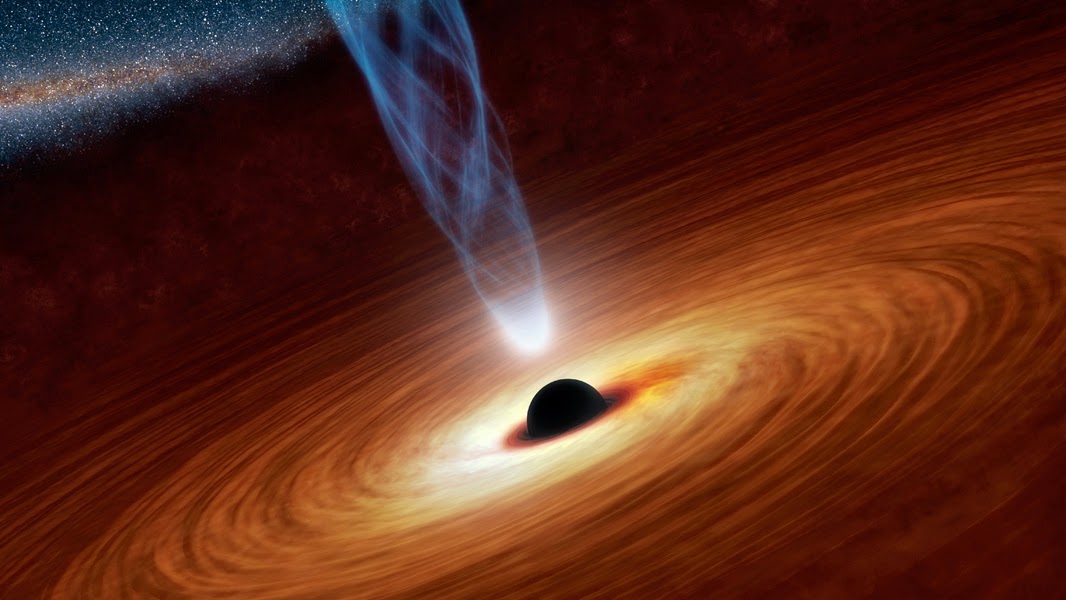
Supermassive black holes are enormously dense objects buried at the hearts of galaxies. 

Credit: NASA/JPL-Caltech

We all fear black holes, but how many of them are there out there, really?

Between the stellar mass black holes and the supermassive ones, just how much of our Universe is black holes?

There are two kinds of black holes in the Universe that we know of: There's stellar mass black holes, formed from massive stars, and a supermassive black holes which lives at the hearts of galaxies.

About 1 in a 1000 stars have enough mass to become a black hole when they die. Our Milky Way has 100 billion stars, this means it could have up to 100 million stellar mass black holes.

As there are hundreds of billions of galaxies in the observable Universe, there are lots, lots more out there.

In fact, the math suggests there's a new black hole forming every second or so. So just to recap, the entire Universe is about 1/1000th "regular flavor" stellar mass black holes.

Supermassive black holes are a slightly different story. Our central galactic black hole is about 26,000 light years away from us.

Formally, it's called Sagittarius A-star, but for our purposes I'm going to call it Kevin. Just so you know they don't throw that term "supermassive" around for no reason, Kevin contains 4.1 million times the mass of the Sun.

Kevin is gigantic and horrible. We can only imagine what it's like to be in the region of space near Kevin. What percentage of the galaxy do you think Kevin makes up, mass wise?


Kevin, whilst absolutely super-massive, is a tiny, tiny 1/10,000 of a percent of the Milky Way galaxy's mass.

So, to be precise, if we add Kevin's mass to the mass of all the stellar mass black holes aka. "mini-Kevins", we get a very minor 11/10000s of a %.

As it turns out this ratio holds up on a Universal scale and is approximately the same for all the mass in the Universe. So, 11 ten thousandths of a percent is the answer to the question. As far as we know.

Unless… dark matter is black holes. Dark matter accounts for more than ¾ of the mass of the Universe. It doesn't absorb light or interact with matter in any way. We're only aware of its presence through its gravitational influence.

As it turns out, Astronomers think that one explanation for dark matter might be primordial black holes.

These microscopic black holes would have the mass of an asteroid or more and could only form in the high pressure, high temperature conditions after the Big Bang.

Experiments to search for primordial black holes have yet to turn up any evidence, and most scientists don't think they're a viable explanation. But if they were, then the Universe is almost entirely composed of the physics inspired nightmare that are black holes.

Saturday, March 22, 2014

ESO MUSE: Creates 3D Views of the Universe - Video


A new telescope tool for peering into the cosmos and creating three-dimensional views of the universe has passed its first major test at the ESO observatory in Chile's Atacama desert.

After a decade of design and development, the tool, called the Multi Unit Spectroscopic Explorer (MUSE), successfully captured its first images of deep space to create 3D views of the early universe.

Installed on the European Southern Observatory's Very Large Telescope (VLT) in Chile, MUSE can both study and image the depths of space.

"It has taken a lot of work by many people over many years," principle investigator Roland Bacon of the Lyon Astrophysics Research Center (CRAL) in France said in a statement.

"This seven-ton collection of optics, mechanics, and electronics is now a fantastic time machine for probing the early universe."

This colour composite of the unusual polar ring galaxy NGC 4650A was created from data from the MUSE instrument on ESO's Very Large Telescope in Chile.

The MUSE instrument, which went online in March 2014, splits the light from each part of the galaxy into component colors to show the chemical and physical properties of each point.

Credit: ESO/MUSE consortium/R. Bacon

MUSE uses 24 spectrographs to split light into its component colours (spectra) to assemble images and spectra of different regions of the sky.

Studies of these spectra can provide insight to astronomers about the composition and movements of various objects.

MUSE also creates a 3D image of objects from the light waves it receives. Known as Integral Field Spectroscopy (IFS), the technique allows astronomers to study the properties of different regions of an object at the same time.

Applying the technique to galaxies, for instance, can reveal not only their chemical composition but also details about their rotation.

Tuesday, March 11, 2014

Council of Giants: Astronomers map out Earth's place in the universe

This is a diagram showing the brightest galaxies within 20 million light years of the Milky Way, as seen from above. 

The largest galaxies, here shown in yellow at different points around the dotted line, make up the "Council of Giants." 

Credit: Marshall McCall / York University

We live in a galaxy known as the Milky Way – a vast conglomeration of 300 billion stars, planets whizzing around them, and clouds of gas and dust floating in between.

Though it has long been known that the Milky Way and its orbiting companion Andromeda are the dominant members of a small group of galaxies, the Local Group, which is about 3 million light years across, much less was known about our immediate neighbourhood in the universe.

Marshall McCall
Now, a new paper by York University Physics & Astronomy Professor Marshall McCall, published today in the Monthly Notices of the Royal Astronomical Society, maps out bright galaxies within 35-million light years of the Earth, offering up an expanded picture of what lies beyond our doorstep.

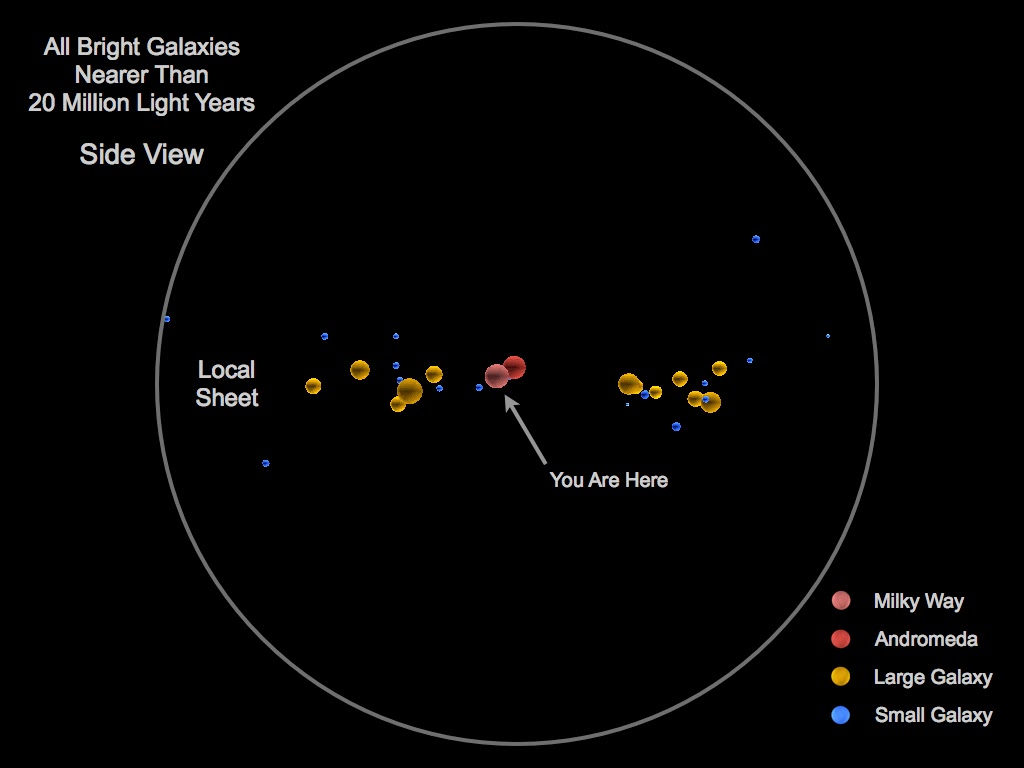
"All bright galaxies within 20 million light years, including us, are organized in a 'Local Sheet' 34-million light years across and only 1.5-million light years thick," says McCall.

"The Milky Way and Andromeda are encircled by twelve large galaxies arranged in a ring about 24-million light years across – this 'Council of Giants' stands in gravitational judgment of the Local Group by restricting its range of influence."

This is a diagram showing the brightest galaxies within 20 million light years of the Milky Way, this time viewed from the side. 

Credit: Marshall McCall / York University

McCall says twelve of the fourteen giants in the Local Sheet, including the Milky Way and Andromeda, are "spiral galaxies" which have highly flattened disks in which stars are forming.

The remaining two are more puffy "elliptical galaxies", whose stellar bulks were laid down long ago.

This movie illustrates the positions of the nearby galaxies, including those in the ‘Council of Giants’, in three dimensions. Credit: Marshall McCall / York University

Intriguingly, the two ellipticals sit on opposite sides of the Council. Winds expelled in the earliest phases of their development might have shepherded gas towards the Local Group, thereby helping to build the disks of the Milky Way and Andromeda.

McCall also examined how galaxies in the Council are spinning. He comments: "Thinking of a galaxy as a screw in a piece of wood, the direction of spin can be described as the direction the screw would move (in or out) if it were turned the same way as the galaxy rotates."

"Unexpectedly, the spin directions of Council giants are arranged around a small circle on the sky. This unusual alignment might have been set up by gravitational torques imposed by the Milky Way and Andromeda when the universe was smaller."

More Information: A Council of Giants - M.McCall, mnras.stu199

Thursday, January 9, 2014

Baryon Oscillation Spectroscopic Survey measures the universe to one-percent accuracy

This is an artist's concept of the new measurement of the size of the Universe. 

The gray spheres show the pattern of the "baryon acoustic oscillations (BAO)" from the early Universe. 

Galaxies today have a slight tendency to align on the spheres -- the alignment is greatly exaggerated in this illustration. 

By comparing the size of the spheres (white line) to the predicted value, astronomers can determine to one-percent accuracy how far away the galaxies are. 

Credit: Zosia Rostomian, Lawrence Berkeley National Laboratory

Today the Baryon Oscillation Spectroscopic Survey (BOSS) Collaboration announced that BOSS has measured the scale of the universe to an accuracy of one percent.

This and future measures at this precision are the key to determining the nature of dark energy.

David Schlegel
"One-percent accuracy in the scale of the universe is the most precise such measurement ever made," says BOSS's principal investigator, David Schlegel, a member of the Physics Division of the U.S. Department of Energy's Lawrence Berkeley National Laboratory (Berkeley Lab).

"Twenty years ago astronomers were arguing about estimates that differed by up to fifty percent. Five years ago, we'd refined that uncertainty to five percent; a year ago it was two percent. One-percent accuracy will be the standard for a long time to come."

BOSS is the largest program in the third Sloan Digital Sky Survey (SDSS-III). Since 2009, BOSS has used the Sloan Foundation Telescope at the Apache Point Observatory in New Mexico to record high-precision spectra of well over a million galaxies with redshifts from 0.2 to 0.7, looking back over six billion years into the universe's past.

Schlegel says, "We believe the BOSS database includes more redshifts of galaxies than collected by all the other telescopes in the world."

Martin White
BOSS will continue gathering data until June, 2014. However, says Martin White, a member of Berkeley Lab, a professor of physics and astronomy at the University of California at Berkeley, and chair of the BOSS science survey team, "We've done the analysis now because we have 90 percent of BOSS's final data and we're tremendously excited by the results."

Baryon acoustic oscillations (BAO) are the regular clustering of galaxies, whose scale provides a "standard ruler" to measure the evolution of the universe's structure.

Accurate measurement dramatically sharpens our knowledge of fundamental cosmological properties, including how dark energy accelerates the expansion of the universe.

More Information: The BOSS analysis is based on SDSS-III's Data Releases 10 and 11 (DR 10 and DR 11) and has been submitted for publication in the Monthly Notices of the Royal Astronomical Society; the analysis is available online at arxiv.org/abs/1312.4877.

Thursday, November 28, 2013

What is the universe expanding into?


"Since astronomers know that the Universe is expanding, what's it expanding into? What's outside of the Universe?"

Ask any astronomer and you'll get an unsatisfying answer. We give you the same unsatisfying answer, but really explain it, so your unsatisfaction doesn't haunt you any more.

The short answer is that this is a nonsense question, the Universe isn't expanding into anything, it's just expanding.

The definition of the Universe is that it contains everything. If something was outside the Universe, it would also be part of the Universe too.

Outside of that? Still Universe. Out side of THAT? Also more Universe. It's Universe all the way down.

Either the Universe is infinite, going on forever, or its finite, with a limited volume. In either case, the Universe has no edge.

When we imagine the Universe expanding after the Big Bang, we imagine an explosion, with a spray of matter coming from a single point. But this analogy isn't accurate.

A better analogy is the surface of an expanding balloon. Not the 3 dimensional balloon, just its 2 dimensional surface.

If you were an ant crawling around the surface of a huge balloon, and the balloon was your whole universe, you would see the balloon as essentially flat under your feet.

Imagine the balloon is inflating. In every direction you look, other ants are moving away from you. The further they are, the faster away they're moving.

Even though it feels like a flat surface, walk in any direction long enough and you'd return to your starting point.

Representation of the timeline of the universe over 13.7 billion years, and the expansion in the universe that followed. 

Credit: NASA /WMAP Science Team.

You might imagine a growing circle and wonder what it's expanding into. But that's a nonsense question.

There's no direction you could crawl that would get you outside the surface.

Your 2-dimensional ant brain can't comprehend an expanding 3-dimensional object.

There may be a center to the balloon, but there's no center to the surface. Just a shape that extends in all directions and wraps in upon itself and yet, your journey to make one lap around the balloon takes longer and longer as the balloon gets more inflated.

To better understand how this relates to our Universe, we need to scale things up by one dimension, from a 2-d surface embedded in a 3-d world, to a 3-d volume embedded within a 4-d universe.

Astronomers think that if you travel in any direction far enough, you'll return to your starting position. If you could stare far enough into space, you would be looking at the back of your own head.

Watch the video for the full story.

Saturday, July 28, 2012

SETI and Three Piatcions: As Seen Through a Telescope

This is an interesting music video for Italian shoegaze band “Thee Piatcions“. Their Wall-Of-Sound, psychedelic music (they must be one of the loudest bands touring Europe) inspired us to create this sort of retro sci-fi comedy about searching for life in space and looking for love on Earth.

Saturday, April 7, 2012

IC 1101: Largest Galaxy in our known Universe

IC 1101 is the largest known galaxy which is situated at the Abell 2029 galaxy cluster. It is a giant elliptical galaxy or otherwise known as the "Supergiant Ellipticals".

It is about 1.07 billion light years away in the constellation of Serpens. It is approximately 5.5 million light years in diameter, making it the largest galaxy in terms of breadth (as of 2010).

It is about 50 times the size and 2000 times massive than our Milky Way Galaxy. It has about 100 trillion stars compared to roughly 100-200 billion stars in our galaxy.

Friday, April 6, 2012

The Planets: The Retro Space Poster Art of Steve Thomas

Visit Steve Thomas's site for more great poster art. A great new creative experience in retro-style Art, with more than a touch of Humour.


Thursday, March 15, 2012

NASA Wise Image: The latest infra-red map of the Universe

The map of the whole sky was compiled by NASA's infrared space telescope, WISE, and is made up of 560 million stars, galaxies and other objects.

The Milky Way's disk and central bulge are traced out in blue, representing infrared light with a wavelength of 3.4 micrometres, which mainly comes from stars.

The bluish blobs to the bottom right are our two largest satellite galaxies, the Large and Small Magellanic clouds, more than 150,000 light years away. Andromeda forms a small blue streak to the lower left, and the image is dotted with more distant galaxies.

Longer-wavelength radiation, coloured green and red, comes from dust clouds. Just above the galactic disk near the centre of the image is the Rho Ophiuchi cloud complex, only 130 light years away, where new stars are forming.

Among the discoveries made by WISE are many near-Earth asteroids, as well as a new class of super-cool stars called Y-dwarfs.

Monday, March 12, 2012

Proposed nuclear clock (ACES) may keep time with the Universe

The exquisite accuracy of atomic clocks is widely used in applications ranging from GPS navigation systems and high-bandwidth data transfer to tests of fundamental physics and system synchronisation in particle accelerators.

A proposed new time-keeping system tied to the orbiting of a neutron around an atomic nucleus could have such unprecedented accuracy that it neither gains nor loses 1/20th of a second in 14 billion years - the age of the Universe.

"This is nearly 100 times more accurate than the best atomic clocks we have now," says one of the researchers, Scientia Professor Victor Flambaum, who is Head of Theoretical Physics in the UNSW School of Physics.

"It would allow scientists to test fundamental physical theories at unprecedented levels of precision and provide an unmatched tool for applied physics research."

In a paper to be published in the journal Physical Review Letters - with US researchers at the Georgia Institute of Technology and the University of Nevada - Flambaum and UNSW colleague Dr Vladimir Dzuba report that their proposed single-ion clock would be accurate to 19 decimal places.

The exquisite accuracy of atomic clocks is widely used in applications ranging from GPS navigation systems and high-bandwidth data transfer to tests of fundamental physics and system synchronization in particle accelerators.

"With these clocks currently pushing up against significant accuracy limitations, a next-generation system is desired to explore the realms of extreme measurement precision and further diversified applications unreachable by atomic clocks," says Professor Flambaum.

"Atomic clocks use the orbiting electrons of an atom as the clock pendulum. But we have shown that by using lasers to orient the electrons in a very specific way, one can use the orbiting neutron of an atomic nucleus as the clock pendulum, making a so-called nuclear clock with unparalleled accuracy."

Because the neutron is held so tightly to the nucleus, its oscillation rate is almost completely unaffected by any external perturbations, unlike those of an atomic clock's electrons, which are much more loosely bound.

Monday, February 20, 2012

The star factory: observing Arp 220

This star forming core of Arp 220 is only about 3,000 light years across, compared to our own galaxy which measures about 60,000 light years.

The galaxy Arp 220 is home to several giant star clusters-about 10 million solar masses-that are twice as massive as any comparable star cluster in the Milky Way Galaxy.

McMaster University's Christine Wilson is captivated by this turbulent galaxy that provides such a target-rich environment for watching stars form.

The reason that star formation is going wild is that the galaxy is in the late stages of a merger between two larger galaxies.

"This is a nearby look at a phenomenon that was common in the early universe, when many galaxies were merging," says Wilson.

At this week's meeting of the American Association for the Advancement of Science (AAAS) in Vancouver, Wilson will be presenting findings on Arp 220's dazzling rate of star formation-200 times faster than our own Milky Way.

What's more, it's all happening in a much smaller space. The star forming core of Arp 220 is only about 3,000 light years across, compared to our own galaxy which measures about 60,000 light years.

Using the Herschel Space Observatory, an orbiting telescope, Wilson's group has found Arp 220 to have large amounts of very warm molecular hydrogen gas, a surprising find that implies molecular hydrogen is the dominant coolant in the high-temperature gas.

Wilson's team has also observed a massive wind from the centre of the galaxy, removing molecular gas from the central star forming core.

Friday, January 13, 2012

New map of the universe reveals its history for the past six-billion years

This image shows the positions of the 900,000 luminous galaxies used in four Sloan Digital Sky Survey studies described during the 2012 annual meeting of the American Astronomical Society. 

Each green dot represents one galaxy. 

The image covers a redshift range from 0.25 to 0.75, a time when the universe was between 7-billion and 11-billion years old. 

Credit: David Kirkby (University of California, Irvine) and the SDSS-III Collaboration

Friday, January 6, 2012

Stephen Hawking at 70: A Brief History of Time - Video


A film about the life and work of the cosmologist, Stephen Hawking, who despite his near total paralysis, is one of the great minds of all time.


Brilliant but unmotivated, Stephen Hawking was a 21-year-old PhD student at Cambridge when he first noticed something was wrong. He was falling down a lot, and dropping things.

He went into the hospital for tests, and learned he had amyotrophic lateral sclerosis, or ALS. The doctors told him he would gradually lose control of every muscle in his body.

“My dreams at that time were rather disturbed,” Hawking said. “Before my condition had been diagnosed, I had been very bored with life.

There had not seemed to be anything worth doing. But shortly after I came out of hospital, I dreamt that I was going to be executed. I suddenly realized that there were a lot of worthwhile things I could do if I were reprieved.”

The doctors gave the young man two and a half years to live. That was in early 1963. Over the next half century, Hawking defied all odds and went on to become one of the most celebrated scientists of the era, making major contributions to quantum cosmology and the understanding of black holes.

Along the way, the wheelchair-bound Hawking became a cultural icon, a symbol of disembodied intellect and indomitable spirit.

This coming Sunday, 49 years after his grim diagnosis, Hawking will turn 70. A scientific conference in his honor got underway today at the University of Cambridge’s Centre for Theoretical Cosmology, and will culminate on Sunday with a public symposium, “The State of the Universe,” featuring some of the world’s greatest astronomers and physicists, including Martin Rees, Kip Thorne and Saul Perlmutter.

You can watch live streaming video of the events at the official website.

To help celebrate, we present Errol Morris’s 1992 film of A Brief History of Time (above), Hawking’s bestselling book.

Morris weaves biography in with the science, interviewing members of Hawking’s family–his mother, sister and aunt–along with friends and colleagues, including Roger Penrose, Dennis Sciama and John Archibald Wheeler.

A Brief History of Time was Morris’s first film as a director-for-hire (he was recruited by Steven Spielberg for Amblin Entertainment), which created some difficulties, but Morris was pleased with the outcome.

He later said, “It’s actually one of the most beautiful films I ever shot.” The film won the Grand Jury Prize for Documentary Filmmaking and the Documentary Filmmaker’s Trophy at the Sundance Film Festival.

In 1992 Morris told the New York Times Magazine that A Brief History of Time was “less cerebral and more moving” than anything he had worked on before.

“This feeling of time, of aging, of mortality combined with this search for the most basic and deep questions about the world around us and ourselves,” Morris said, “is pretty persuasive stuff.”

Tuesday, December 6, 2011

New Exhibition and Website: Evolving Universe

Most stars form close together in nebulae - large cosmic clouds of gas and dust that act as stellar nurseries. 

The nebula IC 410 is located 13,000 light-years from Earth and spans 15 light-years. 

This visible-light photograph was taken with the Megacam instrument on the MMT telescope atop Mount Hopkins, Arizona. Credit: Harvard-Smithsonian CfA.

The cosmos constantly changes. Stars are born, live out their lives, and die - sometimes calmly, sometimes explosively. Galaxies form, grow, and collide dramatically. A new exhibition and website, developed jointly by the Smithsonian Astrophysical Observatory (SAO) and the Smithsonian's National Museum of Natural History, reveal the dynamic and evolving universe through breathtaking photographs and informative captions.

"The Evolving Universe" explores how the stars, galaxies and universe undergo the same stages as life on Earth: from birth, to maturity and, eventually, to death.

This remarkable journey from present-day Earth to the far reaches of space and time will be on view in the museum in Washington, D.C., through July 7, 2013.

A worldwide audience also can experience the exhibition through its website:

All of the images featured in the museum gallery can be downloaded in high-resolution jpegs or PDFs formatted in poster size.

"Anyone can select their favorite space photo, download it, and take it to their local copy shop to print it," said Smithsonian astrophysicist Jonathan McDowell, who played a lead role in developing the exhibition.

Visitors to the exhibition or website can choose one of two paths to explore the cosmos. They can begin close to home with our solar system and move outward to the farthest reaches of the universe. Or they can begin 13.7 billion years ago at the moment of the Big Bang and move forward in time to the present day.

Along their journey they will learn how a variety of telescopes and instruments, many developed by SAO, reveal the fascinating history of the expanding universe.

"We've all seen the amazing pictures from NASA's probes in our own solar system," said McDowell.

"I'm excited about bringing to the public the remarkable images of the broader universe that we astronomers have been exploring with our telescopes. I hope that with this exhibition visitors will take away an appreciation for our larger cosmic neighborhood."

"The Evolving Universe" is located on the second floor of the National Museum of Natural History, between the Minerals Store and the Korea Gallery.

Wednesday, August 31, 2011

Notre Dame astrophysicists identify missing fuel for galactic star formation

The Milky Way will have the fuel to continue forming stars, thanks to massive clouds of ionized gas raining down from its halo and intergalactic space.

This is the conclusion of a new study by Nicolas Lehner and Christopher Howk from the University of Notre Dame, Indiana.

Using the Cosmic Origins Spectrograph, one of the newest instruments on the NASA/ESA Hubble Space Telescope, these researchers measured for the first time the distances to fast-moving clouds of ionized gas previously seen covering a large fraction of the sky.

These fast-moving clouds reside in the distant reaches of the Milky Way and contain huge quantities of gas.

The Milky Way would rapidly change its gas into stars if no supply of new matter were available to replenish the gas.

Astronomers have hypothesized that the ionised fast-moving gas clouds could be this reservoir of gas, but it was not known if they were interacting with the Milky Way.

“Our findings explain why the Milky Way can keep having star formation,” Lehner said. “Knowing the distances to these clouds tells us where the gaseous fuel is for forming stars over billions of years.”

Gas clouds can be identified and studied because elements in the cloud absorb small amounts of light from a star or other light source as it passes through a cloud on its way to Earth. The characteristic “fingerprint” left in the spectrum allows astronomers to determine the properties of the gas.

Star formation in the Milky Way
Earlier studies of these fast-moving ionised clouds used light from quasars, which are too far away to mark the clouds’ locations.

To solve the problem, Lehner and Howk identified 27 stars around the Milky Way whose distances were known and used Hubble to take line-of-sight readings of light coming from them.

Results from the stellar sample showed the ionized clouds largely resided in the Milky Way’s halo. The authors concluded that these flows of ionized gas are within about 1 galactic radius (40,000 light-years) of Earth.

The new Hubble observations revealed the presence of ionized gas in half the stellar samples, comparable to the fraction observed toward more distant quasars.

The gas clouds are not uniformly distributed around the galaxy, but rather collected in different areas.

They cover only part of our galactic sky, analogous to the partial coverage of the sky on a partly cloudy day on Earth.

This research also confirmed models that predicted gas falling into the Milky Way slows as it approaches. Clouds closer to the galaxy seem to have been decelerated and do not move as fast as those farther away, much like a meteorite slowing as it enters Earth’s atmosphere.

“We know now where is the missing fuel for galactic star formation,”

Lehner said. “We now have to learn how it got there.”

Monday, May 2, 2011

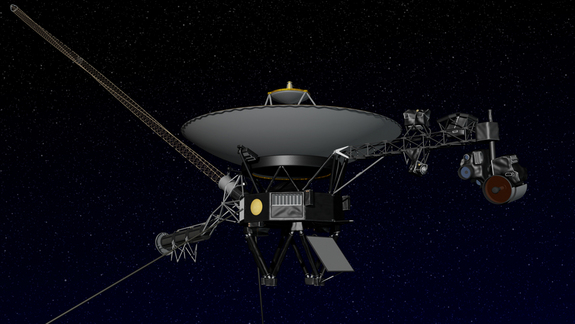
NASA's Voyager 1 & 2 Spacecraft

NASA's twin Voyager probes were launched in the late 1970s to explore the outer planets in our solar system. But now, nearly 34 years later, the two spacecraft are on their way out of our cosmic neighborhood, knocking on the door of interstellar space.

The spacecraft, called Voyager 1 and Voyager 2, were built by NASA's Jet Propulsion Laboratory in Pasadena, Calif., which continues to operate both. Here are five facts about the two Voyager probes, the longest continuously operating spacecraft in deep space:

1. They're marathon runners
Voyager 2 launched on Aug. 20, 1977, and Voyager 1 launched about two weeks later, on Sept. 5. Since then, the spacecraft have been traveling along different flight paths and at different speeds.
Now about 10.8 billion miles (17.4 billion kilometers) from the sun and hurtling toward interstellar space, Voyager 1 is the farthest human-made object from Earth. Voyager 2 is about 8.8 billion miles (14.2 billion km) from the sun. [NASA's 10 Greatest Science Missions]

2. It takes a while to get ahold of them
Both spacecraft are still sending scientific information about their surroundings through NASA's Deep Space Network. A signal from the ground, traveling at the speed of light, takes about 13 hours one way to reach Voyager 2, and 16 hours to reach Voyager 1.

3. They started out on a grand planetary tour
The primary five-year mission of the Voyagers included the close-up exploration of Jupiter and Saturn, Saturn's rings and the larger moons of the two planets. The mission was extended after a succession of discoveries. [The Solar System Explained: From the Inside Out]

Between them, the two spacecraft have explored all the giant outer planets of our solar system -- Jupiter, Saturn, Uranus and Neptune -- as well as 49 moons, and the systems of rings and magnetic fields those planets possess.

The current mission, the Voyager Interstellar Mission, was planned to explore the outermost edge of our solar system and eventually leave our sun's sphere of influence to enter interstellar space -- the space between the stars.


4. They're carrying messages to aliens
Both Voyager spacecraft carry recorded messages from Earth on golden phonograph records -- 12-inch, gold-plated copper disks. A committee chaired by the late astronomer Carl Sagan (SETI) selected the contents of the records for NASA.

The records are cultural time capsules that the Voyagers bear with them to other star systems. They contain images and natural sounds, spoken greetings in 55 languages and musical selections from different cultures and eras.

5. The Voyagers are blazing new trails
Voyager 1 has reached a distant point at the edge of our solar system, where the outward motion of solar wind ceases. The event is the latest milestone in Voyager 1's passage through the heliosheath, the outer shell of the sun's sphere of influence, before entering interstellar space.

Interstellar space begins at the heliopause, and scientists estimate Voyager 1 will cross this frontier within the next five years.

Monday, October 25, 2010

The Milky Way in 360 Degrees


Stéphane Guisard traveled to the Paranal observatory, situated in Chile’s remote Atacama desert, in search of the “darkest sky.”

The result? Some amazing zoomable, fisheye images that reveal the darkest of dark skies (including a glimpse of the Gegenschein).

And then also this “byproduct”: a 360 degree panoramic view of the Milky Way that lies on the dark sky horizon. You can view Los Cielos de Chile here.

Please note that the page can take a little time to load. But once you’re there, you can toggle around the images and control the views.

Thursday, September 23, 2010

Primordial Magnetic Fields Discovered Across The Universe


An artist's conception of an "active galactic nucleus" courtesy of NASA. In some galaxies the nucleus, or central core, produces more radiation than the entire rest of the galaxy. (Credit: NASA)

Scientists from the California Institute of Technology and UCLA have discovered evidence of "universal ubiquitous magnetic fields" that have permeated deep space between galaxies since the time of the Big Bang.

Caltech physicist Shin'ichiro Ando and Alexander Kusenko, a professor of physics and astronomy at UCLA, report the discovery in a paper to be published in an upcoming issue of Astrophysical Journal Letters; the research is currently available online.

Ando and Kusenko studied images of the most powerful objects in the universe - supermassive black holes that emit high-energy radiation as they devour stars in distant galaxies - obtained by NASA's Fermi Gamma-ray Space Telescope.

"We found the signs of primordial magnetic fields in deep space between galaxies," Ando said.

Physicists have hypothesized for many years that a universal magnetic field should permeate deep space between galaxies, but there was no way to observe it or measure it until now.

The physicists produced a composite image of 170 giant black holes and discovered that the images were not as sharp as expected.

"Because space is filled with background radiation left over from the Big Bang, as well as emitted from galaxies, high-energy photons emitted by a distant source can interact with the background photons and convert into electron-positron pairs, which interact in their turn and convert back into a group of photons somewhat later," said Kusenko, who is also a senior scientist at the University of Tokyo's Institute for Physics and Mathematics of the Universe.

"While this process by itself does not blur the image significantly, even a small magnetic field along the way can deflect the electrons and positrons, making the image fuzzy," he said.

From such blurred images, the researchers found that the average magnetic field had a "femto-Gauss" strength, just one-quadrillionth of the Earth's magnetic field. The universal magnetic fields may have formed in the early universe shortly after the Big Bang, long before stars and galaxies formed, Ando and Kusenko said.