Showing posts with label planets. Show all posts

Sunday, January 18, 2015

New Studies Propose Two New Planets Beyond Pluto

New calculations from an international team of researchers suggest that there could be two unknown planets beyond Pluto.

In two new studies, published in the Monthly Notices of the Royal Astronomical Society, scientists from the University of Madrid and the University of Cambridge posit that two, or more, unknown planets are responsible for unusual behaviour beyond Neptune.

Objects, in that far-flung part of the Solar System, don’t act like we believe they should: the paths they move along do not have the orbital inclinations and axes that astronomers would expect to see, based on current theory of what researchers call "trans-Neptunian objects."

Unless, the astrophysicists posit, there’s something else out there, and, after considering the effects of the “Kozai mechanism,” the effect an object orbiting further out from a gravitational source can have one orbiting futher in, they now believe there are at least two mysterious planets at play.

“Our results may be truly revolutionary for astronomy,” says co-author Carlos de la Fuente Marcos in a news release, but the team says this is still a hypothesis.

To prove it, scientists will have to overcome two hurdles. Not only does the new theory challenge astrophysicists' current thinking about how the solar system came to be, but the sample size used in the study’s calculations contains only 13 objects.

However, the team promises that with a larger sample size, coming soon, and new research (a recently-discovered planet-in-process is much further away from a star than scientists suspected to be possible), they’ll soon have even more evidence that our solar system may be even bigger than thought.

More Information
'Flipping minor bodies: what comet 96P/Machholz 1 can tell us about the orbital evolution of extreme trans-Neptunian objects and the production of near-Earth objects on retrograde orbits' published in the Monthly Notices of the Royal Astronomical Society10.1093/mnras/stu2230

Thursday, November 6, 2014

ESA's GAIA satellite set to discover thousands of planets in Milky Way

Princeton University and Lund University researchers project that the recently launched ESA's Gaia satellite could discover tens of thousands of planets during its five-year mission. 

In this image, the colored portions indicate the number of observations Gaia would make of a particular part of the sky during its mission; the scale at the bottom indicates the number of observations from zero (purple) to 200 (red). 

The total number of observations of any part of the sky ranges from about 60 at low ecliptic latitudes to about 80 at high ecliptic latitudes, with a maximum of about 150-200 at intermediate latitudes. 

From these many different observations of each star, the highly accurate Gaia measurements will reveal the tiny star motion, or "wobble," that results from any orbiting planet. 

Credit: Lennart Lindegren, Lund University

A recently launched European satellite could reveal tens of thousands of new planets within the next few years, and provide scientists with a far better understanding of the number, variety and distribution of planets in our galaxy, according to research published today.

Researchers from Princeton University and Lund University in Sweden calculated that ESA's observational satellite Gaia could detect as many as 21,000 exoplanets, or planets outside of Earth's solar system, during its five-year mission.

If extended to 10 years, Gaia could detect as many as 70,000 exoplanets, the researchers report.

The researchers' assessment is accepted in the Astrophysical Journal and was published Nov. 6 in advance-of-print on arXiv, a preprint database run by Cornell University.

Exoplanets will be an important "by-product" of Gaia's mission, Perryman said. Built and operated by the European Space Agency (ESA) and launched in December 2013, Gaia will capture the motion, physical characteristics and distance from Earth, and one another, of roughly 1 billion objects, mostly stars, in the Milky Way galaxy with unprecedented precision.

The presence of an exoplanet will be determined by how its star "wobbles" as a result of the planet's orbit around it.

More important than the numbers of predicted discoveries are the kinds of planets that the researchers expect Gaia to detect, many of which, such as planets with multi-year orbits that pass directly, or transit, in front of their star as seen from Earth, are currently difficult to find, explained first author Michael Perryman, an adviser on large scientific programs who made the assessment while serving as Princeton's Bohdan Paczyński Visiting Fellow in the Department of Astrophysical Sciences, Dublin.

The satellite's instruments could reveal objects that are considered rare in the Milky Way, such as an estimated 25 to 50 Jupiter-sized planets that orbit faint, low-mass stars known as red dwarfs.

One of the main objectives of the Gaia mission is to establish the currently uncertain distance from Earth to various stars using high-precision triangulation, which would allow a much better understanding of the properties of the stars and the planets orbiting them. 

Of the 1,163 confirmed transiting planets, which pass directly in front of their stars as seen from Earth, there are 644 distinct host stars; less than 200 have accurately known distances from Earth. 

This image shows the distances from Earth (center) to the stars (black dots) of transiting exoplanets. 

The inner dashed circle has a radius of 100 parsecs (about 326 light years) with the middle and outer circles corresponding to 500 parsecs (1,630 light years) and 1,000 parsecs (3,260 light years), respectively. 

The cluster of points to the lower right represents the transiting planets discovered by NASA's Kepler satellite. For each star, the straight lines extending from the circle indicate the current uncertainty of its distance from Earth. 

Credit: Michael Perryman

Unique planets and systems, such as planets that orbit in the opposite direction of their companions, can inspire years of research, Perryman said.

"It's not just about the numbers. Each of these planets will be conveying some very specific details, and many will be highly interesting in their own way," Perryman said.

"If you look at the planets that have been discovered until now, they occupy very specific regions of discovery space. Gaia will not only discover a whole list of planets, but in an area that has not been thoroughly explored so far."

More information: Michael Perryman, Joel Hartman, Gáspár Bakos and Lennart Lindegren. 2014. "Astrometric exoplanet detection with Gaia." Astrophysical Journal. Arti¬cle first pub-lished to the Cornell University arXiv preprint database: Nov. 6, 2014.

Monday, September 15, 2014

NASA Messenger: Planets with oddball orbits like Mercury could host life

On Mercury a solar day is about 176 Earth days long. 

During its first Mercury solar day in orbit the MESSENGER spacecraft imaged nearly the entire surface of Mercury to generate a global monochrome map at 250 meters per pixel resolution and a 1 kilometer per pixel resolution color map. 

Credit: NASA/JHU APL/CIW

Mercury has an oddball orbit, it takes longer for it to rotate on its axis and complete a day than it takes to orbit the sun and complete a year.

Now, researchers suggest photosynthesis could take place on an alien planet with a similarly bizarre orbit, potentially helping support complex life.

However, the scientists noted that the threat of prolonged periods of darkness and cold on these planets would present significant challenges to life, and could even potentially freeze their atmospheres.

They detailed their findings in the International Journal of Astrobiology.

Astronomers have discovered more than 1,700 alien planets in the past two decades, raising the hope that at least some might be home to extraterrestrial life.

Scientists mostly focus the search for alien life on exoplanets in the habitable zones of stars.

These are regions where worlds would be warm enough to have liquid water on their surfaces, a potential boon to life.

Although many exoplanets are potentially habitable, they may differ from Earth significantly in one or more ways.

For instance, habitable planets around dim red dwarf stars orbit much closer than Earth does to the Sun, sometimes even closer than Mercury's distance.

Red dwarfs are of interest as possible habitats for life because they are the most common stars in the universe, if life can exist around red dwarfs, then life might be very common across the cosmos.

Recent findings from NASA's Kepler Space Observatory suggest that at least half of all red dwarfs host rocky planets that are one-half to four times the mass of Earth.

Since a planet in the habitable zone of a red dwarf orbits very near its star, it experiences much stronger gravitational tidal forces than Earth does from the Sun, which slows the rate at which those worlds spin.

The most likely result of this slowdown is that the planet enters what is technically called a 1:1 spin orbit resonance, completing one rotation on its axis every time it completes one orbit around its star.

This rate of rotation means that one side of that planet will always face toward its star, while the other side will permanently face away, just as the Moon always shows the same side to Earth.

One recent study suggests that such "tidally locked" planets may develop strange lobster-shaped oceans basking in the warmth of their stars on their daysides, while the nightsides of such worlds are mostly covered in an icy shell.

More information: "Photosynthetic potential of planets in 3 : 2 spin–orbit resonances." S.P. Brown, et al. International Journal of Astrobiology DOI: dx.doi.org/10.1017/S1473550414000068

Wednesday, July 30, 2014

ESO ALMA Observatory: Young binary star system form planets with weird and wild orbits

This is ALMA data of HK Tau shown in a composite image with Hubble infrared and optical data. 

Credit: B. Saxton (NRAO/AUI/NSF); K. Stapelfeldt et al. (NASA/ESA Hubble)

Unlike our solitary Sun, most stars form in binary pairs, two stars that orbit a common center of mass.

Though remarkably plentiful, binaries pose a number of questions, including how and where planets form in such complex environments.

While surveying a series of binary stars with the Atacama Large Millimeter/submillimeter Array (ALMA), astronomers uncovered a striking pair of wildly misaligned planet-forming disks in the young binary star system HK Tau.

These results provide the clearest picture ever of proto-planetary disks around a double star and could reveal important details about the birth and eventual orbit of planets in a multiple star system.

"ALMA has given us an unprecedented view of a main star and its binary companion sporting mutually misaligned protoplanetary disks," said Eric Jensen, an astronomer at Swarthmore College in Pennsylvania.

"In fact, we may be seeing the formation of a solar system that may never settle down."

The two stars in this system, which is located approximately 450 light-years from Earth in the constellation Taurus, are less than 5 million years old and separated by about 58 billion kilometers, or 13 times the distance of Neptune from the Sun.

This system's companion star, dubbed HK Tau, appears fainter to astronomers on Earth because its disk of dust and gas blocks out much of the starlight.

The disk itself, however, can be easily observed by the starlight that it scatters at optical and near-infrared wavelengths.

The key velocity data taken with ALMA that helped the astronomers determine that the disks in HK Tau were misaligned. 

The red areas represent material moving away from Earth and the blue indicates material moving toward us. 

Credit: NASA/JPL-Caltech/R. Hurt (IPAC); ALMA (ESO/NAOJ/NRAO)

The disk around the main star, HK Tau A, is tilted in such a way that the light from its host star shines through unobscured, making it difficult for astronomers to see the disk optically.

This is not a problem for ALMA, however, which can readily detect the millimeter-wavelength light emitted by the dust and gas that comprise the disk.

With its unprecedented resolution and sensitivity, ALMA was able to fully resolve the rotation of HK Tau A's disk for the first time.

This clearer picture enabled the astronomers to calculate that the disks were misaligned, meaning they were out of sync with the orbit of their host stars, by as much as 60 degrees or more.

Rachel Akeson
"This clear misalignment has given us a remarkable look at a young binary star system," said Rachel Akeson of the NASA Exoplanet Science Institute (NEXSCI) at the California Institute of Technology in Pasadena, California.

"Though there have been hints before that this type of misaligned system exists, this is the cleanest and most striking example."

Stars and planets form out of vast clouds of dust and gas. As material in these clouds contracts under gravity, it begins to rotate until most of the dust and gas falls into a flattened proto-planetary disk swirling around a growing central protostar.

Despite forming from a flat, regular disk, planets can end up in highly eccentric orbits, and may be misaligned with the star's equator.

One theory for how planets can migrate to these unusual orbits is that a binary companion star can influence them, but only if its orbit is initially misaligned with the planets.

This is an artist's impression of the misaligned protoplanetary disks around the binary stars in HK Tau. 

Credit: R. Hurt (NASA/JPL-Caltech/IPAC)

"Our results demonstrate that the necessary conditions exist to modify planetary orbits and that these conditions are present at the time of planet formation, apparently due to the binary formation process," noted Jensen.

"We can't rule other theories out, but we can certainly rule in that a second star will do the job."

Since ALMA can see the otherwise invisible dust and gas of protoplanetary disks, it allowed for never-before-seen views of this young binary system.

"Because we're seeing this in the early stages of formation with the protoplanetary disks still in place, we can see better how things are oriented," noted Akeson. "You can simply see gas better than you can see planets."

Looking forward, the researchers want to determine if this type of system is typical or not. They note that this is a remarkable individual case, but additional surveys are needed to determine if this sort of arrangement is common throughout our Galaxy.

More information: Nature DOI: 10.1038/nature13521

Thursday, May 29, 2014

Gemini Planet Imager (GPI): New imaging technique reveal planets near bright stars

The GPI is mounted on mounted on a side port of the instrument support structure of the Gemini South telescope. 

Credit: Gemini Planet Observatory

The Gemini Planet Imager (GPI) was built for one purpose: imaging extrasolar planets.

In the seven months since it came online, GPI is proving to be an order-of-magnitude improvement-so much so that it may rewrite the rules of planet-hunting.

Planet-hunting bears some similarity to tracking a rare species through the jungle.

There are a variety of ways to know that it's there, most of which are indirect: The leaves rustling. The undergrowth is trampled. The animal's shadow appears for a fleeting moment before it fades away again.

It is much the same with planets. We can detect them moving their parent planets ever-so-slightly via Doppler shift.

GPI functioning testbed system
We can see the light from that star dim as an exoplanet-or the planet's shadow-passes in front of it.

Once in a while, a young star's dust disk will have a gap in it, from which we infer the presence of a formed or forming planet.

These detection methods have allowed us to catalog over 1700 exoplanets since 1994.

Naturally, ultimate achievement in observation is to see the species or the planet with our own eyes.

That's what the Gemini Planet Imager (GPI) does best: direct detection of exoplanets.

Technically, direct detection means spatially resolving the light of a planet from the light of its parent star: taking a picture of the planet itself.

Before GPI, there were serious limitations to our ability to photograph an exoplanet.

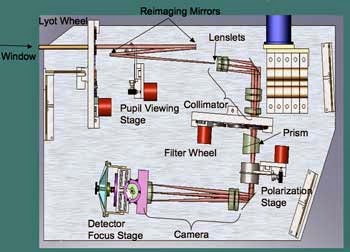
Optical design of the GPI science camera.
The photographic exposure had to be long and the contrast between the star and the exoplanet had to be high. With GPI, what used to be a one-hour photo has become a one-minute photo.

The contrast can be three orders of magnitude lower - the planet can be 1000 times dimmer - and the photo will still turn out.

Micro-Electro-Mechanical Systems (MEMS) mirrors
This remarkable improvement in exoplanet imaging is achieved with a variety of new technologies: for example, deformable silicon Micro-Electro-Mechanical Systems (MEMS) mirrors.

The mirrors can bend and flex in ways that counters atmospheric distortion.

GPI also has a diffraction-suppressing coronagraph, which blocks the light from the parent star so that the planet can be seen more clearly, and an integral field spectrograph, which allows spectra to be taken over an entire two-dimensional field of the sky.

By combining these and other related technologies, images like the now-famous photo of Beta Pictoris b are produced.

They reveal planets many dozens of light years away glowing with residual radiation from their formations millions of years ago.

The bright white dot is the planet Beta Pictoris b, glowing in the infrared light from the heat released when it was formed 10 million years ago. 

The bright star Beta Pictoris b is hidden behind a mask at the center of the image. 

Credit: GPI

GPI can also supply information about the exoplanet's atmospheric composition and interactions with nearby objects such as asteroid belts.

GPI was deployed on the 8-m Gemini South telescope in Chile. Its first image or "first light" took place in November 2013.

Since then, GPI has done an unprecedented job of capturing Jupiter-sized objects around stars similar to our Sun. 

Wednesday, April 23, 2014

Steve Thomas: Art Deco Posters of the Planets

Frank Sinatra's "FLY ME TO THE MOON" has been brought to life in a set of Space posters depicting travel around the Solar System, in the Art deco style of the 1930's.

The posters by Steve Thomas mimic those from the halcyon days of travel, with each one imagining and depicting he wonders of the known planets.

Tuesday, April 1, 2014

NIST New measurement technique helps astronomers find habitable planets

A thorium emission lamp’s violet glow, when viewed through a spectroscope (metal tube on right in top image), is split into a spectrum of thousands of bright lines (bottom image). 

New measurements of these lines could help astronomers search for earthlike planets around distant stars. 

Credit: Boutin/NIST

Researchers at the National Institute of Standards and Technology (NIST) have rejuvenated a technique for finding planets near distant stars.

New measurements of light from special lamps could help astronomers find planets hidden in data from more than a decade's worth of extrasolar planet searches, as well as improve telescopes' current capabilities.

Finding extrasolar planets is tricky. Seen through a telescope, planets in the "habitable zone," a region close to a star, where liquid water could exist on a planet's surface, usually get lost in their star's glare.

But as a planet orbits, its gravity makes its parent star wobble a tiny bit, resulting in slight color changes in the star's light due to the Doppler effect.

These changes can only be spotted if the light is first broken into a spectrum of thin lines, which are then compared to an unchanging reference spectrum.

"It's like holding one ruler in front of another and moving the front one to the right and left," says NIST physicist Gillian Nave.

"You can see the front ruler move compared to the one behind it. The star's spectrum is the front ruler, which moves as the planet tugs at it. But the movement is so small that to see it clearly, we need to put a fixed ruler of very high quality behind it. That's where NIST comes in."

The NIST team made extensive new measurements of thorium, a heavy element often used in emission lamps that help provide that fixed ruler.

Scientists have detected more than 400 planets using the Doppler technique but have yet to discover a solar system similar to ours. The new data could help, says Nave.

"Earth causes the Sun to move at a snail's pace," says Nave. "We don't yet have techniques that can find planets of that size, but our new data will get us much closer."

Craig Sansonetti
Stephen Redman, a postdoctoral fellow working at NIST, worked with Nave and physicist Craig Sansonetti to update the most recent thorough measurement of thorium's spectrum, published in 1983.

The more than 8,000 spectral lines it lists are a bit fuzzy by today's standards, good enough to reveal the larger wobble caused by a Jupiter-sized gas giant's gravity, but not the small one an Earth-like world would cause.

Redman spent a year combining observations he made on a spectrometer at NIST with data culled from other researchers' work. The result is a set of nearly 20,000 spectral lines of far greater clarity.

In addition to finding systems similar to our own, the new data should aid the search for planets around dwarf stars.

These have been hard to find using the Doppler method, in part because dwarfs are so faint, but Nave says the new data include good lines in the near infrared, which is the region of the spectrum in which many of these cool stars give off the most light.

"We've already had astronomers from several telescopes ask if they could use the data for planet hunting," Nave says.

"With luck, the measurements will help us search for planets near stars whose wobbling has been hard to detect."

More information: S.L. Redman, G. Nave and C.J. Sansonetti. "The spectrum of thorium from 250 nm to 5500 nm:Ritz wavelengths and optimized energy levels." Astrophysical Journal, DOI: 10.1088/0067-0049/211/1/4, February. 2014.

Friday, March 21, 2014

Starshade: Space sunflower will help snap pictures of planets

The prototype Starshade, a giant structure designed to block the glare of stars so that future space telescopes can take pictures of planets.

A spacecraft that looks like a giant sunflower might one day be used to acquire images of Earth-like rocky planets around nearby stars.

The prototype deployable structure, called a starshade, is being developed by NASA's Jet Propulsion Laboratory in Pasadena, Calif.

The hunt is on for planets that resemble Earth in size, composition and temperature. Rocky planets with just the right temperature for liquid water—not too hot, not too cold—could be possible abodes for life outside our solar system.

NASA's Kepler mission has discovered hundreds of planets orbiting other stars, called exoplanets, some of which are a bit larger than Earth and lie in this comfortable "Goldilocks" zone.

Researchers generally think it's only a matter of time before we find perfect twins of Earth. The next step would be to image and characterise their spectra, or chemical signatures, which provide clear clues about whether those worlds could support life.

The Starshade is designed to help take those pictures of planets by blocking out the overwhelmingly bright light of their stars.

Simply put, the Starshade is analogous to holding your hand up to the sun to block it while taking a picture of somebody.

The proposed Starshade could launch together with a telescope. Once in space, it would separate from the rocket and telescope, unfurl its petals, then move into position to block the light of stars.

Monday, March 10, 2014

ALMA: 'Death stars' in Orion blast planets before they even form - Video

This artist's concept shows two proplyds, or protostars, around a massive O-type star. 

The nearer proplyd is having its planet-forming dust and gas blasted away by the radiation from the star. 

The farther proplyd is able to retain its planet-making potential. 

Credit: NRAO /AUI /NSF, B. Saxton

The Orion Nebula is home to hundreds of young stars and even younger protostars known as proplyds.

Many of these nascent systems will go on to develop planets, while others will have their planet-forming dust and gas blasted away by the fierce ultraviolet radiation emitted by massive O-type stars that lurk nearby.

A team of astronomers from Canada and the United States has used the Atacama Large Millimeter/submillimeter Array (ALMA) to study the often deadly relationship between highly luminous O-type stars and nearby protostars in the Orion Nebula.

Their data reveal that protostars within 0.1 light-years (about 600 billion miles) of an O-type star are doomed to have their cocoons of dust and gas stripped away in just a few millions years, much faster than planets are able to form.

Rita Mann
"O-type stars, which are really monsters compared to our Sun, emit tremendous amounts of ultraviolet radiation and this can play havoc during the development of young planetary systems," remarked Rita Mann, an astronomer with the National Research Council of Canada in Victoria, and lead author on a paper in the Astrophysical Journal.

"Using ALMA, we looked at dozens of embryonic stars with planet-forming potential and, for the first time, found clear indications where protoplanetary disks simply vanished under the intense glow of a neighbouring massive star."

Many, if not all, Sun-like stars are born in crowded stellar nurseries similar to the Orion Nebula.

Over the course of just a few million years, grains of dust and reservoirs of gas combine into larger, denser bodies.

Left relatively undisturbed, these systems will eventually evolve into fully fledged star systems, with planets, large and small and ultimately drift away to become part of the galactic stellar population.

Astronomers believe that massive yet short-lived stars in and around large interstellar clouds are essential for this ongoing process of star formation.

At the end of their lives, massive stars explode as supernovas, seeding the surrounding area with dust and heavy elements that will get taken up in the next generation of stars.

These explosions also provide the kick necessary to initiate a new round of star and planet formation, but while they still shine bright, these larger stars can be downright deadly to planets if an embryonic solar systems strays too close.


"Massive stars are hot and hundreds of times more luminous than our Sun," said James Di Francesco, also with the National Research Council of Canada.

"Their energetic photons can quickly deplete a nearby protoplanetary disks by heating up its gas, breaking it up, and sweeping it away."

James Di Francesco
Earlier observations with the Hubble Space Telescope revealed striking images of proplyds in Orion.

Many had taken on tear-drop shapes, with their dust and gas trailing away from a nearby massive star.

These optical images, however, couldn't reveal anything about the amount of dust that was present or how the dust and gas concentrations changed in relation to massive stars.

The new ALMA observations detected these and other never-before-imaged proplyds, essentially doubling the number of protoplanetary disks discovered in that region.

"Taken together, our investigations with ALMA suggest that extreme UV regions are not just inhospitable, but they're downright hazardous for planet formation. With enough distance, however, it's possible to find a much more congenial environment," said Mann.

"This work is really the tip of the iceberg of what will come out of ALMA; we hope to eventually learn how common solar systems like our own are."

Journal Reference: Rita K. Mann, James Di Francesco, Doug Johnstone, Sean M. Andrews, Jonathan P. Williams, John Bally, Luca Ricci, A. Meredith Hughes, Brenda C. Matthews. ALMA OBSERVATIONS OF THE ORION PROPLYDS. The Astrophysical Journal, 2014; 784 (1): 82 DOI: 10.1088/0004-637X/784/1/82

Wednesday, February 26, 2014

NASA MAVEN: How magnetic crustal fields affect planets - Video

Radiation environments on Earth and Mars. Credit: NASA JPL

If you are ever lost on the surface of Mars, don't count on a compass to help you get home.

On Mars, compasses don't work.

They don't work because there is not one magnetic field on Mars, rather there are dozens.

These small fields are powerful, concentrated in the crust, and scattered over the surface of the planet.

In their absence, compass needles would lie still; in their presence, they spin, pointing first at one bar magnet, then another.

How well these crustal fields protect the planet is a mystery, and one that may be solved soon by the MAVEN satellite, which is on its way to Mars right now.

What we do know is that if a compass ever worked well on Mars, it was over 3.5 billion years ago.

Before that time, Mars had a molten core, whose contents constantly churned upward towards the surface.

This process of convection permitted cooling of the interior, as well as active volcanism in the highlands and plains. Volcanoes brought iron to the surface, giving Mars its signature colour.

Iron in the core also moved electrons, which created a planetary dynamo: a device that converts mechanical energy into electric energy.

Electric fields generate magnetic fields. Large magnetic fields can provide protection from solar wind for any planet as long its interior maintains a steadfast supply of molten metal.

Large magnetic fields also decay unless maintained. After the first billion years or so, the Martian interior cooled to the point where convection halted. When the iron ceased to flow, the dynamo died. Volcanism declined.

The last iron deposits from the interior left their marks as pockets of magnetism, called crustal anomalies, largely sequestered in the southern hemisphere.


"Mars is on the interesting borderline of the magnetized and the unmagnetized objects," said Janet Luhmann, MAVEN's deputy principal investigator.

"We think that the weak magnetic field has been in place since it was about a billion years old."

We first learned about Mars' strange magnetic fields from the way they interacted with the solar wind.

In 1965 Mariner 4, one of America's first interplanetary probes, passed within 8,000 kilometers (4,971 miles) of Mars' surface.

At that distance, it failed to detect any magnetic field. By contrast, Earth's planet-wide field can be sensed by magnetometers within 60,000 kilometers (37,282 miles).

What Mariner did note was that the solar wind was being bent around the planet, widely in some places.

Position of magnetometers on the MAVEN spacecraft. Credit: NASAexplorer

In terms of solar storms, MAVEN will arrive on the downslope of a solar cycle, during the optimum window for observing one of the most powerful forces affecting atmospheric escape: coronal mass ejections.

"More CMEs (and larger CMEs) occur during the declining phase of the solar cycle, rather than at maximum," said Frank Eparvier, science lead on the Extreme Ultraviolet (EUV) Sensors attached to LPW.

"MAVEN will be at Mars during the declining phase of the current solar cycle, so we will actually be there at the right time to see CME impacts."

Monday, February 3, 2014

Looking for extraterrestrial life in all the wrong places

Alpha Centauri, the closest star system to the Solar System. 

Astrophysicist René Heller of McMaster’s Origins Institute says our planet may not be the most ideal place for life and scientists need to consider non-Earth-like, so-called “superhabitable” planets.

Credit: European Southern Observatory

Scientists have long focused their search for extraterrestrial life on Earth-like planets – but that may be a mistake, according to the McMaster researchers.

Astrophysicist René Heller of McMaster's Origins Institute says our planet may not be the most ideal place for life and scientists need to consider non-Earth-like, so-called "superhabitable" planets.

These planets would probably be two or three times more massive and much less mountainous than Earth. They would probably be older, too.

René Heller
"The Earth just scrapes the inner edge of the solar system's habitable zone – the area in which temperatures allow Earth-like planets to have liquid surface water," says Heller.

"So from this perspective, Earth is only marginally habitable. That led us to ask: could there be more hospitable environments for life on terrestrial planets?"

Heller and co-author John Armstrong of Weber State University describe superhabitable planets in a paper published in the journal Astrobiology early in January.

In it, they outline some of the characteristics such planets might have. They include many, shallower bodies of water (rather than a few large oceans), a more reliable global "thermostat" that impedes ice ages, and a magnetic shield, to protect the planet from cosmic radiation.

John Armstrong
Heller says the theory means astronomers should be aiming their telescopes at planets that have so far not garnered much attention in the search for extraterrestrial life.

"We propose a shift in focus," he says. "We want to prioritize future searches for inhabited planets.

We're saying 'Don't just focus on the most Earth-like planets if you really want to find life.'"

But is the discussion about which planets to look at even worth having? How likely are we ever to find life on another planet?

"Statistically speaking, I would say it's very unlikely that there is nothing out there," says Heller.

"For the first time in history, we have the ability – both technical and intellectual – to find and classify potentially inhabited planets. It's just a matter of how we spend our observation time."

Heller expects the paper to serve as a launching point for a debate about superhabitability. He says it may take some time for the scientific community to come around to the theory.

"When you follow a certain pattern for decades, it can be hard to change your mind."

More information: Read the complete paper here: arxiv.org/ftp/arxiv/papers/1401/1401.2392.pdf

Friday, September 6, 2013

NASA WISE: Coldest brown dwarfs blur lines between stars and planets

This artist's conception portrays a free-floating brown dwarf, or failed star. 

A new study shows that several of these objects are warmer than previously thought with temperatures about 250-350 degrees Fahrenheit. 

Credit: NASA/JPL-Caltech

Astronomers are constantly on the hunt for ever-colder star-like bodies, and two years ago a new class of such objects was discovered by researchers using NASA's WISE space telescope.

However, until now no one has known exactly how cool their surfaces really are - some evidence suggested they could be room temperature.

A new study shows that while these brown dwarfs, sometimes called failed stars, are indeed the coldest known free-floating celestial bodies, they are warmer than previously thought with temperatures about 250-350 degrees Fahrenheit.

To reach such low surface temperatures after cooling for billions of years means that these objects can only have about 5 to 20 times the mass of Jupiter.

Unlike the Sun, these objects' only source of energy is from their gravitational contraction, which depends directly on their mass.

Trent Dupuy
"If one of these objects was found orbiting a star, there is a good chance that it would be called a planet," says Trent Dupuy, a Hubble Fellow at the Harvard-Smithsonian Center for Astrophysics.

But because they probably formed on their own and not in a proto-planetary disk, astronomers still call these objects brown dwarfs even if they are "planetary mass."

Characterizing these cold brown dwarfs is challenging because they emit most of their light at infrared wavelengths, and they are very faint due to their small size and low temperature.

To get accurate temperatures, astronomers need to know the distances to these objects.

"We wanted to find out if they were colder, fainter, and nearby or if they were warmer, brighter, and more distant," explains Dupuy.

Using NASA's Spitzer Space Telescope, the team determined that the brown dwarfs in question are located at distances 20 to 50 light-years away.

Locations of brown dwarfs: The locations of brown dwarfs discovered by NASA's Wide-field Infrared Survey Explorer, or WISE, and mapped by NASA's Spitzer Space Telescope, are shown here in this diagram. 

The view is from a vantage point about 100 light-years away from the sun, looking back towards the constellation Orion. 

At this distance our sun is barely visible as a speck of light. The vastly fainter brown dwarfs would not even be visible in this view. The red lines all link back to the location of the sun. 

Credit: NASA/JPL-Caltech

To determine the distances to these objects the team measured their parallax - the apparent change in position against background stars over time.

As the Spitzer Space Telescope orbits the Sun its perspective changes and nearby objects appear to shift back and forth slightly.

The same effect occurs if you hold up a finger in front of your face and close one eye and then the other. The position of your finger seems to shift when viewed against the distant background.

The new data also present new puzzles to astronomers that study cool, planet-like atmospheres. Unlike warmer brown dwarfs and stars, the observable properties of these objects don't seem to correlate as strongly with temperature.

This suggests increased roles for other factors, such as convective mixing, in driving the chemistry at the surface.

This study examined the initial sample of the coldest brown dwarfs discovered in the WISE survey data.

Additional objects discovered in the past two years remain to be studied and will hopefully shed light on some of these outstanding issues.

Wednesday, April 3, 2013

New Stars surrounded by Protoplanetary Gaseous Disks

Many newly formed stars are surrounded by what are called protoplanetary disks, swirling masses of warm dust and gas that can constitute the core of a developing solar system.

Proof of the existence of such disks didn't come until 1994, when the Hubble telescope examined young stars in the Orion Nebula.

Protoplanetary disks may potentially become celestial bodies such as planets and asteroids but just how they make that transformation will remain a mystery to science until researchers can get a grasp on the disordered movement, or turbulence, that characterizes the constituent gases of the disks.

Turbulence is what some people regard as "the last great classical physics problem."

"By understanding the nature of the gases, we can learn something about how small particles interact with each other, coagulate to become larger particles and then ultimately form planets," says Jake Simon of the University of Colorado, principal investigator of a research project currently taking on two primary challenges in the quest to understand protoplanetary disk turbulence.

"In a particular region in these disks, the electrons are tied to magnetic fields, while the ions are not. This leads to something called the Hall effect and currently, our numerical algorithms cannot accurately capture the nature of this effect," he says.

Edwin Hall
Discovered by American physicist Edwin Hall in 1879, the Hall effect refers to a voltage-difference that occurs across an electrical conductor.

The voltage difference is crossways to an electrical current in the conductor and a magnetic field that is perpendicular to the current.

"If the ions and electrons don't collide with the neutrals frequently enough, ambipolar diffusion acts to damp out the turbulence," he says.

"The degree to which this happens has been explored with our high-resolution numerical simulations that we have run on the Kraken supercomputer. We believe we now have a much better understanding of how disks behave in their outer regions, far from the central star."

KRAKEN SuperComputer


The National Science Foundation's Extreme Science and Engineering Discovery Environment (XSEDE) has provided the compute time allocation for the project on Kraken, one of the most powerful supercomputers in academia.

Kraken is housed at Oak Ridge National Laboratory and managed by the University of Tennessee's National Institute for Computational Sciences.

Read more about Stellar Chemistry here: Stellar Chemistry

Monday, August 20, 2012

Hobby-Eberley Telescope Discovery: First evidence planet's destruction by its star

The first evidence of a planet's destruction by its aging star has been discovered with the Hobby-Eberly Telescope by an international team of astronomers. 

A similar fate may await the inner planets in our solar system, when the sun becomes a red giant and expands all the way out to Earth's orbit some five-billion years from now. 

Credit: Marty Harris/McDonald Obs./UT-Austin 

The first evidence of a planet's destruction by its aging star has been discovered by an international team of astronomers.

The evidence indicates that the missing planet was devoured as the star began expanding into a "red giant" -- the stellar equivalent of advanced age.

"A similar fate may await the inner planets in our solar system, when the Sun becomes a red giant and expands all the way out to Earth's orbit some five-billion years from now," said Alexander Wolszczan, Evan Pugh Professor of Astronomy and Astrophysics at Penn State University, who is one of the members of the research team.

Wolszczan also is the discoverer of the first planet ever found outside our solar system. The astronomers also discovered a massive planet in a surprisingly elliptical orbit around the same red-giant star, named BD+48 740, which is older than the Sun with a radius about eleven times bigger.

Wolszczan and the team's other members detected evidence of the missing planet's destruction while they were using the Hobby-Eberly Telescope to study the aging star and to search for planets around it.

The evidence includes the star's peculiar chemical composition, plus the highly unusual elliptical orbit of its surviving planet.

"Our detailed spectroscopic analysis reveals that this red-giant star, BD+48 740, contains an abnormally high amount of lithium, a rare element created primarily during the Big Bang 14 billion years ago," Adamow said.

Lithium is easily destroyed in stars, which is why its abnormally high abundance in this older star is so unusual.

"Theorists have identified only a few, very specific circumstances, other than the Big Bang, under which lithium can be created in stars," Wolszczan added.

"In the case of BD+48 740, it is probable that the lithium production was triggered by a mass the size of a planet that spiraled into the star and heated it up while the star was digesting it."

The second piece of evidence discovered by the astronomers is the highly elliptical orbit of the star's newly discovered massive planet, which is at least 1.6 times as massive as Jupiter.

"We discovered that this planet revolves around the star in an orbit that is only slightly wider than that of Mars at its narrowest point, but is much more extended at its farthest point," Niedzielski said.

"Such orbits are uncommon in planetary systems around evolved stars and, in fact, the BD+48 740 planet's orbit is the most elliptical one detected so far."

Because gravitational interactions between planets are responsible for such peculiar orbits, the astronomers suspect that the dive of the missing planet toward the star before it became a giant could have given the surviving massive planet a burst of energy, throwing it into an eccentric orbit like a boomerang.

"Catching a planet in the act of being devoured by a star is an almost improbable feat to accomplish because of the comparative swiftness of the process, but the occurrence of such a collision can be deduced from the way it affects the stellar chemistry," Villaver explained.

"The highly elongated orbit of the massive planet we discovered around this lithium-polluted red-giant star is exactly the kind of evidence that would point to the star's recent destruction of its now-missing planet."

The paper describing this discovery is posted in an early online edition of the Astrophysical Journal Letters (Adamow et al. 2012, ApJ, 754, L15).


Read the paper here Astrophysical Journal

Friday, April 6, 2012

The Planets: The Retro Space Poster Art of Steve Thomas

Visit Steve Thomas's site for more great poster art. A great new creative experience in retro-style Art, with more than a touch of Humour.