Showing posts with label mirrors. Show all posts

Wednesday, September 10, 2014

Giant Magellan Telescope: New Mega-Telescope in Chilean Andes

Artist's impression of the Giant Magellan Telescope's mirror system.

Credit: Giant Magellan Telescope /GMTO Corporation

A gigantic telescope designed to help astronomers solve some of the universe's deepest mysteries will soon start taking shape atop an arid mountain in the Chilean Andes.

The Giant Magellan Telescope (GMT) completed several major external reviews earlier this year and is on target to enter the construction phase before the end of 2014, project representatives said.

If all goes according to plan, the megascope should begin observing the heavens early in the next decade.

"The group here on the project is basically anticipating that we will begin construction activities late this year," GMT director Patrick McCarthy, Carnegie Observatories, told reporters.

"We're going ahead full steam, aiming for that 2021 first light when the first few mirrors get up on the mountain, along with all the rest of the hardware."

Scientists will use the enormous telescope to probe the nature of mysterious dark energy and dark matter, find and characterise exoplanets and study how the universe's first stars and galaxies came together, GMT representatives have said.


The Giant Magellan Telescope (GMT) will be built on Chile's Las Campanas Peak, at an altitude of about 8,500 feet (2,550 meters). The site was leveled by an excavation blast in March 2012.

GMT will arrange seven 27.6-foot-wide (8.4 m) primary mirrors, the biggest single-piece astronomical mirrors ever made, into one light-collecting surface 80 feet (24 m) across.

The completed scope will have 10 times the resolving power of NASA's iconic Hubble Space Telescope, project representatives say.

The third primary mirror for the Giant Magellan Telescope (GMT) is cast in a spinning furnace at the University of Arizona's Steward Observatory Mirror Lab on Aug. 23, 2013.

Credit: Mike Wall/Space.com

The GMT design also incorporates seven smaller secondary mirrors, which will change shape to counter the blurring effects of Earth's thick atmosphere.

Each of GMT's 20-ton primary mirrors must be shaped and smoothed to near perfection. Their surfaces cannot be off by more than 20 nanometers, about the width of a single glass molecule.

Adding to the difficulty is the fact that six of the mirrors must be steeply curved, since they surround a central (symmetric) mirror.

Manufacturing and polishing the primary mirrors, activities that are done at the University of Arizona's Steward Observatory Mirror Lab, have proved to be enormously challenging, McCarthy said.

But one of the big mirrors is finished, while two others have already been cast. Casting of the fourth one is scheduled for next March.

"So we've dealt with that as our principal technical risk, and we've retired that," McCarthy said.


Fundraising is another challenge. The project's total cost is pegged at $860 million, though perhaps another $100 million will eventually be needed to cover contingencies and the cost of inflation, McCarthy said.

The money will be provided by GMT's many partners, which include educational institutions such as the University of Arizona, Harvard and the University of Chicago, private organizations like the Carnegie Institution for Science and international entities, such as the state of Sao Paulo in Brazil.

Money is now coming in "at a rate that makes us pretty confident that we'll manage to raise enough funds to keep the project on schedule, and that the schedule will be set by the engineering rather than by how fast we can raise money," McCarthy said.

Thursday, May 29, 2014

Gemini Planet Imager (GPI): New imaging technique reveal planets near bright stars

The GPI is mounted on mounted on a side port of the instrument support structure of the Gemini South telescope. 

Credit: Gemini Planet Observatory

The Gemini Planet Imager (GPI) was built for one purpose: imaging extrasolar planets.

In the seven months since it came online, GPI is proving to be an order-of-magnitude improvement-so much so that it may rewrite the rules of planet-hunting.

Planet-hunting bears some similarity to tracking a rare species through the jungle.

There are a variety of ways to know that it's there, most of which are indirect: The leaves rustling. The undergrowth is trampled. The animal's shadow appears for a fleeting moment before it fades away again.

It is much the same with planets. We can detect them moving their parent planets ever-so-slightly via Doppler shift.

GPI functioning testbed system
We can see the light from that star dim as an exoplanet-or the planet's shadow-passes in front of it.

Once in a while, a young star's dust disk will have a gap in it, from which we infer the presence of a formed or forming planet.

These detection methods have allowed us to catalog over 1700 exoplanets since 1994.

Naturally, ultimate achievement in observation is to see the species or the planet with our own eyes.

That's what the Gemini Planet Imager (GPI) does best: direct detection of exoplanets.

Technically, direct detection means spatially resolving the light of a planet from the light of its parent star: taking a picture of the planet itself.

Before GPI, there were serious limitations to our ability to photograph an exoplanet.

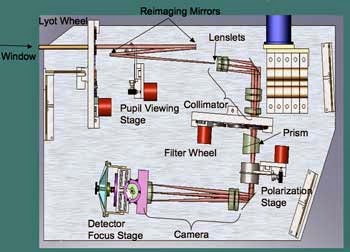
Optical design of the GPI science camera.
The photographic exposure had to be long and the contrast between the star and the exoplanet had to be high. With GPI, what used to be a one-hour photo has become a one-minute photo.

The contrast can be three orders of magnitude lower - the planet can be 1000 times dimmer - and the photo will still turn out.

Micro-Electro-Mechanical Systems (MEMS) mirrors
This remarkable improvement in exoplanet imaging is achieved with a variety of new technologies: for example, deformable silicon Micro-Electro-Mechanical Systems (MEMS) mirrors.

The mirrors can bend and flex in ways that counters atmospheric distortion.

GPI also has a diffraction-suppressing coronagraph, which blocks the light from the parent star so that the planet can be seen more clearly, and an integral field spectrograph, which allows spectra to be taken over an entire two-dimensional field of the sky.

By combining these and other related technologies, images like the now-famous photo of Beta Pictoris b are produced.

They reveal planets many dozens of light years away glowing with residual radiation from their formations millions of years ago.

The bright white dot is the planet Beta Pictoris b, glowing in the infrared light from the heat released when it was formed 10 million years ago. 

The bright star Beta Pictoris b is hidden behind a mask at the center of the image. 

Credit: GPI

GPI can also supply information about the exoplanet's atmospheric composition and interactions with nearby objects such as asteroid belts.

GPI was deployed on the 8-m Gemini South telescope in Chile. Its first image or "first light" took place in November 2013.

Since then, GPI has done an unprecedented job of capturing Jupiter-sized objects around stars similar to our Sun. 

Wednesday, September 19, 2012

NASA - James Webb Space Telescope Mirror 'Cans'

The powerful primary mirrors of the James Webb Space Telescope will be able to detect the light from distant galaxies. 

The manufacturer of those mirrors, Ball Aerospace & Technologies Corp. of Boulder, Colo., recently celebrated their successful efforts as mirror segments were packed up in special shipping canisters (cans) for shipping to NASA.

The Webb telescope has 21 mirrors, with 18 primary mirror segments working together as one large 21.3-foot (6.5-meter) primary mirror.

The mirror segments are made of beryllium, which was selected for its stiffness, light weight and stability at cryogenic temperatures. 

Bare beryllium is not very reflective of near-infrared light, so each mirror is coated with about 0.12 ounce of gold.

Beryllium increases hardness and resistance to corrosion when alloyed to aluminium, cobalt, copper (notably beryllium copper), iron and nickel. 

In structural applications, high flexural rigidity, thermal stability, thermal conductivity and low density (1.85 times that of water) make beryllium a quality aerospace material for high-speed aircraft, missiles, space vehicles and communication satellites.

Image Credit: Ball Aerospace

Thursday, August 23, 2012

Nasa's James Webb Space Telescope (JWST): Mirrors Finished

One of the most challenging parts of NASA’s huge new space telescope, the building of its ultrasophisticated mirror system, is now finished, and the mirrors are ready for delivery.

Send-off ceremonies held here at Ball Aerospace on Aug. 15 saluted the completion of 18 beryllium primary mirror segments for the James Webb Space Telescope (JWST), which is billed as the successor to NASA's venerable Hubble Space Telescope.

Ball is also responsible for JWST’s secondary and tertiary mirrors, a fine steering mirror assembly and several engineering development units.

Ball is the principal subcontractor to manufacturer Northrop Grumman for the JWST optical technology and lightweight mirror system at the heart of the telescope — an astronomical project that is now pegged to cost roughly $8.7 billion and to be lofted in the fall of 2018.

Thursday, September 22, 2011

NASA Completes Giant Mirrors for Webb Space Telescope

In September 2011 engineers completed coating of James Webb's 21 mirror segments with microscopic layers of gold.

NASA's next huge space telescope passed a major mirror milestone this week on its path to become the world's most powerful space observatory when it launches in 2018.

Engineers completed coating 21 mirrors that will make up NASA's flagship James Webb Space Telescope with the thin — but vital — layer of gold that will reflect the faint infrared light collected by the observatory from the most distant reaches of the universe.

"It represents not just the coating event but the completion of a huge engineering project," John Mather, the telescope's senior project scientist, stated. "The mirrors are spectacularly new technology."

Thursday, June 17, 2010

Ultra-Precise Mirrors and Optical Systems For Space


Ultra-Precise Mirrors and Optical Systems For Space

Metal mirrors made with extremely high precision and exactly positioned are the key elements of modern telescopes.

A new production technique enables complex optical surfaces to be manufactured with excellent trueness of shape and hitherto unattained positional accuracy.

The mirrors have been built for an infrared sounder telescope.

For space research as well as climate observation and weather forecasting satellites need increasingly powerful optical measurement and recording devices.

They often consist of several aspherically shaped mirror elements which through their precise interplay provide the desired reflection of the incident light.

"All the mirrors must be produced and characterised with extreme precision, that is to an accuracy of less than one micrometer. They also have to be exactly positioned in relation to each other," explains Sebastian Scheiding from the Fraunhofer Institute for Applied Optics and Precision Engineering IOF in Jena. Up to now this positioning has been very time consuming as it takes place step by step.

First the individual mirrors are fitted in the telescope one after the other, then the imaging quality is measured.

If inaccuracies or errors are found, they are corrected by positional adjustments to the mirrors. Then further measurements and adjustments are made until all components are optimally arranged.

"We wanted to simplify this complicated and time-consuming adjustment process," says Scheiding. In the research project initiated by the German Aerospace Center (DLR) the scientist has therefore developed an innovative production technique which takes into account the later alignment of the components right from the outset.

For this purpose, the individual mirror surfaces are positioned in relation to each other as precisely during processing as they will be later in the telescope. This reduces to a minimum the errors and corrections made when the mirrors are being fitted. The assembly process is simple and reproducible.

"The trick is that we mount all the mirrors for a module in the same machine at the same time and assign them to a common system of coordinates.

To this end, each mirror blank is provided with defined, ultra-precise measurement marks and reference surfaces," explains Scheiding. These fixed marks embody the system of coordinates for diamond turning of the mirror shapes. At the same time, however, they fix the position of each mirror in relation to the adjacent mirrors. Finally they also serve as reference points for subsequent measurement processes to check the quality of the optical system.