Showing posts with label Gemini Planet Imager. Show all posts

Thursday, May 29, 2014

Gemini Planet Imager (GPI): New imaging technique reveal planets near bright stars

The GPI is mounted on mounted on a side port of the instrument support structure of the Gemini South telescope. 

Credit: Gemini Planet Observatory

The Gemini Planet Imager (GPI) was built for one purpose: imaging extrasolar planets.

In the seven months since it came online, GPI is proving to be an order-of-magnitude improvement-so much so that it may rewrite the rules of planet-hunting.

Planet-hunting bears some similarity to tracking a rare species through the jungle.

There are a variety of ways to know that it's there, most of which are indirect: The leaves rustling. The undergrowth is trampled. The animal's shadow appears for a fleeting moment before it fades away again.

It is much the same with planets. We can detect them moving their parent planets ever-so-slightly via Doppler shift.

GPI functioning testbed system
We can see the light from that star dim as an exoplanet-or the planet's shadow-passes in front of it.

Once in a while, a young star's dust disk will have a gap in it, from which we infer the presence of a formed or forming planet.

These detection methods have allowed us to catalog over 1700 exoplanets since 1994.

Naturally, ultimate achievement in observation is to see the species or the planet with our own eyes.

That's what the Gemini Planet Imager (GPI) does best: direct detection of exoplanets.

Technically, direct detection means spatially resolving the light of a planet from the light of its parent star: taking a picture of the planet itself.

Before GPI, there were serious limitations to our ability to photograph an exoplanet.
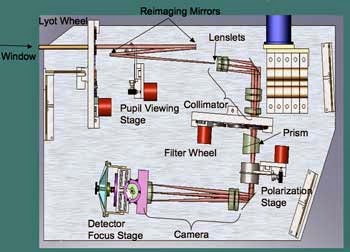
Optical design of the GPI science camera.
The photographic exposure had to be long and the contrast between the star and the exoplanet had to be high. With GPI, what used to be a one-hour photo has become a one-minute photo.

The contrast can be three orders of magnitude lower - the planet can be 1000 times dimmer - and the photo will still turn out.

Micro-Electro-Mechanical Systems (MEMS) mirrors
This remarkable improvement in exoplanet imaging is achieved with a variety of new technologies: for example, deformable silicon Micro-Electro-Mechanical Systems (MEMS) mirrors.

The mirrors can bend and flex in ways that counters atmospheric distortion.

GPI also has a diffraction-suppressing coronagraph, which blocks the light from the parent star so that the planet can be seen more clearly, and an integral field spectrograph, which allows spectra to be taken over an entire two-dimensional field of the sky.

By combining these and other related technologies, images like the now-famous photo of Beta Pictoris b are produced.

They reveal planets many dozens of light years away glowing with residual radiation from their formations millions of years ago.

The bright white dot is the planet Beta Pictoris b, glowing in the infrared light from the heat released when it was formed 10 million years ago. 

The bright star Beta Pictoris b is hidden behind a mask at the center of the image. 

Credit: GPI

GPI can also supply information about the exoplanet's atmospheric composition and interactions with nearby objects such as asteroid belts.

GPI was deployed on the 8-m Gemini South telescope in Chile. Its first image or "first light" took place in November 2013.

Since then, GPI has done an unprecedented job of capturing Jupiter-sized objects around stars similar to our Sun. 

Monday, March 24, 2014

Gemini South Telescope: A new eye to scan the sky for exoplanets

The Gemini South telescope houses the latest gear to hunt down and snap photos of exoplanets. 

Credit: Gemini Observatory, CC BY 

There is excitement in astronomy and planetary science departments worldwide as the new Gemini Planet Imager (GPI), housed in the Gemini South Telescope in the Chilean Andes, turns its razor-sharp gaze to the skies.

This device, known as GPI for short, is the first of a small handful of sophisticated instruments to attempt a task that until recently was considered all but impossible: to image the faint mote of light betraying the presence of a planet nestled against the overwhelming glare of its host star.

Planets in orbit around distant stars, exoplanets, are now known to adorn more than 1,000 star systems. There is possibly five times that number under strong suspicion awaiting only final confirmatory data to join the club.

You could be forgiven for thinking this avalanche of discovery – all coming in the past 20 years – has settled most of the important questions in exoplanetary science.

The reality, though, is it hasn't.


Location, location, location
The sample of exoplanets we now have tells us far more about the limitations of the techniques we use to find them than it does about the exoplanets themselves. We have only seen the tip of the iceberg.

The search can be likened to the proverbial scientist in a dark car park searching for a set of dropped car keys under the only streetlight.

A passer-by asks: "Did you drop your keys there?" "No," you reply. "I dropped them somewhere over there in the dark, but I can only see here."

That patch of discovery illuminated by our present instruments particularly favours the largest planets in the closest orbits about their host stars.

The extreme examples of this (and the most celebrated exoplanet discovery, of 51 Peg, that launched the field in 1995) are known as "hot Jupiters".

The name understates their inhospitable crushing gravity combined with searing radiation field from the looming host star.

In a quest to identify planets capable of supporting life hot Jupiters score low. Astronomers are working on a valuation scheme that would identify those that lie within the so-called "habitable zone".

Tuesday, January 7, 2014

Gemini Planet Imager: Powerful exoplanet camera turns skyward

Gemini Planet Imager's first light image of Beta Pictoris b, a planet orbiting the star Beta Pictoris. 

The star, Beta Pictoris, is blocked in this image by a mask so its light doesn't interfere with the light of the planet. 

In addition to the image, GPI obtains a spectrum from every pixel element in the field of view to allow scientists to study the planet in great detail. 

Beta Pictoris b is a giant planet – several times larger than Jupiter -- and is approximately ten million years old. 

These near-infrared images (1.5-1.8 microns) show the planet glowing in infrared light from the heat released in its formation. 

The bright star Beta Pictoris is hidden behind a mask in the center of the image. 

Credit: Processing by Christian Marois, NRC Canada.

After nearly a decade of development, construction, and testing, the world's most advanced instrument for directly imaging and analyzing planets around other stars is pointing skyward and collecting light from distant worlds.

The instrument, called the Gemini Planet Imager (GPI), was designed, built, and optimized for imaging faint planets next to bright stars and probing their atmospheres.

It will also be a powerful tool for studying dusty, planet-forming disks around young stars. It is the most advanced such instrument to be deployed on one of the world's biggest telescopes – the 8-meter Gemini South telescope in Chile.

Bruce Macintosh
"Even these early first-light images are almost a factor of 10 better than the previous generation of instruments. In one minute, we are seeing planets that used to take us an hour to detect," says Bruce Macintosh of the Lawrence Livermore National Laboratory who led the team that built the instrument.

GPI detects infrared (heat) radiation from young Jupiter-like planets in wide orbits around other stars, those equivalent to the giant planets in our own Solar System not long after their formation. Every planet GPI sees can be studied in detail.

"Most planets that we know about to date are only known because of indirect methods that tell us a planet is there, a bit about its orbit and mass, but not much else," says Macintosh.

"With GPI we directly image planets around stars – it's a bit like being able to dissect the system and really dive into the planet's atmospheric makeup and characteristics."

Stephen Goodsell
GPI carried out its first observations last November – during an extremely trouble-free debut for an extraordinarily complex astronomical instrument the size of a small car.

"This was one of the smoothest first-light runs Gemini has ever seen" says Stephen Goodsell, who manages the project for the observatory.

This is Gemini Planet Imager's first light image of the light scattered by a disk of dust orbiting the young star HR4796A. 

This narrow ring is thought to be dust from asteroids or comets left behind by planet formation; some scientists have theorized that the sharp edge of the ring is defined by an unseen planet.

The left image (1.9-2.1 microns) shows normal light, including both the dust ring and the residual light from the central star scattered by turbulence in the Earth's atmosphere. 

The right image shows only polarized light. Leftover starlight is unpolarized and hence removed from this image. 

The light from the back edge of the disk is strongly polarized as it scatters towards us.

Credit: Processing by Marshall Perrin, Space Telescope Science Institute.

For GPI's first observations, the team targeted previously known planetary systems, including the well-known Beta Pictoris system; in it GPI obtained the first-ever spectrum of the very young planet Beta Pictoris b.

The first-light team also used the instrument's polarization mode – which can detect starlight scattered by tiny particles – to study a faint ring of dust orbiting the very young star HR4796A.

With previous instruments, only the edges of this dust ring, (which may be the debris remaining from planet formation), could be seen, but with GPI astronomers can follow the entire circumference of the ring.