Showing posts with label surrounded. Show all posts

Tuesday, January 13, 2015

ESA Rosetta: Comet 67/P surrounded by dusty vapour cloud

ESA Rosetta NAVCAM Close-up of Comet 67P on January 3, 2015, showing the larger of the two lobes (boulder Cheops labelled), multiple jets of dust, and what are most likely dust particles or aggregates in the comet’s coma or atmosphere. 

Credit: ESA/Rosetta/NAVCAM

Comets fly around the Sun surrounded by a cloud of vapour and grime that's as old as the Solar System itself.

You've probably noticed little flecks and streaks in photos returned by the Rosetta spacecraft in the blackness of space surrounding comet 67P/Churyumov-Gerasimenko.

After a recent year-end break, the ESA Rosetta team has returned with new updates on the comet including a series of four images recently released as a mosaic.

The pictures were processed to highlight surface features; the space around the nucleus is black in comparison. But if we take a closer look at what first appears void, we soon discover it's not empty at all.
Add caption
In photos taken January 3rd, the writer of ESA's Rosetta blog notes that "some of the streaks and specks seen around the nucleus will likely be dust grains ejected from the comet, captured in the 4.3 second exposure time."

Using an image-editing tool like Photoshop, we can hold back the glare of the nucleus and "open up" the shadows around the comet.

Jets of dust released by vaporizing ice are the most obvious features to emerge.

The soft, low-contrast plumes plow into the vacuum around the nucleus wrapping it in a silky cocoon of gas and dust, a tenuous atmosphere that reflects sunlight far more weakly than the comet itself.

While staring at dust spots may not produce the same magical feelings as watching a sunrise, it's fascinating nonetheless to contemplate what we're seeing.

If you've been struck by the beauty of a comet's meteor-like head trailing a wispy tail, you're looking at what countless individual grains of dust can do when sculpted by the master hand of the Sun.

Perusing images of 67P, we see the process in its infancy as individual grains and small clots are released into space to be fashioned into something grander.

Dust and gases released by the comet reflect so little light compared to the nucleus they require special processing to see clearly. 

In this photo, many of the small, irregular specks may be cometary dust grains captured in the 4.3 second exposure. 

Credit: ESA/Rosetta/NAVCAM

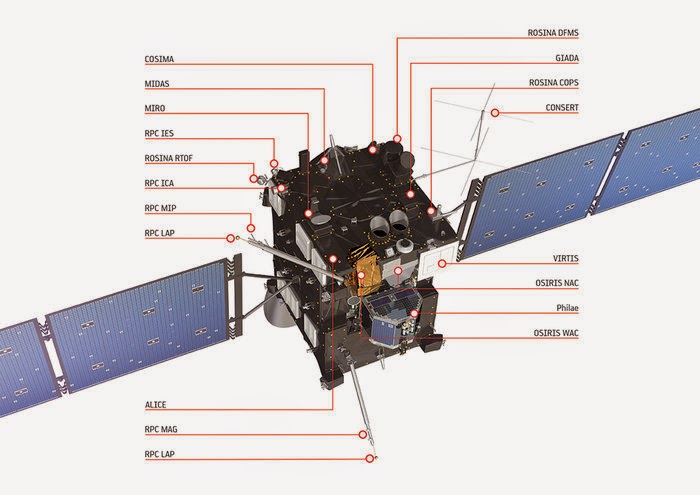
Rosetta's Micro-Imaging Dust Analysis System or MIDAS measures the rate at which dust sweeps past the spacecraft and its size distribution.

MIDAS catches dust grains by exposing a sticky target surface into space and waiting for a mote to drift by.

It snatched its first one last November, a larger than expected mote measuring about 1/100 of a millimeter across with a complex shape and fluffy texture.

Analysis of the composition of another dust grain named "Boris" made by the COSIMA instrument has identified sodium and magnesium.

Magnesium is no surprise as 95% of known minerals observed in comets resemble olivine and pyroxenes, common in meteorites and in the upper mantle of the Earth.

Sodium has also been seen before in comas and tails, and originates in dust grains, but its mineral source remains uncertain.

As we might study the makeup of the dust Pig-Pen leaves in his wake to identify traces of earthly dirt, micro-organisms, pollen, pollution, and even recent volcanic eruptions, so we examine each mote that sprays Rosetta's way, looking for clues to the origin of the planets and Solar System.

At right is a streak that could either be a larger, fast-moving dust particle that trailed during the exposure or perhaps a cosmic ray hit. 

Credit: ESA/Rosetta/NAVCAM

The mosaic image of the comet taken on January 3rd and processed, like most of ESA’s comet images, to highlight surface features. 

Credit: ESA/Rosetta/NAVCAM

Image of the first dust grain (center) captured by MIDAS. The bar at top left is 0.01 mm wide. 

Credit: Courtesy Mark Bentley

COSIMA’s first dust grains. Left: an image of the target plate (measuring 1 cm by 1 cm) on which the grains were collected; right: a section of the plate showing it on August 17th (top) when no dust grains were visible and 24 August 24th (bottom) when two large dust grains were detected. 

The plate is illuminated from the right by LEDs, and the length of the shadows is proportional to the height of the dust grains. 

Credit: ESA /Rosetta /MPS for COSIMA Team MPS /CSNSM /UNIBW /TUORLA /IWF /IAS /ESA / BUW /MPE /LPC2E /LCM /FMI /UTU /LISA /UOFC /vH&S

Tuesday, November 11, 2014

Young Star HD 95086: Two dust belts surrounded by a large dust halo

An artist's impression of a young star surrounded by debris rings and a vast dust halo. 

Credit: NASA/JPL-Caltech

Scientists at the University of Arizona have discovered what might be the closest thing to "baby photos" of our solar system.

A young star called HD 95086 is found to have two dust belts, analogous to the asteroid and Kuiper belts in the Solar System, surrounded by a large dust halo that only young planetary systems have.

Similar dust structures are also found around another, slightly older star called HR 8799, where four massive planets occupy the large gap between the two belts.

HR 8799, the first star found to host four directly imaged planets, is often referred to as a younger and scaled-up version of our Solar System.

Finding another star similar to HR 8799 suggests a common model for how stars form planets and how their planetary systems evolve.

The ages of these systems span an interesting period, about 10 to 90 million years, when terrestrial planets form and giant planets settle down to their final configuration in our own Solar System, the team reports.

"We think HD 95086 is a snapshot of what our solar system might have looked like when it was only 10 to 20 million years old," said Kate Y.L.Su, an associate astronomer in the UA's Department of Astronomy and Steward Observatory and lead author of the paper.

Using data from NASA's Spitzer Space Telescope and ESA's Herschel Space Observatory combined with detailed simulations, the researchers found HD 95086 and HR 8799 each have a vast disk halo of fine dust, suggesting enhanced collisional activities in their Kuiper-belt-like belts.

This is an expected behavior for systems that are experiencing dynamical settling of gas giants and possibly late formation of giant ice planets.

A schematic view of the HD 95086 system. Credit: NASA/JPL-Caltech

The large gap between the warm and cold belts in HD 95086, HR 8799 and some other nearby older systems like debris disk twins Vega and Fomalhaut is an excellent signpost for multiple, yet-to-be-discovered planets, according to the research team.

HD 95086 and HR 8799 are located 295 and 129 light years from Earth in the constellations of Carina and Pegasus, respectively.

"The HD 95086 system with its a young star hosting at least one planet of about five Jupiter masses along with massive asteroid and Kuiper-like debris belts is a promising target for planet hunting,"

Su said. "Both systems are very similar, except the HD 95086 has more dust, which is in line with theories of planet formation and leads us to believe it is the younger of the two. By looking at other systems like these we can piece out how our solar system came to be."

"There have to be more planets than have been discovered to make a gap that is this big," said Sarah Morrison, a co-author of the paper and a PhD student in the UA's Department of Planetary Sciences who ran computer models to constrain the possibilities of how many planets are likely to inhabit the system, what their masses could be like and where their orbits could be.

"We think that the system is a prime candidate for direct imaging campaigns to find those planets."


Monday, July 28, 2014

Computer model shows moon's core surrounded by liquid - Earth Gravitational pull

A team of researchers with team members from China, the U.S. and Japan has created a computer model that shows that the moon is not solid all the way through, instead, it shows a liquid layer surrounding the core. 

In their paper published in the journal Nature Geoscience, the team suggests the liquid layer, if it's really there, is caused by friction due to Earth's gravity.

Scientists have noted anomalies in measurements of the moon's orbit and associated gravitational readings for some time.

Such anomalies have defied explanation, however, as models built to replicate them have generally produced results that weren't very clear.

The Earth and the Moon, an image taken from Mars by the MRO.

Credit: Nasa

At root however, has been the idea that the moon's core may be covered by a thin layer of liquid.

The team noted that gravitational readings of the moon indicate that there is rotation at the core that is not the same as other rotation measurements near the core. This suggests a liquid outer layer.

To getter a better idea of what might be going on at the moon's center, the researchers built a computer model that takes into account the gravity exerted by the moon, the earth and the sun.

Early Science Fiction Image of Moon
When set into motion, the model showed that a liquid layer over the core gave the same gravity readings as scientists have found when measuring the real moon.

This suggests, the team reports, that a liquid layer does truly exist, and likely has been there for a very long time.

As for why such a layer would exist, the team suggests that the tug of Earth's gravity, tidal heating, is likely playing a role, causing friction between the core and material above it, resulting in the creation and maintenance of a liquid layer.

A lot more research will have to be done, of course, before scientists accept the results of the computer model but if such research should prove that there is a liquid layer, scientists might have to do some rethinking of theories that describe the origin of the moon.

If the moon was created due to a large body striking Earth, why did it not cool down over the four and half billion years since then, to the extent that it would be too cold for a liquid layer to exist today?

More information: Nature Geoscience (2014) DOI: 10.1038/ngeo2211

Wednesday, April 3, 2013

New Stars surrounded by Protoplanetary Gaseous Disks

Many newly formed stars are surrounded by what are called protoplanetary disks, swirling masses of warm dust and gas that can constitute the core of a developing solar system.

Proof of the existence of such disks didn't come until 1994, when the Hubble telescope examined young stars in the Orion Nebula.

Protoplanetary disks may potentially become celestial bodies such as planets and asteroids but just how they make that transformation will remain a mystery to science until researchers can get a grasp on the disordered movement, or turbulence, that characterizes the constituent gases of the disks.

Turbulence is what some people regard as "the last great classical physics problem."

"By understanding the nature of the gases, we can learn something about how small particles interact with each other, coagulate to become larger particles and then ultimately form planets," says Jake Simon of the University of Colorado, principal investigator of a research project currently taking on two primary challenges in the quest to understand protoplanetary disk turbulence.

"In a particular region in these disks, the electrons are tied to magnetic fields, while the ions are not. This leads to something called the Hall effect and currently, our numerical algorithms cannot accurately capture the nature of this effect," he says.

Edwin Hall
Discovered by American physicist Edwin Hall in 1879, the Hall effect refers to a voltage-difference that occurs across an electrical conductor.

The voltage difference is crossways to an electrical current in the conductor and a magnetic field that is perpendicular to the current.

"If the ions and electrons don't collide with the neutrals frequently enough, ambipolar diffusion acts to damp out the turbulence," he says.

"The degree to which this happens has been explored with our high-resolution numerical simulations that we have run on the Kraken supercomputer. We believe we now have a much better understanding of how disks behave in their outer regions, far from the central star."

KRAKEN SuperComputer


The National Science Foundation's Extreme Science and Engineering Discovery Environment (XSEDE) has provided the compute time allocation for the project on Kraken, one of the most powerful supercomputers in academia.

Kraken is housed at Oak Ridge National Laboratory and managed by the University of Tennessee's National Institute for Computational Sciences.

Read more about Stellar Chemistry here: Stellar Chemistry