Showing posts with label COSIMA. Show all posts

Wednesday, January 28, 2015

ESA Rosetta Mission: COSIMA collects and analyses Comet 67/P Dust Particles

Two examples of dust grains collected by ESA Rosetta's COmetary Secondary Ion Mass Analyser, (COSIMA) instrument in the period 25-31 October 2014. 

Both grains were collected at a distance of 10-20 km from the comet nucleus. 

Image (a) shows a dust particle (named by the COSIMA team as Eloi) that crumbled into a rubble pile when collected; (b) shows a dust particle that shattered (named Arvid). 

For both grains, the image is shown twice under two different grazing illumination conditions: the top image is illuminated from the right, the bottom image from the left. 

The brightness is adjusted to emphasise the shadows, in order to determine the height of the dust grain. Eloi therefore reaches about 0.1 mm above the target plate; Arvid about 0.06 mm. 

The two small grains at the far right of image (b) are not part of the shattered cluster. The fact that the grains broke apart so easily means their individual parts are not well glued together. 

If they contained ice they would not shatter; instead, the icy component would evaporate off the grain shortly after touching the collecting plate, leaving voids in what remained. 

By comparison, if a pure water-ice grain had struck the detector, then only a dark patch would have been seen. 

These 'fluffy' grains are thought to originate from the dusty layer built up on the comet's surface since its last close approach to the Sun, and will soon be lost into the coma. 

Image courtesy ESA /Rosetta et al

ESA's Rosetta mission is providing unique insight into the life cycle of a comet's dusty surface, watching 67P/Churyumov-Gerasimenko as it sheds the dusty coat it has accumulated over the past four years.

The COmetary Secondary Ion Mass Analyser, (COSIMA), is one of Rosetta's three dust analysis experiments. It started collecting, imaging and measuring the composition of dust particles shortly after the spacecraft arrived at the comet in August 2014.

Results from the first analysis of its data are reported in the journal Nature. "Comet 67P/Churyumov-Gerasimenko sheds dust coat accumulated over the past four years" - Rita Schulz et al. Nature (2015) doi:10.1038/nature14159

The study covers August to October, when the comet moved along its orbit between about 535 million kilometres to 450 million kilometres from the Sun. Rosetta spent the most of this time orbiting the comet at distances of 30 km or less.

The scientists looked at the way that many large dust grains broke apart when they were collected on the instrument's target plate, typically at low speeds of 1-10 m/s.

The grains, which were originally at least 0.05 mm across, fragmented or shattered upon collection.

The fact that they broke apart so easily means that the individual parts were not well bound together. Moreover, if they had contained ice, they would not have shattered.

Instead, the icy component would have evaporated off the grain shortly after touching the collecting plate, leaving voids in what remained.

By comparison, if a pure water-ice grain had struck the detector, then only a dark patch would have been seen.

The dust particles were found to be rich in sodium, sharing the characteristics of 'interplanetary dust particles'.

These are found in meteor streams originating from comets, including the annual Perseids from Comet 109P/Swift-Tuttle and the Leonids from 55P/Tempel-Tuttle.

"We found that the dust particles released first when the comet started to become active again are 'fluffy'.

They don't contain ice, but they do contain a lot of sodium. We have found the parent material of interplanetary dust particles," says lead author Rita Schulz of ESA's Scientific Support Office.

The scientists believe that the grains detected were stranded on the comet's surface after its last perihelion passage, when the flow of gas away from the surface had subsided and was no longer sufficient to lift dust grains from the surface.

While the dust was confined to the surface, the gas continued evaporating at a very low level, coming from ever deeper below the surface during the years that the comet travelled furthest from the Sun.

Effectively, the comet nucleus was 'drying out' on the surface and just below it.

"We believe that these 'fluffy' grains collected by Rosetta originated from the dusty layer built up on the comet's surface since its last close approach to the Sun," explains Martin Hilchenbach, COSIMA principal investigator at the Max-Planck Institute for Solar System research in Germany.

"This layer is being removed as the activity of the comet is increasing again. We see this layer being removed, and we expect it to evolve into a more ice-rich phase in the coming months."

The comet is on a 6.5-year circuit around the Sun, and is moving towards its closest approach in August of this year.

At that point, Rosetta and the comet will be 186 million kilometres from the Sun, between the orbits of Earth and Mars.

As the comet warms, the outflow of gases is increasing and the grains making up the dry surface layers are being lifted into the inner atmosphere, or coma.

Eventually, the incoming solar energy will be high enough to remove all of this old dust, leaving fresher material exposed at the surface.

"In fact, much of the comet's dust mantle should actually be lost by now, and we will soon be looking at grains with very different properties," says Rita.

"Rosetta's dust observations close to the comet nucleus are crucial in helping us to link together what is happening at the very small scale with what we see at much larger scales, as dust is lost into the comet's coma and tail," says Matt Taylor, ESA's Rosetta project scientist.

"For these observations, it really is a case of "watch this space" as we continue to watch in real time how the comet evolves as it approaches the Sun along its orbit over the coming months."

Tuesday, January 13, 2015

ESA Rosetta: Comet 67/P surrounded by dusty vapour cloud

ESA Rosetta NAVCAM Close-up of Comet 67P on January 3, 2015, showing the larger of the two lobes (boulder Cheops labelled), multiple jets of dust, and what are most likely dust particles or aggregates in the comet’s coma or atmosphere. 

Credit: ESA/Rosetta/NAVCAM

Comets fly around the Sun surrounded by a cloud of vapour and grime that's as old as the Solar System itself.

You've probably noticed little flecks and streaks in photos returned by the Rosetta spacecraft in the blackness of space surrounding comet 67P/Churyumov-Gerasimenko.

After a recent year-end break, the ESA Rosetta team has returned with new updates on the comet including a series of four images recently released as a mosaic.

The pictures were processed to highlight surface features; the space around the nucleus is black in comparison. But if we take a closer look at what first appears void, we soon discover it's not empty at all.

Add caption
In photos taken January 3rd, the writer of ESA's Rosetta blog notes that "some of the streaks and specks seen around the nucleus will likely be dust grains ejected from the comet, captured in the 4.3 second exposure time."

Using an image-editing tool like Photoshop, we can hold back the glare of the nucleus and "open up" the shadows around the comet.

Jets of dust released by vaporizing ice are the most obvious features to emerge.

The soft, low-contrast plumes plow into the vacuum around the nucleus wrapping it in a silky cocoon of gas and dust, a tenuous atmosphere that reflects sunlight far more weakly than the comet itself.

While staring at dust spots may not produce the same magical feelings as watching a sunrise, it's fascinating nonetheless to contemplate what we're seeing.

If you've been struck by the beauty of a comet's meteor-like head trailing a wispy tail, you're looking at what countless individual grains of dust can do when sculpted by the master hand of the Sun.

Perusing images of 67P, we see the process in its infancy as individual grains and small clots are released into space to be fashioned into something grander.

Dust and gases released by the comet reflect so little light compared to the nucleus they require special processing to see clearly. 

In this photo, many of the small, irregular specks may be cometary dust grains captured in the 4.3 second exposure. 

Credit: ESA/Rosetta/NAVCAM

Rosetta's Micro-Imaging Dust Analysis System or MIDAS measures the rate at which dust sweeps past the spacecraft and its size distribution.

MIDAS catches dust grains by exposing a sticky target surface into space and waiting for a mote to drift by.

It snatched its first one last November, a larger than expected mote measuring about 1/100 of a millimeter across with a complex shape and fluffy texture.

Analysis of the composition of another dust grain named "Boris" made by the COSIMA instrument has identified sodium and magnesium.

Magnesium is no surprise as 95% of known minerals observed in comets resemble olivine and pyroxenes, common in meteorites and in the upper mantle of the Earth.

Sodium has also been seen before in comas and tails, and originates in dust grains, but its mineral source remains uncertain.

As we might study the makeup of the dust Pig-Pen leaves in his wake to identify traces of earthly dirt, micro-organisms, pollen, pollution, and even recent volcanic eruptions, so we examine each mote that sprays Rosetta's way, looking for clues to the origin of the planets and Solar System.

At right is a streak that could either be a larger, fast-moving dust particle that trailed during the exposure or perhaps a cosmic ray hit. 

Credit: ESA/Rosetta/NAVCAM

The mosaic image of the comet taken on January 3rd and processed, like most of ESA’s comet images, to highlight surface features. 

Credit: ESA/Rosetta/NAVCAM

Image of the first dust grain (center) captured by MIDAS. The bar at top left is 0.01 mm wide. 

Credit: Courtesy Mark Bentley

COSIMA’s first dust grains. Left: an image of the target plate (measuring 1 cm by 1 cm) on which the grains were collected; right: a section of the plate showing it on August 17th (top) when no dust grains were visible and 24 August 24th (bottom) when two large dust grains were detected. 

The plate is illuminated from the right by LEDs, and the length of the shadows is proportional to the height of the dust grains. 

Credit: ESA /Rosetta /MPS for COSIMA Team MPS /CSNSM /UNIBW /TUORLA /IWF /IAS /ESA / BUW /MPE /LPC2E /LCM /FMI /UTU /LISA /UOFC /vH&S

Friday, May 2, 2014

ESA Rosetta commissioning in final stages

Artist’s impression of the ESA Rosetta orbiter

Credit: ESA/ATG medialab

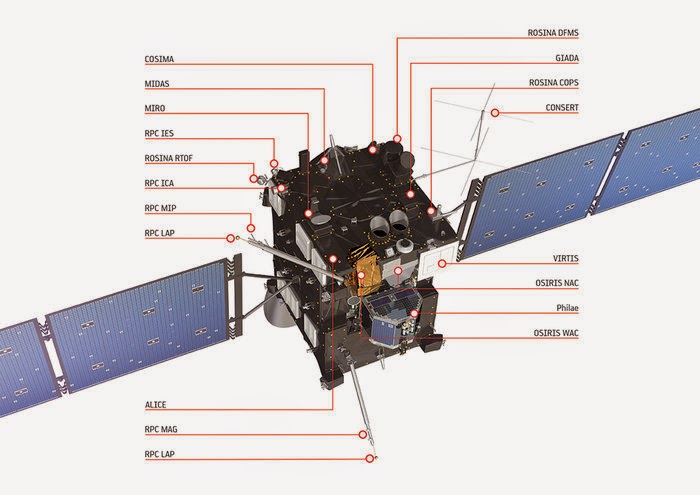
All of ESA Rosetta's 11 science instruments and the lander Philae have now been successfully switched on!

But the data are still being analysed to confirm the mission's readiness for science operations, so the commissioning period is not officially complete until those final reports from the instrument teams are in (this is expected to take place on 13 May, and we'll provide another update then).

The instrument commissioning period lasted for an intense six weeks, with each instrument assigned dedicated timeslots to be put through their paces.

ESA Rosetta lander Philae
Some of the instruments behaved a little erratically at first (who wouldn't after being woken up after a nearly three-year sleep), which required a few of the observations to be repeated towards the end of the commissioning period.

For example, see the most recent blog contribution from the RPC-ICA instrument team for the challenges they encountered.

Now all of the instruments have been successfully reactivated and the necessary measurements have been taken.

Some were also treated to software upgrades, read more about COSIMA's upgrade here, and MIDAS here.

The majority of instruments have since been switched back off until the science readiness reviews are complete and Rosetta is closer to comet 67P/CG, but OSIRIS and the spacecraft's NavCams continue to take images for navigation purposes.

OSIRIS is also taking lightcurve measurements to determine the comet's rotation period.

Final preparations are now being made for a series of rendezvous manoeuvres that will bring the spacecraft closer to the comet, ready for arriving at 67P/CG in August; as of today, there's just over 2 million kilometres to go.

A separate blog entry will be posted in the next week to outline in more detail these critical manoeuvres.