Showing posts with label infra-red. Show all posts

Wednesday, March 27, 2013

ESA Herschel Image: How to Build a Very Large Star

This image does not show any stars because the Herschel Space Observatory’s cameras record far-infrared light instead of visible light. 

Gas is not visible either, even though it makes up most of the 400,000 solar masses of matter in this cloud: dust amounts to only about one percent of the mass. 

Credit: ESA/PACS Array SPIRE consortium, A. Rivera-Ingraham and P. G. Martin, University of Toronto, HOBYS Key Programme (F. Motte)

Stars ten times as massive as the Sun, or more, should not exist: as they grow, they tend to push away the gas they feed on, starving their own growth.

Scientists have been struggling to figure out how some stars overcome this hurdle.

Now, a group of researchers led by two astronomers at the University of Toronto suggests that baby stars may grow to great mass if they happen to be born within a corral of older stars –with these surrounding stars favorably arranged to confine and thus feed gas to the younger ones in their midst.

The astronomers have seen hints of this collective feeding, or technically “convergent constructive feedback,” in a giant cloud of gas and dust called Westerhout 3 (W3), located 6,500 light years from us.

Their results are published in the upcoming month in The Astrophysical Journal.

Alana Rivera-Ingraham
“This observation may lift the veil on the formation of the most massive stars which remains, so far, poorly understood,” says Alana Rivera-Ingraham, who led the study while she was a graduate student in the Department of Astronomy and Astrophysics at the University of Toronto, Canada, and is currently a postdoctoral researcher at the Institut de Recherche en Astrophysique et Planétologie in Toulouse, France.

To study the formation of high-mass stars, Rivera-Ingraham and collaborators used high-quality and high-resolution far-infrared images from a space telescope launched by the European Space Agency in 2009 —the Herschel Space Observatory.

This telescope’s two cameras recorded light that is not visible to the naked eye, spanning a range from infrared radiation partway to the microwave region.

Peter Martin
Exploiting these cameras, scientists including Peter Martin, Professor in the Canadian Institute for Theoretical Astrophysics at the University of Toronto, created the HOBYS Key Programme to study the birth of very massive stars in nearby giant clouds of gas and dust in our own Galaxy, including W3.

Research on HOBYS at the University of Toronto is supported in part by the Canadian Space Agency and the Natural Sciences and Engineering Research Council of Canada.

Scientists track the regions of the gas cloud where stars are about to form by mapping the density of dust and its temperature, looking for the most dense regions where the dust is shielded and cold.

“We can now see where stars are about to be born before it even happens, because we can detect the cold dust condensations,” says Martin. “Until Herschel, we could only dream of doing that.”

Stars are born in the denser parts of gas clouds, where the gas gets compressed enough by gravity to trigger nuclear fusion. The more massive the newborn star, the more visible and ultraviolet light it emits, heating up its surroundings —including the dust studied by Herschel.

“The radiation during the birth of high-mass stars is so intense that it tends to destroy and push away the material from which they need to feed for further growth,” says Rivera-Ingraham.

Scientists have modeled this process and found that stars about eight times the mass of our Sun would stop growing because they run out of gas.

Reference
Herschel Observations of the W3 GMC: Clues to the Formation of Clusters of High-Mass Stars. The Astrophysical Journal, 2013

Wednesday, January 30, 2013

ESA Herschel Image: Andromeda's Colourful Rings

The ring-like swirls of dust filling the Andromeda galaxy stand out colourfully in this new image from the Herschel Space Observatory, a European Space Agency mission with important NASA participation.

The glow seen here comes from the longer-wavelength, or far, end of the infrared spectrum, giving astronomers the chance to identify the very coldest dust in our galactic neighbor.

These light wavelengths span from 250 to 500 microns, which are a quarter to half of a millimeter in size.

Herschel's ability to detect the light allows astronomers to see clouds of dust at temperatures of only a few tens of degrees above absolute zero.

These clouds are dark and opaque at shorter wavelengths. The Herschel view also highlights spokes of dust between the concentric rings.

The colours in this image have been enhanced to make them easier to see, but they do reflect real variations in the data. The very coldest clouds are brightest in the longest wavelengths, and coloured red here, while the warmer ones take on a bluish tinge.

These data, together with those from other observatories, reveal that other dust properties, beyond just temperature, are affecting the infrared color of the image.

Clumping of dust grains, or growth of icy mantles on the grains towards the outskirts of the galaxy, appear to contribute to these subtle color variations.

These observations were made by Herschel's Spectral and Photometric Imaging Receiver (SPIRE) instrument

The data were processed as part of a project to improve methods for assembling mosaics from SPIRE observations.

Light with a wavelength of 250 microns is rendered as blue, 350-micron is green, and 500-micron light is red. Color saturation has been enhanced to bring out the small differences at these wavelengths.

Image credit: ESA/NASA/JPL-Caltech/NHSC

Thursday, December 6, 2012

Suomi NPP VIIRS Image: Night time view of the Aurora Borealis over Canada

The so-called day-night band of the Visible Infrared Imaging Radiometer Suite, or VIIRS, can distinguish the night-time glow of Earth's atmosphere as well as a light from a single ship at sea. 

The resolution is far sharper than what has been available previously. 

VIIRS is aboard the Suomi NPP satellite, which orbits about 500 miles (800 km) above Earth's poles.Some VIIRS image have surprised scientists. 

The sensor, for example, captured light from the upper atmosphere illuminating clouds and ice in visible wavelengths - by night.

Night time view of the Aurora Borealis over Canada

Picture: NASA/Earth Observatory

Friday, August 10, 2012

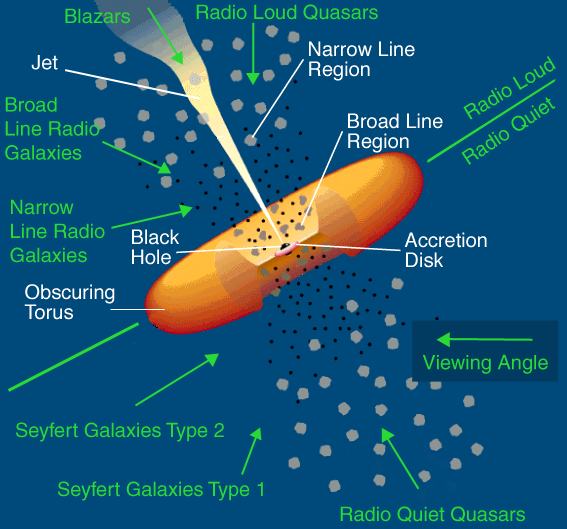
NASA Chandra Image: Hidden galactic nuclei

The galaxy NGC 1068 with an active supermassive black hole at its nucleus. 

Astronomers studying similar extreme galaxies in the infrared have found that in many cases material obscuring the nucleus may be located over an extended region, and not confined in a small torus.

Credit: NASA and the Chandra X-ray Observatory 

At the core of most galaxies including our own Milky Way is a massive black hole.

Material falling into the environment of the black hole heats up, and can radiate dramatically, sometimes also powering the ejection of bipolar jets of rapidly moving charged particles.

These so-called active galactic nuclei (AGN) are observed to have roughly two types of characteristics: bright, rapidly moving hot gas with dust emission features, or dust absorption with modest (or no) fast gas.

According to the "unified" model of AGN, these and most other variations in appearance are primarily due to the angle at which a galaxy and its central engine are seen.

In the first case the galaxy is seen face-on, and fast-moving gas close to the black hole is clearly visible.

In the latter, the whole galaxy as well as a torus of obscuring dust around the black hole are seen edge-on; the torus blocks our view of the fast-moving gas and absorbs infrared in characteristic dust features, but is this simple model correct in all cases?

Harvard CfA astronomers Andy Goulding, Bill Forman, Christine Jones, and Markos Trichas have undertaken a study of the origin of this infrared dust absorption feature.

They specifically study the nature of the presumed torus: is it a small, uniform ring of dense material, a large extended structure of more diffuse material, or is it perhaps composed of many small dense clumps?

The observed strength the infrared dust absorption is key to sorting out these differences.

The astronomers used the infrared spectrometer on the Spitzer Space Telescope to examine the dust feature in all twenty nearby AGN having extremely large columns of neutral gas (Compton-thick AGN).

The spectra provide quantitative measures of star formation as well as dust absorption. Writing in the Astrophysical Journal, the scientists reach several important conclusions.

They find that in a significant minority of cases the absorbing dust is spread over a region larger than a torus, in support of one variant of the unified model.

They also caution that these kinds of AGN have unusually high levels of star-formation; searches for other extreme AGN that neglect star-formation signatures are likely to miss a significant population of the most heavily obscured AGN.


Thursday, April 26, 2012

Images from NASA's Wide-field Infrared Survey Explorer (WISE) reveal an old star in the throes of a fiery outburst, spraying the cosmos with dust.

The findings offer a rare, real-time look at the process by which stars like our sun seed the universe with building blocks for other stars, planets and even life.

 The star, catalogued as WISE J180956.27-330500.2, was discovered in images taken during the WISE survey in 2010, the most detailed infrared survey to date of the entire celestial sky.

It stood out from other objects because it glowed brightly with infrared light. When compared to images taken more than 20 years ago, astronomers found the star was 100 times brighter.

"We were not searching specifically for this phenomenon, but because WISE scanned the whole sky, we can find such unique objects," said Poshak Gandhi of the Japan Aerospace Exploration Agency (JAXA), lead author of a new paper to be published in the Astrophysical Journal Letters.

Results indicate the star recently exploded with copious amounts of fresh dust, equivalent in mass to our planet Earth. The star is heating the dust and causing it to glow with infrared light.

"Observing this period of explosive change while it is actually ongoing is very rare," said co-author Issei Yamamura of JAXA.

"These dust eruptions probably occur only once every 10,000 years in the lives of old stars, and they are thought to last less than a few hundred years each time. It's the blink of an eye in cosmological terms."

The aging star is in the "red giant" phase of its life. Our own sun will expand into a red giant in about 5 billion years.

When a star begins to run out of fuel, it cools and expands. As the star puffs up, it sheds layers of gas that cool and congeal into tiny dust particles.

This is one of the main ways dust is recycled in our universe, making its way from older stars to newborn solar systems.

The other way, in which the heaviest of elements are made, is through the deathly explosions, or supernovae, of the most massive stars.

"It's an intriguing glimpse into the cosmic recycling program," said Bill Danchi, WISE program scientist at NASA Headquarters in Washington. "Evolved stars, which this one appears to be, contribute about 50 percent of the particles that make up humans."

Thursday, March 15, 2012

NASA Wise Image: The latest infra-red map of the Universe

The map of the whole sky was compiled by NASA's infrared space telescope, WISE, and is made up of 560 million stars, galaxies and other objects.

The Milky Way's disk and central bulge are traced out in blue, representing infrared light with a wavelength of 3.4 micrometres, which mainly comes from stars.

The bluish blobs to the bottom right are our two largest satellite galaxies, the Large and Small Magellanic clouds, more than 150,000 light years away. Andromeda forms a small blue streak to the lower left, and the image is dotted with more distant galaxies.

Longer-wavelength radiation, coloured green and red, comes from dust clouds. Just above the galactic disk near the centre of the image is the Rho Ophiuchi cloud complex, only 130 light years away, where new stars are forming.

Among the discoveries made by WISE are many near-Earth asteroids, as well as a new class of super-cool stars called Y-dwarfs.

Thursday, February 2, 2012

ESA ESO Elst Pizarro: Strangest Comet

On August 7, 1996, Eric W. Elst (Royal Observatory, Uccle, Belgium) reported his discovery of a cometary image on mid-July exposures by Guido Pizarro with the 1.0-m ESO Schmidt telescope at the La Silla Observatory.

Further ESO Schmidt plates were then obtained, and on August 19, with the help of orbital computations by Brian Marsden (IAU Central Bureau for Astronomical Telegrams, Cambridge, Mass., USA), Elst was able to identify the object on them.

Even though the orbit (Period = 5.6 years; inclination = 1.4 deg; eccentricity = 0.17) is entirely characteristic of that of a main-belt minor planet with the implied long-term orbital stability, the continued presence of a tail seemingly confirms the object as a 'comet'.

The object now carries the designation 'Comet P/1996 N2 (Elst-Pizarro)'.

Guido Pizarro and his brother Oscar have worked as nights assistants at the ESO Schmidt telescope since 1973. It is the first comet which carries their name.

Zdenek Sekanina (Jet Propulsion Laboratory, Pasadena, California, USA) believes that the comet's narrow, straight and structureless tail is likely to be a signature of a past dust-emission episode, probably in late May - early July 1996.

At this moment, it is not known, whether it was caused by an outburst from the surface of the object (dust being pushed into space by the gas pressure of evaporating ice), or perhaps a collision with another orbiting object.

It is therefore not entirely excluded that the object is in fact a minor planet (a kilometre-size piece of solid rock), and not a comet with a comparatively large content of icy materials. Further observations are needed to decide this question.

Eso9637a is also available in a larger version. It is reproduced from a 10-min R-filter exposure obtained on Augus t 23, 1996 with the 1.5-m Danish telescope at La Silla and the DFOSC multi-mode instrument. The observers were visiting astronomers Heike Rauer (Paris Observatory, Meudon France) and Hermann Boehnhardt (Munich Observatory, Germany).

The field of view here shown is 8.1 x 6.6 arcmin with North up and East to the left. At the time of the observation, the comet was 1.68 AU from Earth and 2.68 AU from the Sun.

The comet can easily be identified in the frame. No coma is seen, only the pronounced, extremely narrow dust tail which points towards position angle p.a. = 252 deg (about 2 deg away from the direction towards the Sun).

The overall length of the tail in the frame is about 7.6 arcmin (= 555,000 km at the comet), but actually it is longer than 8.5 arcmin, since it extends beyond the edge of the field of view of the original image.

Thursday, January 26, 2012

NASA Earth: The Blue Marble

A 'Blue Marble' image of the Earth taken from the VIIRS instrument aboard NASA's most recently launched Earth-observing satellite - Suomi NPP.

This composite image uses a number of swaths of the Earth's surface taken on January 4, 2012.

The NPP satellite was renamed 'Suomi NPP' on January 24, 2012 to honor the late Verner E. Suomi of the University of Wisconsin.

Suomi NPP is NASA's next Earth-observing research satellite. It is the first of a new generation of satellites that will observe many facets of our changing Earth.

Suomi NPP is carrying five instruments on board. The biggest and most important instrument is The Visible/Infrared Imager Radiometer Suite or VIIRS.

Image Credit: NASA/NOAA/GSFC/Suomi NPP/VIIRS/Norman Kuring

Thursday, January 19, 2012

ESA ESO: The Helix in New Colours


ESO’s VISTA telescope, at the Paranal Observatory in Chile, has captured a striking new image of the Helix Nebula. 

This picture, taken in infrared light, reveals strands of cold nebular gas that are invisible in images taken in visible light, as well as bringing to light a rich background of stars and galaxies.

The Helix Nebula is one of the closest and most remarkable examples of a planetary nebula.

It lies in the constellation of Aquarius (The Water Bearer), about 700 light-years away from Earth.

This strange object formed when a star like the Sun was in the final stages of its life.

Unable to hold onto its outer layers, the star slowly shed shells of gas that became the nebula. It is evolving to become a white dwarf star and appears as the tiny blue dot seen at the centre of the image.

The nebula itself is a complex object composed of dust, ionised material as well as molecular gas, arrayed in a beautiful and intricate flower-like pattern and glowing in the fierce glare of ultraviolet light from the central hot star.

The main ring of the Helix is about two light-years across, roughly half the distance between the Sun and the nearest star. However, material from the nebula spreads out from the star to at least four light-years.

This is particularly clear in this infrared view since red molecular gas can be seen across much of the image.

While hard to see visually, the glow from the thinly spread gas is easily captured by VISTA’s special detectors, which are very sensitive to infrared light.

The 4.1-metre telescope is also able to detect an impressive array of background stars and galaxies.

The powerful vision of ESO’s VISTA telescope also reveals fine structure in the nebula’s rings. The infrared light picks out how the cooler, molecular gas is organised.

The material clumps into filaments that radiate out from the centre and the whole view resembles a celestial firework display.

Even though they look tiny, these strands of molecular hydrogen, known as cometary knots, are about the size of our Solar System.

The molecules in them are able to survive the high-energy radiation that emanates from the dying star precisely because they clump into these knots, which in turn are shielded by dust and molecular gas. It is currently unclear how the cometary knots may have originated.

Tuesday, January 10, 2012

NASA Spitzer Space telescope Image: Cygnus X

In this new action-packed view of the Cygnus X star-forming region from NASA's Spitzer Space Telescope, stars can be seen at different stages of development.

Infrared light that we can't see with our eyes has been colour-coded, such that the shortest wavelengths are shown in blue, the longest in red, and the middle wavelengths in green.

The top left box shows AFGL 2636, which is a bright-rimmed shell of material, carved out by winds and radiation from massive stars.

These massive stars are located near the tip of the pillar in the center of the region. The inner region is glowing red due to gas that has been ionized by the massive stars.

Spitzer has revealed a cluster of young stars with planet-forming disks in the central region, and embryonic stars embedded in the rim around the cavity.

The situation is similar in the top right image, a region called DR22.

The lower left and right images show clouds that are so thick to appear dark even to the dust-piercing, infrared eyes of Spitzer. Young stars, visible as red points, are buried in these dark clouds.

They are red because they are heating up surrounding dust, causing it to glow at longer infrared wavelengths.

The red orb in the lower right image surrounds what is thought to be a star called a luminous blue variable, visible as the blue central point.

This is a more evolved massive star that, after periods of instability, cast off a shell of material (red) from its outer layers.

The bright object below the dark cloud in the lower right image is the tip of a large pillar, called DR 15, which is being eroded by winds and radiation from a large number of massive stars located above it.

Image credit: NASA/JPL-Caltech/Harvard-Smithsonia CfA

NASA Infra-Red: Small Magellanic Cloud

This new image shows the Small Magellanic Cloud galaxy in infrared light from the Herschel Space Observatory a European Space Agency-led mission with important NASA contributions, and NASA’s Spitzer Space Telescope.

The Large and Small Magellanic Clouds are the two biggest satellite galaxies of our home galaxy, the Milky Way, though they are still considered dwarf galaxies compared to the big spiral of the Milky Way.

In combined data from Herschel and Spitzer, the irregular distribution of dust in the Small Magellanic Cloud becomes clear. A stream of dust extends to the left in this image, known as the galaxy's "wing," and a bar of star formation appears on the right.

The colours in this image indicate temperatures in the dust that permeates the Cloud. Colder regions show where star formation is at its earliest stages or is shut off, while warm expanses point to new stars heating surrounding dust.

The coolest areas and objects appear in red, corresponding to infrared light taken up by Herschel's Spectral and Photometric Imaging Receiver at 250 microns, or millionths of a meter.

Herschel's Photodetector Array Camera and Spectrometer fills out the mid-temperature bands, shown here in green, at 100 and 160 microns. The warmest spots appear in blue, courtesy of 24- and 70-micron data from Spitzer.

Image credit: ESA/NASA/JPL-Caltech/STScI

Wednesday, December 7, 2011

NASA: Infra red Image of Cygnus X

This NASA image shows Cygnus X as it hosts many young stellar groupings. 

The combined outflows and ultraviolet radiation from the region's numerous massive stars have heated and pushed gas away from the clusters, producing cavities of hot, lower-density gas. 

In this 8-micron infrared image, ridges of denser gas mark the boundaries of the cavities. 

Bright spots within these ridges show where stars are forming today.
Picture: NASA/PAC/MSX/AFP/Getty

Sunday, November 20, 2011

NASA ESA's Cassini Captures Saturn's Massive Storm

This false-colour mosaic from NASA's Cassini spacecraft shows the tail of Saturn's huge northern storm.

See PIA14905 to learn more about this storm and watch its development over several months.

Earlier in the Cassini mission, the spacecraft chronicled a smaller storm in the southern hemisphere called the "Dragon Storm."

See PIA06197 to learn more about that storm and to see a similar, false-colour view.

The head of the storm is beyond the horizon in this view. Saturn's atmosphere and its rings are shown here in a false colour composite made from 12 images taken in near- infrared light through filters that are sensitive to varying degrees of methane absorption.
  • Red and orange colours in this view indicate clouds that are deep in the atmosphere.
  • Yellow and green coloors, most noticeable near the top of the view, indicate intermediate clouds.
  • White and blue indicate high clouds and haze. 
The rings appear as a thin horizontal line of bright blue because they are outside of the atmosphere and not affected by methane absorption.

The oval in the upper left of this image that appears slightly blue is the same hole in the deep clouds of the planet's atmosphere that can be seen near the tail in a larger false-color mosaic, PIA14903.

The blue colour comes from the high haze overlying the hole.

This view looks toward the northern, sunlit side of the rings from just above the ring plane. The shadow of the moon Enceladus is visible on the planet in the lower left of the image.

The images were taken with the Cassini spacecraft wide-angle camera using a combination of spectral filters sensitive to wavelengths of near-infrared light.

The images filtered at 890 nanometers are projected as blue. The images filtered at 728 nanometers are projected as green, and images filtered at 752 nanometers are projected as red.

The images were taken on Jan. 12, 2011, over about one hour at a distance of approximately 684,000 miles (1.1 million kilometers) from Saturn and at a sun-Saturn-spacecraft, or phase, angle of 52 degrees.

The images were re-projected to the same viewing geometry, so that scale in this final mosaic is 76 miles (122 kilometers) per pixel.

The Cassini-Huygens mission is a cooperative project of NASA, the European Space Agency and the Italian Space Agency.

The Cassini orbiter and its two onboard cameras were designed, developed and assembled at JPL. The imaging operations centre is based at the Space Science Institute in Boulder, Colo.

For more information about the Cassini-Huygens mission, visit http://saturn.jpl.nasa.gov and the Cassini imaging team home page, http://ciclops.org.

Image credit:NASA/JPL-Caltech/Space Science Institute

Saturday, November 19, 2011

Monster Storm Rages on Saturn

Credit: NASA/JPL-Caltech/Space Science Institute

The head of Saturn's huge northern storm is well established in this view captured early in the storm's development by NASA's Cassini spacecraft in late 2010.

Saturn's atmosphere and its rings are shown here in a false colour composite made from three images taken in near infrared light through filters that are sensitive to varying degrees of methane absorption.

Red and orange colours in this view indicate clouds that are deep in the atmosphere.

Yellow and green colours, most noticeable near the top of the view, indicate intermediate clouds.

White and blue indicate high clouds and haze. The rings appear as a thin horizontal line of bright blue because they are outside of the atmosphere and not affected by methane absorption.

This view looks toward the southern, unilluminated side of the rings from just below the ringplane.

Tuesday, October 25, 2011

ESA DLR: ROSAT Space telescope crash lands over Bay of Bengal


Rosat_Eintritt_16_9_l.jpg 
ROSAT, pictured in a false-colour radar image at an altitude of 200 kilometres on 20 October, three days before deorbiting (Image: Fraunhofer Institute for High Frequency and Radar Technology)

The German X-ray telescope ROSAT fell to earth over the Bay Of Bengal on 23 October, say mission controllers at the DLR lab in Cologne.

Tracking data supplied by NASA on 25 October does not reveal if any of the craft survived searing temperatures to reach the ocean, nor if any debris hit land.

"But 48 hours after deorbiting we have had no reports of any damage," says DLR spokesman Andreas Schutz. "We think it fell entirely over water."

As predicted, Germany's defunct ROSAT space telescope plummeted from Earth orbit over the weekend, burning up somewhere along a path over the Indian Ocean that headed towards Myanmar and China at around 02.00 GMT on 23 October. As the satellite deorbited in daylight, no visual sightings of it were possible - and there are, as yet at least, no reports of any damage due to falling space debris.
 
Mission controllers at the German space agency still do not know precisely where any parts that did not burn up - and large parts were expected to survive - may have hit the Earth's surface.
 
"We are still waiting for updates from our satellite tracking partners on the eastern and western sides of the world," says spokesman Andreas Schutz.

The lack of precise location information has caused consternation in the media, baffled by the dearth of data in the days of GPS. 
 
But it is likely that US Strategic Command (STRATCOM) knows exactly where ROSAT came down - because it has infrared-seeking satellites trained on the planet seeking signs of heat from ballistic missile launches.

The searing heat from a re-entering satellite should be readily apparent to these satellites. But STRATCOM never quickly reveals what it knows (it took four or five days to reveal where NASA's UARS came down in September) as it might give an adversary clues about its tracking technology.
 
So the German space agency will have to wait until STRATCOM is good and ready to reveal all its data.

Tuesday, September 27, 2011

NASA WISE: Asteroid Caught Marching Across Tadpole Nebula

This infrared image from NASA's Wide-field Infrared Survey Explorer, or WISE, showcases the Tadpole Nebula, a star-forming hub in the Auriga constellation about 12,000 light-years from Earth.

As WISE scanned the sky, capturing this mosaic of stitched-together frames, it happened to catch an asteroid in our solar system passing by.

The asteroid, called 1719 Jens, left tracks across the image, seen as a line of yellow-green dots in the boxes near center. A second asteroid was also observed cruising by.

But that's not all that WISE caught in this busy image -- two natural satellites orbiting above WISE streak through the image, appearing as faint green trails. This Tadpole region is chock full of stars as young as only a million years old -- infants in stellar terms -- and masses over 10 times that of our sun.

It is called the Tadpole nebula because the masses of hot, young stars are blasting out ultraviolet radiation that has etched the gas into two tadpole-shaped pillars, called Sim 129 and Sim 130. These "tadpoles" appear as the yellow squiggles near the center of the frame.

The knotted regions at their heads are likely to contain new young stars. WISE's infrared vision is helping to ferret out hidden stars such as these.

The 1719 Jens asteroid, discovered in 1950, orbits in the main asteroid belt between Mars and Jupiter. The space rock, which has a diameter of 19 kilometers (12 miles), rotates every 5.9 hours and orbits the sun every 4.3 years.

Twenty-five frames of the region, taken at all four of the wavelengths detected by WISE, were combined into this one image. The space telescope caught 1719 Jens in 11 successive frames. Infrared light of 3.4 microns is color-coded blue: 4.6-micron light is cyan; 12-micron-light is green; and 22-micron light is red.

WISE is an all-sky survey, snapping pictures of the whole sky, including everything from asteroids to stars to powerful, distant galaxies.

Image Credit: NASA/JPL-Caltech/UCLA

Monday, September 26, 2011

NASA - Saturn's Moon Enceladus Spreads its Influence

Chalk up one more feat for Saturn's intriguing moon Enceladus.

The small, dynamic moon spews out dramatic plumes of water vapor and ice -- first seen by NASA's Cassini spacecraft in 2005.

It possesses simple organic particles and may house liquid water beneath its surface.

Its geyser-like jets create a gigantic halo of ice, dust and gas around Enceladus that helps feed Saturn's E ring.

Now, thanks again to those icy jets, Enceladus is the only moon in our solar system known to influence substantially the chemical composition of its parent planet.

In June, the European Space Agency announced that its Herschel Space Observatory, which has important NASA contributions, had found a huge donut-shaped cloud, or torus, of water vapor created by Enceladus encircling Saturn.

The torus is more than 373,000 miles (600,000 kilometers) across and about 37,000 miles (60,000 kilometers) thick. It appears to be the source of water in Saturn's upper atmosphere.

Though it is enormous, the cloud had not been seen before because water vapor is transparent at most visible wavelengths of light. But Herschel could see the cloud with its infrared detectors.

"Herschel is providing dramatic new information about everything from planets in our own solar system to galaxies billions of light-years away," said Paul Goldsmith, the NASA Herschel project scientist at NASA's Jet Propulsion Laboratory, Pasadena, Calif.

The discovery of the torus around Saturn did not come as a complete surprise. NASA's Voyager and Hubble missions had given scientists hints of the existence of water-bearing clouds around Saturn.

Then in 1997, the European Space Agency's Infrared Space Observatory confirmed the presence of water in Saturn's upper atmosphere. NASA's Submillimeter Wave Astronomy Satellite also observed water emission from Saturn at far-infrared wavelengths in 1999.

While a small amount of gaseous water is locked in the warm, lower layers of Saturn's atmosphere, it can't rise to the colder, higher levels.

To get to the upper atmosphere, water molecules must be entering Saturn's atmosphere from somewhere in space. But from where and how? Those were mysteries until now.

Build the model and the data will come.

NASA - Saturn's Moon Enceladus Spreads its Influence

Saturday, August 27, 2011

Converting Infrared radiation into visible light

Jeppe Seidelin Dam and colleagues at the Technical University of Denmark in Roskilde are developing a device that can convert infrared radiation into visible light. Attached to a digital camera fitted with an infrared flash, it could detect tumours by recording the telltale pattern of infrared light they reflect.

"This would allow a surgeon to quickly determine if the entire tumour has been removed before finishing an operation," he says.

At the heart of the system is a multilayered crystal of potassium titanium oxide phosphate in which the infrared photons from the object to be imaged interfere with photons from an infrared laser, also fired into the crystal. The interaction shifts the wavelength into the visible spectrum while preserving the image information, allowing it to be captured by a normal camera.

Mirror amplifiers

The idea was first explored in the 1970s, but improvements to methods for growing crystals since then have improved the resolution of the device 300-fold. By placing a pair of mirrors on either side of the crystal so that the laser light reflects back and forth, the team increased the odds of its photons interfering with infrared photons from the object.

"We pass the same photons through the crystal up to 100 times," says Dam. The crystal was able to capture an infrared panorama with a resolution of 200 by 1000 pixels, the team says.

The device could be placed in front of a digital camera lens like a filter, and be used to take thermal photographs or video. Shrinking it down to a size suitable for everyday use should not be difficult, says Dam. "These are basically the same components that are in green laser pointers."

While current infrared colour imagers need to run at -200°C and cost around $100,000, Dam says that an upconversion imager would run at room temperature and cost about $10,000.

Stefano Bonora of the University of Padua, Italy, calls the upconversion technique "really interesting" for its potential to generate infrared images at room temperature. Such detectors are lacking at the moment, he says.

Friday, August 26, 2011

First glimpse into birth of the Milky Way

On top, an edge-on image of our simulated galaxy, as an observer would see it if he could enter in the computer and look at the light emitted by our simulated stars. 

He could clearly see that the galaxy is composed by a thin disk of stars, and a brighter, small bulge at the center. 

At the bottom, a real image of our Milky Way galaxy as you would see it in infrared, where stars emit most of their light. 

Here too the Milky Way is seen edge-on, as our solar system lies in the plane of the disk. 

Thursday, June 16, 2011

NASA - A Green Ring Fit for a Superhero

This glowing emerald nebula seen by NASA's Spitzer Space Telescope is reminiscent of the glowing ring wielded by the superhero Green Lantern.

In the comic books, the diminutive Guardians of the Planet "Oa" forged his power ring, but astronomers believe rings like this are actually sculpted by the powerful light of giant "O" stars, the most massive type of star known to exist.

Named RCW 120, this region of hot gas and glowing dust can be found in the murky clouds encircled by the tail of the constellation Scorpius.

The ring of dust actually is glowing in infrared colours that our eyes cannot see, but show up brightly when viewed by Spitzer's infrared detectors.

At the centre of this ring are a couple of giant stars whose intense ultraviolet light has carved out the bubble, though they blend in with other stars when viewed in infrared.

This bubble is far from unique. Just as the Guardians of Oa have selected many beings to serve as Green Lanterns and patrol different sectors of space, Spitzer has found that such bubbles are common and an can be found around O stars throughout our Milky Way galaxy.

The small objects at the lower right area of the image may themselves be similar regions seen at much greater distances across the galaxy.

Rings like this are so common in Spitzer's observations that astronomers have even enlisted the help of the public to help them find and catalogue them all.

Anyone interested in joining the search as a citizen scientist can visit "The Milky Way Project," part of the "Zooniverse" of public astronomy projects, at http://www.milkywayproject.org/.

Image Credit: NASA/JPL-Caltech