Showing posts with label CSA. Show all posts

Tuesday, January 27, 2015

Canadian Space Technology to Help Sick Children


Surgeons would have us believe that nothing rivals the dexterity of a good surgeon's hands, but humans being humans, fatigue or even tremors after a long day at the hospital can make things challenging, especially when operating on small children.

That is why Toronto's SickKids Centre for Image-Guided Innovation & Therapeutic Intervention (CIGITI) turned to the Canadian space technology behind Canadarm, Canadarm2 and Dextre and partnered with MacDonald, Dettwiler and Associates Ltd. (MDA) to develop KidsArm.

KidsArm
KidsArm platform with biopsy tool attached.

Image Credit: MDA and CIGITI

The third prototype of KidsArm, the first image-guided robotic surgical arm in the world specifically designed for pediatric surgery, is currently being tested at SickKids Hospital, and researchers are hoping that the technology might soon lend a helping hand to surgeons around the country.

While more testing is needed, the robot is also promising for fetal, cardiac, neurological and urological surgeries.

The suturing tool demonstrates image-guided anastomosis, which means the connecting of parts such as vessels. 

The target on the top of the tool is used to lead the tool's tip. 

This is the same technology used to track the robotic systems on the space shuttle and the International Space Station.

Image Credit: MDA and CIGITI

Using a pair of hand controllers in conjunction with high-precision, real-time imaging technology, surgeons can pinpoint the area of concern to make it easier to reconnect delicate vessels, for example.

KidsArm is also equipped with miniaturized dexterous tools that can cut, coagulate, apply suction, or use a laser.

It is capable of working 10 times faster and with more accuracy than a surgeon's hands when performing intricate procedures.

Advanced technologies such as imaged-based tissue tracking and robotic assistance select and track sutures so that surgeons can compensate for the tissue motion that sometimes makes these surgeries difficult.

A stereo camera generates a 3D point cloud, a set of data points that guide the tool tip and apply a series of sutures. KidsArm pushes the envelope using advanced imaging to identify suture locations.

This allows the surgeon to automate the suturing of small vessels and other microsurgical tasks.

The precision required by KidsArm has to be at least 10 times better than what DEXTRE is able to achieve.

CSA DEXTRE on the ISS
To face this technical challenge, the MDA team adopted the virtual decomposition control (VDC) approach developed by Canadian Space Agency (CSA) engineer Wen-Hong Zhu.

Wen-Hong Zhu
Thanks to this technology, KidsArm is capable of performing intricate procedures such as the suturing of blood vessels and tissues 10 times faster and with more accuracy than a surgeon's hands.

The VDC is a Canadian game-changing technology for precision control of future medical manipulators and space manipulators.

In terms of robotics, the team used a combination of industrial robots, control electronics, cameras and haptics (force-feedback controllers).

The control software evolved directly from the Dextre and Canadarm programs at MDA, and the vision was adapted from their satellite navigation work for the CSA.

One day, this technology may help by making medical procedures on children less invasive and less painful, allowing them to return home faster... so that kids can be kids.

Tuesday, August 19, 2014

CSA: Most complete Antarctic map available for climate research

This is a mosaic of satellite images of Antarctica taken by RADARSAT-2

Credit: CSA, RADARSAT-2 Data.

The University of Waterloo has unveiled a new satellite image of Antarctica, and the imagery will help scientists all over the world gain new insight into the effects of climate change.

Thanks to a partnership between the Canadian Space Agency (CSA), MacDonald, Dettwiler and Associates Ltd. (MDA), the prime contractor for the RADARSAT-2 program, and the Canadian Cryospheric Information Network (CCIN) at UWaterloo, the mosaic is free and fully accessible to the academic world and the public.

Using Synthetic Aperture Radar with multiple polarization modes aboard the RADARSAT-2 satellite, the CSA collected more than 3,150 images of the continent in the autumn of 2008, comprising a single pole-to-coast map covering all of Antarctica.

This is the first such map of the area since RADARSAT-1 created one in 1997.

"The mosaic provides an update on the ever-changing ice cover in this area that will be of great interest to climatologists, geologists, biologists and oceanographers," said Professor Ellsworth LeDrew, director of the CCIN and a professor in the Faculty of Environment at Waterloo.

"When compared to the previous Antarctic RADARSAT-1 mosaic, we can map changes in the icescape with unprecedented accuracy and confidence. The earth's polar regions are considered a bellwether for the effects of climate change."

Professor LeDrew is at the forefront of a cultural shift in the way researchers discover, share and preserve their research data.

The CCIN links international researchers around the world with numerous government, university and private organizations to provide data and information management infrastructure for the Canadian cryospheric community.

This mosaic map of the Antarctic is the latest addition to the CCIN's Polar Data Catalogue. It is available on the Polar Data Catalogue website.

"The Polar Data Catalogue's mandate is to make such information freely available to scientists, students and the public to enhance our understanding and stewardship of the polar regions," said Professor LeDrew.

"We are proud to work with the Canadian Space Agency and MDA to bring this outstanding Canadian technology and science to the international community."

Next up for the partnership is a similar mosaic for Greenland, which will provide further crucial information about our shifting climate in the northern hemisphere.

There are also plans to continue creating mosaics of Antarctica every few years to provide more data for researchers.

Wednesday, May 28, 2014

CSA Dextre: ISS Space robot repairs itself

Dextre, the Canadian Space Agency’s robotic handyman aboard the International Space Station. 

Credit: CSA/NASA

In a thrilling demonstration of space robotics, today the Dextre "hand" replaced a malfunctioning camera on the station's Canadarm-2 robotic arm.

And the Canadian Space Agency gleefully tweeted every step of the way, throwing in jokes to describe what was happening above our heads on the International Space Station.

"Dextre's job is to reduce the risk to astronauts by relieving them of routine chores, freeing their time for science," the Canadian Space Agency tweeted today (May 27) .

"Spacewalks are thrilling, inspiring, but can potentially be dangerous. They also take a lot of resources and time. So Dextre is riding the end of Canadarm-2 today instead of an astronaut. And our inner child is still yelling out 'Weeeee…!' "

The complex maneuvers actually took a few days to accomplish, as the robot removed the broken camera last week and stowed it.

Today's work (performed by ground controllers) was focused on putting in the new camera and starting to test it. You can see some of the most memorable tweets of the day below.

The cookie you see in the first tweet is part of a tradition in Canada's robotic mission control near Montreal, Que., where controllers have this snack on the day when they are doing robotic work in space.


Incidentally, the Canadian Space Agency bet NASA a box of maple cream cookies in February during a gold-medal Olympic hockey game between the two countries, which Canada won.

Thursday, May 22, 2014

CSA DEXTRE: Space Station Robotic Handyman To Replace Canadarm2 Camera - Video


Dextre, the Canadian robotic handyman on board the International Space Station, has done several repair and maintenance jobs to date, as well as the Robotic Refueling Mission technology demonstration, when he became the first robot to refuel a mock satellite in space.

The space bot is now poised to claim a first for robotkind: self-repair. This animation shows how Dextre will swap two cameras on Canadarm2 and the mobile base, which together form the three main components of Canada's Mobile Servicing System.

Dextre will start by retrieving a faulty camera located near Canadarm2's elbow joint. Since the camera is functional, but produces hazy images, Dextre will move it to a less critical location on the mobile base.

Dextre will then head over to Japan's Kibo module to fetch a camera from the module's transfer airlock, a type of sliding drawer that can be depressurized, where the station's crew will place it for Dextre to retrieve.

Dextre will install the new camera on Canadarm2's elbow joint, where it will provide critical views of the robotic arm's movements.

In addition to repairing and replacing two valuable cameras used for robotic operations, Dextre's task has far-reaching implications for what robots could do in the future.

Technologies for on-orbit robotic servicing, repairing and refueling satellites in space, hold great potential for addressing the issue of space debris, a growing concern for the world's space agencies.

The work done by Dextre today is laying the foundation for the future when one day, robots will be sent to repair, refuel and reposition orbiting satellites.

On-orbit robotic servicing could therefore save satellite operators from the significant costs of building and launching new replacement satellites, and help reduce space debris.

Wednesday, September 18, 2013

WINFOCUS ADUM brings ISS ultrasound from orbit to the ends of the Earth

NASA astronaut Tom Marshburn assists Canadian Space Agency astronaut Chris Hadfield, with an Ultrasound 2 scan in the Columbus Module of the International Space Station. Credit: NASA

Fast, efficient and readily available medical attention is key to survival in a health emergency.

When a person is stricken with injury or illness, getting a quick and accurate diagnosis through medical imaging technology can be crucial for ensuring proper treatment. NASA

For people who live in major cities and towns where fully-equipped hospitals are only a quick ambulance ride away, that's not usually a problem. But for those without medical facilities within easy reach, it can mean the difference between life and death.

For astronauts in orbit about 240 miles above Earth aboard the International Space Station, that problem was addressed through the Advanced Diagnostic Ultrasound in Microgravity (ADUM) investigation.

Station crew members trained to use a small ultrasound unit aboard the station to examine fellow crewmates.

In the event of a health concern, astronauts could use this facility to diagnose many injuries and illnesses with the help of doctors on Earth.

Last year, the ultrasound unit used for ADUM was replaced with a smaller and even more sophisticated scanner dubbed Ultrasound 2, currently in use aboard the orbiting laboratory.

Now those same techniques are being adapted and used for people living in remote, underdeveloped areas far from any hospital, where CT scans, MRIs and even simple X-ray exams are impossible.

Scott Dulchavsky
In partnership with the World Interactive Network Focused on Critical Ultrasound (WINFOCUS), ADUM principal investigator Dr. Scott Dulchavsky is taking techniques originally developed for space station astronauts and adapting them for use in Earth's farthest corners.

"The ADUM experiment developed protocols for performing complex procedures rapidly with remote expert guidance," said Dulchavsky.

"The procedure was streamed live to allow doctors to request adjustments to the exam real-time.

We did about 80 hours of ultrasound exams on the space station, and it worked pretty famously. After some modification of the process, we got a pretty slick product."

This is a view of the screen during a tele-ultrasound guidance session performed by a WINFOCUS doctor in Italy to a team in rural Brazil. Credit: WINFOCUS

Although the experiment worked on the space station, Dulchavsky was looking to further the reach of this valuable tool.

"I'm a doctor on Earth way more than I'm a space medicine doctor, so I was trying to figure out how we could transition this work to care for people on the planet, particularly in remote, austere, underserved environments," Dulchavsky explained.

He already had adapted ADUM protocols for Earth-bound use by non-medical professionals, such as athletic trainers of several pro sports teams and Olympic athletes, but he knew that much more was possible. Enter WINFOCUS.

"Ninety-five percent of the population doesn't have quick access to some of the most common diagnostic tools doctors use," said Dulchavsky.

"WINFOCUS is a global network organization, and their main goal is to use ultrasound as an enabling point-of-care device."

Friday, July 26, 2013

New Generation of Canadarm: Pack and Go!

The Next-Generation Large Canadarm is a 15-metre robotic arm which is able to collapse and fit onboard future smaller spacecraft.

Credit: Canadian Space Agency

Canada has developed a new version of its famed robotic space arm to give exploration of the final frontier a helping hand.

The nation's Next-Generation Canadarm (NGC) program is designed to support both missions in low-Earth orbit and deep space, ranging from repairing communication satellites to assisting manned missions to the moon, asteroids, Mars and other corners of the universe, officials said.

"With the retirement of the space shuttle, a new generation of crewed space exploration vehicles will soon become available," said Alain Ouellet, director of space exploration development at the Canadian Space Agency (CSA).

Thursday, May 16, 2013

NASA completes first part of Webb Telescope's MIRI Instrument

Much like the inside of an operating room, in the clean room at NASA's Goddard Space Flight Center in Greenbelt, MD, engineers worked meticulously to implant part of the eyes of the James Webb Space Telescope.

They scrubbed up and suited up to perform one of the most delicate performances of their lives. 

That part of the eyes, the MIRI, or Mid-Infrared Instrument, will glimpse the formation of galaxies and see deeper into the universe than ever before. 

Credit: NASA/Chris Gunn

Much like the inside of an operating room, in the clean room at NASA's Goddard Space Flight Center in Greenbelt, Md., engineers worked meticulously to implant part of the eyes of the James Webb Space Telescope.


They scrubbed up and suited up to perform one of the most delicate performances of their lives. That part of the eyes, the MIRI, or Mid-Infrared Instrument, will glimpse the formation of galaxies and see deeper into the universe than ever before.

It's high-stakes surgery that has taken years of preparation. This science instrument must fit precisely into the ISIM, or Integrated Science Instrument Module (the black frame on the right to which they install the MIRI), so that it is installed exactly where it needs to be within the width of a thin human hair.


This intricate process involves a tremendous amount of work from the engineering team to make sure the instrument is settled and installed just right.

The MIRI itself weighs 181 pounds (82 kg) and is being held by a crane (on the left of the photo), which is being maneuvered by the engineer at the base of the ladder.

Each engineer has a role in the process that must be done as delicately as possible so as not to disturb anything, said Jason Hylan, the engineer responsible for the operation from start to finish.

Disturbing MIRI would cost the mission the critical science that will help shape our knowledge of the universe, and push the boundaries of scientific discoveries.

For that reason, precise engineering is key and that can put some of the engineers in awkward positions, literally.

"Because we are trying to put so much stuff into such a small space, we always run into problems related to access," Hylan said. "This is somewhat akin to working on a car under the hood – some things are easy to get to because they are on the outside of where you are working."

"Other parts are buried and are very difficult to get to. Much of what we have to integrate is on the 'inside' and so access is very difficult. "

"During the operation, we need to access multiple things at the same time and one person may only be able to access one area, so we need multiple people all around doing the same thing at the same time. It is a very coordinated operation."

Hylan said that, like watching the new World Trade Center being built in New York right now, the process is tedious, but the end result is something significant that will leave its mark on a generation.

The James Webb Space Telescope is the successor to NASA's Hubble Space Telescope.

It will be the most powerful space telescope ever built and observe the most distant objects in the universe, provide images of the first galaxies formed and see unexplored planets around distant stars.

The Webb telescope is a joint project of NASA, the European Space Agency and the Canadian Space Agency.

Friday, April 12, 2013

Can you see the face in Eua Island, Tonga?

Can you see the face in Eua Island, Tonga?

Credit: NASA/CSA/Chris_Hadfield

Wednesday, March 27, 2013

ESA Herschel Image: How to Build a Very Large Star

This image does not show any stars because the Herschel Space Observatory’s cameras record far-infrared light instead of visible light. 

Gas is not visible either, even though it makes up most of the 400,000 solar masses of matter in this cloud: dust amounts to only about one percent of the mass. 

Credit: ESA/PACS Array SPIRE consortium, A. Rivera-Ingraham and P. G. Martin, University of Toronto, HOBYS Key Programme (F. Motte)

Stars ten times as massive as the Sun, or more, should not exist: as they grow, they tend to push away the gas they feed on, starving their own growth.

Scientists have been struggling to figure out how some stars overcome this hurdle.

Now, a group of researchers led by two astronomers at the University of Toronto suggests that baby stars may grow to great mass if they happen to be born within a corral of older stars –with these surrounding stars favorably arranged to confine and thus feed gas to the younger ones in their midst.

The astronomers have seen hints of this collective feeding, or technically “convergent constructive feedback,” in a giant cloud of gas and dust called Westerhout 3 (W3), located 6,500 light years from us.

Their results are published in the upcoming month in The Astrophysical Journal.

Alana Rivera-Ingraham
“This observation may lift the veil on the formation of the most massive stars which remains, so far, poorly understood,” says Alana Rivera-Ingraham, who led the study while she was a graduate student in the Department of Astronomy and Astrophysics at the University of Toronto, Canada, and is currently a postdoctoral researcher at the Institut de Recherche en Astrophysique et Planétologie in Toulouse, France.

To study the formation of high-mass stars, Rivera-Ingraham and collaborators used high-quality and high-resolution far-infrared images from a space telescope launched by the European Space Agency in 2009 —the Herschel Space Observatory.

This telescope’s two cameras recorded light that is not visible to the naked eye, spanning a range from infrared radiation partway to the microwave region.

Peter Martin
Exploiting these cameras, scientists including Peter Martin, Professor in the Canadian Institute for Theoretical Astrophysics at the University of Toronto, created the HOBYS Key Programme to study the birth of very massive stars in nearby giant clouds of gas and dust in our own Galaxy, including W3.

Research on HOBYS at the University of Toronto is supported in part by the Canadian Space Agency and the Natural Sciences and Engineering Research Council of Canada.

Scientists track the regions of the gas cloud where stars are about to form by mapping the density of dust and its temperature, looking for the most dense regions where the dust is shielded and cold.

“We can now see where stars are about to be born before it even happens, because we can detect the cold dust condensations,” says Martin. “Until Herschel, we could only dream of doing that.”

Stars are born in the denser parts of gas clouds, where the gas gets compressed enough by gravity to trigger nuclear fusion. The more massive the newborn star, the more visible and ultraviolet light it emits, heating up its surroundings —including the dust studied by Herschel.

“The radiation during the birth of high-mass stars is so intense that it tends to destroy and push away the material from which they need to feed for further growth,” says Rivera-Ingraham.

Scientists have modeled this process and found that stars about eight times the mass of our Sun would stop growing because they run out of gas.

Reference
Herschel Observations of the W3 GMC: Clues to the Formation of Clusters of High-Mass Stars. The Astrophysical Journal, 2013

Friday, March 1, 2013

Bonnie but Rugged: Canadian Astronaut Hadfield snaps Scotland from ISS

"Bonnie but Rugged!" Loch Lomond and the Clyde estuary in view here.

Cmdr Hadfield: "The ruggedness of Scotland evident in the snowy hills and lochs north of the Firth of Clyde." 

First Minister Alex Salmond tweeted the astronaut saying he was impressed with his photography. 

Cmdr Hadfield responded by saying he hoped to visit Scotland when he was "back on earth". 


The "Whiskey Islands" - The Isle of Skye photographed by Cmdr Hadfield - he described them as "a stirring landscape". 

The islands of Canna, Rum, Eigg, and Muck are visible to the south of Skye, as well as the mainland from Loch Torridon down to Loch Nevis. Cmdr Hadfield said: 


"Edinburgh to Dundee, with the big Tay and Forth bridges visible. 


Wednesday, February 6, 2013

Wideband GLOBAL Satcom Partnership: Radarsat Constellation Mission

The Canadian government hopes to adopt the U.S. Air Force’s Wideband Global Satcom (WGS) partnership model for Canada’s three-satellite Radarsat Constellation Mission (RCM) by asking other nations to add their spacecraft to improve RCM performance, Canadian defense officials said.

The effort has picked up steam since the Jan. 9 announcement by the Canadian government that it was funding RCM’s full development, launch and first year of operations, with the first of the three satellites to be launched in 2018.

“Our phone has rung a couple of times,” said Col. Andre Dupuis, director of space requirements at Canada’s National Defence Headquarters, when asked whether other nations have expressed interest in joining the RCM effort. He declined to be specific, but said the industrial component of any collaboration may prove more complicated than establishing the necessary bilateral relations with prospective contributing governments.

Addressing the Defence Geospatial Intelligence 2013 conference here organized by Worldwide Business Research, Dupuis said the performance of an RCM-based constellation of satellites would substantially improve if it grew to as many as six satellites in the same orbit to reduce the amount of time between flights over a given point on Earth.

WGS nations contributing to the purchase of additional satellites automatically receive pro rata access to the entire constellation. It is a model also used in Earth observation by the DMC International Imaging Ltd. of Britain, which manages a five-satellite optical-imaging constellation on behalf of contributors from Britain, China, Nigeria, Turkey, Spain and Algeria.

One of the more obvious candidates for a collaboration with Canada would be Germany, whose civil TerraSAR-X and TanDEM-X radar satellites are in orbit and operated by Astrium Geo-Information Services of Europe in a partnership with the German Aerospace Center, DLR.

Astrium and DLR have been negotiating for months on a second-generation TerraSAR-X — the satellite was launched in 2007 and has a seven-year contracted design life — but thus far have not come to an agreement. Astrium had been scheduled to finance the second-generation system on its own, but has found the global market for radar imagery tougher to crack than forecast.

In a Jan. 24 briefing with journalists, DLR Chairman Johann-Dietrich Woerner said he expected DLR and Astrium to conclude their negotiations this year. Woerner said DLR is also looking for international partners on an L-band radar-imaging system, and that a decision here would also be made in 2013.

Woerner said he was in Canada when the government made the RCM announcement, and that he was “very happy” that the government is moving forward with the constellation.

Jean-Michel Darroy, director-general of Astrium Geo-Information Services, said the company’s radar sales improved in 2012, and that the commercial release of the WorldDEM product is coming in 2014. This will provide a global 3D digital elevation model based on stereo viewing of the globe by TerraSAR-X and TanDEM-X, flying in close formation, one behind the other.

Tuesday, January 29, 2013

CSA Dextre Robot: Refuels Mock Satellite on ISS

Dextre, the Canadian Space Agency's robotic "handyman" on board the International Space Station (ISS), made space history last night by successfully refueling a mock satellite on the exterior of the station.

Topping off the satellite's fuel tank was the pivotal task in the experimental Robotic Refueling Mission (RRM), a collaboration between the National Aeronautics and Space Administration (NASA) and the Canadian Space Agency (CSA) to demonstrate how robots could service and refuel satellites on location in space to extend their useful lifetime.

For RRM, NASA's Goddard Space Flight Center designed a module simulating a satellite, as well as custom power tools for Dextre.

Since RRM operations began in 2011, Dextre has performed three series of tests to show how a robot could service satellites, which were designed never to be opened in space.

In this latest set of operations, Dextre removed two safety caps, cut through two sets of thin retaining wires, and finally transferred a small quantity of liquid ethanol into the washing machine-sized module.

The latter maneuver was particularly tricky, since handling liquids in space required perfect precision to prevent dangerous leaks.

The specialized tools built for the job allowed Dextre to seal the connections between the tool and the fuel valve to eliminate the possibility of leaks.

Adding to the level of difficulty was the fuel hose itself, which adds additional forces that tend to pull Dextre's hands.

It took the combined skills of the experienced NASA and CSA robotics controllers to pull off this first-of-a-kind space refueling demonstration successfully and without any mishap.

RRM is a significant step in pioneering robotic technologies and techniques in the field of satellite servicing-saving ailing space hardware by refueling or refurbishing them before they become space debris.

The ability to refuel satellites in space could one day save satellite operators from the significant costs of building and launching new replacement satellites.

Thursday, December 27, 2012

CSA astronaut Chris Hadfield strums his guitar

Canadian Space Agency astronaut Chris Hadfield strums his guitar in the International Space Station's Cupola on Dec. 25, 2012.

Hadfield, a long-time member of an astronaut band called Max Q, later joined with the other five Expedition 34 crew members in a more spacious location to provide an assortment of Christmas carols for the public.

Whilst on the ISS, Cmdr. Hadfield finished off his own songwriting creation "Jewel in the night!"

Credit: Nasa

Wednesday, December 19, 2012

Space Station Commander Provides Tour of Orbital Laboratory

Credit: NASA, ESA, CSA, JAXA In her final days as Commander of the International Space Station, Sunita Williams of NASA recorded an extensive tour of the orbital laboratory and downlinked the video on Nov. 18. The tour took place just hours before she, cosmonaut Yuri Malenchenko and Flight Engineer Aki Hoshide of the Japan Aerospace Exploration Agency departed in their Soyuz TMA-05M spacecraft for a crash landing on the steppes of Kazakhstan. The tour includes scenes of each of the station's modules and research facilities with a running narrative by Williams of the work that has taken place and which is ongoing aboard the orbital outpost.

Monday, December 17, 2012

NASA Soyuz Expedition 34 Rollout


The Soyuz rocket is rolled out to the launch pad by train on Monday, Dec. 17, 2012, at the Baikonur Cosmodrome in Kazakhstan.

Launch of the Soyuz rocket is scheduled for Dec. 19 and will send Expedition 34/35 Flight Engineer Tom Marshburn of NASA, Soyuz Commander Roman Romanenko and Expedition 35 Commander Chris Hadfield of the Canadian Space Agency (CSA) on a five-month mission aboard the International Space Station. 

Image Credit: NASA/Carla Cioffi

Wednesday, November 21, 2012

Critical Mobility Technologies: CSA's New Lunar Rover - YouTube


Peter Visscher of Ontario Drive and Gear presented this talk titled "Critical Mobility Technologies to Enable Long Term Lunar Surface Activity" at the 2012 Canadian Space Summit. Peter's company has been funded by the Canadian Space Agency (CSA) to work on lunar rover prototypes.

NASA has expressed an interest in using one of Canada's lunar rovers for a future moon mission as part of a Canadian contribution.

Tuesday, August 14, 2012

Second Flight Instrument Delivered for James Webb Space Telescope

The second of four main instruments to fly aboard NASA's James Webb Space Telescope (Webb) has been delivered to NASA.

The Fine Guidance Sensor (FGS) will enable the telescope to accurately and precisely point at the correct, intended objects for it to observe.

The FGS is packaged together as a single unit with the Near-Infrared Imager and Slitless Spectrograph (NIRISS) science instrument.

FGS/NIRISS arrived at NASA's Goddard Space Flight Center in Greenbelt, Md., July 30. It has been undergoing inspection before post-delivery testing and then integration into Webb's science instrument payload known as the Integrated Science Instrument Module (ISIM).

"This is an exciting event," said Scott Lambros, Webb telescope Instrument Systems Manager at NASA Goddard.

"The FGS instrument is part of the integrated control system that performs the extremely fine pointing and stability needed for the observatory; while the NIRISS instrument will provide great science and new discovery space.

This milestone is the culmination of many years of hard work by our Canadian partners. We have had great cooperation between the FGS team and the Webb telescope team and look forward to continued cooperation integrating the instrument into the ISIM and observatory."

The Canadian Space Agency (CSA) developed the Webb's Fine Guidance Sensor and the Near-Infrared Imager and Slitless Spectrograph.

The FGS will direct the telescope precisely, allowing it to study stars and planets forming in other stellar systems.

Both were designed, built and tested by COM DEV International in Ottawa and Cambridge, Ontario, Canada with technical contributions from the University of Montreal and the National Research Council Canada, and scientific guidance of the FGS science team.

"Imagine the challenge at hand here: design and deliver technology capable of unprecedented levels of precision to conduct breakthrough science on board the largest, most complex and most powerful telescope ever built," said Steve MacLean, President of the CSA, Longueil, Quebec, Canada.

The FGS consists of two identical cameras that are critical to Webb's ability to "see." Their images will allow the telescope to determine its position, locate its celestial targets, and remain pointed to collect high-quality data.

The FGS will guide the telescope with incredible precision, with an accuracy of one millionth of a degree of angle.

Although the NIRISS is packaged with the FGS, it is functionally independent. NIRISS provides unique capabilities that will aid in finding the earliest and most distant objects in the universe's history.

It will also peer through the glare of nearby young stars to unveil new Jupiter-like exoplanets. It will have the capability of detecting the thin atmosphere of small, habitable, Earth-like planets and determine its chemical composition to seek water vapour, carbon dioxide and other potential biomarkers such as methane and oxygen.

Wednesday, August 8, 2012

CSA Commander Hadfield: Checking his Headlight

Commander Hadfield of the CSA undergoing astronaut training for ISS and spacewalks (EVA), checks his equipment.

Friday, July 27, 2012

NASA ISS and CSA Canadarm over Aurora

This image was taken by Nasa astronaut Joe Acaba the flight engineer on board the International Space Station. 

The photograph, taken from an altitude of approximately 240 miles, shows the ISS Canadarm Two robot arm in the foreground with the Southern Lights in the background.

Wednesday, July 11, 2012

ESA NASA CSA Hubble spots new moon around Pluto


Pluto’s new-found moon, visible as a speck of light in Hubble images, is estimated to be irregular in shape and between 10 and 25 kilometres across.

The moons form a series of neatly nested orbits, a bit like Russian dolls,” said Mark Showalter of the SETI Institute in Mountain View, USA, leader of the scientific team that


The Pluto team is intrigued that such a small planet can have such a complex collection of satellites. The new discovery provides additional clues for unraveling how the Pluto system formed and evolved.

The favoured theory is that all the moons are relics of a collision between Pluto and another large Kuiper belt object billions of years ago.

Pluto animiert.gifPluto’s largest moon, Charon, was discovered in 1978. Hubble observations in 2006 uncovered two additional small moons, Nix and Hydra. In 2011 another moon, known as P4, was found in Hubble data.

Provisionally designated S/2012 (134340) 1, or P5, the latest moon was detected in nine separate sets of images taken by Hubble’s Wide Field Camera 3 on 26, 27 and 29 June, and 7 and 9 July 2012.

New Horizons, a NASA space probe, is currently en route to Pluto, with a high-speed flyby scheduled for 2015.

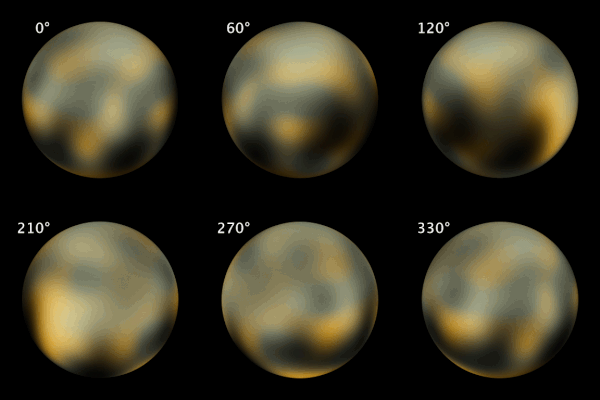
It will return the first ever detailed images of the Pluto system, which is so small and distant that even Hubble can barely see the largest features on its surface.

In the years following the New Horizons Pluto flyby, astronomers plan to use the infrared vision of Hubble’s planned successor, the NASA/ESA/CSA James Webb Space Telescope, for follow-up observations.

The James Webb Space Telescope will be able to study the surface chemistry of Pluto, its moons, and many other bodies that lie in the distant Kuiper Belt along with Pluto