Showing posts with label Hydra. Show all posts

Friday, September 26, 2014

New Horizons has One Last Sleep til Pluto

On Aug. 25, New Horizons crossed the orbit of Neptune-the last planetary orbit crossing during cruise.

Now the spacecraft is outbound for Pluto.

On Aug. 29 the team put New Horizons into hibernation for the final time, prior to its encounter with Pluto.

This last hibernation lasts 99 days and ends on Dec. 6.

After seven-plus years of hibernating through most of the 2.5-billion mile journey from Jupiter to Pluto and the inner reaches of the Kuiper Belt, the spacecraft has reached the final, short leg of cruise.

New Horizons will be re-awakened for the last time in just 10 weeks. Once this has been done, 'encounter' preparations will begin, and six weeks later, the Pluto encounter itself will begin.

At that time, the New Horizons team will have good cause to celebrate. They will have reached the outer end of our Solar System, twenty-five years after first wondering if Pluto might someday be explored.

This summer's eighth and final "pre-Pluto" spacecraft and payload Active Check Out (ACO-8) lasted from June through late August. All spacecraft subsystems-both prime and backup-were checked out and were found to be operating successfully.

Additionally, the team performed their first course-correction since 2010, uploaded the final autonomy system software for the encounter, checked out all seven payload instruments, conducted some final instrument calibrations, and performed their first optical navigation campaign to home in on Pluto using New Horizons' Long Range Reconnaissance Imager (LORRI).

Those activities went well, and so did many others, including more sampling of the heliospheric plasma and dust environment with PEPSSI, SWAP and Student Dust Counter instruments.

The only real anomaly of the entire ACO-8 was a failed startup of a single Alice ultraviolet spectrometer observation.

That observation was to study the distribution of interplanetary hydrogen near Neptune's orbit; it failed because Alice was much colder than was planned, and onboard software "safed" (or turned off) Alice's high-voltage power supply when it took too long to get to its set point voltages.

The team have now learned that they need to adjust some timing settings for future power-ons when Alice will be as cold or even colder, On its approach to Pluto.

Additionally, ACO-8 was the subject of a recent news story from New Horizons: While testing the methods to be used to search for hazards in the Pluto system on approach, the spacecraft detected Pluto's little moon Hydra.

The team didn't think it would be possible to see Hydra until early in 2015, when the spacecraft was much closer, but science team members John Spencer and Hal Weaver found Hydra in the July hazard-sequence test.

The New Horizons team sees the early detection of Hydra as good news, because it anticipates their ability to detect currently unknown moons and rings close to Pluto.

Tuesday, September 16, 2014

New Horizons: Team spot Charon, the tiny moon of Pluto

Artist’s conception of the New Horizons spacecraft flying past Pluto and Charon, one of the dwarf planet’s moons. 

Credit: Johns Hopkins University/APL 

The New Horizons team spotted Charon, the tiny moon of Pluto in July, about six months ahead of when they expected to.

You can check it out in the images below.

The find is exciting in itself, but it also bodes well for the spacecraft's search for orbital debris to prepare for its close encounter with the system in July 2015.

Most of Pluto's moons were discovered while New Horizons was under development, or already on its way.

Mission planners are thus concerned that there could be moons out there that aren't discovered yet, moons that could pose a danger to the spacecraft if it ended up in the wrong spot at the wrong time.

That's why the team is engaging in long-range views to see what else is lurking in Pluto's vicinity.

"We're thrilled to see it, because it shows that our satellite-search techniques work, and that our camera is operating superbly, but it's also exciting just to see a third member of the Pluto system come into view, as proof that we're almost there," stated science team member John Spencer, of the Southwest Research Institute.

Hydra was spotted using the spacecraft's Long Range Reconnaissance Imager (LORRI), which took 48 images of 10 seconds apiece between July 18 and July 20.

Then the team used half the images, the ones that show Hydra better, to create the images you see above.

The spacecraft was still 267 million miles (430 million kilometers) from Pluto when the images were taken.

Another moon discovered around the same time as Hydra, Nix, is still too close to be seen given it's so close to Pluto, but just wait.

Meanwhile, scientists are busily trying to figure out where to send New Horizons after Pluto.

In July, researchers using the Hubble Space Telescope began a full-scale search for a suitable Kuiper Belt Object, which would be one of trillions of icy or rocky objects beyond Neptune's orbit.

Flying past a KBO would provide more clues as to how the Solar System formed, since these objects are considered leftovers of the chunks of matter that came together to form the planets.

Watch the difference: Pluto’s moon Hydra stands out in these images taken by the New Horizons spacecraft on July 18 and 20, 2014. 

Credit: NASA /Johns Hopkins University Applied Physics Laboratory /Southwest Research Institute

Monday, July 16, 2012

When Galaxies Collide: Early Merger

A very wide 130,000 light-years separates the two galaxies in the object known as 2MASXJ09133888-1019196.

But they are caught in one another’s gravitational spell and have begun a slow dance that will one day result in a merger.

The galaxies are about 700 million light-years away in the constellation Hydra.

Image: NASA, ESA, the Hubble Heritage Team (STScI/AURA)-ESA/Hubble Collaboration and A. Evans (University of Virginia, Charlottesville/NRAO/Stony Brook University)

When Galaxies Collide: Dusty Merger

Dust from the foreground galaxy in this image obscures much of the action.

The merger, AM1316-241, is found 400 million light-years away in the constellation Hydra, and is created from two galaxies colliding.

The background light appears red as it travels through the dust.

Image: NASA, ESA, the Hubble Heritage Team (STScI/AURA)-ESA/Hubble Collaboration and W. Keel (University of Alabama, Tuscaloosa)

Wednesday, July 11, 2012

ESA NASA CSA Hubble spots new moon around Pluto


Pluto’s new-found moon, visible as a speck of light in Hubble images, is estimated to be irregular in shape and between 10 and 25 kilometres across.

The moons form a series of neatly nested orbits, a bit like Russian dolls,” said Mark Showalter of the SETI Institute in Mountain View, USA, leader of the scientific team that


The Pluto team is intrigued that such a small planet can have such a complex collection of satellites. The new discovery provides additional clues for unraveling how the Pluto system formed and evolved.

The favoured theory is that all the moons are relics of a collision between Pluto and another large Kuiper belt object billions of years ago.

Pluto animiert.gifPluto’s largest moon, Charon, was discovered in 1978. Hubble observations in 2006 uncovered two additional small moons, Nix and Hydra. In 2011 another moon, known as P4, was found in Hubble data.

Provisionally designated S/2012 (134340) 1, or P5, the latest moon was detected in nine separate sets of images taken by Hubble’s Wide Field Camera 3 on 26, 27 and 29 June, and 7 and 9 July 2012.

New Horizons, a NASA space probe, is currently en route to Pluto, with a high-speed flyby scheduled for 2015.

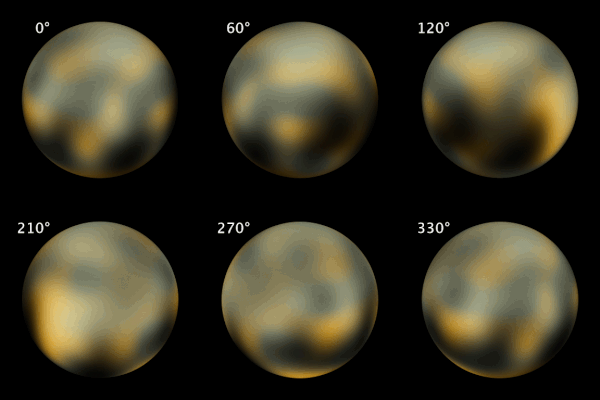
It will return the first ever detailed images of the Pluto system, which is so small and distant that even Hubble can barely see the largest features on its surface.

In the years following the New Horizons Pluto flyby, astronomers plan to use the infrared vision of Hubble’s planned successor, the NASA/ESA/CSA James Webb Space Telescope, for follow-up observations.

The James Webb Space Telescope will be able to study the surface chemistry of Pluto, its moons, and many other bodies that lie in the distant Kuiper Belt along with Pluto