Showing posts with label Visible. Show all posts

Tuesday, September 16, 2014

IPHAS: Most detailed catalogue of the visible Milky Way released

Click on the image to see the large version.

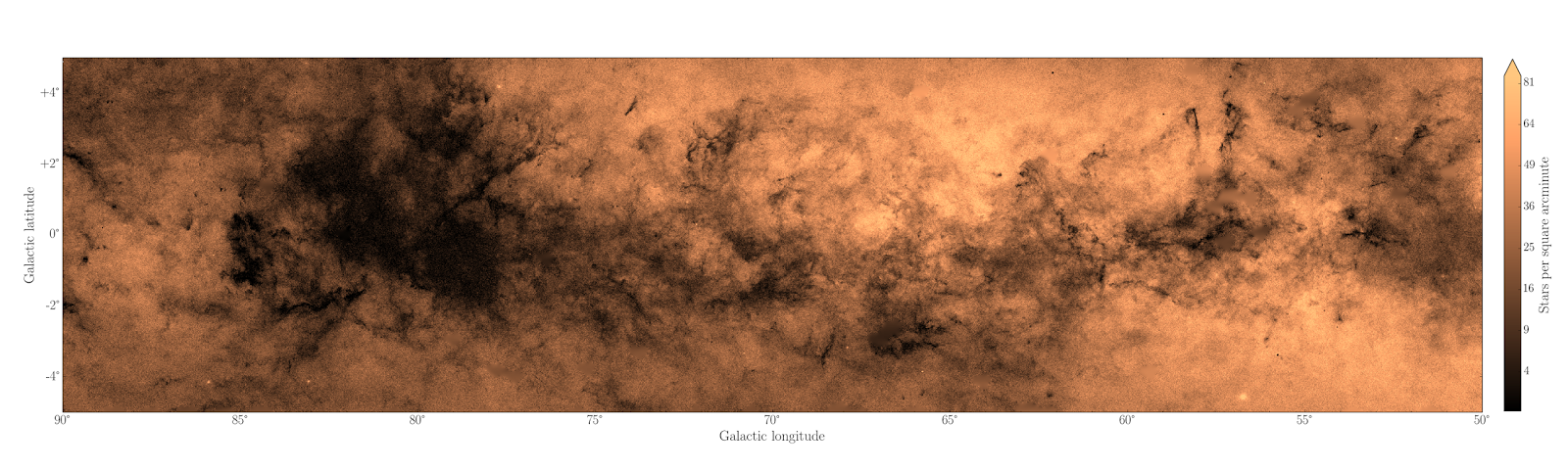
A density map of part of the Milky Way disk, constructed from IPHAS data. The scales show galactic latitude and longitude, coordinates that relate to the position of the centre of the galaxy. 

The mapped data are the counts of stars detected in i, the longer (redder) wavelength broad band of the survey, down to a faint limit of 19th magnitude. 

Although this is just a small section of the full map, it portrays in exquisite detail the complex patterns of obscuration due to interstellar dust. 

This image contains 600 x 2400 independent data points, each of which represents the star count within 1 x 1 square arcminute cells (1 arcminute is 1/60th of a degree). 

At the level of the original exposed images, each cell is itself made up of 32000 pixels. 

The typical effective angular resolution of the data is close to 1 arcsecond (1/3600th of a degree or about 10 original image pixels). 

The section shown features the edge of the Sagittarius spiral arm (near longitude 60 degrees) and the Cygnus-X

A new catalogue of the visible part of the northern part of our home Galaxy, the Milky Way, includes no fewer than 219 million stars.

Geert Barentsen of the University of Hertfordshire led a team who assembled the catalogue in a ten year programme using the Isaac Newton Telescope (INT) on La Palma in the Canary Islands.

Their work appears today in the journal Monthly Notices of the Royal Astronomical Society. A preprint version is available on the arXiv server.

From dark sky sites on Earth, the Milky Way appears as a glowing band stretching across the sky.

To astronomers, it is the disk of our own galaxy, a system stretching across 100,000 light-years, seen edge-on from our vantage point orbiting the Sun.

The disk contains the majority of the stars in the galaxy, including the Sun, and the densest concentrations of dust and gas.

Isaac Newton Telescope (INT)
The unaided human eye struggles to distinguish individual objects in this crowded region of the sky, but the 2.5-m mirror of the INT enabled the scientists to resolve and chart 219 million separate stars.

The INT programme charted all the stars brighter than 20th magnitude,or 1 million times fainter than can be seen with the human eye.

Using the catalogue, the scientists have put together an extraordinarily detailed map of the disk of the Galaxy that shows how the density of stars varies, giving them a new and vivid insight into the structure of this vast system of stars, gas and dust.

The image included here, a cut-out from a stellar density map mined directly from the released catalogue, illustrates the new view obtained.

The Turner-like brush strokes of dust shadows would grace the wall of any art gallery. Maps like these also stand as useful tests of new-generation models for the Milky Way.

The production of the catalogue, IPHAS DR2 (the second release from the survey programme The INT Photometric H-alpha Survey of the Northern Galactic Plane or IPHAS), is an example of modern astronomy's exploitation of 'big data', it contains information on the 219 million detected objects, each of which is summarised in 99 attributes.

With this catalogue release, the team are offering the world community free access to measurements taken through two broad band filters capturing light at the red end of the visible spectrum, and in a narrowband capturing the brightest hydrogen emission line, H-alpha.

The inclusion of H-alpha also enables exquisite imaging of the nebulae (glowing clouds of gas) found in greatest number within the disk of the Milky Way.

The stellar density map illustrated here is derived from the longest (reddest) wavelength band in which the darkening effect of the dust is moderated in a way that brings out more of its structural detail, compared to maps built at shorter (bluer) wavelengths.

More information
"The second data release of the INT Photometric Hα Survey of the Northern Galactic Plane (IPHAS DR2)", Barentsen et al, Monthly Notices of the Royal Astronomical Society, vol. 444, pp. 3230-3257, 2014, published by Oxford University Press. A preprint version is available on the arXiv server.

Tuesday, March 11, 2014

ESA Venus Express spies rainbow-like 'glories' in Venus atmosphere

False colour composite of a ‘glory’ seen on Venus on 24 July 2011. 

The image is composed of three images at ultraviolet, visible, and near-infrared wavelengths from the Venus Monitoring Camera (VMC)

The images were taken 10 seconds apart and, due to the motion of the spacecraft, do not overlap perfectly. 

The glory is 1200 km across, as seen from the spacecraft, 6000 km away. 

Credit: ESA /MPS /DLR /IDA

INTERACTIVE 3D MODEL OF THE VENUS EXPRESS

A rainbow-like feature known as a 'glory' has been seen by ESA's Venus Express orbiter in the atmosphere of our nearest neighbour – the first time one has been fully imaged on another planet.

Rainbows and glories occur when sunlight shines on cloud droplets – water particles in the case of Earth.

While rainbows arch across wide swathes of the sky, glories are typically much smaller and comprise a series of coloured concentric rings centred on a bright core.

Glories are only seen when the observer is situated directly between the Sun and the cloud particles that are reflecting sunlight.

On Earth, they are often seen from aeroplanes, surrounding the shadow of the aircraft on the clouds below, or around the shadow of climbers atop misty mountain peaks.

A glory requires two characteristics: the cloud particles are spherical, and therefore most likely liquid droplets, and they are all of a similar size.

The atmosphere of Venus is thought to contain droplets rich in sulphuric acid.

By imaging the clouds with the Sun directly behind the Venus Express spacecraft, scientists hoped to spot a glory in order to determine important characteristics of the cloud droplets.

They were successful. The glory in the images here was seen at the Venus cloud tops, 70 km above the planet's surface, on 24 July 2011.

It is 1200 km wide as seen from the spacecraft, 6000 km away.

From these observations, the cloud particles are estimated to be 1.2 micrometres across, roughly a fiftieth of the width of a human hair.

The fact that the glory is 1200 km wide means that the particles at the cloud tops are uniform on this scale at least.

The variations of brightness of the rings of the observed glory is different than that expected from clouds of only sulphuric acid mixed with water, suggesting that other chemistry may be at play.

Simulated views of the glory phenomena on Venus (left) and Earth (right), without considering any effects of haze or background cloud brightness.

Glories occur when sunlight shines on cloud droplets – water particles in the case of Earth, sulphuric acid particles for Venus.

The main difference between the appearance of the glory on Venus and on Earth is not because of composition, but rather the particle size.

Cloud droplets on Earth are typically between 10 and 40 thousandths of a millimetre in diameter, but on Venus the droplets found at the cloud tops are much smaller, typically no more than 2 thousandths of a millimetre across. 

Because of this, the coloured fringes are further apart than they would appear on Earth. 

Credit: C. Wilson/P. Laven

One idea is that the cause is the "UV-absorber", an unknown atmospheric component responsible for mysterious dark markings seen in the cloud tops of Venus at ultraviolet wavelengths. More investigation is needed to draw a firm conclusion.

More information: "Glory on Venus Cloud Tops and the Unknown UV Absorber," by W.J. Markiewicz et al, is accepted for publication in Icarus. dx.doi.org/10.1016/j.icarus.2014.01.030

Thursday, December 5, 2013

Supernova, Nova Centauri 2013, Visible to Naked Eye in Southern Hemisphere

Nova Centauri 2013 imaged from São Paulo, Brazil. Credit: Ednilson Oliveira

If you live in the southern hemisphere, the southern sky constellation of Centaurus may look a little different to you tonight, as a bright nova has been identified in the region early this week.

The initial discovery of Nova Centauri 2013 (Nova Cen 2013) was made by observer John Seach based out of Chatsworth Island in New South Wales Australia.

The preliminary discovery magnitude for Nova Cen 2013 was magnitude +5.5, just above naked eye visibility from a good dark sky site. Estimates by observers over the past 24 hours place Nova Cen 2013 between magnitudes +4 and +5 "with a bullet," meaning this one may get brighter still as the week progresses.

We first got wind of the discovery via the American Association of Variable Star Observers yesterday afternoon when alert notice 492 was issued.

Established in 1911, the AAVSO is a great resource for info and a fine example of amateur collaboration in the effort to conduct real scientific observation.

Follow-up spectra measurements by Rob Kaufman in White Cliffs Australia and Malcolm Locke in Christchurch New Zealand demonstrated the presence of strong hydrogen alpha and hydrogen beta emission lines, the classic hallmark of an erupting nova.

Like Nova Delphini 2013 witnessed by observers in the northern hemisphere, this is a garden variety nova located in our own galaxy, going off as seen along the galactic plane from our Earthbound perspective.

A handful of galactic novae are seen each year, but such a stellar conflagration reaching naked eye visibility is worthy of note.

In fact, Nova Cen 2013 is already knocking on the ranks of the 30 brightest novae observed of all time.

This is not to be confused with a supernova, the last of which observed in our galaxy was Kepler's Supernova in 1604, just before the advent of the telescope in modern astronomy.

Supernovae are seen in other galaxies all the time, but here at home, you could say we're "due".

So, who can see Nova Cen 2013, and who's left out? Well, the coordinates for the nova are:

Right Ascension: 13 Hours 54' 45"

Declination: -59°S 09' 04"

An animation showing a comparison between the constellation Centaurus before and after a nova eruption. Credit: Ernesto Guido, Nick Howes and Martino Nicolini/Remanzacco Observatory.

That puts it deep in the southern celestial hemisphere sky where the constellation Centaurus meets up with the constellations of Circinus, Musca and the Crux.

Located within three degrees of the +0.6th magnitude star Hadar—also named Beta Centauri—it would be possible to capture the southern deep sky objects of the Coal Sack and Omega Centauri with Nova Cen 2013 in the same wide field of view.

Though Nova Cen 2013 technically peeks above the southern horizon from the extreme southern United States, the viewing circumstances aren't great.

In fact, the nova only rises just before the Sun as seen from Miami in December, at 25 degrees north latitude.

The Centaurus region is much better placed in northern hemisphere during the springtime, when many southern tier states can actually glimpse the celestial jewels that lie south, such as Omega Centauri.

But the situation gets better, the farther south you go. From Guayaquil, Ecuador just below the equator, the nova rises to the southeast at about 3 AM local, and sits 20 degrees above the horizon at sunrise.

Friday, November 15, 2013

Comet ISON Now Visible to Naked Eye After Outburst - Video


The much-anticipated Comet ISON is now visible to the naked eye according to reports from many observers.

Comet ISON — the potential "comet of the century" — has suddenly brightened in an outburst of activity with just two weeks to go before it grazes the surface of the sun.

In recent months, Comet ISON has repeatedly befuddled forecasters trying to anticipate just how bright it will ultimately become. But earlier this week, the comet's brightening trend again seemed to sputtering and stalling, but more recent observations suggest a sudden and radical upsurge in brightness.

Friday, November 1, 2013

Milky Way supernova should be visible from Earth in next 50 years

Barred Spiral Milky Way. Illustration Credit: R. Hurt (SSC), JPL-Caltech, NASA

Astronomers at Ohio State University have calculated the odds that, sometime during the next 50 years, a supernova occurring in our home galaxy will be visible from Earth.

The good news: they've calculated the odds to be nearly 100 percent that such a supernova would be visible to telescopes in the form of infrared radiation.

The bad news: the odds are much lower—dipping to 20 percent or less—that the shining stellar spectacle would be visible to the naked eye in the nighttime sky.

Yet, all this is great news to astronomers, who, unlike the rest of us, have high-powered infrared cameras to point at the sky at a moment's notice.

For them, this study suggests that they have a solid chance of doing something that's never been done before: detect a supernova fast enough to witness what happens at the very beginning of a star's demise.

A massive star "goes supernova" at the moment when it's used up all its nuclear fuel and its core collapses, just before it explodes violently and throws off most of its mass into space.

Chris Kochanek
"We see all these stars go supernova in other galaxies, and we don't fully understand how it happens. We think we know, we say we know, but that's not actually 100 percent true," said Christopher Kochanek, professor of astronomy at Ohio State and the Ohio Eminent Scholar in Observational Cosmology.

"Today, technologies have advanced to the point that we can learn enormously more about supernovae if we can catch the next one in our galaxy and study it with all our available tools."

The results will appear in an upcoming issue of The Astrophysical Journal.

First through calculations and then through computer models, generations of astronomers have worked out the physics of supernovae based on all available data, and today's best models appear to match what they see in the skies.

But actually witnessing a supernova—that is, for instance, actually measuring the changes in infrared radiation from start to finish while one was happening—could prove or disprove those ideas.

Kochanek explained how technology is making the study of Milky Way supernovae possible.

Astronomers now have sensitive detectors for neutrinos (particles emitted from the core of a collapsing star) and gravitational waves (created by the vibrations of the star's core) which can find any supernova occurring in our galaxy.

The question is whether we can actually see light from the supernova because we live in a galaxy filled with dust—soot particles that Kochanek likened to those seen in diesel truck exhaust—that absorb the light and might hide a supernova from our view.

"Every few days, we have the chance to observe supernovae happening outside of our galaxy," said doctoral student Scott Adams.

"But there's only so much you can learn from those, whereas a galactic supernova would show us so much more. Our neutrino detectors and gravitational wave detectors are only sensitive enough to take measurements inside our galaxy, where we believe that a supernova happens only once or twice a century."

Adams continued: "Despite the ease with which astronomers find supernovae occurring outside our galaxy, it wasn't obvious before that it would be possible to get complete observations of a supernova occurring within our galaxy."

"Soot dims the optical light from stars near the center of the galaxy by a factor of nearly a trillion by the time it gets to us. Fortunately, infrared light is not affected by this soot as much and is only dimmed by a factor of 20."

By balancing all these factors, the astronomers determined that they have nearly a 100 percent chance of catching a prized Milky Way supernova during the next 50 years. Adams summarized the findings in a video:


More information: arxiv.org/abs/1306.0559

Sunday, September 16, 2012

JWST: "Infrared: Beyond the Visible" explores the wonder of infrared astronomy


The answers to some of the universe's greatest cosmic mysteries are written across the night sky, inscribed in light we can't see with our human eyes — but it won't be invisible to us forever.

"Infrared: Beyond the Visible" explores the wonder of infrared astronomy and the promise of the upcoming Webb Space Telescope.

Get a sense of the sights Webb will capture, with its Hubble-sharp vision and ability to reach into the farthest depths of space and time.

Join the journey of discovery, and when you're done, check out the other links for more on the infrared universe.

Saturday, August 27, 2011

Converting Infrared radiation into visible light

Jeppe Seidelin Dam and colleagues at the Technical University of Denmark in Roskilde are developing a device that can convert infrared radiation into visible light. Attached to a digital camera fitted with an infrared flash, it could detect tumours by recording the telltale pattern of infrared light they reflect.

"This would allow a surgeon to quickly determine if the entire tumour has been removed before finishing an operation," he says.

At the heart of the system is a multilayered crystal of potassium titanium oxide phosphate in which the infrared photons from the object to be imaged interfere with photons from an infrared laser, also fired into the crystal. The interaction shifts the wavelength into the visible spectrum while preserving the image information, allowing it to be captured by a normal camera.

Mirror amplifiers

The idea was first explored in the 1970s, but improvements to methods for growing crystals since then have improved the resolution of the device 300-fold. By placing a pair of mirrors on either side of the crystal so that the laser light reflects back and forth, the team increased the odds of its photons interfering with infrared photons from the object.

"We pass the same photons through the crystal up to 100 times," says Dam. The crystal was able to capture an infrared panorama with a resolution of 200 by 1000 pixels, the team says.

The device could be placed in front of a digital camera lens like a filter, and be used to take thermal photographs or video. Shrinking it down to a size suitable for everyday use should not be difficult, says Dam. "These are basically the same components that are in green laser pointers."

While current infrared colour imagers need to run at -200°C and cost around $100,000, Dam says that an upconversion imager would run at room temperature and cost about $10,000.

Stefano Bonora of the University of Padua, Italy, calls the upconversion technique "really interesting" for its potential to generate infrared images at room temperature. Such detectors are lacking at the moment, he says.

Monday, May 2, 2011

Invisibility cloak: Researchers create terahertz version

Researchers at Northwestern University have created a new kind of cloaking material that can render objects invisible in the terahertz range. Though this design can't translate into an invisibility cloak for the visible spectrum, it could have implications in diagnostics, security, and communication.

The cloak, designed by Cheng Sun, assistant professor of mechanical engineering at Northwestern's McCormick School of Engineering and Applied Science, uses microfabricated gradient-index materials to manipulate the reflection and refraction of light. Sun's results will be presented May 4 at CLEO: 2011, the annual Conference on Lasers and Electro-Optics.

Humans generally recognise objects through two features: their shape and colour. To render an object invisible, one must be able to manipulate light so that it will neither scatter at an object's surface nor be absorbed or reflected by it (the process which gives objects colour).

In order to manipulate light in the terahertz frequency, which lies between infrared and microwaves, Sun and his group developed metamaterials: materials that are designed at the atomic level.

Sun's tiny, prism-shaped cloaking structure, less than 10 millimeters long, was created using a technique called electronic transfer microstereolithography, where researchers use a data projector to project an image on a liquid polymer, then use light to transform the liquid layer into a thin solid layer.

Each of the prism's 220 layers has tiny holes that are much smaller than terahertz wavelengths, which means they can vary the refraction index of the light and render invisible anything located beneath a bump on the prism's bottom surface; the light then appears to be reflected by a flat surface.

Sun says the purpose of the cloak is not to hide items but to get a better understanding of how to design materials that can manipulate light propagation.

"This demonstrates that we have the freedom to design materials that can change the refraction index," Sun said. "By doing this we can manipulate light propagation much more effectively."

The terahertz range has been historically ignored because the frequency is too high for electronics. But many organic compounds have a resonant frequency at the terahertz level, which means they could potentially be identified using a terahertz scanner.

Sun's research into terahertz optics could have implications in biomedical research (safer detection of certain kinds of cancers) and security (using terahertz scanners at airports).

Next Sun hopes to use what he's learned through the cloak to create its opposite: a terahertz lens. He has no immediate plans to extend his invisibility cloak to visible frequencies.

"That is still far away," he said. "We're focusing on one frequency range, and such a cloak would have to work across the entire spectrum."

Thursday, February 11, 2010

The International Space Station together with Space Shuttle Endeavour visible from Europe


The conditions in northern Europe are set for nice views of the ISS as it passes overhead up to four times a night this coming weekend. All you need is the timetable and a clear sky.

The International Space Station together with Space Shuttle Endeavour docked to it is so bright that spotting them with the naked eye is not at all difficult, provided you know where and when to look.

The ISS orbits Earth every 92 minutes only about 400 km above our heads and tilted about 52 degrees in relation to the equator. When the position of the Station is projected onto a conventional map of the world, it moves in a curve from south to north. The ISS passes over most regions on Earth every day, in some places several times a day.


For most locations in Europe the ISS can be seen easily only when the northern points of the orbit happen to coincide with good lighting conditions and night time. This is the case right now: the ISS enjoys very good visibility from the northern parts of Europe.

Normally the best time for ISS-gazing is just before dawn or just after sunset, when the observer is in the dark but the ISS is lit by the Sun. When visible, ISS is one of the brightest objects in the night sky, making it fairly easy to spot from when it rises above the horizon in a westerly direction until it sets towards the east.

How about photographing ISS as it glides through the night sky? Send your best images via twitpics to @esa or by email esabuzz@gmail.com

Monday, December 14, 2009

VISTA comes online (the Visible and Infrared Survey Telescope for Astronomy)

A new telescope - VISTA (Visible and Infrared Survey Telescope for Astronomy) - has just started it's working life at ESO's Paranal Observatory and has made its first release of pictures.

VISTA is a survey telescope working at infrared wavelengths and is the world's largest telescope dedicated to mapping the sky.

Its large mirror, wide field of view and very sensitive detectors will reveal a completely new view of the southern sky. Spectacular new images of the Flame Nebula, the centre of our Milky Way galaxy and the Fornax Galaxy Cluster show that it is working extremely well.

VISTA is the latest telescope to be added to ESO's Paranal Observatory in the Atacama Desert of northern Chile. It is housed on the peak adjacent to the one hosting the ESO Very Large Telescope (VLT) and shares the same exceptional observing conditions.

VISTA's main mirror is 4.1 metres across and is the most highly curved mirror of this size and quality ever made - its deviations from a perfect surface are less than a few thousandths of the thickness of a human hair - and its construction and polishing presented formidable challenges.

VISTA was conceived and developed by a consortium of 18 universities in the United Kingdom [1] led by Queen Mary, University of London and became an in-kind contribution to ESO as part of the UK's accession agreement. The telescope design and construction were project-managed by the Science and Technology Facilities Council's UK Astronomy Technology Centre (STFC, UK ATC).

Provisional acceptance of VISTA was formally granted by ESO at a ceremony at ESO's Headquarters in Garching, Germany, attended by representatives of Queen Mary, University of London and STFC, on 10 December 2009 and the telescope will now be operated by ESO.

"VISTA is a unique addition to ESO's observatory on Cerro Paranal. It will play a pioneering role in surveying the southern sky at infrared wavelengths and will find many interesting targets for further study by the Very Large Telescope, ALMA and the future European Extremely Large Telescope," says Tim de Zeeuw, the ESO Director General.

Read More...........