
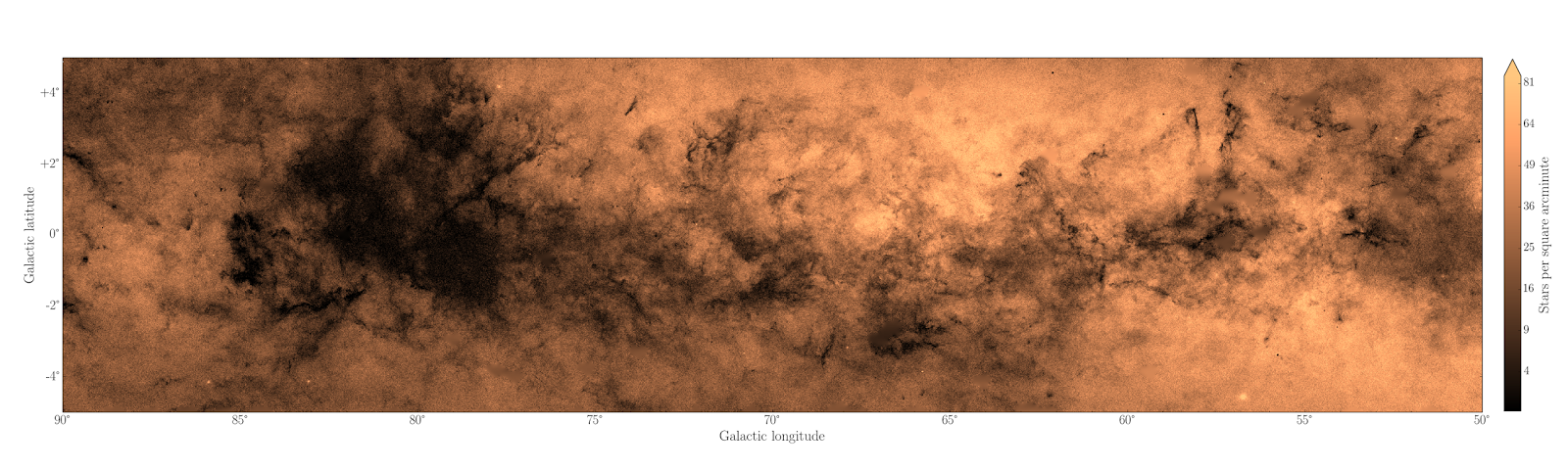
A density map of part of the Milky Way disk, constructed from IPHAS data. The scales show galactic latitude and longitude, coordinates that relate to the position of the centre of the galaxy.
The mapped data are the counts of stars detected in i, the longer (redder) wavelength broad band of the survey, down to a faint limit of 19th magnitude.
Although this is just a small section of the full map, it portrays in exquisite detail the complex patterns of obscuration due to interstellar dust.
This image contains 600 x 2400 independent data points, each of which represents the star count within 1 x 1 square arcminute cells (1 arcminute is 1/60th of a degree).
At the level of the original exposed images, each cell is itself made up of 32000 pixels.
The typical effective angular resolution of the data is close to 1 arcsecond (1/3600th of a degree or about 10 original image pixels).
The section shown features the edge of the Sagittarius spiral arm (near longitude 60 degrees) and the Cygnus-X
A new catalogue of the visible part of the northern part of our home Galaxy, the Milky Way, includes no fewer than 219 million stars.

Their work appears today in the journal Monthly Notices of the Royal Astronomical Society. A preprint version is available on the arXiv server.
From dark sky sites on Earth, the Milky Way appears as a glowing band stretching across the sky.
To astronomers, it is the disk of our own galaxy, a system stretching across 100,000 light-years, seen edge-on from our vantage point orbiting the Sun.
The disk contains the majority of the stars in the galaxy, including the Sun, and the densest concentrations of dust and gas.
 |
| Isaac Newton Telescope (INT) |
The INT programme charted all the stars brighter than 20th magnitude,or 1 million times fainter than can be seen with the human eye.
Using the catalogue, the scientists have put together an extraordinarily detailed map of the disk of the Galaxy that shows how the density of stars varies, giving them a new and vivid insight into the structure of this vast system of stars, gas and dust.
The image included here, a cut-out from a stellar density map mined directly from the released catalogue, illustrates the new view obtained.
The Turner-like brush strokes of dust shadows would grace the wall of any art gallery. Maps like these also stand as useful tests of new-generation models for the Milky Way.
The production of the catalogue, IPHAS DR2 (the second release from the survey programme The INT Photometric H-alpha Survey of the Northern Galactic Plane or IPHAS), is an example of modern astronomy's exploitation of 'big data', it contains information on the 219 million detected objects, each of which is summarised in 99 attributes.
With this catalogue release, the team are offering the world community free access to measurements taken through two broad band filters capturing light at the red end of the visible spectrum, and in a narrowband capturing the brightest hydrogen emission line, H-alpha.
The inclusion of H-alpha also enables exquisite imaging of the nebulae (glowing clouds of gas) found in greatest number within the disk of the Milky Way.
The stellar density map illustrated here is derived from the longest (reddest) wavelength band in which the darkening effect of the dust is moderated in a way that brings out more of its structural detail, compared to maps built at shorter (bluer) wavelengths.
More information
"The second data release of the INT Photometric Hα Survey of the Northern Galactic Plane (IPHAS DR2)", Barentsen et al, Monthly Notices of the Royal Astronomical Society, vol. 444, pp. 3230-3257, 2014, published by Oxford University Press. A preprint version is available on the arXiv server.


 Posts
Posts


