Showing posts with label Cubesats. Show all posts

Sunday, October 19, 2014

Cubesats Payload on Europa Clipper Mission

Artist's impression of cubesats exploring Europa.

Credit: NASA/JPL-Caltech

NASA’s Jet Propulsion Laboratory (JPL) in Pasadena, Calif., has selected proposals from 10 universities to begin investigating the possible use of cubesats as auxiliary components to missions to Europa and beyond.

Cubesats are small, low cost space probes that can be used to collect scientific data by themselves or part of a “flock.”

They have been used extensively in the low-Earth orbit, providing a low-cost means for universities and institutions to carry out experiments in this microgravity environment.

As cubesat technology is maturing, so does the scope of their application.

So, as NASA steps up its plans for the Europa Clipper concept to visit the icy Jupiter moon, JPL has asked for cubesat proposals from universities that could complement the primary Clipper payload.

As we have a mission going to Europa, why not attach some cubesats for the ride?

NASA has outlined some key science objectives these axillary cubesats should be able to carry out, including “reconnaissance for future landing sites, gravity fields, magnetic fields, atmospheric and plume science, and radiation measurements.”

“We’ve seen some innovative and quite creative surprises among the CubeSat ideas submitted by these universities,” said Barry Goldstein, pre-project manager for the Europa Clipper mission.

“Using CubeSats for planetary exploration is just now becoming possible, so we want to explore how a future mission to Europa might take advantage of them.”

The chosen proposals have been awarded $25,000 each to develop their cubesat concepts to be included in the study, which is expected in the summer of 2015.

Europa is known to possess a sub-surface ocean of liquid water protected by a thick icy shell. As we learn more and more about this little world, our fascination with its life-giving potential is only amplified.

We now know that, combined with the oceans of water, nutrients are actively cycling to and from the surface. The icy surface appears to have plate tectonics.

Also, scientists believe there’s an abundance of oxygen in the ocean that’s heated by the tidal squishing of Europa’s orbit around Jupiter.

All of these factors point to a possibly habitable world where it has been hypothesized that multicellular life could thrive, but to test this hypothesis, we need to start sending missions to Europa so a close-up picture of its life-giving potential may be formulated, a mission that could be accelerated by the introduction of hitchhiking cubesats to the next big NASA missions to Jovian orbit.

Friday, August 15, 2014

NASA: The Future benefits of CubeSats

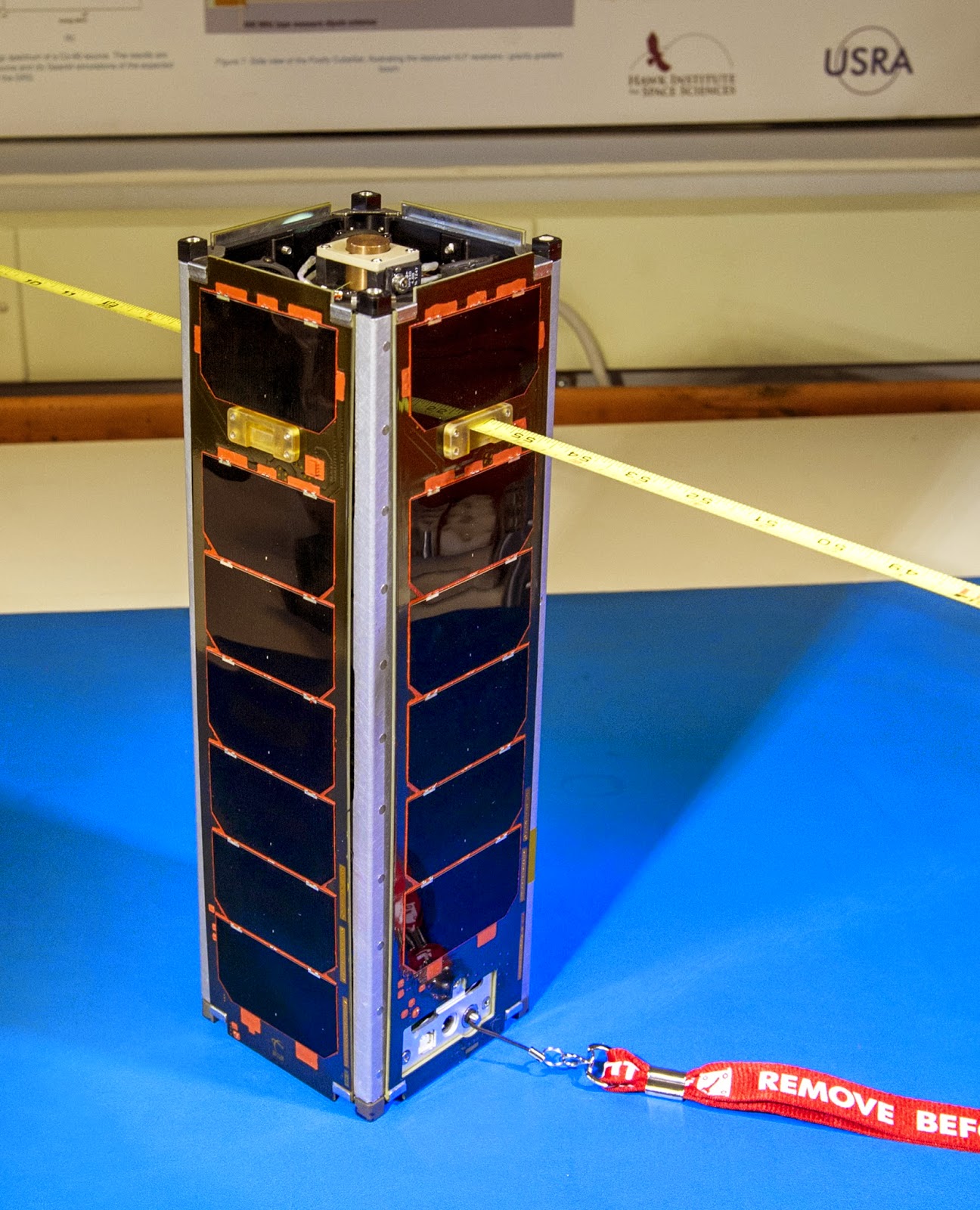
Three cans of soda would fill the Firefly CubeSat to the brim but don't let its size fool youm NASA has big plans for these tiny satellites.

Image Credit: NASA/Bill Hrybyk

To investigate climate change, scientists and engineers at NASA’s Goddard Space Flight Center are developing the IceCube satellite, which will be no larger than a loaf of bread.

In 2016, this satellite will mature technology that scientists will use to analyze cloud ice in the atmosphere.

“We’re using IceCube to test a radiometer that we want to fly on a big space mission,” said Jeffrey Piepmeier, associate head of Goddard’s Microwave Instruments and Technology Branch.

“Climate scientists have never used this frequency to measure cloud ice from space before.”

The project highlights a growing trend toward testing instruments and running scientific experiments aboard CubeSats.

“Every pound that you send into space costs a phenomenal amount of money,” said Todd Bonalsky, an electrical engineer at Goddard.

“Hence in the investment in CubeSats, which are tiny, complete satellites that are cheaper and easier to build than their larger counterparts.”

At about a foot in length and four inches wide, these three-unit (3U) CubeSats are similar in design to IceCube.

Image Credit: NASA

Bonalsky’s Dellingr CubeSat is slated to launch in March 2015.

Employing a magnetometer system Bonalsky miniaturised for CubeSat use, Dellingr will measure magnetic fluctuations to help scientists better understand how space weather affects Earth.

Dellingr will be the first CubeSat to fly this type of science grade magnetometer system.

Scientists however face a number of challenges when working on CubeSats. Due to their size, CubeSats cannot power many of NASA’s formidable scientific instruments, and there are limits to what can be miniaturised.

The Hubble Space Telescope for example uses a mirror nearly eight feet wide to capture light and translate it into images that a smaller mirror could not produce.

Doug Rowland, a solar scientist at NASA, faced this dilemma when gathering data from his Firefly CubeSat.

He built it to investigate the correlation between lightning and gamma radiation, but his CubeSat can only download 20 milliseconds slots of data to Earth each day.

“The Firefly just doesn’t have enough electrical power to simultaneously run its GPS receiver, its communications antenna and our experiment at the same time,” Rowland said.

“On a big spacecraft, you’d have a thousand times as much data, at least, and you’d have other ways to transmit the data down to Earth.”

Todd Bonalsky holds the solar panel that will power the Dellingr satellite.

Image Credit: NASA/Kristen Basham

Despite such drawbacks, the size and cost of CubeSats open up new strategies for scientific investigations.

In conventional missions, every component must function exactly as designed, but, depending on the mission, a single CubeSat is expendable.

“Instead of pouring money into one big satellite, we try to make a swarm,” said Robert Clayton, a Goddard intern from Dartmouth College.

“It’s okay if we lose two or three from our swarm of 20. We instead focus on making each CubeSat as cheap and reproducible as possible.”

CubeSats can thus slash a scientific mission’s budget and allow scientists to measure multiple data points that would be unobtainable otherwise. Using multiple spacecraft for a single mission is by no means a novel concept.

The Solar Terrestrial Relations Observatory for example is a pair of nearly identical observatories that trace solar matter as it flows from the sun.

However losing one of these expensive observatories would spell catastrophe for the mission, as opposed to losing one CubeSat in a swarm.

Saturday, March 1, 2014

Deployment of NanoRacks CubeSats from the International Space Station

A set of NanoRacks CubeSats is photographed by an Expedition 38 crew member after deployment by the NanoRacks Launcher attached to the end of the Japanese robotic arm. 

The CubeSats program contains a variety of experiments such as Earth observations and advanced electronics testing. 

International Space Station solar array panels are at left. 

Earth's horizon and the blackness of space provide the backdrop for the scene. 

Two sets of CubeSats were deployed late Wednesday, Feb. 26 and early Thursday, Feb. 27, leaving just two more launches to go of the 33 CubeSats that were delivered to the station in January by Orbital Sciences’ Cygnus cargo ship. 

The latest CubeSats were sent on their way at 8:50 p.m. EST Wednesday and 2:40 a.m. Thursday. 

CubeSats are a class of research spacecraft called nanosatellites and have small, standardized sizes to reduce costs. 

Two final batches of CubeSats are set for deployment at 11:20 p.m. Thursday and 2:30 a.m. Friday, but more are scheduled to be delivered to the station on the second Orbital commercial resupply mission in May. 

Image Credit: NASA

Friday, February 21, 2014

NASA ORS-3 Mission: STPSat-3 and 28 CubeSats deployed into Earth orbit

The Minotaur 1 four-stage rocket carrying the Air Force's Space Test Program Satellite-3 (STPSat-3) and 28 other CubeSats also carried a compact Autonomous Flight Safety System unit that operated in "shadow mode" to track the rocket's path as it lifted off the gantry and streaked across the horizon. 

Credit: Chris Perry /NASA Wallops

A spectacular launch from Virginia's eastern shore recently resulted in the successful deployment of Air Force's Space Test Program Satellite-3 (STPSat-3) and 28 other CubeSats into orbit, but that wasn't the only first for the mission or the bustling spaceport at NASA's Wallops Flight Facility.

Range safety officers also used the ORS-3 mission, run by the U.S. military's Operationally Responsive Space Office, to carry out the first of three planned certification tests of a new technology that promises to eventually eliminate the need for expensive down-range tracking and command infrastructure to manually terminate rockets if they veer off course.

Barton Bull
According to Barton Bull, the chief engineer of the Wallops Research Range, the Minotaur 1 four-stage rocket carrying the Air Force's Space Test Program Satellite-3 (STPSat-3) and 28 other so-called CubeSats also carried a compact Autonomous Flight Safety System (AFSS) unit that integrated GPS, an inertial measurement unit and Wallops-developed algorithms to track the rocket's path as it lifted off the gantry and streaked across the horizon.

Developed by ATK, a supplier of aerospace and defense products from its location in Plymouth, Minn., the shoe box-size unit worked in shadow mode during its first certification test.

As part of that test, range officers programmed the unit to respond to a simulated signal indicating that the rocket had gone off course and to send a self-destruct or detonate command at the appropriate time.

Initial Data 'Positive'
"We're still looking at the data, but initial indications are pretty positive," said Bull, whose organization created the unit's software.

"Preliminary data indicate that the unit sent the simulated termination command at the right time."

Traditionally, range-safety officials use radar from ground stations operating in the Outer Banks of North Carolina, Bermuda and Antigua to track flight vehicles and a ground-based command system to terminate rockets that deviate from their flight plans.

Due to increasing costs to maintain and staff these systems, NASA and the military launched a program several years ago to develop an autonomous system that would migrate flight-safety functions onto the rocket itself.

"All these systems need to be tied together and that costs money and time," Bull said. "Our objective is to save money and allow faster decision-making." Initial testing of AFSS began more than three years ago.

However, in those flight demonstrations the team used a system cobbled together with commercial, off-the-shelf components married to the Wallops-developed software.

The test during ORS-3, however, employed the actual unit that ATK built under contract.

As a result of the unit's successful function test, the AFSS team plans to execute another test during a rocket launch from the Pacific Missile Range Facility in Kauai, Hawaii, in the coming months.

A launch date has not been set. Once the team finishes the certification, it believes AFSS will become fully operational in a couple years.

New Mission Graphics System Debuts
In addition to carrying out the first AFSS test toward certification, the mission debuted and tested a new, user-friendly mission-graphics system that updates radar and other data on a computer screen, Bull said.

"It takes an enormous amount of time to set up these systems" and make sure all the data, which typically arrive in different formats, are easily displayed, he added.

The new system is more configurable and faster to set up.


"This was a mission of firsts on many different levels," Bull said. The team deployed a record-breaking 29 CubeSats, including, among others, Firefly (developed at NASA's Goddard Space Flight Center in Greenbelt, Md.), which is studying lightening and its possible connection to incredibly powerful bursts called terrestrial gamma-ray flashes, or TGFs, just miles off the ground.

Also aboard were NASA's so-called "PhoneSat," which is testing a smartphone's capability as a communication technology for nanosatellites, and 11 student-developed research satellites.

A student team from a high school in Alexandria, Va., provided one of the 11, also a first.

"I think we were all pleased with the results," Bull said.

Tuesday, February 4, 2014

33 'Cubesats' to Launch from Space Station This Month

Three small CubeSats float above the Earth after deployment from the International Space Station.

Astronaut Rick Mastracchio tweeted the photo from the station on Nov. 19, 2013.

Credit: Rick Mastracchio ‏(via Twitter as @AstroRM)

Astronauts aboard the International Space Station are preparing for the deployment of nearly three dozen tiny satellites from the orbiting lab over the coming weeks.

The spaceflyers have been installing special equipment that will launch 33 "cubesats" from the space station this month, with the first round of ejections scheduled to take place on Thursday (Feb. 6).

Mike Johnson
"We believe this will be a world-record deployment, of the number of satellites in one deployment," Michael Johnson, chief technology officer of the space-hardware firm NanoRacks, said in a NASA video last week.


NanoRacks helps organize and integrate some research activites aboard the space station. The company built eight new deployers that will launch the 33 cubesats, which were delivered to the orbiting lab Jan. 12 on the first contracted cargo mission of Orbital Sciences' unmanned Cygnus resupply spacecraft.

Six cubesats will be launched from the station Thursday, NASA officials said. The rest will begin flying freely over the course of the following two weeks or so.

Twenty-eight of the 33 cubesats were built by the San Francisco-based company Planet Labs.

Together, these spacecraft make up "Flock 1," which Planet Labs says will be the world's biggest constellation of Earth-imaging satellites.

Monday, December 9, 2013

Scientists launch 'CubeSats' into radiation belts

The twin FIREBIRD CubeSats. 

Credit: MSU Space Science and Engineering Laboratory.

Twin, pintsized satellites built in part at the University of New Hampshire's Space Science Center by UNH graduate student Alex Crew were launched into orbit from Vandenberg Air Force Base in California just before midnight on December 5, 2013.

The two 4x4x6-inch Focused Investigations of Relativistic Electron Burst Intensity, Range, and Dynamics (FIREBIRD) satellites will now brave a region of space 400 miles above Earth, where they have begun probing a mysterious physical process within our planet's dangerous radiation belts.

That process, known as microbursts, involves electrons moving at nearly the speed of light during short-duration (100 milliseconds) events.

Microbursts are thought to be one of the primary mechanisms by which the outer radiation belt loses energetic particles to Earth's atmosphere after the occurrence of powerful solar storms.

Such storms can dramatically change the intensity of the radiation belts.

Alex Crew holds FIREBIRD's full-size engineering unit, which contains twin particle detectors. 

The boxy structure to Crew's left is a copy of the miniscule FIREBIRD spacecraft.

Photo by David Sims, UNH-EOS.

"We care about this because the belts' high-energy particles, particularly the electrons, pose a real risk to spacecraft," says Crew, who worked on FIREBIRD for over three years to recently earn his Ph.D.

"So if we understand these physical processes better, we'll be able to predict how the radiation belts will behave and both protect the satellites we depend upon for telecommunications, weather monitoring and prediction, etcetera, and design them to withstand this high-energy radiation," Crew adds.

FIREBIRD was among ten other CubeSats that shared a ride into space on a rocket dedicated to a larger mission - in this case, an Atlas 5 rocket launching a payload for the U.S. National Reconnaissance Office (NRO).

Such ridesharing is standard operating procedure for a program designed to put small, low-cost satellites into space much more quickly than typical satellite missions.

The little satellites are placed into a compartment known as a Poly Picosatellite Orbital Deployer, P-POD for short, and jettisoned from the rocket at the proper orbital height above Earth.

FIREBIRD was the first to be deployed and is the first CubeSat mission UNH scientists have been involved with.

Funded by the National Science Foundation (NSF), the CubeSat program is launching a new generation of tiny satellites outfitted with modern, smart-phone-like electronics and miniaturized scientific instruments to study highly focused science questions and go where bigger, more costly and complex satellite missions cannot.


"The tiny Firebird CubeSats are poised for big science discoveries, providing first-of-a-kind, multi-point observations of microbursts that will help answer crucial questions about radiation belt dynamics and processes," says Therese Moretto Jorgensen, program director in the NSF Division of Atmospheric and Geospace Science.

California Polytechnic State and Stanford universities first developed the CubeSat specifications in an effort to help universities worldwide perform space science and exploration, and NSF's program is providing students and young professionals with the opportunity to participate as never before in satellite missions end-to-end.

Crew's advisor and UNH mission lead scientist for FIREBIRD is astrophysicist Harlan Spence, director of the Institute for the Study of Earth, Oceans, and Space.

Says Spence, "In contrast to typical satellite missions, which can take over a decade from conception to launch, the CubeSat program provides invaluable opportunities for scholars like Alex to experience a complete spacecraft mission and to conduct high-quality scientific research as a graduate student."

UNH and collaborators have already been funded for the follow-up FIREBIRD II mission slated for launch in October 2014.

More information: For more information on the FIREBIRD mission, visit: firebird.unh.edu

Tuesday, December 3, 2013

An interstellar journey for CubeSats

In Greek mythology, Icarus was the impulsive son who ignored his father's warning about flying too close to the sun but the students in the Drexel University chapter of Icarus Interstellar are much too dedicated to do anything that careless. Besides, they're aiming for a star located even farther away.

Those students went above and beyond to create the first chapter at any university of Icarus Interstellar, an international nonprofit foundation dedicated to achieving interstellar flight—travel to star systems beyond our own solar system—by the year 2100.

The research-oriented organization's mandate is to train the next generation of interstellar engineers, so the idea of a Drexel chapter organization wasn't very far-fetched.

Icarus is attempting to build the first-ever mission to Alpha Centauri, the star system located the closest to our solar system.

The timing of the project is especially important because no other similar missions are planned and the only mission that could reach a neighboring solar system—the Voyager spacecraft launched into space in 1977—will take tens of thousands of years.

Icarus' Project Tin Tin aims to reach the nearest star in about one-third of the Voyager's time, even though the Voyager will have received a 40-year head start.

Through Project Tin Tin, Icarus plans to create cost-effective technology and prototype CubeSats, or tiny cube-shaped research spacecraft nanosatellites, to test before sending to Alpha Centauri.

The Drexel students will contribute to the mission by designing, analyzing and building their own interstellar CubeSat.

"The idea is that this CubeSat will push the boundaries of what is possible with our current technology and will serve as a stepping-stone for future [faster] missions," said Damien Turchi, a pre-junior mechanical engineering and mechanics major and the president and founder of Drexel's Icarus chapter.

The group plans to send Icarus a project proposal by March 2014 to earn approval and start funding for the Drexel CubeSat, which will potentially be launched as early as 2016.

"By promoting specifically student involvement in interstellar research, the breakthroughs required for this endeavor may very well happen in our generation, because innovation tends to lie in the naïve," Turchi said.

Other activities planned for the Drexel chapter include discussions about Icarus' projects and the implications of long-term interstellar flight on human health and psychology.

The group is also planning a possible trip to the Icarus Interstellar Starship Congress in Texas and is looking into ways to aid other universities to create student chapters.

Wednesday, November 27, 2013

JAXA: How Nanosatellites are deployed from ISS


JAXA's ISS Program Manager Masazumi Miyake explains how 3 nanosatellites (aka cubesats) were deployed from the Japanese 'Kibo' Experimental Module on Nov. 19. 2013. Credit: NASA

Saturday, November 23, 2013

Kibo lab SSOD Releases Cubesats From Space Station

Three nanosatellites, known as Cubesats, are deployed from a Small Satellite Orbital Deployer (SSOD) attached to the Kibo laboratory’s robotic arm at 7:10 a.m. (EST) on Nov. 19, 2013. 

Japan Aerospace Exploration Agency astronaut Koichi Wakata, Expedition 38 flight engineer, monitored the satellite deployment while operating the Japanese robotic arm from inside Kibo. 

The Cubesats were delivered to the International Space Station Aug. 9, aboard Japan’s fourth H-II Transfer Vehicle, Kounotori-4. 

Image Credit: NASA

Thursday, August 8, 2013

JAXA: ArduSat-1 and ArduSat-X CubeSats launched into space

CAD Drawing of ArduSat. Credit: Peter Platzer / Wikipedia.

Japan Aerospace Exploration Agency (JAXA) has successfully launched an H-2B cargo rocket into space—a portion of which is bound for a rendezvous with the International Space Station.

After it docks, two CubeSats, ArduSat-1 and ArduSat-X, held in its cargo module will be deployed into an orbit above the Earth.

The two tiny cube-shaped satellites will be pulled from the same cargo module that holds Kirobo—a talking humanoid type robot designed to study whether astronauts might benefit from an electronic companion.

The small satellites usher in a new low cost era in space technology—each will offer the possibility of non-professionals running real-time experiments aboard a real orbiting satellite.

Both of the miniature satellites are loaded with technology, including cameras, ozone and CO2 sensors, a Geiger counter and temperature gauges.

They also have an onboard computer running Arduino, an open-source platform that allows for controlling instruments aboard the craft.

Arduino was chosen because it is an already established platform used by educational institutions and hobbyists alike.

Both craft have a set list of objectives to fulfill before time runs out—both will plummet to the Earth at some point in time between three and seven months.

Once its initial objectives have been fulfilled, the satellite will be made available to other projects run by customers on the ground. $125 will get a user three days worth of satellite time while $250 will get a whole week.

Since each satellite is capable of running 16 experiments simultaneously, there will be plenty of opportunities for schools and other organizations to take advantage of this unique opportunity.

Shortly after docking with the ISS, ArduSat-1 and ArduSat-X will be pulled from the cargo module by a robotic arm which will then release them into space.

The two CubeSats were partly built in Australia and were also partly funded via a Kickstarter project. The aerospace company responsible for their creation is Nanosatisfi LLC, their stated goal is to "democratise access to space."

They deployment of the two CubeSats is just the beginning they have told reporters. They hope to send up hundreds or even thousands of tiny satellites allowing almost anyone with a desire to perform experiments in space, a platform for doing so.

Friday, October 5, 2012

Nasa ISS Image: Cubesats sent into orbit

Nasa Astronauts record small (Cube) satellites leaving the ISS earlier today, jettisoned from the Japanese robot arm.

Credit: NASA