Showing posts with label benefits. Show all posts

Friday, August 15, 2014

NASA: The Future benefits of CubeSats

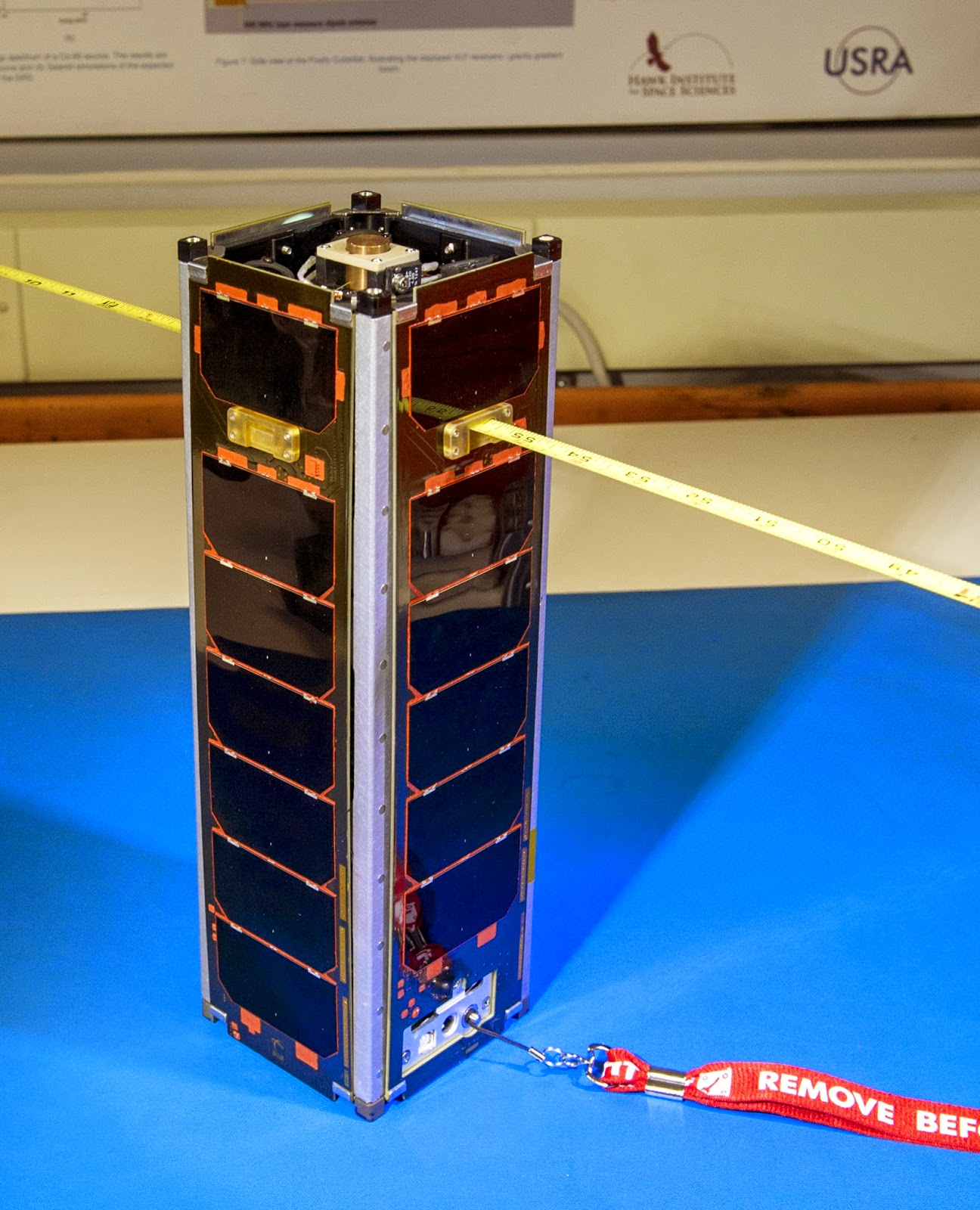
Three cans of soda would fill the Firefly CubeSat to the brim but don't let its size fool youm NASA has big plans for these tiny satellites.

Image Credit: NASA/Bill Hrybyk

To investigate climate change, scientists and engineers at NASA’s Goddard Space Flight Center are developing the IceCube satellite, which will be no larger than a loaf of bread.

In 2016, this satellite will mature technology that scientists will use to analyze cloud ice in the atmosphere.

“We’re using IceCube to test a radiometer that we want to fly on a big space mission,” said Jeffrey Piepmeier, associate head of Goddard’s Microwave Instruments and Technology Branch.

“Climate scientists have never used this frequency to measure cloud ice from space before.”

The project highlights a growing trend toward testing instruments and running scientific experiments aboard CubeSats.

“Every pound that you send into space costs a phenomenal amount of money,” said Todd Bonalsky, an electrical engineer at Goddard.

“Hence in the investment in CubeSats, which are tiny, complete satellites that are cheaper and easier to build than their larger counterparts.”

At about a foot in length and four inches wide, these three-unit (3U) CubeSats are similar in design to IceCube.

Image Credit: NASA

Bonalsky’s Dellingr CubeSat is slated to launch in March 2015.

Employing a magnetometer system Bonalsky miniaturised for CubeSat use, Dellingr will measure magnetic fluctuations to help scientists better understand how space weather affects Earth.

Dellingr will be the first CubeSat to fly this type of science grade magnetometer system.

Scientists however face a number of challenges when working on CubeSats. Due to their size, CubeSats cannot power many of NASA’s formidable scientific instruments, and there are limits to what can be miniaturised.

The Hubble Space Telescope for example uses a mirror nearly eight feet wide to capture light and translate it into images that a smaller mirror could not produce.

Doug Rowland, a solar scientist at NASA, faced this dilemma when gathering data from his Firefly CubeSat.

He built it to investigate the correlation between lightning and gamma radiation, but his CubeSat can only download 20 milliseconds slots of data to Earth each day.

“The Firefly just doesn’t have enough electrical power to simultaneously run its GPS receiver, its communications antenna and our experiment at the same time,” Rowland said.

“On a big spacecraft, you’d have a thousand times as much data, at least, and you’d have other ways to transmit the data down to Earth.”

Todd Bonalsky holds the solar panel that will power the Dellingr satellite.

Image Credit: NASA/Kristen Basham

Despite such drawbacks, the size and cost of CubeSats open up new strategies for scientific investigations.

In conventional missions, every component must function exactly as designed, but, depending on the mission, a single CubeSat is expendable.

“Instead of pouring money into one big satellite, we try to make a swarm,” said Robert Clayton, a Goddard intern from Dartmouth College.

“It’s okay if we lose two or three from our swarm of 20. We instead focus on making each CubeSat as cheap and reproducible as possible.”

CubeSats can thus slash a scientific mission’s budget and allow scientists to measure multiple data points that would be unobtainable otherwise. Using multiple spacecraft for a single mission is by no means a novel concept.

The Solar Terrestrial Relations Observatory for example is a pair of nearly identical observatories that trace solar matter as it flows from the sun.

However losing one of these expensive observatories would spell catastrophe for the mission, as opposed to losing one CubeSat in a swarm.

Sunday, October 14, 2012

Chronic stress during pregnancy prevents brain benefits of motherhood

A new study in animals shows that chronic stress during pregnancy prevents brain benefits of motherhood, a finding that researchers suggest could increase understanding of postpartum depression.

Rat mothers showed an increase in brain cell connections in regions associated with learning, memory and mood.

In contrast, the brains of mother rats that were stressed twice a day throughout pregnancy did not show this increase.

The researchers were specifically interested in dendritic spines – hair-like growths on brain cells that are used to exchange information with other neurons.

Previous animal studies conducted by lead author Benedetta Leuner of Ohio State University showed that an increase of dendritic spines in new mothers’ brains was associated with improved cognitive function on a task that requires behavioral flexibility – in essence, enabling more effective multitasking.

The dendritic spines increased by about 20 percent in these brain regions in new mothers, according to her findings.

The stress in this new study negated those brain benefits of motherhood, causing the stressed rats’ brains to match brain characteristics of animals that had no reproductive or maternal experience.

The stressed rats also had less physical interaction with their babies than did unstressed rats, a behaviour observed in human mothers who experience postpartum depression.

“Animal mothers in our research that are unstressed show an increase in the number of connections between neurons. Stressed mothers don’t,” said Leuner, assistant professor of psychology and neuroscience at Ohio State.

“We think that makes the stressed mothers more vulnerable. They don’t have the capacity for brain plasticity that the unstressed mothers do, and somehow that’s contributing to their susceptibility to depression.”


Previous research has suggested that there are a number of risk factors for postpartum depression, including hormone fluctuations, prior history of mental illness and environmental factors such as smoking or low socioeconomic status.

One of the strongest predictors, however, is chronic stress during pregnancy, so Leuner sought to create an animal model that could help explain brain changes linked to postpartum depression.

“It’s devastating not only for the mother, because it affects her well-being, but previous research also has shown that children of depressed mothers have impaired cognitive and social development, may have impaired physical development, and are more likely as adults to have depression or anxiety,” she said.

“A better understanding of postpartum depression is important to help the mother but also to prevent some of the damaging effects that this disorder can have on the child.”

The researchers exposed pregnant rats to stress twice a day by limiting their mobility on some days and on other days placing them in water. For three weeks after the rats gave birth, Leuner and colleagues monitored the rats.

The animals showed classic signs of the effects of stress, including lower than normal weight gain and enlarged adrenal glands, a sign of high stress-hormone production. The mothers stressed during pregnancy also gave birth to smaller pups.

“And they were not very good mothers,” Leuner said. After separation from pups for 30 minutes, unstressed mothers would gather up their babies, put them in the nest and nurse them. Stressed mother rats left the pups scattered around, wandered around the cage and fed the babies less frequently.

The stressed mother rats also exhibited more floating than unstressed rats in a water test; animals that float rather than swim are showing depressive-like symptoms.

“These findings in rats mimic some of the symptoms that are seen in women with postpartum depression,” Leuner said.

An examination of the animals’ brains showed that the rats exposed to chronic stress did not grow the additional dendritic spines in the hippocampus and prefrontal cortex that the unstressed mother rats did.

The stressed rats’ brains more closely resembled the brains of control rats that had never been mothers.

“We don’t yet know what the exact trigger is for the increase in spines in motherhood, but we know that the increase goes away with stress,” Leuner said.

She is continuing the work by investigating whether the beneficial effects of motherhood on cognitive functions are also blocked in mothers who are exposed to pregnancy stress as well as whether hormonal factors play a role.

Monday, December 7, 2009

Physics finally benefits from LHC - Large UK contributions

Protons were collided in the LHC, for the first time, on Monday 23rd November at relatively low energies. High energy collisions are expected early next year when physicists hope to discover new secrets about the nature of matter and the early universe.

Professor Keith Mason, CEO of the Science and Technology Facilities Council (STFC), said, "This is great news. The LHC is now fully on track and gearing up to some unique and possibly world changing science. We're very proud of the huge contribution of our skilled scientists here in the UK."

The UK is one of the biggest contributors to the LHC project. Through the Science and Technology Facilities Council (STFC), which funds the UK nuclear and particle physics program, including the CERN subscription, the UK has contributed vital hardware, computing and scientific knowledge and has around 150 UK scientists currently involved in the project.