Showing posts with label cause. Show all posts

Saturday, November 1, 2014

Climate Change Caused by the Ocean Circulation and Atmosphere

The Thermohaline Circulation or ocean conveyor belt moves heat and water between the hemispheres, along the ocean bottom. It also moves carbon dioxide.

Most of the concerns about climate change have focused on the amount of greenhouse gases that have been released into the atmosphere, but in a new study published in Science, a group of Rutgers researchers have found that circulation of the ocean plays an equally important role in regulating the earth's climate.

In their study, the researchers say the major cooling of Earth and continental ice build-up in the Northern Hemisphere 2.7 million years ago coincided with a shift in the circulation of the ocean - which pulls in heat and carbon dioxide in the Atlantic and moves them through the deep ocean from north to south until it's released in the Pacific.

The ocean conveyor system, Rutgers scientists believe, changed at the same time as a major expansion in the volume of the glaciers in the northern hemisphere as well as a substantial fall in sea levels.

It was the Antarctic ice, they argue, that cut off heat exchange at the ocean's surface and forced it into deep water. They believe this caused global climate change at that time, not carbon dioxide in the atmosphere.

"We argue that it was the establishment of the modern deep ocean circulation - the ocean conveyor - about 2.7 million years ago, and not a major change in carbon dioxide concentration in the atmosphere that triggered an expansion of the ice sheets in the northern hemisphere," says Stella Woodard, lead author and a post-doctoral researcher in the Department of Marine and Coastal Sciences.

Their findings, based on ocean sediment core samples between 2.5 million to 3.3 million years old, provide scientists with a deeper understanding of the mechanisms of climate change today.

The study shows that changes in heat distribution between the ocean basins is important for understanding future climate change.

However, scientists can't predict precisely what effect the carbon dioxide currently being pulled into the ocean from the atmosphere will have on climate.

Still, they argue that since more carbon dioxide has been released in the past 200 years than any recent period in geological history, interactions between carbon dioxide, temperature changes and precipitation, and ocean circulation will result in profound changes.

Scientists believe that the different pattern of deep ocean circulation was responsible for the elevated temperatures 3 million years ago when the carbon dioxide level in the atmosphere was arguably what it is now and the temperature was 4 degree Fahrenheit higher.

They say the formation of the ocean conveyor cooled the earth and created the climate we live in now.

"Our study suggests that changes in the storage of heat in the deep ocean could be as important to climate change as other hypotheses, tectonic activity or a drop in the carbon dioxide level, and likely led to one of the major climate transitions of the past 30 million years," says Yair Rosenthal, co-author and professor of marine and coastal sciences at Rutgers

Monday, June 9, 2014

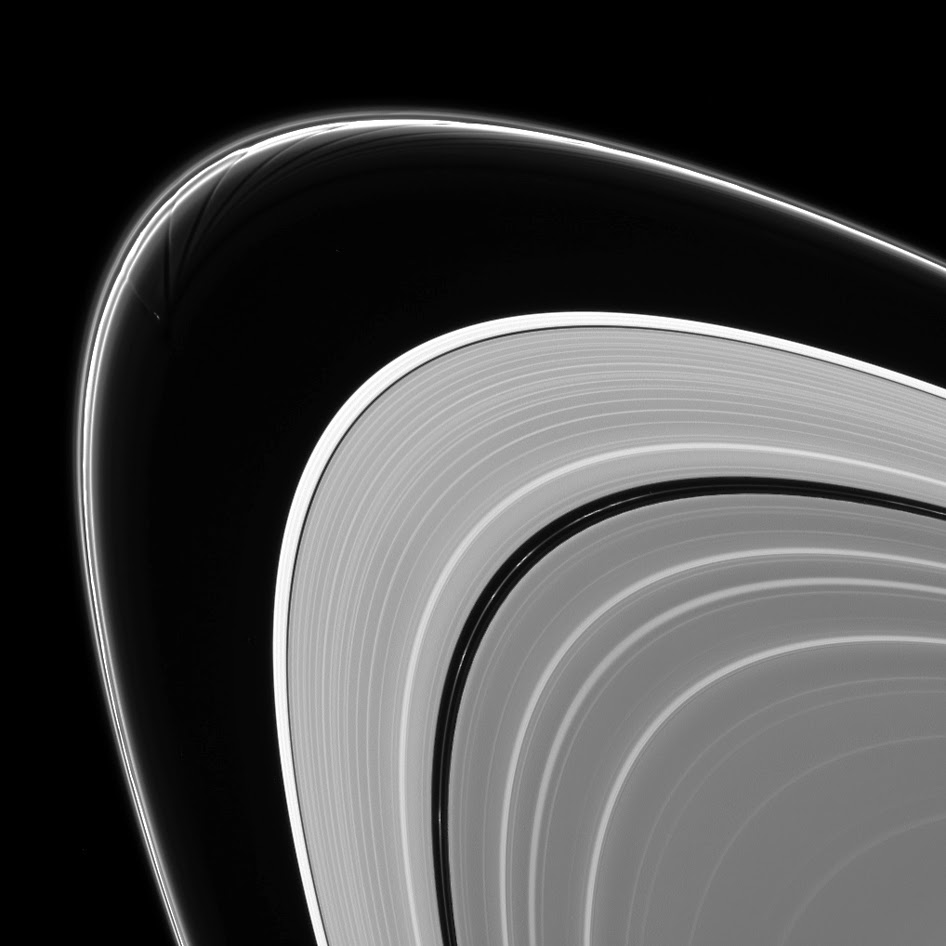
Saturn's Moon Prometheus causes turbulence in it's F ring - video

Prometheus is caught in the act of creating gores and streamers in the F ring. 

Scientists believe that Prometheus and its partner-moon Pandora are responsible for much of the structure in the F ring.

Image Credit: NASA /JPL-Caltech /Space Science Institute (SSI)

The orbit of Prometheus (53 miles, or 86 kilometers across) regularly brings it into the F ring.

When this happens, it creates gores, or channels, in the ring where it entered. 

Prometheus then draws ring material with it as it exits the ring, leaving streamers in its wake.

This process creates the pattern of structures seen in this image.

This process is described in detail, along with a movie of Prometheus creating one of the streamer/channel features, in the image PIA08397.


This view looks toward the sunlit side of the rings from about 8.6 degrees above the ringplane. The image was taken in visible light with the Cassini spacecraft narrow-angle camera on Feb. 11, 2014.

The view was acquired at a distance of approximately 1.3 million miles (2.1 million kilometers) from Saturn and at a Sun-Saturn-spacecraft, or phase, angle of 147 degrees. Image scale is 8 miles (13 kilometers) per pixel.

The Cassini-Huygens mission is a cooperative project of NASA, the European Space Agency and the Italian Space Agency.

The Cassini orbiter and its two onboard cameras were designed, developed and assembled at JPL. The imaging operations center is based at the Space Science Institute in Boulder, Colo.

For more information about the Cassini-Huygens mission. You can also visit the Cassini imaging team homepage.


Thursday, April 17, 2014

Smallest speed jump of pulsar caused by billions of superfluid vortices

Artist’s impression of a pulsar. Pulsars are rotating neutron stars -- remnants of massive stars that end their lives in supernova explosions. They act like cosmic lighthouses whose beams sweep through the universe. 

Credit: NASA

A team of astronomers, including Danai Antonopoulou and Anna Watts from the University of Amsterdam, has discovered that sudden speed jumps in the rotational velocity of pulsars have a minimum size, and that they are caused not by the unpinning and displacement of just one sub-surface superfluid vortex, but by billions.

This result is important to our understanding of the behaviour of matter under extreme conditions, and has been published this week in the journal Monthly Notices of the Royal Astronomical Society.

Pulsars are rotating neutron stars - remnants of massive stars that end their lives in supernova explosions. They act like cosmic lighthouses whose beams sweep through the Universe.

Their rotational velocity decreases in time, but can suddenly increase in rare events called glitches.

These glitches are caused by the unpinning and displacement of vortices that connect the crust with the mixture of particles containing superfluid neutrons beneath the crust.

The team of astronomers discovered that the glitches of the Crab Pulsar always involve a decrease in the rotational period of at least 0.055 nanoseconds.

The Crab Pulsar was one of the first pulsars to be discovered and has been observed almost daily with the 42-ft Telescope at the Jodrell Bank Observatory over the last 29 years.

The huge amount of data makes this object the best choice to study glitches.

The smallest glitch is likely to be caused by the unpinning and movement of billions of vortices. "Surprisingly, no one tried to determine a lower limit to glitch size before. Many assumed that the smallest glitch would be caused by a single vortex unpinning.

The smallest glitch is clearly much larger than we expected", says Danai Antonopoulou from the University of Amsterdam (UvA).

"Astronomers would of course like to know whether the smallest glitches of other pulsars are also caused by billions of vortices. The next step is to sift through the data of other pulsars and to continue observing", says first author Cristobal Espinoza (IA-PUC, Chile).

Antonopoulou's supervisor Anna Watts (UvA) adds: "By comparing the observations with theoretical predictions we learn about the behavior of matter in these exotic objects. The precise cause of glitches is still a mystery to us, and this result offers a new challenge to theorists."

More information: "Neutron star glitches have a substantial minimum size," C. M. Espinoza, D. Antonopoulou, B. W. Stappers, A. Watts, A. G. Lyne, Monthly Notices of the Royal Astronomical Society, MNRAS (2014) 440 (3): 2755 dx.doi.org/10.1093/mnras/stu395, preprint: arxiv.org/abs/1402.7219

Thursday, March 20, 2014

NASA STEREO: UNH detector illuminate cause of sun's 'perfect storm'

This image combines data from two coronagraphs and an extreme ultra-violet imager (green) on STEREO A. 

The CME is the bright streaks emanating from the sun. 

A coronagraph is a telescope that uses a disk to block the sun's bright surface revealing the solar corona. 

Credit: NASA.

An international team of scientists, including three from the University of New Hampshire's (UNH) Space Science Center, uncovers the origin and cause of an extreme space weather event that occurred on July 22, 2012 at the sun and generated the fastest solar wind speed ever recorded directly by a solar wind instrument.

The formation of the rare, powerful storm showed striking, novel features that were detected by a UNH-built instrument on board NASA's twin-satellite Solar TErrestrial RElations Observatory (STEREO) mission.

An instrument led by the University of California, Berkeley also made key measurements.

The 2012 storm was so powerful that had it been aimed at Earth instead of at the STEREO A spacecraft, which was located 120 degrees off to the side of Earth, the consequences would have been dramatic: widespread aurora, satellite malfunctions, and potential for failures with ground-based electricity grids.

To date, it has been unclear how extreme space weather storms form and evolve.

Developing a better understanding of their causes is vital to protect modern society and its technological infrastructures, and is one of the goals of the STEREO mission.

"These results provide a new view crucial to solar physics and space weather as to how an extreme space weather event can arise from a combination of multiple solar eruptions," says research assistant professor Noe Lugaz of the UNH Institute for the Study of Earth, Oceans, and Space (EOS) and a coauthor on the Nature Communications paper.

Lead author is Ying D. Liu of the State Key Laboratory of Space Weather, National Space Science Center and Chinese Academy of Sciences.

The authors suggest it was the successive, one-two punch of solar eruptions known as coronal mass ejections (CMEs) that was the key to the event, which blasted away from the sun at 3,000 kilometers per second-a speed that would circle the Earth five times in one minute.

Detecting the successive eruptions would not have been possible prior to STEREO.

"In a sense, this was the 'perfect storm'," Lugaz says. "The first, fast eruption greased the skids for the quick propagation of the subsequent, extremely fast eruptions through interplanetary space."

More Information: Nature Communications Journal - 'Observations of an extreme storm in interplanetary space caused by successive coronal mass ejections' Ying D. Liu, Noé Lugaz, et al. doi:10.1038/ncomms4481

Thursday, October 24, 2013

Human Spaceflight: Just two weeks in orbit causes changes in Astronauts' eyes

Animal Enclosure Modules similar to the one shown here, being inspected by Mission Specialist Tracy Caldwell, Ph.D., and Pilot Charles Hobaugh aboard Space Shuttle Endeavor (STS-118), are used to study animals in low gravity conditions. 

Scientists are reporting mice traveling aboard STS-133 showed evidence of ocular nerve damage and changes in eye gene expression. 

Credit: NASA

Just 13 days in space may be enough to cause profound changes in eye structure and gene expression, report researchers from Houston Methodist, NASA Johnson Space Center, and two other institutions in the October 2013 issue of Gravitational and Space Research.

The study, which looked at how low gravity and radiation and oxidative damage impacts mice, is the first to examine eye-related gene expression and cell behavior after spaceflight.

Patricia Chévez-Barrios
"We found many changes in the expression of genes that help cells cope with oxidative stress in the retina, possibly caused by radiation exposure," said Houston Methodist pathologist Patricia Chévez-Barrios, M.D., the study's principal investigator.

"These changes were partially reversible upon return to Earth. We also saw optic nerve changes consistent with mechanical injury, but these changes did not resolve."

"We also saw changes in the expression of DNA damage repair genes and in apoptotic pathways, which help the body destroy cells that are irreparably damaged."

Since 2001, studies have shown astronauts are at increased risk of developing eye problems, like premature age-related macular degeneration. Experts suspect the cause is low gravity, heightened exposure to solar radiation, or a combination of the two.

In Nov. 2011, a NASA-sponsored Ophthalmology study of seven astronauts showed that all seven had experienced eye problems after spending at least six months in space.

Doctors saw a flattening of the back of the eyeball, folding of the choroid (vascular tissue behind the retina), excess fluid around and presumed swelling of the optic nerve, or some combination of these.

High-energy radiation from the Sun can cause nasty, extremely damaging chemical reactions in cells, collectively called oxidative stress.

Earth's atmosphere reflects or absorbs much of this radiation and is, ironically, a much better shield than the thick metal hulls of space shuttles and the International Space Station.

Damage to eyes isn't merely a long-term health issue for some astronauts back on Earth—it could interfere with future missions.

Any loss of focus or vision will make it difficult for humans to complete long missions, such as round-trip travel to Mars (12 to 16 months) or to the moons of Jupiter (about two years).

If both radiation exposure and gravity loss are to blame, one solution to save astronauts' eyes might be a spacecraft with a more protective hull and inside, a spinning hamster wheel that simulates gravity similar to those envisioned by futurist author Arthur C. Clarke and realized in Stanley Kubrick's film, 2001: A Space Odyssey.

Thursday, June 13, 2013

Marks On Mars' Dunes - Caused By Dry Ice? - Video


NASA turned an Earth dune into a dry ice 'slip and slide' to see how downhill flow features are forming on Mars. 

In the case of dry ice, the frozen carbon dioxide interacting with the sand, created a CO2 gas pillow for the ice to ride on

Credit: NASA / JPL-Caltech

Monday, May 6, 2013

Russian researchers find more evidence that lightning is caused by cosmic rays

Russian physicists Alex Gurevich and Anatoly Karashtin claim, in a paper published in the journal Physical Review Letters, they have found more evidence to support their idea that lightning is caused by cosmic rays.

The notion was first proposed by Gurevich back in 1992, and has been a source of debate ever since.

No one really knows what causes lightning to form and strike—the prevailing view is that it comes about as a result of collisions between ice crystals in clouds and hail stones. But because clouds and the lightning they produce are unpredictable and hard to pin down, no one has been able to prove this theory.

Another theory, proposed by Gurevich twenty years ago, says that lightning is formed from the collisions between cosmic rays and water droplets present in thunderclouds. Now he and a colleague claim to have found evidence to support this idea.

Gurevich suggests that cosmic rays entering thunder clouds cause the air in them to be ionized, resulting in a lot of free electrons floating around. The electronic field already present in the cloud, he continues, leads to the free electrons being boosted to higher energies.

When the electrons present in the air collide with water atoms, more electrons are released, setting off what he describes as an avalanche of high-energy particles that eventually give way to a "runaway breakdown"—a discharge that is witnessed as a lightning strike.

As with other theories regarding the origins of lightning, Gurevich's ideas haven't been proved. But he hasn't been sitting still.

In this new effort, he along with Karashtin have been measuring and analyzing radio waves in storm clouds as lightning occurs. The idea is that if such strikes are due to interactions with cosmic rays, there should be measurable amounts of radio waves given off.

Gurevich and Karashtin set up equipment to monitor storm clouds over Russia and Kazakhstan—recording radio waves emitted during 3,800 lightning strikes. In analyzing the data, they found that hundreds, and perhaps even thousands of short radio wave pulses occurred just as a bolt of lightning was about to form.

Perhaps more importantly, they matched the models Gurevich had built years before. There was on hitch however, the amount of energy delivered by the cosmic rays in the model don't happen often enough in the real world to cause lightning strikes in most every thunderstorm.

Gurevich and Karashtin say the discrepancy can be explained by the addition of energy into the system by free electrons passing near hydrometeors (bits of hail or water droplets).

When that happens, very small discharges result, adding to the total charge. Taken together they say, enough energy is added to cause the cascade that leads to lightning formation.

More information: Runaway Breakdown and Hydrometeors in Lightning Initiation, Phys. Rev. Lett. 110, 185005 (2013). prl.aps.org/abstract/PRL/v110/i18/e185005

Friday, May 3, 2013

Russian research: Rocks found from object that caused Tunguska explosion

Andrei Zlobin of the Russian Academy of Sciences' Vernadsky State Geological Museum, claims in a paper he's uploaded to the preprint server arXiv, that he's found rocks he believe to be from the object that caused the Tunguska explosion over Siberia in 1908. 

If further analysis of the rocks confirms them to be from space, it will mark the discovery of the first physical evidence of the source of the famous blast.

The Tunguska Event, as it's known, was a very powerful explosion that occurred in the air over a part of Siberia near the Podkamennaya Tunguska River.

The force of it flattened forests for 2,150 square kilometers—it's considered to be the largest impact event in modern history.

Despite the immensity of the explosion, no debris from the object that caused it has ever been found—likely due to the remoteness of the impact zone and the political climate in Russia at that time.

Even more mysterious is the lack of an impact crater. Because of the dearth of evidence, there has been a lot of speculation about what caused the explosion, with the two most likely candidates being a meteoroid or a comet.

In his paper, Zlobin says he dug some holes in the permafrost in an area believed to be near the center of the impact zone, back in 1988.

He reports that he found nothing that could be tied to the explosion.

Before returning home, however, he collected some rock samples from the bottom of a shoal on the Khushmo River and brought them back with him to the museum.

Zlobin says he didn't sort or examine the rock samples until twenty years later.

He doesn't say so, but perhaps it was the hundred year anniversary of the Tunguska Event that spurred him into action—in any case, he found three samples that he believes came from outer-space.

He thinks so because they exhibit signs of both melting and ablations known as regmaglypts. Scientists believe the explosion was not hot enough to cause rocks on the ground to melt, thus, the melting of rocks in the area must have come as a result of the intense heat of passage through the Earth's atmosphere.

Zlobin says he believes the impact was caused by a comet, likely of a size close to Halley's Comet. Further testing of the rocks will need to be done to confirm they came from outer-space, of course.

If they come back positive, scientists will then have to debate amongst themselves whether they were part of the object that caused the Tunguska Event, or were a separate event altogether.

More information: Discovery of probably Tunguska meteorites at the bottom of Khushmo river's shoal, arXiv:1304.8070 [physics.gen-ph] arxiv.org/abs/1304.8070

Thursday, September 24, 2009

Obesity is the leading cause of Cancer in Western Women

Being obese is nothing to sing about. Obesity is fast becoming the leading cause of cancer in women in Western countries, European researchers said Thursday.

Being overweight or obese accounts for up to 8% of cancers in Europe. Experts said that figure is poised to increase substantially, as the obesity epidemic continues.


This is partly caused by a decrease in the other major causes of cancer, such as smoking and hormone replacement therapy for menopausal women. These causes have dropped or been reduced, dramatically.

"Obesity is catching up at a rate that makes it possible it could become the biggest attributable cause of cancer in women within the next decade," said Andrew Renehan, a cancer expert at the University of Manchester. Renehan presented his findings to a joint meeting of the European Cancer Organisation and the European Society for Medical Oncology in Berlin on Thursday.

Renehan and colleagues designed a model to estimate the number of cancers that could be blamed on being fat in 30 European countries. In 2002, they calculated that 70,000 cases of cancer out of about 2 million cancer cases were attributable to being overweight or obese. By 2008, the number had jumped to at least 124,000.

Colorectal cancer, breast cancer in menopausal women and endometrial cancer accounted for 65% of all cancers linked to being fat. Renehan said that in the U.S., some studies found obesity was responsible for up to 20% of cancers.

European health experts said the results will shape future cancer policies across Europe.

"Being overweight or obese is one of the biggest single causes of cancer after smoking," said Lucy Boyd, an epidemiologist at Cancer Research United Kingdom who was not linked to the research.


Scientists aren't sure why being fat boosts your cancer risk, but suspect it is connected to hormones. As people become fatter, they produce more hormones like estrogen that help tumors grow. People with big bellies also have more acid in their stomachs, which can lead to stomach, intestinal or esophageal cancer.