Showing posts with label turbulence. Show all posts

Monday, June 9, 2014

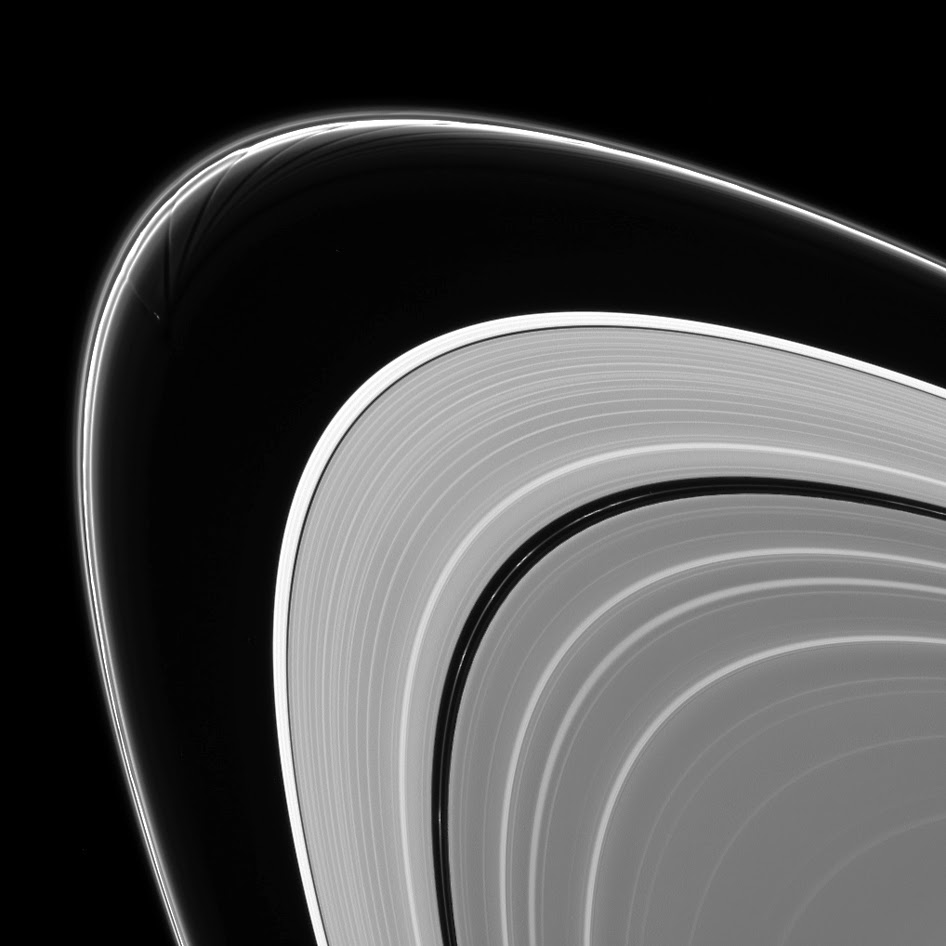
Saturn's Moon Prometheus causes turbulence in it's F ring - video

Prometheus is caught in the act of creating gores and streamers in the F ring. 

Scientists believe that Prometheus and its partner-moon Pandora are responsible for much of the structure in the F ring.

Image Credit: NASA /JPL-Caltech /Space Science Institute (SSI)

The orbit of Prometheus (53 miles, or 86 kilometers across) regularly brings it into the F ring.

When this happens, it creates gores, or channels, in the ring where it entered. 

Prometheus then draws ring material with it as it exits the ring, leaving streamers in its wake.

This process creates the pattern of structures seen in this image.

This process is described in detail, along with a movie of Prometheus creating one of the streamer/channel features, in the image PIA08397.


This view looks toward the sunlit side of the rings from about 8.6 degrees above the ringplane. The image was taken in visible light with the Cassini spacecraft narrow-angle camera on Feb. 11, 2014.

The view was acquired at a distance of approximately 1.3 million miles (2.1 million kilometers) from Saturn and at a Sun-Saturn-spacecraft, or phase, angle of 147 degrees. Image scale is 8 miles (13 kilometers) per pixel.

The Cassini-Huygens mission is a cooperative project of NASA, the European Space Agency and the Italian Space Agency.

The Cassini orbiter and its two onboard cameras were designed, developed and assembled at JPL. The imaging operations center is based at the Space Science Institute in Boulder, Colo.

For more information about the Cassini-Huygens mission. You can also visit the Cassini imaging team homepage.


Friday, June 6, 2014

Fluid Turbulence in Gravitational Fields around Black Holes

This artist's concept depicts a supermassive black hole at the center of a galaxy. 

The blue colour here represents radiation pouring out from material very close to the black hole. 

The grayish structure surrounding the black hole, called a torus, is made up of gas and dust. 

Credit: NASA/JPL-Caltech

Fasten your seatbelts, gravity is about to get bumpy. Of course, if you're flying in the vicinity of a black hole, a bit of extra bumpiness is the least of your worries. But it's still surprising.

The accepted wisdom among gravitational researchers has been that spacetime cannot become turbulent. New research from Perimeter, though, shows that the accepted wisdom might be wrong.

The researchers followed this line of thought: Gravity, it's thought, can behave as a fluid. One of the characteristic behaviours of fluids is turbulence, that is, under certain conditions, they don't move smoothly, but eddy and swirl. Can gravity do that too?

Perimeter Faculty member Luis Lehner explains why it might make sense to treat gravity as a fluid. "There's a conjecture in physics, the holographic conjecture, which says gravity can be described as a field theory," he says.

"And we also know that at high energies, field theories can be described with the mathematical tools we use to describe fluids."

"So it's a two-step dance: gravity equals field theory, and field theory equals fluids, so gravity equals fields equals fluids. That's called the gravity/fluids duality."

The gravity/fluids duality is not new work, it's been developing over the past six years but hidden at the heart of it is a tension. If gravity can be treated as a fluid, then what about turbulence?

"For many years, the folklore among physicists was that gravity could not be turbulent," notes Lehner.

The belief was that gravity is described by a set of equations that are sufficiently different from fluid dynamics equations, such that there would not be turbulence under any circumstances.

Lehner highlights the emerging paradox: "Either there was a problem with the duality and gravity really can't be fully captured by a fluid description, or there was a new phenomenon in gravity and turbulent gravity really can exist."

A team of researchers; Lehner, Huan Yang (Perimeter and the Institute for Quantum Computing), and Aaron Zimmerman (Canadian Institute for Theoretical Astrophysics), set out to find out which.

They had hints about what directions to go. Previous simulations at Perimeter, and independent work out of MIT, had hinted that there could be turbulence around the non-realistic case of black holes confined in anti-de Sitter space.

"There might be turbulence if you confine gravity in a box, essentially," says Lehner. "The deeper question is whether this can happen in a realistic situation."

More information: Read the original paper on arXiv: arxiv.org/abs/1402.4859

Tuesday, March 18, 2014

New improved view of supernova explosion and death throes

Three-dimensional turbulent mixing in a stratified burning oxygen shell which is four pressure scale heights deep. 

The yellow ashes of sulphur are being dredged up from the underlying orange core. 

The multi-scale structure of the turbulence is prominent. 

Entrained material is not particularly well mixed, but has features which trace the large scale advective flows in the convection zone. 

Also visible are smaller scale features, which are generated as the larger features become unstable, breaking apart to become part of the turbulent cascade. 

The white lines indicate the boundary of the computational domain. 

Credit: Arnett, Meakin and Viallet/AIP Advances

A powerful, new three-dimensional model provides fresh insight into the turbulent death throes of supernovas, whose final explosions outshine entire galaxies and populate the universe with elements that make life on Earth possible.

W. David Arnett
The model is the first to represent the start of a supernova collapse in three dimensions, said its developer, W. David Arnett, Regents Professor of Astrophysics at the University of Arizona, who developed the model with Casey Meakin and Nathan Smith at Arizona and Maxime Viallet of the Max-Planck Institut fur Astrophysik.

Described in the journal AIP Advances, it shows how the turbulent mixing of elements inside stars causes them to expand, contract, and spit out matter before they finally detonate.

Arnett, a pioneer in building models of physical processes inside stars, traces his fascination with turbulence to 1987A, the first supernova of 1987.

Located in a nearby galaxy, it was bright enough to see with the naked eye.

The star puzzled astronomers, Arnett recalled, because the material ejected by its explosion appeared to mix with material previously ejected from the star.

Existing models could not explain that. "Instead of going gently into that dark night, it is fighting. It is sputtering and spitting off material. This can take a year or two. There are small precursor events, several peaks, and then the big explosion.

"Perhaps what we need is a more sophisticated notion of what an explosion is, to explain what we are seeing," Arnett concludes.

More information: The article, "Chaos and turbulent nucleosynthesis prior to a supernova explosion" by David Arnett, Casey Meakin and Maxime Viallet appears in the journal AIP Advances (DOI: 10.1063/1.4867384). 

The article will be published online on March 18, 2014. dx.doi.org/10.1063/1.4867384

Friday, December 20, 2013

Supercomputers capture turbulence in the solar wind

Solar storms unleash bursts of radiation that can reach crew and passengers on commercial flights at certain altitudes and latitudes. 

Eventually the system could be used to log radiation exposure over longer periods of time for pilots and flight crews. 

Credit: NASA

As inhabitants of Earth, our lives are dominated by weather.

Not just in the form of rain and snow from atmospheric clouds, but also a sea of charged particles and magnetic fields generated by a star sitting 93 million miles away—our Sun.

This phenomenon is called solar wind.

When strong magnetic storms occur on the Sun, tons of highly energetic particles are released into the solar wind.

If these particles were free to hit the Earth, the radiation would cause life-threatening damage to our DNA, debilitate power grids, disrupt communications networks and damage electronic devices.

Fortunately for us, the Earth's magnetic dipole field and magnetosphere act as an invisible shield barring these particles from plummeting through the atmosphere.

However, this magnetic shield is not perfect and during particularly intense solar storms the magnetosphere can "crack," allowing charged particles to seep in and wreak havoc on the Earth's technological infrastructure—an event calledspace weather.

Homa Karimabadi
Scientists currently do not have the ability to accurately predict the severity of a space weather event or where it will have the most impact but a team of researchers led by University of California, San Diego's (UCSD's) Homa Karimabadi is hoping to change that.

"One of the challenges in developing accurate predictive forecasts is that the solar wind is turbulent, and the details of turbulence are not well understood," says Karimabadi, who heads the space plasma simulation group at UCSD.

Because turbulence in the solar wind occurs on widely different scales of physics—from planet-size to the sub-atomic—it is especially difficult to study but using supercomputers at the National Institute of Computational Sciences (NICS), Karimabadi and his colleagues managed to simulate all the scales of solar wind turbulence at once—for the first time ever.

Burlen Loring
To make sense of this massive dataset, they tapped Lawrence Berkeley National Laboratory (Berkeley Lab) Visualization Specialist Burlen Loring, who developed custom analysis tools using supercomputers at the National Energy Research Scientific Computing Center (NERSC).

Loring's work allows researchers to study turbulence in unprecedented detail, and the results may hold clues about some of the processes that lead to destructive space weather events. This work was published in Physics of Plasmas.

More information: Read the paper: hpcvis.com/PhysPlasmas_20_012303.pdf