Showing posts with label LADEE. Show all posts

Monday, November 3, 2014

NASA’s LRO Spacecraft Captures Images of LADEE’s Impact Crater

This image shows the area of the LADEE impact after spacecraft's planned impact into the eastern rim of Sundman V crater. 

Image Credit: NASA/Goddard/Arizona State University

NASA’S Lunar Reconnaissance Orbiter (LRO) spacecraft has spied a new crater on the lunar surface; one made from the impact of NASA’s Lunar Atmosphere and Dust Environment Explorer (LADEE) mission.

“The Lunar Reconnaissance Orbiter Camera (LROC) team recently developed a new computer tool to search Narrow Angle Camera (NAC) before and after image pairs for new craters, the LADEE impact event provided a fun test, said Mark Robinson, LROC principal investigator from Arizona State University in Tempe.

“As it turns there were several small surface changes found in the predicted area of the impact, the biggest and most distinctive was within 968 feet (295 meters) of the spot estimated by the LADEE operations team. What fun!”

The LADEE mission ended on April 18, 2014, with the spacecraft’s planned impact into the eastern rim of Sundman V crater on the far side of the moon.

LRO has taken an image of the LADEE impact site on the eastern rim of Sundman V crater.

The image was created by ratioing two images, one taken before the impact and another afterwards. 

The bright area highlights what has changed between the time of the two images, specifically the impact point and the ejecta.

Image Credit: NASA /Goddard /Arizona State University

LADEE's engines fired April 11, 2014, to perform a final orbital maintenance maneuver and adjust to guarantee it would impact on the farside of the moon and away from the Apollo landing sites.

Over a seven-day period, LADEE's orbit decreased and the spacecraft orbited very low to the surface and close to the walls of lunar craters and mountain ridges to give the team a chance to collect valuable science data.

Finally, LADEE impacted the eastern rim of Sundman V crater on April 18. The impact site is about half a mile (780 meters) from the crater rim with an altitude of about 8,497 feet (2,590 meters) and was only about two tenths of a mile (300 meters) north of the location mission controllers predicted based on tracking data.

The impact crater is small, less than ten feet (three meters) in diameter, barely resolvable by the LROC NAC.

The crater is small because the spacecraft, compared to most celestial impacts, was not traveling very fast, approximately 3,800 miles per hour (1,699 meters per second) and had a low mass and a low density.

The size of the impact crater made it hard to identify among the myriad of small fresh craters on the lunar surface. Images acquired of the impact region before the impact, were compared with images obtained after the impact to identify the crater.

Artist concept of the Lunar Reconnaissance Orbiter with Apollo mission imagery of the moon in the background.

Image Credit: NASA's Goddard Space Flight Center

Since the NAC images are so large (250 mega-pixels) and the new crater is so small, the LROC team co-registered the before and after images (called a temporal pair) and then divided the before image by the after image. By doing this, changes to the surface become evident.

The ejecta from the impact forms a triangular pattern primarily downrange to the west, extending about 656-984 feet (200-300 meters) from the impact site.

There is also a small triangular area of ejecta up range but it extends only about 66-98 feet (20-30 meters).

The ejecta pattern is oriented northwest, consistent with the direction the spacecraft was traveling when it impacted the surface.

"I'm happy that the LROC team was able to confirm the LADEE impact point," said Butler Hine, LADEE project manager at Ames Research Center in Moffett Field, California.

"It really helps the LADEE team to get closure and know exactly where the product of their hard work wound up."

Friday, February 14, 2014

NASA LADEE transmits its first images of the Moon

Series of LADEE star tracker images features the lunar terrain. Credit: NASA Ames

Earlier this month, NASA's Lunar Atmosphere and Dust Environment Explorer (LADEE) observatory successfully downlinked images of the moon and stars taken by onboard camera systems, known as star trackers.

This is the first time the LADEE team commanded the spacecraft to send these pictures back to Earth.

The main job of a star tracker is to snap images of the surrounding star field so that the spacecraft can internally calculate its orientation in space.

It completes this task many times per minute. The accuracy of each of LADEE's instruments' measurements depends on the star tracker calculating the precise orientation of the spacecraft.

Butler Hine
"Star tracker cameras are actually not very good at taking ordinary images," said Butler Hine LADEE project manager at NASA's Ames Research Center in Moffett Field, Calif.

"But they can sometimes provide exciting glimpses of the lunar terrain."

Given the critical nature of its assignment, a star tracker doesn't use ordinary cameras.

Star trackers' lenses have a wide-angle field of view to capture the night sky in a single frame.

The images shown here were acquired on Feb. 8, 2014, around 23:45 UTC, while LADEE was carrying out atmospheric measurements.

The series of five images were taken at one-minute intervals, and caught features in the northern western hemisphere of the moon.

LADEE was traveling approximately 60 miles (100 km) per minute along its orbit.

All images were taken during lunar night, but with Earthshine illuminating the surface.

The initial image captured the smooth-floored crater Krieger, about 14 miles (23 km) in diameter, on the horizon, with four mile (seven km) wide Toscanelli, in the foreground.

The second image shows Wollaston P, about two-and-a-half miles (4 km) diameter, near the horizon, and the southeastern flank of the lunar mountain Mons Herodotus.

The third image caught a minor lunar mountain range, Montes Agricola, which is northwest of the large bright crater Aristarchus (out of view), as well as the flat-floored crater Raman, about six miles (10 km) diameter.

Image four in the series captures Golgi, about four miles (6 km) in diameter, and three-mile-wide (5 km) Zinner.

The final image views craters Lichtenberg A and Schiaparelli E in the smooth mare basalt plains of Western Oceanus Procellarum, west of the Aristarchus plateau.

The star trackers will operate while LADEE continues to measure the chemical composition of the atmosphere, collect and analyze samples of lunar dust particles in the atmosphere and hope to address a long-standing question: Was lunar dust, electrically charged by sunlight, responsible for the pre-sunrise glow above the lunar horizon observed during several Apollo missions? And who knows?

The LADEE star trackers may help answer that question.

Tuesday, February 4, 2014

NASA LADEE: Moon Dust Probe Gets Longer Lunar Life

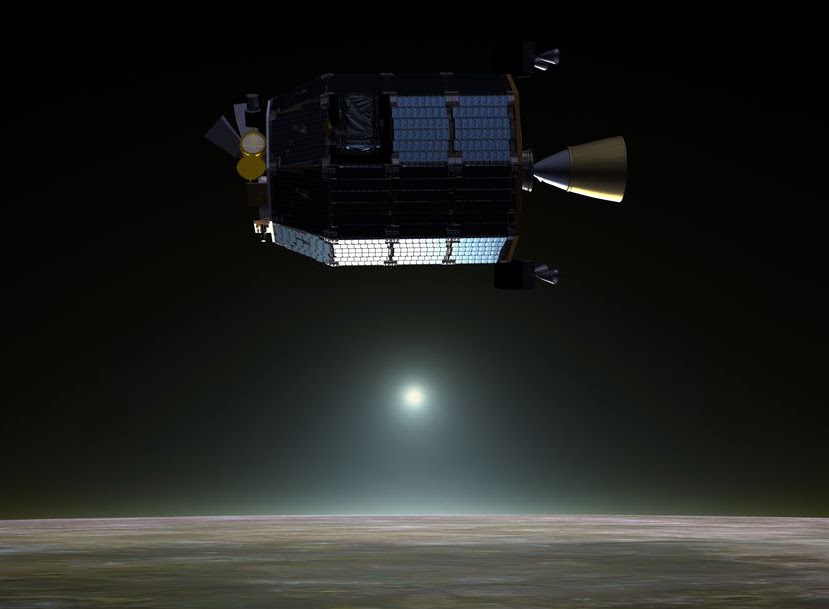
Artist’s concept of NASA's Lunar Atmosphere and Dust Environment Explorer (LADEE) spacecraft in orbit above the moon as dust scatters light during the lunar sunset.

Credit: NASA Ames / Dana Berry

NASA's newest lunar probe now has a longer lease on life, giving it more time to investigate the mysteries of moon dust as it orbits Earth's natural satellite.

Space agency official have granted the LADEE spacecraft (short for Lunar Atmosphere and Dust Environment Explorer) a 28-day mission extension.

Scientists will use the additional time to make different measurements of lunar dust in the moon's thin atmosphere from a lower orbit than LADEE has used before, NASA representatives said.

Rick Elphic
"The science team has already established a baseline of data for the tenuous lunar atmosphere, or exosphere, and dust impacts," Rick Elphic, LADEE project scientist, said in a statement.

"One cool thing about this extension is that we plan to fly LADEE at only a few kilometers above the lunar surface. This will be much lower than we’ve been before."


LADEE launched to the moon on Sept. 6, 2013 on a mission to investigate the nature of moon dust and solve a long-standing mystery dating back to before the Apollo program.

Scientists are trying to uncover what caused a glow Apollo astronauts saw on the lunar horizon before sunrise.

Researchers expect that magnetically charged dust in the moon's exosphere is to blame for the unexpected glimmering. However, LADEE is designed to collect more data on the subject.

Saturday, November 23, 2013

NASA LADEE: Collecting lunar atmosphere data

Artist’s concept of NASA's Lunar Atmosphere and Dust Environment Explorer (LADEE) spacecraft in orbit above the moon as dust scatters light during the lunar sunset. 

Credit: NASA Ames / Dana Berry

NASA's Lunar Atmosphere and Dust Environment Explorer (LADEE) is ready to begin collecting science data about the moon.

On Nov. 20, the spacecraft successfully entered its planned orbit around the moon's equator—a unique position allowing the small probe to make frequent passes from lunar day to lunar night.

This will provide a full scope of the changes and processes occurring within the moon's tenuous atmosphere.

LADEE now orbits the moon about every two hours at an altitude of eight to 37 miles (12-60 kilometers) above the moon's surface.

For about 100 days, the spacecraft will gather detailed information about the structure and composition of the thin lunar atmosphere and determine whether dust is being lofted into the lunar sky.

Sarah Noble
"A thorough understanding of the characteristics of our lunar neighbour will help researchers understand other small bodies in the solar system, such as asteroids, Mercury, and the moons of outer planets," said Sarah Noble, LADEE program scientist at NASA Headquarters in Washington.

Scientists also will be able to study the conditions in the atmosphere during lunar sunrise and sunset, where previous crewed and robotic missions detected a mysterious glow of rays and streamers reaching high into the lunar sky.

"This is what we've been waiting for – we are already seeing the shape of things to come," said Rick Elphic, LADEE project scientist at NASA's Ames Research Center in Moffett Field, Calif.

Rick Elphic
On Nov. 20, flight controllers in the LADEE Mission Operations Center at Ames confirmed LADEE performed a crucial burn of its orbit control system to lower the spacecraft into its optimal position to enable science collection.

Mission managers will continuously monitor the spacecraft's altitude and make adjustments as necessary.

"Due to the lumpiness of the moon's gravitational field, LADEE's orbit requires significant maintenance activity with maneuvers taking place as often as every three to five days, or as infrequently as once every two weeks," said Butler Hine, LADEE project manager at Ames.

Butler Hine
"LADEE will perform regular orbital maintenance maneuvers to keep the spacecraft's altitude within a safe range above the surface that maximizes the science return."

In addition to science instruments, the spacecraft carried the Lunar Laser Communications Demonstration, NASA's first high-data-rate laser communication system.

It is designed to enable satellite communication at rates similar to those of high-speed fiber optic networks on Earth.

The system was tested successfully during the commissioning phase of the mission, while LADEE was still at a higher altitude.

LADEE was launched Sept. 6 on a U.S. Air Force Minotaur V, an excess ballistic missile converted into a space launch vehicle and operated by Orbital Sciences Corp. of Dulles, Va. LADEE is the first spacecraft designed, developed, built, integrated and tested at Ames.

It also was the first probe launched beyond Earth orbit from NASA's Wallops Flight Facility on the Virginia coast.

More information: For more information about the LADEE mission, visit: www.nasa.gov/ladee

Monday, September 9, 2013

NASA LADEE Moon Probe: Engineers fix Reaction Wheel Glitch after night launch

Photographer Chris Bakley captured this stunning image of NASA's LADEE moon probe launch from the beach in Cape May Point, N.J., on Sept. 6, 2013. 

LADEE launched from Wallops Island, Va., and was visible across a wide swath of the U.S. East Coast

Credit: Chris Bakley

Engineers have fixed a technical glitch on NASA's newest robotic moon explorer, bringing the spacecraft back up to full health one day after a spectacular nighttime launch Friday that wowed spectators up and down the U.S. East Coast.

NASA's LADEE moon probe launch into space Friday night (Sept. 6) in a flawless liftoff from the agency's Wallops Flight Facility on Wallops Island, Va. An Orbital Sciences Corp. Minotaur V rocket, making its debut flight, launched the lunar probe.

But just hours after the 11:27 p.m. EDT (0327 GMT) liftoff, NASA officials reported that the spacecraft's reaction wheels — which spin to position and stabilize LADEE in space without using precious thruster fuel — unexpectedly shut down.


By Saturday afternoon, the glitch had been traced to safety limits programmed into LADEE before launch to protect the reaction wheel system, NASA officials said.

Those fault protection limits caused LADEE to switch off its reaction wheels shortly after powering them up, according to a mission status update.

Engineers have since disabled the safety limits causing the glitch and taking extra care in restoring the fault-protection protocols.

Butler Hine
"Our engineers will determine the appropriate means of managing the reaction wheel fault protection program. Answers will be developed over time and will not hold up checkout activities," NASA's LADEE project manager at AMES, Butler Hine said in a statement.

"The reaction wheel issue noted soon after launched was resolved a few hours later," added NASA Ames Research Center director Pete Worden.

"The LADEE spacecraft is healthy and communicating with mission operators." NASA's Ames center developed and built the LADEE spacecraft, and is overseeing its mission operations.

Friday, September 6, 2013

NASA LADEE Ready for Launch

In an attempt to answer prevailing questions about our moon, NASA is making final preparations to launch a probe at 11:27 p.m. EDT Friday, Sept. 6, from NASA's Wallops Flight Facility on Wallops Island, Va.

The small car-sized Lunar Atmosphere and Dust Environment Explorer (LADEE) is a robotic mission that will orbit the moon to gather detailed information about the structure and composition of the thin lunar atmosphere and determine whether dust is being lofted into the lunar sky. 

A thorough understanding of these characteristics of our nearest celestial neighbor will help researchers understand other bodies in the solar system, such as large asteroids, Mercury, and the moons of outer planets.

For more information about the LADEE mission.

Image Credit: NASA

Wednesday, September 4, 2013

NASA LADEE Spin Test

Preparations continue for NASA's Lunar Atmosphere and Dust Environment Explorer (LADEE) observatory launch on Sept. 6, 2013.

The spacecraft went through final preparations and close-outs, which included checking alignment after its cross-country shipment, checking the propulsion system for leaks, inspecting and repairing solar panels, and final electrical tests. 

After these activities were completed, more challenging portions of the launch preparations began: spin testing and fueling.

Image Credit: NASA

To make sure that the spacecraft is perfectly balanced for flight, engineers mounted it onto a spin table and rotate it at high speeds, approximately one revolution per second.

The team measured any offsets during the spinning, and then added small weights to the spacecraft to balance it.

Once the spacecraft was balanced dry, the team loaded the propulsion tanks with fuel, oxidizer, and pressurant.

The spin testing was performed again "wet," or with fuel, in order to see if the balance changed with the full fuel tanks.

Engineers from NASA's Ames Research Center in Moffett Field, Calif., have now successfully completed launch preparation activities for LADEE, which has been encapsulated into the nose-cone of the Minotaur V rocket at NASA's Wallops Flight Facility in Virginia.

LADEE is ready to launch when the window opens on Friday. 

Tuesday, August 27, 2013

LADEE, Lunar Atmosphere and Dust Environment Explorer

In an attempt to answer prevailing questions about our moon, NASA is making final preparations to launch a probe at 11:27 p.m. EDT Friday, Sept. 6, 2013, from NASA's Wallops Flight Facility on Wallops Island, Va.

The small car-sized Lunar Atmosphere and Dust Environment Explorer (LADEE) is a robotic mission that will orbit the moon to gather detailed information about the structure and composition of the thin lunar atmosphere and determine whether dust is being lofted into the lunar sky. 

A thorough understanding of these characteristics of our nearest celestial neighbor will help researchers understand other bodies in the solar system, such as large asteroids, Mercury, and the moons of outer planets.

In this photo, engineers as NASA's Wallops Flight Facility in Virginia encapsule the LADEE spacecraft into the fairing of the Minotaur V launch vehicle nose-cone. 

LADEE is the first spacecraft designed, developed, built, integrated and tested at NASA's Ames Research Center in Moffett Field, Calif. 

Image credit: NASA Wallops / Terry Zaperach

Monday, July 15, 2013

NASA LADEE lunar probe unveiled

The LADEE spacecraft awaits spin balance testing, conducted to ensure stability during flight, at NASA’s Wallops Flight Facility in Virginia. 

LADEE is slated to liftoff from Wallops on Sept. 5, 2013. 

Credit: NASA/Patrick Black

NASA's Lunar Atmosphere and Dust Environment Explorer (LADEE) Observatory has arrived at the launch site on the Eastern Shore of Virginia at NASA's Wallops Flight Facility on Wallops Island and is now in the midst of weeks of performance testing to ensure it is ready for liftoff in early September.

The LADEE lunar orbiting probe will be the first planetary science mission ever launched from NASA Wallops and the Mid-Atlantic Regional Spaceport (MARS).

It will soar to space atop a solid fueled Minotaur V rocket on its maiden flight.

LADEE will blaze a brilliant trail to the Moon during a spectacular nighttime blastoff slated for Sept. 5, 2013 at 11:27 PM from Launch Pad 0B.

LADEE is equipped with three science instruments to gather detailed information about the lunar atmosphere, conditions near the surface and environmental influences on lunar dust.

"LADEE will investigate the moons tenuous exosphere, trace outgases like the sodium halo and lofted dust at the terminator," said Jim Green, Planetary Science Division Director at NASA HQ.

"The spacecraft has a mass spectrometer to identify the gases, a physical dust detector and an imager to look at scattered light from the dust. These processes also occur at asteroids."

"And it will also test a laser communications system that is a technology demonstrator for future planetary science missions. It communicates at 650 megabits per second," Green explained to me.

Credit: NASA

The couch sized 844 pound (383 kg) robotic explorer was assembled at NASA's Ames Research Center, Moffett Field Calif., and is a cooperative project with NASA Goddard Spaceflight Center in Maryland.

The spacecraft was then shipped cross country by a dedicated truck inside a specially-designed shipping container – blanketed with protective nitrogen – which insulated the spacecraft from temperature, moisture, bumps in the road and more than a few crazy drivers.

The first leg of LADEE's trip to the Moon took 5 days. The trans lunar leg will take 30 days.

It's standard practice that whenever space probes are moved by ground transportation that they are accompanied by a caravan that includes a lead scout vehicle to ensure safe road conditions and followed by engineers monitoring the health and environmental storage conditions.

Technicians are now engaged in a lengthy series of performance tests to confirm that LADEE was not damaged during the road trip and that all spacecraft systems are functioning properly.

"One important preparation about to begin is spin-balancing LADEE," says Butler Hine, LADEE Project Manager.

"During this procedure, the spacecraft is mounted to a spin table and rotated at a high-speed to make sure it is perfectly balanced for launch."

After all spacecraft systems pass the performance tests, LADEE will be fueled, encapsulated and moved to the Wallops Island launch pad later this summer for mating with the five stage Minotaur V booster stack.

"I'm excited about the night launch because people up and down the Atlantic seacoast will be able to see it," Green told me.

Sunday, June 9, 2013

NASA LADEE Arrives at Wallops for Moon Mission

The NASA Lunar Atmosphere and Dust Environment Explorer (LADEE) arrives at NASA Wallops to begin final processing for its trip to the moon later this year.

LADEE is a robotic mission that will orbit the moon to gather detailed information about the lunar atmosphere, conditions near the surface and environmental influences on lunar dust.

A thorough understanding of these characteristics will address long-standing unknowns, and help scientists understand other planetary bodies as well.

LADEE has three science instruments and one technology demonstration onboard.

LADEE's scheduled Sep. 5, 2013, launch will mark several firsts. It will be;
  1. the first payload to launch on a U.S. Air Force Minotaur V rocket integrated by Orbital Sciences Corp., and 
  2. the first deep space mission to launch from NASA's Goddard Space Flight Center's Wallops Flight Facility.
NASA's Science Mission Directorate in Washington funds the LADEE mission, a cooperative effort led by NASA’s Ames Research Center, Moffett Field, Calif.

Ames is responsible for managing the mission, building the spacecraft and performing mission operations.

NASA’s Goddard Space Flight Center, Greenbelt, Md., is responsible for managing the science instruments and technology demonstration payload, and the science operations center.

Wallops is responsible for launch vehicle integration, launch services, and launch range operations.

NASA’s Marshall Space Flight Center, Huntsville, Ala., manages LADEE within the Lunar Quest Program Office.