Showing posts with label solar energy. Show all posts

Friday, December 20, 2013

Fresnel reflectors: Producing electricity on the moon at night

System for producing electricity on the Moon using reflective mirrors and a thermal engine. 

Fresnel reflectors (dark blue and grey mirrors) will concentrate solar rays into the elongated collector above. 

Beneath, there is a tube filled with fluid that transforms into a gas when heated. 

This heats the thermal mass or reservoir (grey box), which can transfer this heat to a Stirling engine (cross-shaped object) to produce electricity during the long lunar night. 

The radiator (blue) can heat rovers and crew. 

The yellow cover is a protector that prevents the heat from rapidly dissipating.

Credit: Blai Climent et al.

Scientists from the Polytechnic University of Catalonia and other international collaborators have proposed a system of mirrors, processed lunar soil and a heat engine to provide energy to vehicles and crew during the lunar night.

This would preclude the need for batteries and nuclear power sources such as those used by the Chinese rover that recently landed on the moon.

The lunar night lasts approximately 14 days, during which temperatures as low as -150 ÂșC have been recorded.

This complicates vehicle movement and equipment functioning on the lunar surface, requiring the transport of heavy batteries from Earth or the use of nuclear energy, as exemplified by the Chinese rover Yutu.

Now, a team of researchers from the Polytechnic University of Catalonia, along with collaborators from the USA, have studied two options for storing energy on the Moon during the day for use at night.

Michael Griffin
The details have been published in the journal Acta Astronautica, in an article featuring the participation of former NASA administrator, Michael Griffin.

"The first system consists of modifying fragments of regolith or lunar soil, incorporating elements such as aluminium, for example, such that it becomes a thermal mass," Ricard Gonzalez-Cinca, a physics researcher at the Polytechnic University of Catalonia and co-author of the study, explains to SINC.

"When the Sun's rays hit the surface, a system of mirrors reflects the light to heat the thermal mass, which later," he adds, "can transmit heat during the night to rovers and other lunar equipment."

The second system is similar, but incorporates a more sophisticated series of mirrors and a heat engine.

The mirrors are Fresnel reflectors, such as those used in some solar energy technologies on Earth, which concentrate solar rays upon a fluid-filled tube.

This heat converts the liquid into a gas, which in turn heats the thermal mass.

Afterwards, during the long lunar night, the heat is transferred to a Stirling engine to produce electricity.

"This system is better equipped than the previous model for lunar projects with greater energy needs, such as a manned mission spending the night on the moon," reports Gonzalez-Cinca.

Starting in 2020, the world's major space agencies, including NASA, the European Space Agency (ESA) and the China National Space Administration, are planning their first manned missions to our satellite.

Other countries, such as India and Japan, have also voiced their interest to send their own missions from that date onwards.

More information: Blai Climent, Oscar Torroba, Ricard Gonzalez-Cinca, Narayanan Ramachandran, Michael D. Griffin. "Heat storage and electricity generation in the Moon during the lunar night". Acta Astronautica 93: 352-358, January 2014. (Invited paper). DOI: 10.1016/j.actaastro.2013.07.024

Friday, November 29, 2013

Japan's Simuzu Luna Ring: Transmitting solar energy from Moon to Earth

Japanese construction firm Shimizu Corp. has unveiled a proposal that entails building a solar panel array around the moon's equator, then sending the power it collects back to Earth. They are calling the project LUNA RING.

Since the earthquake and tsunami that struck Japan back in March 2011 (which led to closing the country's nuclear power plants) scientists there (and elsewhere) have been scrambling to find ways to create electricity for the country in other ways. In this latest proposal, a private company is reaching, quite literally, for the sky.

The idea, company reps say, is to lay down a band of concrete (which can be made from moon soil) 250 miles wide all the way around the moon's equator (a distance of approximately 6,800 miles), using robots directed by humans back here on Earth.

Next, the concrete would be covered with solar panels, which would be connected via cables to microwave and laser transmission stations.

The energy beams sent from the moon would be directed at receiving stations on Earth, allowing for a round-the-clock source of energy as there are no clouds or other bad weather on the moon.

Shimizu claims that such a system would be capable of sending 13,000 terawatts of power back to Earth and that construction could begin on the project as early as 2035.

Not addressed are the costs and considerable hurdles such a project would have to overcome—foremost among them would be building such a massive structure from such a great distance—nothing like it has ever been attempted.

There are also issues of getting the international community to go along with the project and overcoming seemingly simple problems, such as lunar soil disrupting the robots and their construction efforts—not to mention dusting the solar cells once in place.


Thursday, August 16, 2012

NASA ACE is tracking electron beams (Strahls) from the Sun

NASA's Advanced Composition Explorer (ACE) observes a wide array of particles that flow toward Earth from the sun to better understand the great space weather system that connects the sun to our planet. 

Credit: NASA/H. Zell

In the quest to understand how the world's weather moves around the globe, scientists have had to tease apart different kinds of atmospheric movement, such as the great jet streams that can move across a whole hemisphere versus more intricate, localized flows.

Much the same must currently be done to understand the various motions at work in the great space weather system that links the sun and Earth as the sun shoots material out in all directions, creating its own version of a particle sea to fill up the solar system.

"People think of the sun as giving out light and heat," says Ruth Skoug, a space scientist at Los Alamos National Laboratory in N.M. "But it is also always losing particles, losing mass."

For example, the sun sends out a steady outflow of solar particles called the solar wind and additionally giant, sudden explosions of material called coronal mass ejections or CMEs erupt out into space.

Skoug studies a third kind of particle flow: jets of high-energy electrons streaming from the sun known as electron strahl.

Through a new five-year study of observations of the strahl, Skoug and her colleagues have researched another piece of this giant space weather puzzle around Earth.

Skoug says that each fast-moving electron is by and large constrained to move along magnetic field lines that flow out from the sun, some of which loop back to touch the sun again, others which extend out to the edges of the solar system.

The charge on an electron interacts with the field lines such that each particle sticks close to the line, somewhat like a bead on an abacus – with the added motion that the electron gyrates in circles around the field lines at the same time.

In general, the magnetic fields get weaker further away from the sun. A physical law that applies in those cases in which electrons are not pushed off course, or "scattered," demands that the electron gyrations get smaller and more stretched out along the field line.

If this were the only physics at work, therefore, one would expect the strahl to become a more and more focused, pencil-thin beam when measured near Earth.

This measurement is done by NASA's Advanced Composition Explorer (ACE) mission, but it shows that the expected focusing doesn't quite happen.

"Wherever we look, the electron strahl is much wider than we would have expected," says Eric Christian, the NASA's deputy project scientist for ACE at NASA Goddard Space Flight Center in Greenbelt, Md.

"So there must be some process that helps scatter the electrons into a wider beam."

Indeed, the strahls come in a wide variety of sizes, so Skoug and her colleagues sifted through five years worth of ACE data to see if they could find any patterns.

While they spotted strahls of all widths, they did find that certain sizes showed up more frequently.

They also found that strahls along open field lines, those that do not return to the sun, have different characteristics than those on closed field lines, those that do return to the sun.

On the open field lines, the most common width by far is about ten times the size of the thin beam of electrons expected if there had been no extra scattering.

The closed field lines, however, showed a nearly equal number of strahls at that width and at a width some four times even larger.

Monday, August 13, 2012

Antartic Neutron Detectors Offer Predictions of Damaging Solar Radiation

Credit: Peter Rejcek, Antarctic Sun

One of the most frigid places on the planet appears to be an ideal location to help protect humans living and working in the cold of outer space against radiation bursts from the sun.

Scientists recently reported in the journal Space Weather and Space Climate that neutron detectors at the U.S. Antarctic Program's South Pole Station appear to offer a reasonably reliable early-warning system to detect damaging radiation associated with high-energy particles that sometimes accompany what's called coronal mass ejections (CMEs), a massive blast of low-energy plasma from the sun.

The high-energy protons and other subatomic particles ejected during such events blast through space near the speed of light. The particles that hit the Earth, called primary cosmic rays, are destroyed when they hit the atmosphere, producing a cascade of secondary subatomic particles.
Neutron detectors at the South Pole are particularly sensitive to the highest and rarest of the high-energy particles, which arrive before a slower but more intense "wave" of high-energy particles capable of delivering hazardous doses of radiation to humans in space.

The researchers used the measurements from a pair of ground-based detectors at the South Pole to predict the peak intensity at different particle energies.

"What we're predicting is a particle storm, which is a high-energy, high-intensity burst of particle radiation," explained Paul Evenson , a co-author on the study with the Bartol Research Institute at the University of Delaware .

"By using our comparatively simple technique -- measuring the energy spectrum of these particles -- we actually can make a prediction that's worth something for the lower-energy and more damaging particles."

The solar storm that produces such a blast of high-energy particles usually arrives about two days later, with the potential to disrupt satellites and the planet's energy grid.

Such an event crashed into Earth's magnetic field in mid-July, doing no damage but producing some of the most intense auroral displays seen in years, including at the South Pole.

These sorts of sun-generated storms are outside the scope of the South Pole early-warning system.

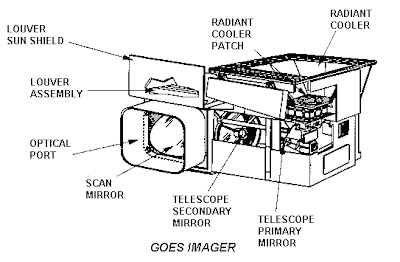
GOES GImager
The team validated its method against data collected from satellites that are part of the NOAA Geostationary Operational Environmental Satellite System (GOES).

However, the instruments aboard the satellites aren't capable of detecting particles much higher in energy than those associated with the peak radiation dose, according to Evenson.

"The instruments on the spacecraft are just too small to detect the faster, high-energy particles. They are set up to detect the particles that are most damaging," he explained.

Read more at the Antartic Sun

Thursday, April 5, 2012

SOHO Supersonic snowballs: Comets interacting with the Sun's atmosphere

This coronagraph image from the Solar and Heliospheric Observatory (SOHO) shows Comet Lovejoy receding from the sun after its close encounter.

The horizontal lines through the comet's nucleus are digital artifacts caused by saturation of the detector. Yes, Lovejoy is that bright! To view a movie of Comet Lovejoy's path please go here. 

Since the 1980s astronomers have seen thousands of comets falling towards the Sun, most of them too small to survive a close approach, let alone to re-emerge.

Until recently no such objects had been seen very close to the Sun as the glare of sunlight made them impossible to observe.

Now a team of scientists led by Professor Emeritus John Brown, Astronomer Royal for Scotland (Edinburgh's Royal Observatory) and former Regius Professor of Astronomy at Glasgow University, have worked out which comets make it through this fiery journey, which fizzle out high up and which explode just above the surface.

Prof. Brown presented this new work in a paper at the National Astronomy Meeting in Manchester on Friday 30 March.

Comets are giant dusty snowballs believed to date from the epoch of the formation of the Sun and planets, so carry important information about the early history and composition of the Solar system.

The comets we see spend most of their time very far from the Sun, orbiting in the so called Oort Cloud, before being disrupted into orbits that carry them towards our nearest star over tens of thousands of years.

When comets reach the inner Solar System, their dusty ices melt and vapourise to form huge tails blown back by the solar wind and by sunlight.

The largest, like the famous Comet Hale Bopp seen in the late 1990s, have nuclei tens of kilometres across and masses of 10 million million tonnes.

Objects this large only lose a tiny fraction of their material on each passage around the Sun, so are able to survive thousands of journeys through the Solar System.

In contrast, the smallest objects may only be 10 metres across with a mass of 1000 tonnes. If these small comets make a close approach to the Sun, they are vapourised by sunlight and by the friction of the atmospheric gas.

In the culmination of work carried out over the last few years, Professor Brown and his colleagues are now able to predict how comets lose their mass and are destroyed in the solar atmosphere, their behaviour depending on whether or not their orbital path reaches into the 'lower atmosphere' 7000 km (roughly 1% of the solar radius) from the top of the brightest visible solar layer, the photosphere.

Solar Eruptions Cause Sunquakes

A study led by UCL's Mullard Space Science Laboratory has shown for the first time that sunquakes can be produced during eruptions of magnetic field and charged particles, as the immense magnetic structure blasts off into the Solar System. 

The results were presented by Dr Sergei Zharkov at the National Astronomy Meeting 2012 in Manchester on Friday 30th March 2012.

The first observation of a sunquake was reported by Kosovichev and Zharkova in the late 1990s. During the last decade it has become well established that explosions in the Sun's atmosphere, known as solar flares, can create sunquakes through the impact of powerful beams of particles which travel into the Sun.

This new study shows that eruptions of material known as coronal mass ejections are also able to produce sunquakes.

The authors studied an eruption that took place on 15 February 2011 and found that sunquakes 1000 times more powerful than the Great East Japan Earthquake (and subsequent tsunami), March 2011, were triggered at the two ends of the erupting rope of magnetic field.

This indicates that the sudden expansion of the magnetic field that takes place as the eruption occurs is likely to play an important role in generating the quakes.

The eruption raced through the Solar System with an average speed of 600 km/s and was Earth directed, driving a geomagnetic storm and a beautiful display of the aurora when it reached us.

"Sunquakes were first predicted in 1972 by Wolff and are seen at the Sun's surface as circular ripples emanating outward, looking much like those produced as a stone is dropped into to a pond. (Wolff referred to them as like 'trapped sound waves')

"However, they are actually caused by sudden a release of energy below the solar surface that produces sound waves which bend and travel up to the surface of the Sun, lifting it and producing the ripples," said Zharkov.

These spectacular events are helping scientists understand how energy and momentum are transported from the Sun's atmosphere down to the surface and into the interior.

With solar activity currently increasing, and due to peak in 2013, more sunquakes will be observed helping unravel the mechanisms that cause them.

Thursday, March 22, 2012

NASA MARS: Dusty Rover Opprtunity's Self Portrait

This self portrait from NASA's Mars Exploration Rover Opportunity shows dust accumulation on the rover's solar panels as the mission approached its fifth Martian winter.

The dust reduces the rover's power supply, and the rover's mobility is limited until the winter is over or wind cleans the panels.

This is a mosaic of images taken by Opportunity's panoramic camera (Pancam) during the 2,111th to 2,814th Martian days, or sols, of the rover's mission (Dec. 21 to Dec. 24, 2011).

The downward-looking view omits the mast on which the camera is mounted.

The portrait is presented in approximate true colour, the camera team's best estimate of what the scene would look like if humans were there and able to see it with their own eyes.

Opportunity has worked through four Martian southern hemisphere winters since it landed in in January 2004 about 14 miles (23 kilometers) northwest of its current location.

Closer to the equator than its twin rover, Spirit, Opportunity has not needed to stay on a sun-facing slope during the previous winters.

Now, however, Opportunity's solar panels carry a thicker coating of dust, and the team is using a strategy employed for three winters with Spirit: staying on a sun-facing slope.

The sun will pass relatively low in the northern sky from the rover's perspective for several months of shortened daylight before and after the southern Mars winter solstice on March 30, 2012.

Opportunity is conducting research while located on the north-facing slope of a site called "Greeley Haven."

Image Credit: NASA/JPL-Caltech/Cornell/Arizona State Univ.

Wednesday, January 11, 2012

Boeing begins NASA solar electric propulsion study

Boeing has begun work on a four-month NASA contract to develop a mission concept study for solar electric propulsion technologies.

Under the $600,000 firm, fixed-price contract, Boeing will evaluate concepts that combine high-power solar arrays with advanced electric thrusters to power spacecraft and payloads to high Earth orbit and deep space destinations.

"Boeing pioneered the use of electric propulsion, and has developed an approach to integrate compact, lightweight, and highly efficient solar arrays with next-generation electric thrusters in future spacecraft," said Steve Johnston, director of Boeing Phantom Works' Advanced Space Exploration division.

"This technology offers weight and cost advantages while enabling increased on-orbit maneuverability for satellites in Earth orbit, and efficient deep space transportation for human exploration and robotic science missions."

Boeing is one of five contractors selected to develop a mission concept to demonstrate solar electric propulsion technologies, capabilities and the infrastructure required to affordably sustain a human presence in space.

Phantom Works will conduct the study in Huntington Beach with support from Boeing Space and Intelligence Systems electric power and propulsion experts in El Segundo, Calif.

Tuesday, November 1, 2011

ESA BepiColumbo Mercury Mission: Surviving a Heat Sandwich - Video


Set to launch in 2014, Europe's BepiColumbo satellite pair will deliver unique imagery of Mercury during extra-close orbital passes.

The pair will contend with extreme temperatures from the nearby Sun and bright reflections from Mercury's surface.
Credit: ESA

Thursday, October 13, 2011

PlanetSolar: Solar Powered Boat

PlanetSolar, the first solar-powered boat to attempt to travel around the world, arrives at the VivoCity shopping centre waterfront in Singapore.

The 31m by 15m white catamaran was unveiled to the world last year and embarked on a world tour from Monaco in September to promote solar energy for pollution-free shipping.

The Swiss-flagged boat, which was built in Germany and cost £16 million, is topped by 500 square metres of solar panels.

Picture: ROSLAN RAHMAN/AFP/Getty Images

Electric car charging from public solar panels


Electric car owners in Zurich who want to charge up with green energy can have their battery communicate with a local utility’s solar panels and find out whether the panels are producing at that point in time.

If they are, the battery can instruct the utility to send electricity.

It’s part of a small trial between IBM and Swiss utility EKZ involving an app, cloud computing services and a phonebook sized data-recording device installed on “several” EVs including a Renault Twingo, an IBM press release states.

The device was developed by Zurich University.

The app also lets the car owner hand over charging responsibility to EKZ, which can schedule charge-ups when sun and wind power is available, and better manage its peak load generation.

One knock on EVs is that they’re only as green as the form of electricity that feeds them – coal-base electricity does not reduce a car’s carbon footprint as much as renewable electricity does. But wind and solar sources do not furnish constant electricity the way coal does.

The app can help assure the car charges only when the sun shines or the wind blows. (Although the bigger step will come when utilities switch to 100 percent renewable, taking the guesswork out).

The app runs on mobile devices, tablets and web browsers.

In addition, owners can read the app while they’re away from their car – say, in the office or even thousands of miles away – to check how much charge remains.

All the more reason why cars might could one day come for “free” as part of a service package from a utility, a mobile phone company or an internet provider.

Photo: BP Solar

Friday, August 12, 2011

Solar Kitchen Restaurant in Helsinki

Chef Antto Melasniemi is seen at the Lapin Kulta Solar Kitchen Restaurant in Helsinki, where cooking is done using purely solar energy. Headed by Chef Antto Melasniemi, the unusual restaurant will be following the sun through Europe this summer. To produce its food the kitchen relies on concentrated solar discs. Apparently, unlike traditional ways of cooking solar heat affects the taste and texture of the dish. This is partly due to the fact the sun heats all of the food simultaneously instead of just directing heat to the top or bottom of a pot or pan. When the sun is at its peak dishes can be cooked in a matter of minutes, but less sunshine equals slower cooking times.
Chef Antto Melasniemi is seen at the Lapin Kulta Solar Kitchen Restaurant in Helsinki, where cooking is done using purely solar energy.

Headed by Chef Antto Melasniemi, the unusual restaurant will be following the sun through Europe this summer.

To produce its food the kitchen relies on concentrated solar discs.

Apparently, unlike traditional ways of cooking solar heat affects the taste and texture of the dish.

This is partly due to the fact the sun heats all of the food simultaneously instead of just directing heat to the top or bottom of a pot or pan.

When the sun is at its peak dishes can be cooked in a matter of minutes, but less sunshine equals slower cooking times.

Picture: Lehtikuva OY / Rex Features

Thursday, December 23, 2010

Solar Simulator: Reactor could make fuel from solar energy and CO2

SolarSimulator.jpg

(Image: Aldo Steinfield/Swiss Federal Institute of Technology)

Imagine filling up your car on an environmentally-friendly fuel produced from sunlight, water and carbon dioxide from the air.

That goal may now be a step closer following successful tests of a new solar-powered reactor.

Researchers around the world have recently been experimenting with different catalysts capable of producing hydrocarbon fuels from water and carbon dioxide when heated by concentrated sunlight.

Such a fuel would not only reduce greenhouse gas emissions, but could be used with little change to our existing cars and infrastructure.

Now William Chueh at the California Institute of Technology in Pasadena and colleagues have developed a reactor that uses cerium oxide as a catalyst. Cerium oxide is an abundant material suitable for commercial-scale fuel production, but it hadn't been demonstrated in a reactor under realistic conditions.

In Chueh's reactor, concentrated solar energy enters the chamber through a window. Once inside the chamber, the sunlight is reflected several times to capture as much of the solar energy as possible. It is used to heat a 35 millimetre-diameter cylinder of cerium oxide to around 1500 degrees Celsius. This causes the cerium to release an oxygen atom.

The temperature in the chamber is then reduced to around 900 degrees Celsius, and carbon dioxide is pumped into the chamber through an inlet. The cerium grabs an oxygen atom from the carbon dioxide to replace the one that it has lost, producing carbon monoxide and cerium oxide.

The carbon monoxide is then removed from the chamber, which is heated back up to 1500 degrees Celsius and the whole cycle is repeated.

The same process is also used to generate hydrogen from steam. The team has successfully run the process to produce the two gases in over 500 cycles.

The efficiency of the device is low, at around 0.4 per cent, but much of this is due to heat loss through the reactor walls and aperture, which can be dealt with through improvements to the device's insulation and design, the team say. Efficiencies of up to 19 per cent should then be possible, they add.

Carbon monoxide and hydrogen can be converted into a synthetic liquid using a technique such as the Fischer-Tropsch process, in which they are heated in the presence of an iron-based catalyst to produce hydrocarbon fuels.

Ultimately, such plants could use carbon dioxide from the air to produce fuel. Team member Aldo Steinfeld at the Swiss Federal Institute of Technology, Zurich, has already demonstrated that a similar process can be used to remove CO2 from the atmosphere.

He and his team used concentrated sunlight to heat calcium oxide to 400 degrees Celsius, causing it to react with CO2 in the air to form calcium carbonate. When heated again, this time to 800 degrees Celsius, the calcium carbonate releases a pure stream of CO2 that can then be used in the solar fuel reactor.

Journal reference: Science, DOI: 10.1126/science.1197834

Wednesday, November 24, 2010

Monday, December 21, 2009

Closer To Home-Brewed Electricity With Personalised Solar Energy

A simple inexpensive rooftop solar panel can convert sunlight to electricity. In a new study, an expert describes progress toward an efficient and inexpensive method for storing and distributing solar energy in the home

New scientific discoveries are moving society toward the era of "personalized solar energy," in which the focus of electricity production shifts from huge central generating stations to individuals in their own homes and communities.

That's the topic of a report by an international expert on solar energy published in the ACS' Inorganic Chemistry, a bi-weekly journal.

It describes a long-awaited, inexpensive method for solar energy storage that could help power homes and plug-in cars in the future while helping keep the environment clean.

Daniel Nocera explains that the global energy need will double by mid-century and triple by 2100 due to rising standards of living world population growth. Personalised solar energy - the capture and storage of solar energy at the individual or home level - could meet that demand in a sustainable way, especially in poorer areas of the world.

The report describes development of a practical, inexpensive storage system for achieving personalized solar energy. At its heart is an innovative catalyst that splits water molecules into oxygen and hydrogen that become fuel for producing electricity in a fuel cell.

The new oxygen-evolving catalyst works like photosynthesis, the method plants use to make energy, producing clean energy from sunlight and water. "Because energy use scales with wealth, point-of-use solar energy will put individuals, in the smallest village in the nonlegacy world and in the largest city of the legacy world, on a more level playing field," the report states.

Friday, December 4, 2009

Solar Impulse prepared for first flight at Duebendorf, Zurich

An aircraft dubbed Solar Impulse is prepared for its first flight at Duebendorf airport near Zurich, to test the feasibility of a flight over two days and one night under solar energy power only, paving the way for a round the world flight in 2012
Picture: AFP/GETTY

Wednesday, October 14, 2009

An electromagnetic "black hole" created in Lab

An electromagnetic "black hole" that sucks in surrounding light has been built for the first time.

The device, which works at microwave frequencies, may soon be extended to trap visible light, leading to an entirely new way of harvesting solar energy to generate electricity.

A theoretical design for a table-top black hole to trap light was proposed in a paper published earlier this year by Evgenii Narimanov and Alexander Kildishev of Purdue University in West Lafayette, Indiana. Their idea was to mimic the properties of a cosmological black hole, whose intense gravity bends the surrounding space-time, causing any nearby matter or radiation to follow the warped space-time and spiral inwards.

Narimanov and Kildishev reasoned that it should be possible to build a device that makes light curve inwards towards its centre in a similar way. They calculated that this could be done by a cylindrical structure consisting of a central core surrounded by a shell of concentric rings