Showing posts with label Exoskeleton. Show all posts

Tuesday, May 20, 2014

HAL Hybrid Robotic Exoskeleton: Robot suit helps paraplegic patients

For most paraplegic patients, being able to walk again remains a dream.

The HAL robot suit can help them regain a certain degree of mobility and activity.

An expert team at the Centre for Neurorobotic Movement Training (ZNB) in Bochum has been testing the exoskeleton that was originally developed in Japan since 2011. With excellent results.

Paraplegia is essentially the result of damaged nerve structures in the spine.

To perform a movement, the brain sends out a signal via the spinal cord and its surrounding nerves to a muscle – e.g.one in the arm or in the leg.

Due to his injury, a paraplegic patient's muscles operate with weakened signals.

As a result, the signal does not arrive in the leg or in the arm.

This is where the HAL robot suit comes into play: it picks up the weakened signals through sensors that are attached to the patient's skin and sets the motors in the pelvic and knee-joint regions in motion.

Thus, HAL takes over locomotion on the patient's behalf by connecting directly to the patient's nervous system.

"This is how we wish to activate and foster the residual function of the muscles and, ultimately, to help the patients attain better activity levels," explains Professor Schild Hauer, Medical Director at the university hospital Berufsgenossenschaftliches Universitätsklinikum Bergmannsheil.

The expert team uses the clinical trials at the ZNB to determine, among other things, how much training is required in the best possible scenario and how long the training effects will or will not last.

They have implemented a three-month training cycle, with five sessions per week.

With excellent results: "Our patients attain activity levels which improve their ability to navigate around their everyday life and their surroundings."

"Thus, they continue to train their movement routine every day," explains Professor Schildhauer.

A patient who had been permanently confined to a wheelchair, for example, will be able to walk short distances with the aid of a walking frame after a three-month training period.

In Germany, Bergmannsheil is the only hospital where the robot suit is being tested. In Japan, similar suits are being utilised in some 200 geriatric rehab centres.

The long-term objective is to launch HAL in the German market so that it can be used as a therapy instrument to help as many people as possible.

However, insurance companies will not incorporate the therapy into their clearing system until well-founded data are available, which will only be the case once further trials have been conducted.

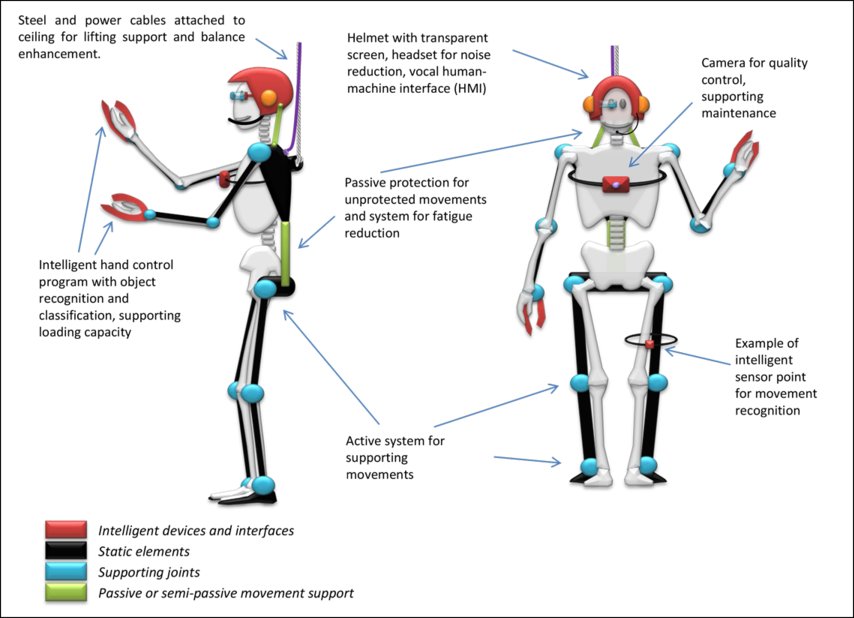
Wednesday, September 11, 2013

RoboMate Project: Development of intelligent and wearable body exoskeleton

The Fraunhofer Institute for Industrial Engineering IAO is partner in the Robo-Mate project, starting in September 2013. 

Together with 11 European partners this research project aims at designing a human-guided exoskeleton to improve work safety and enhance productivity in the industrial environment.

Various manual work tasks necessary to industrial manufacturing processes are difficult to automate – even today – due to their complexity.

This is particularly the case in assembling and dismantling operations, such as those used in the automotive or food processing industries. This type of work, however, entails severe risks of injury.

According to the Work Foundation Alliance (UK), as many as 44 million workers in the European Union are affected by work-place related musculo-skeletal disorders (MSDs), representing a total annual cost of more than 240 billion Euros.

To overcome these industrial and societal challenges, a new project, called RoboMate, has been designed.

Set to get underway in September 2013, the objective of the RoboMate project is to develop an intelligent, easy-to-manoeuvre, and wearable body exoskeleton for manual-handling work.

The project comprises 12 partners from 7 European countries, including key players from industry and academia.

The fundamental idea behind Robo-Mate is to enhance work conditions for load workers and facilitate repetitive lifting tasks, thereby reducing the incidence of work-place related injury and disease.

As a consequence, productivity, flexibility and the quality of production will increase. Bringing this concept to fruition involves merging human-guided manipulators with computer-controlled industrial robots in order to create a human-guided and computer-supported exoskeleton for use in various industries.

The development includes modelling and simulating the exoskeleton in a virtual-factory environment at the Fraunhofer Institute for Industrial Engineering IAO.

Putting the Robo-Mate exoskeleton into service will engender practical and far-reaching impacts, including making the industrial work-site safer for skilled personnel, providing a means for workers to apply less physical effort, and facilitating higher-quality outputs resulting in industrial benefit.

Monday, August 19, 2013

'Iron Man' Exoskeleton Could Give Astronauts Superhuman Strength


Astronauts could one day get a power surge from hi-tech robotic suits, like real-life versions of "Iron Man" hero Tony Stark.

That's not to suggest that spaceflyers will soon become superheroes; most of Iron Man's abilities will long remain in the realm of science fiction. 

But the X1 Robotic Exoskeleton, which NASA is co-developing along with several partners, could give superhuman strength to people on long-duration space missions to an asteroid or Mars, or act as a "resistive device" for exercising, agency officials say.

The 57-pound (26 kilograms) X1 fits over an astronaut's legs, with a harness that goes across the back and shoulders. 

The exoskeleton has motorized joints at the knees and hips, as well as six passive joints that allow the person wearing it to turn, flex and sidestep as needed.


NASA project engineer Roger Rovekamp demonstrating the X1 Robotic Exoskeleton.

Credit: Robert Markowitz

In the short term, astronauts could use the device to add resistive force in microgravity to improve exercising on the International Space Station, NASA officials say.

X1 can record information on each session and stream the data back to Earth, where doctors can monitor an astronaut's progress.

But NASA aims to send astronauts farther afield — to a near-Earth asteroid by 2025, then on to the vicinity of Mars by the mid-2030s — and X1 could really shine in deep space.

The suit "could provide a robotic power boost to astronauts as they work on the surface of distant planetary bodies," NASA officials wrote in a description of the technology earlier this month.

"Coupled with a spacesuit, X1 could provide additional force when needed during surface exploration, improving the ability to walk in a reduced gravity environment, providing even more bang for its small bulk."

While the device has otherworldly applications, X1 could also be used closer to home, officials said.

The exoskeleton shows promise as an assistive walking device, so it may eventually provide a valuable service to people who have trouble getting around here on Earth.

Sunday, February 10, 2013

"Robotic Exoskeleton" on show in London's Science Museum

A "bionic man" costing one million dollars went on display on Tuesday at Britain's Science Museum, complete with artificial organs, synthetic blood and robot limbs.

Named Rex, which is short for "Robotic Exoskeleton", the six foot six inch (two metre) humanoid with its uncannily life-like face was assembled by leading roboticists for a television programme.

Although cheaper than the "Six Million Dollar Man" made famous by the cult 1970s television series starring Lee Majors, the technology is far advanced from the fictional bionics on show back then.

The creation includes key advances in prosthetic technology, as well as an artificial pancreas, kidney, spleen and trachea and a functional blood circulatory system.

Welcoming Rex to the museum in London on Tuesday was Swiss social psychologist Bertolt Meyer, who was himself born without a left hand and has a sophisticated bionic replacement.

"I've looked around for new bionic technologies, out of personal interest, for a very long time and I think that until five or six years ago nothing much was happening," Meyer said.

"Then suddenly we are now at a point where we can build a body that is great and beautiful in its own special way."

The museum exhibit, which opens to the public on Thursday, will explore changing perceptions of human identity against the background of rapid progress in bionics -- although Rex is not strictly bionic as he does not include living tissue.

Below is a lengthy YouTube video, recorded in Dublin, discussing the issues that surround Prosthetics.

Bertolt Meyer
One of the panel members is Bertolt Meyer, who was born with a congenitally missing lower left arm. He was fitted with his first prosthetic device when he was only three months old.

The passive device he was fitted with at the time bears little comparison to the cutting edge 'active' prosthetic device he wears today. He is one of the first users of Touch Bionics' i-LIMB Pulse.

Between the ages of 14 and 19, Bertolt wore a body powered "split hook" device, which was attached via a harness operated by the movement of his remaining arm.