Showing posts with label intelligent. Show all posts

Wednesday, September 11, 2013

RoboMate Project: Development of intelligent and wearable body exoskeleton

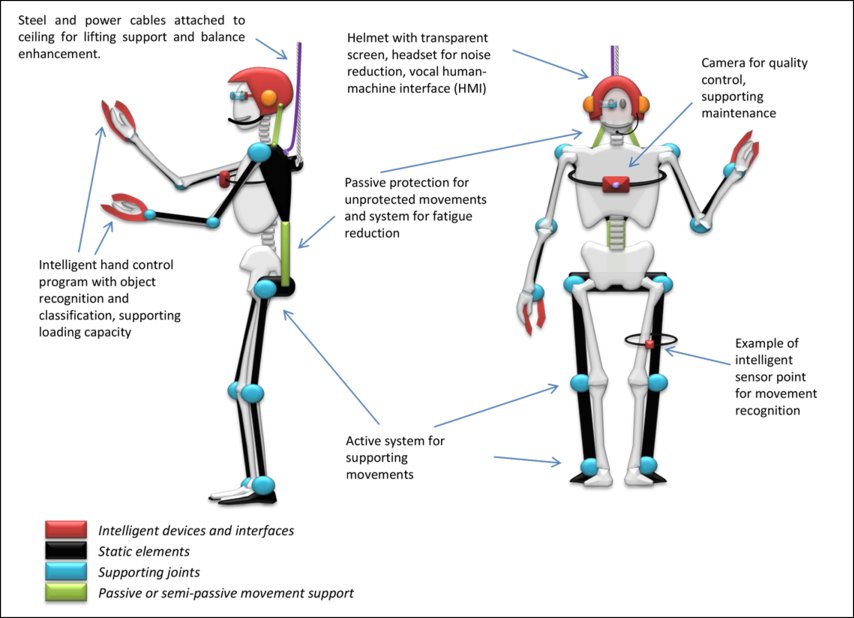
The Fraunhofer Institute for Industrial Engineering IAO is partner in the Robo-Mate project, starting in September 2013. 

Together with 11 European partners this research project aims at designing a human-guided exoskeleton to improve work safety and enhance productivity in the industrial environment.

Various manual work tasks necessary to industrial manufacturing processes are difficult to automate – even today – due to their complexity.

This is particularly the case in assembling and dismantling operations, such as those used in the automotive or food processing industries. This type of work, however, entails severe risks of injury.

According to the Work Foundation Alliance (UK), as many as 44 million workers in the European Union are affected by work-place related musculo-skeletal disorders (MSDs), representing a total annual cost of more than 240 billion Euros.

To overcome these industrial and societal challenges, a new project, called RoboMate, has been designed.

Set to get underway in September 2013, the objective of the RoboMate project is to develop an intelligent, easy-to-manoeuvre, and wearable body exoskeleton for manual-handling work.

The project comprises 12 partners from 7 European countries, including key players from industry and academia.

The fundamental idea behind Robo-Mate is to enhance work conditions for load workers and facilitate repetitive lifting tasks, thereby reducing the incidence of work-place related injury and disease.

As a consequence, productivity, flexibility and the quality of production will increase. Bringing this concept to fruition involves merging human-guided manipulators with computer-controlled industrial robots in order to create a human-guided and computer-supported exoskeleton for use in various industries.

The development includes modelling and simulating the exoskeleton in a virtual-factory environment at the Fraunhofer Institute for Industrial Engineering IAO.

Putting the Robo-Mate exoskeleton into service will engender practical and far-reaching impacts, including making the industrial work-site safer for skilled personnel, providing a means for workers to apply less physical effort, and facilitating higher-quality outputs resulting in industrial benefit.

Friday, January 15, 2010

Seemingly Intelligent oil droplet solves maze


There's some humbling news from the chemical world for anyone who has ever found themselves lost in a garden maze. A simple droplet of organic solvent can find its way through a complicated labyrinth with nothing more to go on than a slight pH difference.

Bartosz Grzybowski's team at Northwestern University in Evanston, Illinois, used a common polymer to fashion a two-dimensional labyrinth some 2 centimetres on each side. They then flooded the maze with strongly alkaline potassium hydroxide solution, before placing a hydrochloric acid-soaked chunk of gel at the maze exit.

After about 40 seconds they placed a droplet of mineral oil containing hexyldecanoic acid at the maze entrance. The oil, which cannot mix with the potassium hydroxide solution, sits on the surface. But it remains still only for a matter of seconds – it soon begins tearing around the maze at speeds of up to 10 millimetres per second, sniffing out the shortest path to the acid-soaked gel, and solving the maze in the process.

"In the movie files you can see the droplet makes decisions," says Grzybowski. "It goes left along the wrong path, decides there's something fishy with that and so it reverses. It looks almost alive."

Tuesday, April 7, 2009

Herschel & Planck satellites ready to go

Herschel will reveal the young universe in new detail (Image: ESA)

Herschel, the monster space telescope, will position itself in an extended orbit (1.5Mn Km) on the other side of the Earth from the Sun (L2, Le Grange point). It will use the Earth as a shield to protect it from the Sun's local radiation. Its mission is to reveal the young universe in new detail.

Whereas the Planck satellite will take up a similar orbit at the L2, Le Grange point and start to record the background radiation left after the Big Bang. (Image: ESA)

Thursday, March 12, 2009

Debris threat - ISS Evacuation

Given enough notice of a possible collision, the space station can fire thrusters to move out of the way - eight such 'avoidance manoeuvres' have been made in the past. But on Thursday, the threat of a collision was discovered too late to move the station, so the crew took shelter in a docked Soyuz spacecraft (Image: NASA)

The crew of the ISS had to evacuate the International Space Station because of the threat of Debris Collision

Given enough notice of a possible collision, the space station can fire thrusters to move out of the way - eight such 'avoidance manoeuvres' have been made in the past. But on Thursday, the threat of a collision was discovered too late to move the station, so the crew took shelter in a docked Soyuz spacecraft (Image: NASA)

Display model of Soyuz Module

Sunday, February 15, 2009

Darwinian Nodes of Action

Charles Darwin
The principles of life on Earth may also be applied to life on other planets, with some exceptions. I am including here an extract from Marc D Hauser's book on Moral Minds. He is influenced in turn by the work of Eduard Tinkelpaugh, the 1920's psychologist, famous for his work with examining the intelligence levels of primates and monkeys.

'We do not know what it is like to have a primate experience of expectation, satisfaction and dissatisfaction. Tinkelpaugh proposed that the primate brain has evolved to respond to actions and events and set up expectations about, the causes and consequences to detect violations, using mimicry, learned behaviour and experiences.

I have listed the 5 principles of living as a primate, emanating from the studies of Tinkelpaugh, Darwin and others. These studies involved intelligent animals, primarily primates but occasionally dolphins and birds (Ravens and Jays).

Principle 1 - If an object moves on its own, it is an animal or part of an animal

Principle 2 - If an object moves in a particular direction towards another object or location, the targeted direction picks out or implies the object's goal

Principle 3 - If an object moves 'flexibly', changing direction in response to environmental objects or events, then it is rational

Principle 4 - If one object's action is followed closely by a second object's action, the second object's action is perceived as a socially intelligent response

Principle 5 - If an object is self-propelled, goal-directed and flexibly responsive to environmental constraints and events, then the object has the potential to cause harm or comfort to other similar objects.

Now you have some insight into the simple rules of thought and behaviour a primate is subject to. Can we now apply these principles more wildly and include them in the search for socially intelligent extra-terrestrial life?