
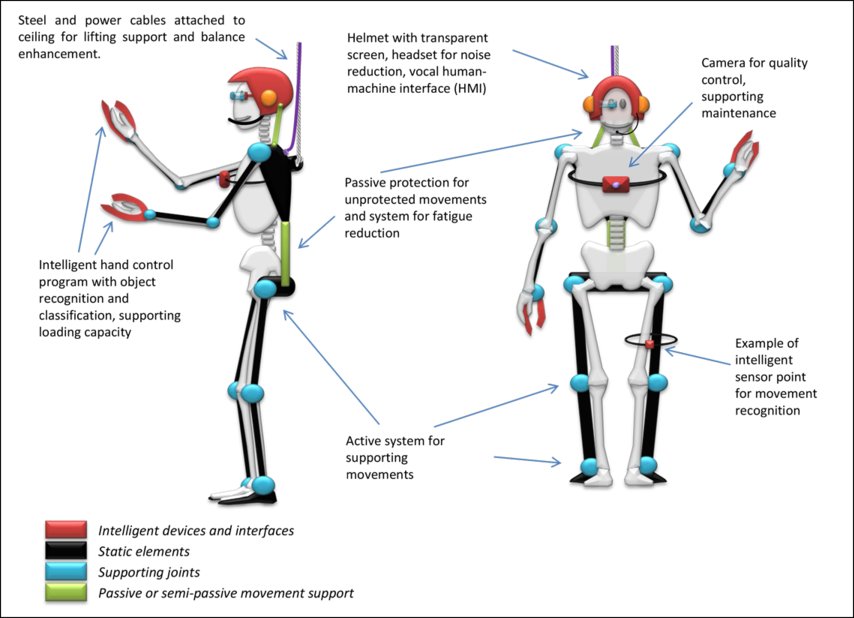
Together with 11 European partners this research project aims at designing a human-guided exoskeleton to improve work safety and enhance productivity in the industrial environment.
Various manual work tasks necessary to industrial manufacturing processes are difficult to automate – even today – due to their complexity.
This is particularly the case in assembling and dismantling operations, such as those used in the automotive or food processing industries. This type of work, however, entails severe risks of injury.
According to the Work Foundation Alliance (UK), as many as 44 million workers in the European Union are affected by work-place related musculo-skeletal disorders (MSDs), representing a total annual cost of more than 240 billion Euros.
To overcome these industrial and societal challenges, a new project, called RoboMate, has been designed.
Set to get underway in September 2013, the objective of the RoboMate project is to develop an intelligent, easy-to-manoeuvre, and wearable body exoskeleton for manual-handling work.
The project comprises 12 partners from 7 European countries, including key players from industry and academia.
The fundamental idea behind Robo-Mate is to enhance work conditions for load workers and facilitate repetitive lifting tasks, thereby reducing the incidence of work-place related injury and disease.
As a consequence, productivity, flexibility and the quality of production will increase. Bringing this concept to fruition involves merging human-guided manipulators with computer-controlled industrial robots in order to create a human-guided and computer-supported exoskeleton for use in various industries.
The development includes modelling and simulating the exoskeleton in a virtual-factory environment at the Fraunhofer Institute for Industrial Engineering IAO.
Putting the Robo-Mate exoskeleton into service will engender practical and far-reaching impacts, including making the industrial work-site safer for skilled personnel, providing a means for workers to apply less physical effort, and facilitating higher-quality outputs resulting in industrial benefit.


 Posts
Posts


