Showing posts with label Amateur astronomers. Show all posts

Thursday, April 24, 2014

Professional and amateur astronomers join forces: Pro-Am Venture

Starting in the upper left and moving clockwise, the galaxies are M101 (the "Pinwheel Galaxy"), M81, Centaurus A, and M51 (the "Whirlpool Galaxy"). 

M101 is a spiral galaxy like our Milky Way, but about 70% bigger. 

Credit: X-ray: NASA /CXC /SAO; Optical: Detlef Hartmann; Infrared: NASA /JPL-Caltech

Long before the term "citizen science" was coined, the field of astronomy has benefited from countless men and women who study the sky in their spare time.

These amateur astronomers devote hours exploring the cosmos through a variety of telescopes that they acquire, maintain, and improve on their own.

Some of these amateur astronomers specialise in capturing what is seen through their telescopes in images and are astrophotographers.

What happens when the work of amateur astronomers and astrophotographers is combined with the data from some of the world's most sophisticated space telescopes?

Collaborations between professional and amateur astronomers reveal the possibilities and are intended to raise interest and awareness among the community of the wealth of data publicly available in NASA's various mission archives.

This effort is particularly appropriate for this month because April marks Global Astronomy Month, the world's largest global celebration of astronomy.

The images in this quartet of galaxies represent a sample of composites created with X-ray data from NASA's Chandra X-ray Observatory, infrared data from the Spitzer Space Telescope, and optical data collected by an amateur astronomer.

In these images, the X-rays from Chandra are shown in pink, infrared emission from Spitzer is red, and the optical data are in red, green, and blue.

The two astrophotographers who donated their images for these four images, Detlef Hartmann and Rolf Olsen, used their personal telescopes of 17.5 inches and 10 inches in diameter respectively.

More details on how these images were made can be found in this blog post.

However, the long exposures of these objects may help to reveal phenomena that may otherwise be missed in the relatively short snapshots taken by major telescopes, which are tightly scheduled and often oversubscribed by professional astronomers.

Therefore, projects like this Astro Pro-Am collaboration might prove useful not only for producing spectacular images, but also contributing to the knowledge of what is happening in each of these cosmic vistas.

Monday, December 10, 2012

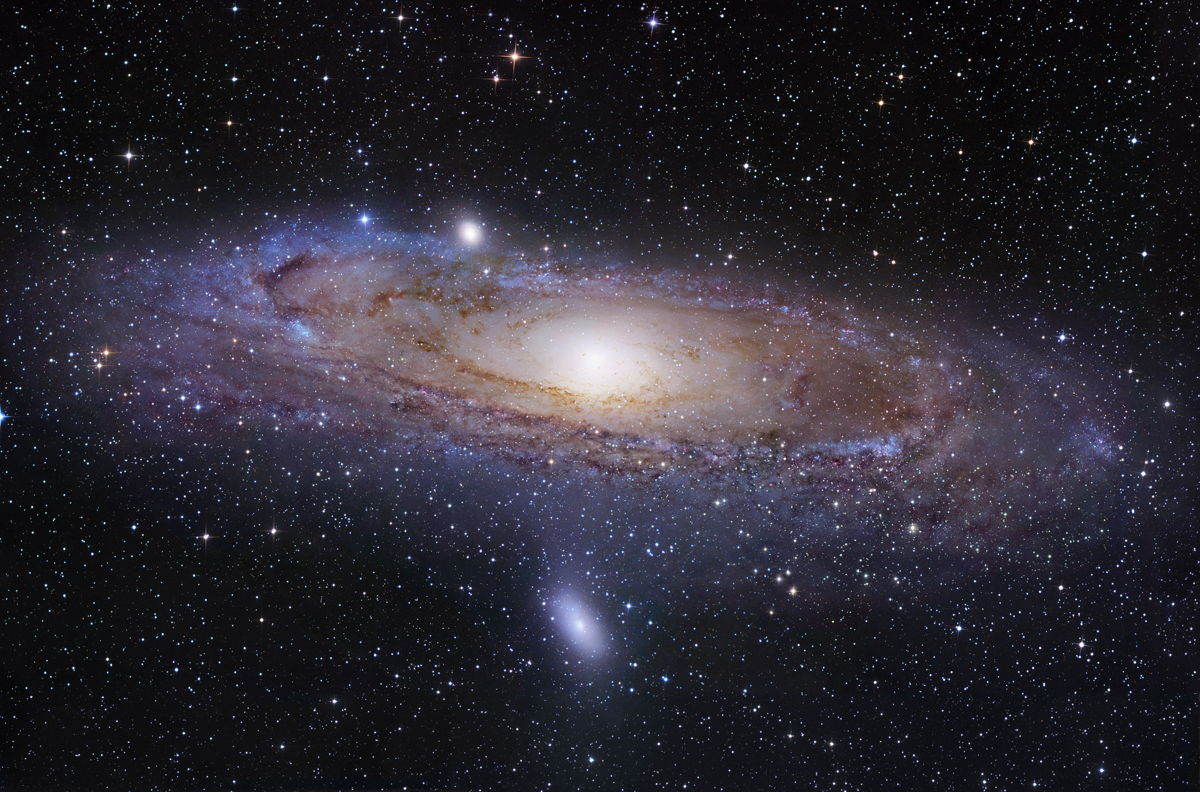
Amateur Astronomers' Help Needed to Study Andromeda Galaxy

Astronomers are asking the public to help find star clusters in Andromeda, a bright, neighbouring galaxy to our Milky Way.

CREDIT: Robert Gendler

A group of astronomers is inviting the public to join their star-hunting team in a search of the bright Andromeda Galaxy.

The project aims to identify star clusters in our neighboring galaxy, also known as M31.

All it takes to find the clusters in Andromeda is an Internet-enabled computer and a desire to help, said Anil Seth, the team's lead investigator. "No special training is required," he said.

The so-called "Andromeda Project," which began Wednesday (Dec. 5), will generate the largest sample of clusters from a single spiral galaxy when it is completed.

Scientists expect the project could identify 2,500 new star clusters when finished. This would provide useful goalposts to chart how the galaxy, which is on a collision course with the Milky Way, formed and evolved.

"The general benefit is to better understand how spiral galaxies form," said Seth, an assistant professor of physics and astronomy at the University of Utah.

"Andromeda is the nearest example of a [spiral] galaxy, except for the Milky Way," he said. "We can study in detail things we can't see in larger distances."

Tuesday, November 20, 2012

Stargazer Captures Striking Nebula View

Bill Snyder captured Sh2-112 Sharpless on July 29, 2012 from his home observatory in Connellsville, Pa.

He used a TMB130mm telescope equipped with an Apogee U8300 camera, as well as an Atlas EQG mount and several filters to view SH2-112.

The total exposure time to capture this image was more than 18 hours.

CREDIT: Bill Snyder, Astrophotography

Wednesday, July 25, 2012

Astronomers' Capture Hercules Star Cluster

The hundreds of thousands of stars that make the mighty Hercules globular cluster shine bright in this astronomers' photo.

Astrophotography team Bob and Janice Fera took this image in May 18 and 20, 2012 from Eagle Ridge Observatory in Foresthill, Calif.

Also known as M13, this cluster has more than 100,000 stars that shine from about 25,000 light-years away. The brightest stars  are packed tightly at the core and sometimes slam into each other creating new stars called “blue stragglers.”


These blue stars shine a bluish-white because their core temperatures are extremely hot. Bright red stars found within the cluster are cooler because they are older stars that have expanded in size. These stars are often called ancient red giants.

The Feras used an Officina Stellare RC-360AST 14" f/8 Ritchey Chretien Cassegrain telescope with two-element field flattener to observe the M13 cluster. An Apogee Alta U16M CCD camera with Astrodon filters was used to capture the image.

Tuesday, July 10, 2012

Cat's Paw Nebula

The Cats Paw Nebula is revisited in a combination of exposures from the MPG/ESO 2.2-metre telescope and amateur astronomers Robert Gendler and Ryan M Hannahoe. 

The distinctive shape of the nebula is revealed in reddish puffy clouds of glowing gas against a dark sky dotted with stars.

Picture: ESO/AFP/GettyImages

Thursday, March 29, 2012

Cone and Fox Fur Nebulas Glow Together - Image


Astrophotography duo Bob and Janice Fera snapped this photo of the Cone and Foxfur nebulas, which are part of a larger system called NGC 2264 located in the Monoceros constellation about 2,600 light-years away from Earth.

CREDIT: Bob and Janice Fera at Fera Photography
Cone Nebula

Monday, February 27, 2012

Markarian Chain: A stretch of galaxies in the Virgo cluster

Credit: Larry Van VleetThis stunning image by skywatcher Larry Van Vleet is of Markarian's Chain, a stretch of galaxies in the Virgo cluster.

The galaxies are said to be in a smooth, curved line making them appear to be connected in a chain.

Located about 70 million light-years away, the Virgo cluster is a large collection of some 2,000 galaxies that dominate our part of the universe.

A light-year is the distance light travels in one year, or about 6 trillion miles (10 trillion kilometers).

Lynd's Dark Nebula: The Native American Woman Dancer

Credit: Adam Block/Mount Lemmon SkyCenter/University of Arizona

Resembling a dancer twirling her skirt in the wind, this image of the Lynd's Dark Nebula (LDN 1622) glows with deep blue and maroon colors.

The picture was taken by skywatcher and photographer Adam Block from the University of Arizona's Mt. Lemmon Sky Center.

LDN 1622 is called a dark nebula because interstellar dust is so thick it obscures light from nearby stars or other nebulas.

It is located near the plane of our Milky Way Galaxy close the Belt and Sword of Orion, an area that can be a favorite observing ground for avid skywatchers.

"My first impression of this nebula, especially looking at the raw grayscale images, was of a Native American woman dancer. She makes a cloud of dust as she twists in her movement. Perhaps I am influenced by where I reside, but the impressionistic form seems sinuous and kinetic," Block reported.

Monday, February 20, 2012

Carina Nebula: Delayed Broadcast of Powerful Stellar Eruption

These images reveal light from a massive stellar outburst in the Carina Nebula reflecting off dust clouds surrounding a behemoth double-star system.

The colour image at left shows the Carina Nebula, a star-forming region located 7,500 light-years from Earth.

The massive double-star system Eta Carinae resides near the top of the image.

The star system, about 120 times more massive than the Sun, produced a spectacular outburst that was seen on Earth from 1837 to 1858. But some of the light from the eruption took an indirect path and is just now reaching our planet.

The light bounced off dust clouds (the boxed region about 100 light-years away at the bottom of the image) and was rerouted to Earth, a phenomenon called a light echo. The image was taken in February 2000 by the U.S. National Optical Astronomy Observatory's Curtis Schmidt Telescope at the Cerro Tololo Inter-American Observatory (CTIO) in Chile.

The three black-and-white images at right show light from the eruption illuminating dust clouds near the doomed star system as it moves through them. The effect is like shining a flashlight on different regions of a vast cavern.

The images were taken over an eight-year span by the U.S. National Optical Astronomy Observatory's Blanco 4-meter telescope at the CTIO.

Credit: NASA, NOAO, and A. Rest (Space Telescope Science Institute, Baltimore, Md.)

Wednesday, November 30, 2011

Stunning Photo of Beta Pictoris Galaxy by Amateur Astronomer

An amateur astronomer captured the shot of his life when he took a picture of forming solar system.

Auckland resident Rolf Olsen is the first amateur astronomer to take pictures of another solar system from his small telescope in his backyard.

Olsen managed to photograph the star Beta Pictoris, which is located 60 light years away.

He only used a 25 cm telescope to capture the image of the distant galaxy.

Beta Pictoris is estimated to be about 12 million years old and is considered a model for what the Milky Way looked like 4.5 billion years ago. It had been previously been photographed by the Hubble Space Telescope.

In the 1980s infrared images of the galaxy revealed that it's surrounded by a flat dust disk. The disk is larger than our solar system and scientists have wanted to capture a picture of it for further study. The only problem is that the star is so bright that it can obscure the dust disk around it.

Rolf managed to get rid of the unwanted light to get a clear picture of Beta Pictoris with the dust disk surrounding it.

Rolf got the idea from an 18-year-old scientific paper from Harvard tiled "Observation of the central part of the beta Pictoris disk with an anti-blooming CCD" that describes how to get an image using similar equipment.

First he took pictures of Beta Pictoris using a camera mounted on his telescope. He then took another batch of pictures of another star, Alpha Pictoris which is similar to Beta Pictoris in brightness and color.

He subtracted the image of the second star to eliminate the glare from Beta Pictoris. Rolf cleaned up the raw subtracted image to make the dust disk easier to see. The result is a clear image of Beta Pictoris with the dust disk surrounding it.

"And the result is, I believe, the first amateur image of another solar system: The protoplanetary disc around Beta Pictoris. I must say it feels really special to have actually captured this," Olsen writes in his website.

The scientific community has been quick to laud Olsen's effort.

Wednesday, October 19, 2011

Gloria: Providing worldwide acess to robotic telescope network

Amateur astronomers wanting to observe celestial bodies soon won’t be limited to just their own personal telescopes, or visits to the local public observatory.

Starting next year, the first in a worldwide network of robotic telescopes will be going online, which users from any location on the planet will be able to operate for free via the internet.

Known as Gloria (GLObal Robotic telescopes Intelligent Array for e-Science), the three-year European project will ultimately include 17 telescopes on four continents, run by 13 partner groups from Russia, Chile, Ireland, the United Kingdom, Italy, the Czech Republic, Poland and Spain.

Not only will users be able to control the telescopes from their computers, but they will also have access to the astronomical databases of Gloria and other organizations.

Friday, September 9, 2011

The Moon: Crater Petavius

The Moon’s Crater Petavius seen to the lower right of the photograph is almost 200 kilometres wide and over three kilometres deep, with a central peak reaching nearly two kilometres from the crater floor.

The Moon’s many craters have been formed by meteorites, asteroids and comets which have crashed into the lunar surface over billions of years.

Picture: George Tarsoudis

Saturn's Dragon Storm

These images show the progress of a huge storm, called the Dragon Storm, moving in Saturn’s upper atmosphere as the planet rotates.

Saturn is best known for its brilliant rings which are made up of countless ice and dust particles orbiting the planet in intricate patterns, some of which can be seen in this series of photographs.

Picture: © Paul Haese (Australia)

Astronomy Photographer of 2011

Amateur astronomer Damian Peach has become the first British entrant to win the title of Astronomy Photographer of the Year, beating hundreds of photographers from around the globe in the 2011 competition.

As well as securing the £1,500 top prize, his image takes pride of place in the exhibition of winning photographs opening at the Royal Observatory Greenwich on 9 September 2011.

Wednesday, August 31, 2011

Hubble movies reveal solar-system-sized traffic jams

Rice astronomer Patrick Hartigan displays a target from an experiment to re-create the physics of stellar jets on a small scale. Powerful lasers blasted a tiny plug of titanium inside the gold-coated cone, shooting the atomised material into a ball of foam-covered plastic. 

The experiment re-created some of the fluid dynamics that occur on a huge scale when newborn stars spew columns of high-speed gas and dust. Jeff Fitlow/Rice University


When it comes to big-budget action movies, Rice University astronomer Patrick Hartigan prefers Hubble to Hollywood.

Using Hubble Space Telescope images collected over 14 years, Hartigan has created time-lapse movies that offer astronomers their first glimpse of the dynamic behaviour of stellar jets, huge torrents of gas and particles that spew from the poles of newborn stars.

An analysis of the movies that was published in The Astrophysical Journal is forcing astronomers to rethink some of the processes that occur during the latter stages of star birth.

In an effort to learn even more, Hartigan and colleagues are using powerful lasers to recreate a small-scale version of the solar-system-sized jets in a lab in upstate New York.

"The Hubble's given us spectacular images," said Hartigan, professor of physics and astronomy at Rice. "In the nebulae where stars are born, for instance, we can see beautiful filaments and detailed structure.

We know these images are frozen snapshots in time, but we would need to watch for hundreds of thousands of years to see how things actually play out."

Hartigan said stellar jets are different because they move very quickly. Stellar jets blast out into space from the poles of newly formed stars at about 600,000 miles an hour.

Astronomers first noticed them about 50 years ago, and they believe the sun probably had stellar jets when it formed about 4.5 billion years ago.

Hartigan began using Hubble to collect still frames of stellar jets in 1994. The jets emerge from each pole of a young star, and Hartigan used Hubble to revisit the jets from three stars in 1994, 1998 and 2008.

All three stars are about 1,350 light years from Earth. Two are near the Orion Nebula, and the third is in the southern sky in the constellation Vela.

By lacing the images together and using a computer to fill in what occurred between still frames, Hartigan and his collaborators created time-lapse movies.

The movies clearly showed something that wasn't obvious in any of the still images; clouds of dust and gas within the jets move at different speeds.

"The bulk motion of the jet is about 300 kilometers per second," Hartigan said. "That's really fast, but it's kind of like watching a stock car race; if all the cars are going the same speed, it's fairly boring.

The interesting stuff happens when things are jumbling around, blowing past one another or slamming into slower moving parts and causing shockwaves."

Understanding what happens in those huge collisions is another challenge. The phenomena didn't look like anything that Hartigan and his astronomer colleagues had seen. But when he showed them to colleagues who were familiar with the physics of nuclear explosions, they immediately saw patterns in the shockwaves that looked familiar.

Wednesday, July 13, 2011

The Astronomy Masterclass


Wednesday, February 16, 2011

Thick Stellar Disk Isolated in Andromeda

A team of astronomers from the UK, the US and Europe have identified a thick stellar disk in the nearby Andromeda galaxy for the first time.

The discovery and properties of the thick disk will constrain the dominant physical processes involved in the formation and evolution of large spiral galaxies like our own Milky Way.


By analysing precise measurements of the velocities of individual bright stars within the Andromeda galaxy using the Keck telescope in Hawaii, the team have managed to separate out stars tracing out a thick disk from those comprising the thin disc, and assess how they differ in height, width and chemistry.

Spiral structure dominates the morphology of large galaxies at the present time, with roughly 70% of all stars contained in a flat stellar disc.

The disk structure contains the spiral arms traced by regions of active star formation, and surrounds a central bulge of old stars at the core of the galaxy.

“From observations of our own Milky Way and other nearby spirals, we know that these galaxies typically possess two stellar disks, both a ‘thin’ and a ‘thick’ disc,” explains the leader of the study, Michelle Collins, a PhD student at Cambridge’s Institute of Astronomy.


The thick disk consists of older stars whose orbits take them along a path that extends both above and below the more regular thin disk.

“The classical thin stellar discs that we typically see in Hubble imaging result from the accretion of gas towards the end of a galaxy’s formation, whereas thick discs are produced in a much earlier phase of the galaxy’s life, making them ideal tracers of the processes involved in galactic evolution.”

Currently, the formation process of the thick disc is not well understood. Previously, the best hope for comprehending this structure was by studying the thick disc of our own Galaxy, but much of this is obscured from our view.


The discovery of a similar thick disk in Andromeda presents a much cleaner view of spiral structure. Andromeda is our nearest large spiral neighbour, close enough to be visible to the unaided eye, and can be seen in its entirety from the Milky Way.


Astronomers will be able to determine the properties of the disk across the full extent of the galaxy and look for signatures of the events connected to its formation. It requires a huge amount of energy to stir up a galaxy’s stars to form a thick disk component, and theoretical models proposed include accretion of smaller satellite galaxies, or more subtle and continuous heating of stars within the galaxy by spiral arms.

Thick Stellar Disk Isolated in Andromeda

Thursday, November 25, 2010

Astronomers Probe 'Sandbar' Between Islands Of Galaxies

This diagram shows an unusual galaxy with bent jets.

The galaxy was found with the help of NASA's Spitzer Space Telescope in a filament (purple area) connecting two massive islands of galaxies.

The little dots in the diagram are other galaxies.

The twin jets of material are bending backwards as they sweep through the hot gas in the filament. Image credit:

NASA/JPL-Caltech

Astronomers have caught sight of an unusual galaxy that has illuminated new details about a celestial "sandbar" connecting two massive islands of galaxies.

The research was conducted in part with NASA's Spitzer Space Telescope.