Showing posts with label Binary Star System. Show all posts

Tuesday, November 4, 2014

Astronomers solve puzzle about bizarre object at the center of our galaxy

Telescopes from Hawaii's W.M. Keck Observatory use a powerful technology called adaptive optics, which enabled UCLA astronomers to discover that G2 is a pair of binary stars that merged together, cloaked in gas and dust. 

Credit: Ethan Tweedie

For years, astronomers have been puzzled by a bizarre object in the center of the Milky Way that was believed to be a hydrogen gas cloud headed toward our galaxy's enormous black hole.

Having studied it during its closest approach to the black hole this summer, UCLA astronomers believe that they have solved the riddle of the object widely known as G2.

A team led by Andrea Ghez, professor of physics and astronomy in the UCLA College, determined that G2 is most likely a pair of binary stars that had been orbiting the black hole in tandem and merged together into an extremely large star, cloaked in gas and dust, its movements choreographed by the black hole's powerful gravitational field.

The research is published today in the journal Astrophysical Journal Letters.

Astronomers had figured that if G2 had been a hydrogen cloud, it could have been torn apart by the black hole, and that the resulting celestial fireworks would have dramatically changed the state of the black hole.

"G2 survived and continued happily on its orbit; a simple gas cloud would not have done that," said Ghez, who holds the Lauren B. Leichtman and Arthur E. Levine Chair in Astrophysics. "G2 was basically unaffected by the black hole. There were no fireworks."

Black holes, which form out of the collapse of matter, have such high density that nothing can escape their gravitational pull, not even light.

They cannot be seen directly, but their influence on nearby stars is visible and provides a signature, said Ghez, a 2008 MacArthur Fellow.

Ghez, who studies thousands of stars in the neighborhood of the supermassive black hole, said G2 appears to be just one of an emerging class of stars near the black hole that are created because the black hole's powerful gravity drives binary stars to merge into one.

She also noted that, in our galaxy, massive stars primarily come in pairs. She says the star suffered an abrasion to its outer layer but otherwise will be fine.

Ghez and her colleagues, who include lead author Gunther Witzel, a UCLA postdoctoral scholar, and Mark Morris and Eric Becklin, both UCLA professors of physics and astronomy, conducted the research at Hawaii's W.M. Keck Observatory, which houses the world's two largest optical and infrared telescopes.

When two stars near the black hole merge into one, the star expands for more than 1 million years before it settles back down, said Ghez, who directs the UCLA Galactic Center Group. "This may be happening more than we thought.

The stars at the center of the galaxy are massive and mostly binaries. It's possible that many of the stars we've been watching and not understanding may be the end product of mergers that are calm now."

Ghez and her colleagues also determined that G2 appears to be in that inflated stage now. The body has fascinated many astronomers in recent years, particularly during the year leading up to its approach to the black hole.

"It was one of the most watched events in astronomy in my career," Ghez said.

Ghez said G2 now is undergoing what she calls a "spaghetti-fication", a common phenomenon near black holes in which large objects become elongated.

At the same time, the gas at G2's surface is being heated by stars around it, creating an enormous cloud of gas and dust that has shrouded most of the massive star.

Witzel said the researchers wouldn't have been able to arrive at their conclusions without the Keck's advanced technology.

"It is a result that in its precision was possible only with these incredible tools, the Keck Observatory's 10-meter telescopes," Witzel said.

The telescopes use adaptive optics, a powerful technology pioneered in part by Ghez that corrects the distorting effects of the Earth's atmosphere in real time to more clearly reveal the space around the supermassive black hole.

The technique has helped Ghez and her colleagues elucidate many previously unexplained facets of the environments surrounding supermassive black holes.

"We are seeing phenomena about black holes that you can't watch anywhere else in the universe," Ghez added.

"We are starting to understand the physics of black holes in a way that has never been possible before."

More information: Astrophysical Journal Letters, iopscience.iop.org/2041-8205/796/1/L8/article

Saturday, November 1, 2014

ESO ALMA: Planet-forming Lifeline Discovered in a Binary Star System

This artist's impression shows the dust and gas around the double star system GG Tauri-A

Researchers using ALMA have detected gas in the region between two discs in this binary system. 

This may allow planets to form in the gravitationally perturbed environment of the binary. 

Half of Sun-like stars are born in binary systems, meaning that these findings will have major consequences for the hunt for exoplanets. 

Image courtesy ESO/L. Calcada

For the first time, researchers using ALMA have detected a streamer of gas flowing from a massive outer disc toward the inner reaches of a binary star system.

This never-before-seen feature may be responsible for sustaining a second, smaller disc of planet-forming material that otherwise would have disappeared long ago.

Half of Sun-like stars are born in binary systems, meaning that these findings will have major consequences for the hunt for exoplanets.

The results are published in the journal Nature on 30 October 2014.

Anne Dutrey
A research group led by Anne Dutrey from the Laboratory of Astrophysics of Bordeaux, France and CNRS used the Atacama Large Millimeter/submillimeter Array (ALMA) to observe the distribution of dust and gas in a multiple-star system called GG Tau-A.

This object is only a few million years old and lies about 450 light-years from Earth in the constellation of Taurus (The Bull).

Like a wheel in a wheel, GG Tau-A contains a large, outer disc encircling the entire system as well as an inner disc around the main central star.

This second inner disc has a mass roughly equivalent to that of Jupiter.

Its presence has been an intriguing mystery for astronomers since it is losing material to its central star at a rate that should have depleted it long ago.

While observing these structures with ALMA, the team made the exciting discovery of gas clumps in the region between the two discs.

The new observations suggest that material is being transferred from the outer to the inner disc, creating a sustaining lifeline between the two.

"Material flowing through the cavity was predicted by computer simulations but has not been imaged before. Detecting these clumps indicates that material is moving between the discs, allowing one to feed off the other," explains Dutrey.

"These observations demonstrate that material from the outer disc can sustain the inner disc for a long time. This has major consequences for potential planet formation."

Planets are born from the material left over from star birth. This is a slow process, meaning that an enduring disc is a prerequisite for planet formation.

If the feeding process into the inner disc now seen with ALMA occurs in other multiple-star systems the findings introduce a vast number of new potential locations to find exoplanets in the future.

The first phase of exoplanet searches was directed at single-host stars like the Sun. More recently it has been shown that a large fraction of giant planets orbit binary-star systems.

Now, researchers have begun to take an even closer look and investigate the possibility of planets orbiting the individual stars of multiple-star systems.

The new discovery supports the possible existence of such planets, giving exoplanet discoverers new happy hunting grounds.

Emmanuel Di Folco, co-author of the paper, concludes: "Almost half the Sun-like stars were born in binary systems. This means that we have found a mechanism to sustain planet formation that applies to a significant number of stars in the Milky Way. Our observations are a big step forward in truly understanding planet formation."

Wednesday, October 8, 2014

NRAO Radio telescopes unravel mystery of nova gamma rays

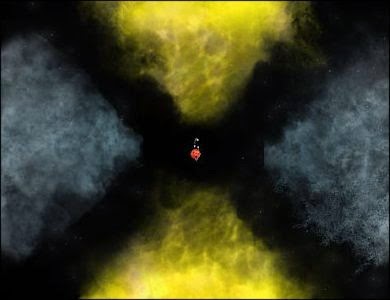
A nova does not explode like an expanding ball, but instead throws out gas in different directions at different times and different speeds. 

When this gas inevitably crashes together, it produces shocks and high-energy gamma-ray photons. 
The complex explosion and gas collisions in nova V959 Mon is illustrated here. 

In the first days of the nova explosion, dense, relatively slow-moving material is expelled along the binary star system's equator (yellow material in left panel). 

Over the next several weeks, fast winds pick up and are blown off the binary, but they are funneled along the binary star system's poles (blue material in central panel). 

The equatorial and polar material crashes together at their intersection, producing shocks and gamma-ray emission (red regions in central panel). 

Finally, at later times, the nova stops blowing a wind, and the material drifts off into space, the fireworks finished (right panel). 

Credit: Bill Saxton, NRAO/AUI/NSF

Highly-detailed radio-telescope images have pinpointed the locations where a stellar explosion called a nova emitted gamma rays, the most energetic form of electromagnetic waves.

The discovery revealed a probable mechanism for the gamma-ray emissions, which mystified astronomers when first observed in 2012.

"We not only found where the gamma rays came from, but also got a look at a previously-unseen scenario that may be common in other nova explosions," said Laura Chomiuk, of Michigan State University.

A nova occurs when a dense white dwarf star pulls material onto itself from a companion star, triggering a thermonuclear explosion that blows debris into interstellar space.

Astronomers did not expect this scenario to produce high-energy gamma rays.

However, in June of 2012, NASA's Fermi spacecraft detected gamma rays coming from a nova called V959 Mon, some 6500 light-years from Earth.

At the same time, observations with the Karl G. Jansky Very Large Array (VLA) indicated that radio waves coming from the nova probably were caused by subatomic particles moving at nearly the speed of light interacting with magnetic fields.

The high-energy gamma-ray emission, the astronomers noted, also required such fast-moving particles.

Later observations with the extremely-sharp radio "vision" of the Very Long Baseline Array (VLBA) and the European VLBI network revealed two distinct knots of radio emission. These knots then were seen to move away from each other.

This observation, along with studies made with e-MERLIN in the UK, and another round of VLA observations in 2014, provided the scientists with information that allowed them to put together a picture of how the radio knots, and the gamma rays, were produced.

In the first stage of this scenario, the white dwarf and its companion give up some of their orbital energy to boost some of the explosion material, making the ejected material move outward faster in the plane of their orbit.

Later, the white dwarf blows off a faster wind of particles moving mostly outward along the poles of the orbital plane.

When the faster-moving polar flow hits the slower-moving material, the shock accelerates particles to the speeds needed to produce the gamma rays, and the knots of radio emission.

"By watching this system over time and seeing how the pattern of radio emission changed, then tracing the movements of the knots, we saw the exact behavior expected from this scenario," Chomiuk said.

Since the 2012 outburst of V959 Mon, Fermi has detected gamma rays from three additional nova explosions.

"This mechanism may be common to such systems. The reason the gamma rays were first seen in V959 Mon is because it's close," Chomiuk said.

Because the type of ejection seen in V959 Mon also is seen in other binary-star systems, the new insights may help astronomers understand how those systems develop.

This "common envelope" phase occurs in all close binary stars, and is poorly understood.

"We may be able to use novae as a 'testbed' for improving our understanding of this critical stage of binary evolution," Chomiuk said.

Chomiuk worked with an international team of astronomers. The researchers reported their findings in the scientific journal Nature.

More information: Binary orbits as the driver of gamma-ray emission and mass ejection in classical novae , Nature, DOI: 10.1038/nature13773

Friday, September 12, 2014

ESA Gaia team discovers their first Type Ia supernova

An artist’s impression of a Type Ia supernova, the explosion of a white dwarf locked in a binary system with a companion star. 

While other types of supernovas are the explosive demises of massive stars, several times more massive than the Sun, Type Ia supernovas are the end product of their less massive counterparts.

Low-mass stars, with masses similar to the Sun’s, end their lives gently, puffing up their outer layers and leaving behind a compact white dwarf. 

Due to their high density, white dwarfs can exert an intense gravitational pull on a nearby companion star, accreting mass from it until the white dwarf reaches a critical mass that then sparks a violent explosion. 

Credit: ESA/ATG medialab/C. Carreau

While scanning the sky to measure the positions and movements of stars in our Galaxy, ESA's Gaia satellite has discovered its first stellar explosion in another galaxy far, far away.

This powerful event, now named Gaia14aaa, took place in a distant galaxy some 500 million light-years away, and was revealed via a sudden rise in the galaxy's brightness between two Gaia observations separated by one month.

Add caption
ESA Gaia, which began its scientific work on 25 July, repeatedly scans the entire sky, so that each of the roughly one billion stars in the final catalogue will be examined an average of 70 times over the next five years.

"This kind of repeated survey comes in handy for studying the changeable nature of the sky," comments Simon Hodgkin from the Institute of Astronomy in Cambridge, UK.

Many astronomical sources are variable: some exhibit a regular pattern, with a periodically rising and declining brightness, while others may undergo sudden and dramatic changes.

"As ESA's Gaia goes back to each patch of the sky over and over, we have a chance to spot thousands of 'guest stars' on the celestial tapestry," notes Dr Hodgkin.

"These transient sources can be signposts to some of the most powerful phenomena in the Universe, like this supernova."

Dr Hodgkin is part of Gaia's Science Alert Team, which includes astronomers from the Universities of Cambridge, UK, and Warsaw, Poland, who are combing through the scans in search of unexpected changes.

It did not take long until they found the first 'anomaly' in the form of a sudden spike in the light coming from a distant galaxy, detected on 30 August.

The same galaxy appeared much dimmer when Gaia first looked at it just a month before.

"We immediately thought it might be a supernova, but needed more clues to back up our claim," explains Ɓukasz Wyrzykowski from the Warsaw University Astronomical Observatory, Poland.

Other powerful cosmic events may resemble a supernova in a distant galaxy, such as outbursts caused by the mass-devouring supermassive black hole at the galaxy centre.

However, in Gaia14aaa, the position of the bright spot of light was slightly offset from the galaxy's core, suggesting that it was unlikely to be related to a central black hole.

Supernova Gaia14aaa and its host galaxy. 

Credit: M. Fraser /S. Hodgkin /L. Wyrzykowski /H. Campbell /N. Blagorodnova /Z. Kostrzewa-Rutkowska /Liverpool Telescope /SDSS

Isaac Newton Telescope (INT)
To confirm the nature of this supernova, the astronomers complemented the Gaia data with more observations from the ground, using the Isaac Newton Telescope (INT) and the robotic Liverpool Telescope on La Palma, in the Canary Islands, Spain.

A high-resolution spectrum, obtained on 3 September with the INT, confirmed not only that the explosion corresponds to a Type Ia supernova, but also provided an estimate of its distance.

This proved that the supernova happened in the galaxy where it was observed.


"This is the first supernova in what we expect to be a long series of discoveries with Gaia," says Timo Prusti, ESA's Gaia Project Scientist.

Supernovas are rare events: only a couple of these explosions happen every century in a typical galaxy, but they are not so rare over the whole sky, if we take into account the hundreds of billions of galaxies that populate the Universe.

In addition to supernovas, Gaia will discover thousands of transient sources of other kinds, stellar explosions on smaller scale than supernovas, flares from young stars coming to life, outbursts caused by black holes that disrupt and devour a nearby star, and possibly some entirely new phenomena never seen before.

"The sky is ablaze with peculiar sources of light, and we are looking forward to probing plenty of those with Gaia in the coming years," concludes Dr Prusti.

Saturday, May 18, 2013

South Africa's New Radio Telescope SKA Reveals Giant Outbursts from Binary Star System

An artist's impression of the Circinus X-1 system showing the binary (double) star system. 

Two stars orbit each other every 16.5 days in an elliptical orbit. 

The small white sphere is the neutron star - an extremely dense and compact remnant of an exploded star, only about 20 km in diameter. 

The red sphere is an ordinary star - the companion star in this system. 

When the two stars are at their closest, the neutron star pulls material from its companion star. 

An accretion disk (the blue disk) forms around the neutron star, containing the matter that is sucked from the ordinary star. 

Powerful jets of material (the orange rays) then blast out from the neutron star at close to the speed of light, causing powerful flares in radio frequencies. 

Credit: Image courtesy of University of Southampton /SKA South Africa

An international team of astronomers have reported the first scientific results from the Karoo Array Telescope (KAT-7) in South Africa, the pathfinder radio telescope for the $3 billion global Square Kilometre Array (SKA) project.

The results appear in the latest issue of the international astronomical journal Monthly Notices of the Royal Astronomical Society (MNRAS).

Using the seven-dish KAT-7 telescope and the 26 m radio telescope at the Hartebeesthoek Radio Astronomy Observatory (HartRAO), astronomers have observed a neutron star system known as Circinus X-1 as it fires energetic matter from its core into the surrounding system in extensive, compact `jets' that flare brightly, details of which are visible only in radio waves.

Journal Reference: 
R. P. Armstrong, R.P. Fender, G.D. Nicolson, S. Ratcliffe, M. Linares, J.Horrell, L. Richter, M. P. E. Schurch, M. Coriat, P. Woudt, J. Jonas, R. Booth, B. Fanaroff. A return to strong radio flaring by Circinus X-1 observed with the Karoo Array Telescope test array KAT-7. Monthly Notices of the Royal Astronomical Society, 2013