Showing posts with label New Light. Show all posts

Monday, March 10, 2014

NASA Operation Icebridge: new light on changing Greenland ice

This is the calving front of Greenland's Jakobshavn Glacier seen during an IceBridge survey flight in 2012. 

Credit: NASA / Jefferson Beck

Research using NASA data is giving new insight into one of the processes causing Greenland's ice sheet to lose mass.

A team of scientists used satellite observations and ice thickness measurements gathered by NASA's Operation IceBridge to calculate the rate at which ice flows through Greenland's glaciers into the ocean.

The findings of this research give a clearer picture of how glacier flow affects the Greenland Ice Sheet and shows that this dynamic process is dominated by a small number of glaciers.

Over the past few years, Operation IceBridge measured the thickness of many of Greenland's glaciers, which allowed researchers to make a more accurate calculation of ice discharge rates.

In a new study published in the journal Geophysical Research Letters, researchers calculated ice discharge rates for 178 Greenland glaciers more than one kilometer (0.62 miles) wide.

Ice sheets grow when snow accumulates and is compacted into ice. They lose mass when ice and snow at the surface melts and runs off and when glaciers at the coast discharge ice into the ocean.

The difference between yearly snowfall on an ice sheet and the sum of melting and discharge is called a mass budget.

When these factors are equal, the mass budget is balanced, but for years the Greenland Ice Sheet has had a negative mass budget, meaning the ice sheet is losing mass overall.

For years the processes of surface melt and glacier discharge were roughly equal in size, but around 2006 surface melt increased and now exceeds iceberg production.

In recent years, computer model projections have shown an increasing dominance of surface melt, but a limited amount of glacier thickness data made pinpointing a figure for ice discharge difficult.

Ice discharge is controlled by three major factors: ice thickness, glacier valley shape and ice velocity.

MCoRDS
Researchers used data from IceBridge's ice-penetrating radar – the Multichannel Coherent Radar Depth Sounder, (MCoRDS), which is operated by the Center for Remote Sensing of Ice Sheets at the University of Kansas, Lawrence, Kan. – to determine ice thickness and sub-glacial terrain, and images from satellite sources such as Landsat and Terra to calculate velocity.

The team used several years of observations to ensure accuracy.

"Glacier discharge may vary considerably between years," said Ellyn Enderlin, glaciologist at the University of Maine, Orono, Maine and the study's lead author.

"Annual changes in speed and thickness must be taken into account."

Wednesday, October 2, 2013

ESA Herschel throws new light on oldest cosmic light

photons in the Cosmic Microwave Background (CMB)
This illustration shows how photons in the Cosmic Microwave Background (CMB) are deflected by the gravitational lensing effect of massive cosmic structures as they travel across the Universe. 

Using data from ESA's Planck satellite, cosmologists have been able to measure this gravitational lensing of the CMB over the whole sky for the first time. 

Credit: ESA and the Planck Collaboration

Cosmologists have achieved a first detection of a long-sought component in the Cosmic Microwave Background (CMB).

This component, known as B-mode polarisation, is caused by gravitational lensing, the bending of light by massive structures as it travels across the Universe.

The result is based on the combination of data from the South Pole Telescope and ESA's Herschel Space Observatory.

This detection is a milestone along the way to the possible discovery of another kind of B-mode signal in the polarised CMB - a signal produced by gravitational waves less than a second after the Universe began.

The Cosmic Microwave Background is the most ancient light that has travelled almost unimpeded across the Universe, and it contains a wealth of information about the origin and nature of the cosmos.

During their journey, photons from the CMB have encountered a multitude of galaxies and galaxy clusters and have been deflected by these large concentrations of matter.

This phenomenon, known as gravitational lensing, imprints a subtle distortion on the pattern of the CMB that encodes details about the large-scale distribution of structure in the Universe.

In recent years, cosmologists have detected the signature of gravitational lensing on the CMB temperature using data from ground-based and space-borne experiments, including the first all-sky image of this effect achieved using ESA's Planck satellite.

A small portion of the CMB is polarised, and gravitational lensing also affects this part of the signal. In fact, the polarised CMB is an additional and even richer treasure trove than the unpolarised signal to use to explore the Universe's past.

Now a team of cosmologists studying the polarised CMB has detected in it the signature of gravitational lensing, opening new and exciting possibilities to study the distribution of matter across the cosmos.

This result is also the first detection of the elusive second component of the CMB polarisation – the long-sought B-modes.

The study is based on the combination of data from SPTpol, the polarisation-sensitive receiver on the National Science Foundation's South Pole Telescope (SPT), and the SPIRE instrument on board ESA's Herschel Space Observatory.

The SPT is a ground-based telescope, located in Antarctica, to observe the CMB to very high angular resolution in a small patch of the southern sky.

Thursday, June 13, 2013

Subaru Telescope: Cosmic giants shed new light on dark matter

Dark matter maps for 50 individual galaxy clusters (left), the average galaxy cluster (centre), and based on dark matter theory (right). 

The CDM theory (right, centre) is a close match with the average galaxy cluster observed with the Subaru telescope. 

The density of dark matter increases in the order of blue, green, yellow, red, and black colors. Credit: University of Birmingham

Astronomers at the University of Birmingham (UK), Academica Sinica in Taiwan, and the Kavli Institute of Physics and Mathematics of the Universe in Japan, have found new evidence that the mysterious dark matter that pervades our universe behaves as predicted by the 'cold dark matter' theory (CDM).

At a press conference today in Taipei the team of astronomers report their measurements of the density of dark matter in the most massive objects in the universe, namely galaxy clusters.

They found that the density of dark matter decreases gently from the centre of these cosmic giants out to their diffuse outskirts.

The fall in dark matter density from the centre to the outskirts agrees very closely with the CDM theory.

Almost eighty years after the first evidence for dark matter emerged from astronomy research, few scientists seriously doubt that it exists.

However astronomers cannot see dark matter directly in the night sky, and particle physicists have not yet identified the dark matter particle in their experiments.

"What is dark matter?"
This is still a big unanswered question facing astronomers and particle physicists, especially because there is strong evidence that 85% of the mass in the universe is invisible dark matter.

The team, led by Dr Nobuhiro Okabe (Academia Sinica) and Dr Graham Smith (Birmingham), used the Subaru telescope in Hawaii to investigate the nature of dark matter by measuring its density in fifty galaxy clusters, the most massive objects in the Universe.

"A galaxy cluster is like a huge city that you view from above during the night', explains Smith. 'Each bright city light is a galaxy, and the dark areas between the lights that appears to be empty during the night are actually full of dark matter. You can think of the dark matter in a galaxy cluster as being the infrastructure within which the galaxies live. We wanted to know how the density of dark matter changes as you drive from the centre of a these huge cities out to the suburbs."

More information: 
The research paper on which this release is based was published online in the May 17, 2013 edition of the Astrophysical Journal Letters: N. Okabe et al., "LoCuSS: The Mass Density Profile of Massive Galaxy Clusters at z=0.2", Volume 769, Number 2, Article ID. 35 (2013). iopscience.iop.org/2041-8205/769/2/L35/

Thursday, June 17, 2010

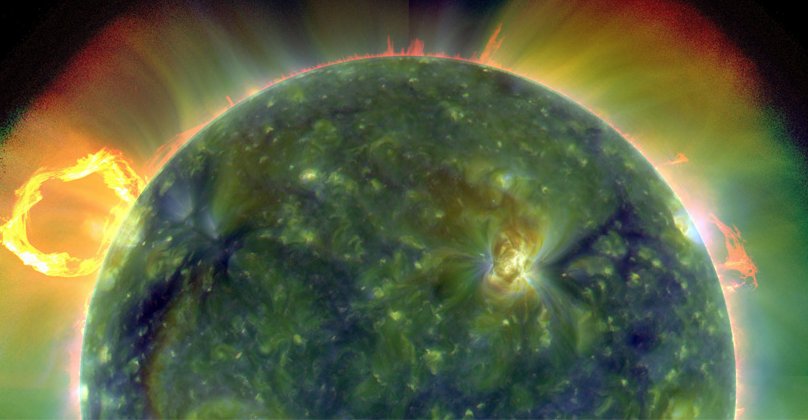
Seeing the Sun in a New Light : First SDO Photographs


Seeing the Sun in a New Light : First SDO Photographs

April 21, 2010 will be remembered as the day we saw the sun in a new light.

NASA showcased the Solar Dynamics Observatory (SDO) 'first light' imagery of the sun, photographs that are 10 times the clarity of a household high definition television.

After decades of solar physics research, the advanced instrumentation aboard the SDO will answer many mysteries about our nearest star and will no doubt uncover new questions. Already, solar physicists are examining whether long-standing solar theories are holding true, and the SDO's sheer power will help scientists protect the Earth against potentially paralyzing space weather.