
Showing posts with label Perigee. Show all posts
Showing posts with label Perigee. Show all posts
Saturday, March 19, 2011
ScienceCasts: Perigee Super Moon
"The full Moon of March 19th occurs less than one hour away from perigee--a near-perfect coincidence1 that happens only 18 years or so," adds Chester.
A perigee full Moon brings with it extra-high "perigean tides," but this is nothing to worry about, according to NOAA.
In most places, lunar gravity at perigee pulls tide waters only a few centimeters (an inch or so) higher than usual. Local geography can amplify the effect to about 15 centimeters (six inches)--not exactly a great flood.
Indeed, contrary to some reports circulating the Internet, perigee Moons do not trigger natural disasters.
The "super moon" of March 1983, for instance, passed without incident. And an almost-super Moon in Dec. 2008 also proved harmless.
Okay, the Moon is 14% bigger than usual, but can you really tell the difference? It's tricky. There are no rulers floating in the sky to measure lunar diameters. Hanging high overhead with no reference points to provide a sense of scale, one full Moon can seem much like any other.
The best time to look is when the Moon is near the horizon. That is when illusion mixes with reality to produce a truly stunning view. For reasons not fully understood by astronomers or psychologists, low-hanging Moons look unnaturally large when they beam through trees, buildings and other foreground objects.
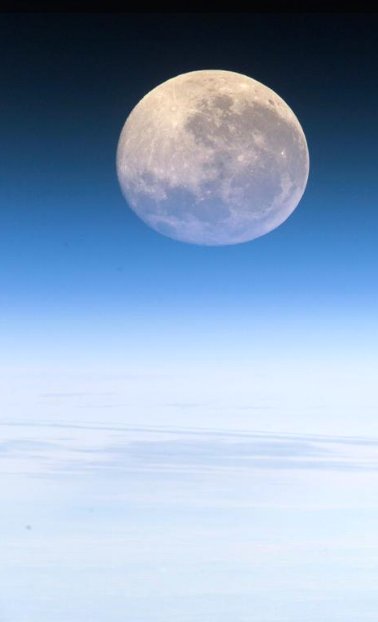
On March 19th, why not let the "Moon illusion" amplify a full Moon that's extra-big to begin with? The swollen orb rising in the east at sunset may seem so nearby, you can almost reach out and touch it but you can't because even a super Perigee Moon is still 356,577 km away.

Friday, January 29, 2010
Lunar Orbit: Perigee and Apogee Moon(s)
 Properties of the lunar orbit
The orbit of the Moon is distinctly elliptical with an average eccentricity of 0.0549.
The non-circular form of the lunar orbit causes variations in the Moon's angular speed and apparent size as it moves towards and away from an observer on Earth.
The mean angular daily movement relative to an imaginary observer at the barycenter is 13.176358° to the east. The orientation of the orbit is not fixed in space, but precesses over time.
Elongation
The Moon's elongation is its angular distance east of the Sun at any time. At new moon it is zero and the Moon is said to be in conjunction. At full moon the elongation is 180° and it is said to be in opposition. In both cases the moon is in syzygy, that is, the Sun, Moon and Earth are nearly aligned. When elongation is either 90° or 270° the Moon is said to be in quadrature.
Nodes
The line of nodes of the lunar orbit (the line of the intersection of the plane of the lunar orbit with the plane of the ecliptic) has a retrograde motion, that is, it rotates towards the west (along the ecliptic) at a rate of 19°21′ per year, that is, with a period of 6,793 days or 18.60 years (nutation period).
Thus the node, or point at which the Moon's orbit crosses the ecliptic, moves steadily clockwise (viewed from celestial north), closely aligned with Earth's orbital path but in the opposite direction. The interval of time between the passage of the Moon through the same node is called the draconitic month, and is 27.2122 days. The times of the eclipses depend upon these factors.
Line of Apsides
Perigee is the distance of closest approach, whereas apogee is its farthest recession. The line joining these two points (the line of apsides) has a progressive motion or advances, that is, it slowly rotates counterclockwise in space in the plane of the Moon's orbit, that is, direct motion, making one complete revolution in 3232.575 days or about 8.85 years.
Lunar Standstill
When the ascending node of the moon's orbit coincides with the vernal equinox in the northern hemisphere, the declination of the moon in the sky reaches a maximum at 23°29′ + 5°9′ or 28°36′.
This is called the major standstill. Nine and a half years later, when the descending node has come to the same point, the angle is only 23°28′ − 5°8′ or 18°19′, and the declination of the moon is a minimum. This is the minor standstill.
Subscribe to:
Posts (Atom)


 Posts


