Showing posts with label Twice. Show all posts

Friday, June 28, 2013

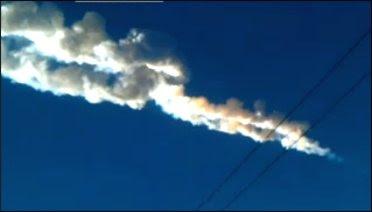
Russian Chelyabinsk meteor shockwave circled the Earth twice

The shock wave from an asteroid that burned up over Russia in February was so powerful that it travelled twice around the globe, scientists say.

They used a system of sensors set up to detect evidence of nuclear tests and said it was the most powerful event ever recorded by the network.

More than 1,000 people were injured when a 17m, 10,000-tonne space rock burned up above Chelyabinsk.

The study appears in the journal Geophysical Research Letters.

The researchers studied data from the International Monitoring System (IMS) network operated by the Comprehensive Nuclear-Test-Ban Treaty Organisation (CTBTO).

The detection stations look out for ultra-low frequency acoustic waves, known as infrasound, that could come from nuclear test explosions but the system can also detect large blasts from other sources, such as the Chelyabinsk fireball.

Alexis Le Pichon, from the Atomic Energy Commission in France and colleagues report that the explosive energy of the impact was equivalent to 460 kilotonnes of TNT.

This makes it the most energetic event reported since the 1908 Tunguska meteor in Siberia.

Friday, October 12, 2012

Scientists Discover Planet with Diamond Mantle - Twice The Size Of Our Sun

Scientists have announced the discovery of a planet made almost entirely of diamonds.

The planet, called 55 Cancri e, is located in a solar system inside the constellation of Cancer, reports NBC News.

It was discovered in 2004, and scientists have been working since then to determine its mass and radius, as well as study its host star’s composition.

The planet is called a “super-Earth,” and scientists believe that the rocky world is composed mostly of carbon (in the form of either graphite or diamond). It also includes iron, silicon carbide, and possibly silicates.

Scientists also believe, based on their research, that at least one-third of the planet’s mass is pure diamond. Lead researcher Nikku Madhusudhan of Yale University stated:

“This is our first glimpse of a rocky world with a fundamentally different chemistry from Earth. The surface of this planet is likely covered in graphite and diamond rather than water and granite.”

While worlds like the “diamond planet” of 55 Cancri e have been theorized before, and at least one has been discovered before now, it is the first of its kind to be identified orbiting around a sun-like star.

Madhusudhan’s study on the planet was published in the journal Astrophysical Journal Letters.

Princeton University astronomer David Spergel stated that it is relatively easy to find out a star’s basic structure and history once its age and mass have been discovered. He added:

“Planets are much more complex. This ‘diamond-rich super-Earth’ is likely just one example of the rich sets of discoveries that await us as we begin to explore planets around nearby stars.”