Showing posts with label Meteor. Show all posts

Wednesday, July 9, 2014

Scientists discover radio emissions are emanating from fireballs

These images show the sky above the first LWA station. 

Each image shows the full sky, down to the horizon at the image's edge.

Streaking across the sky at more than 50 kilometers per second at atmospheric heights of more than a 90 kilometers high, researchers using the first station of University of New Mexico’s Long Wavelength Array (LWA) saw something new that had never been seen before; something that could hold a treasure trove of new information in the world of physics.

Very Large Array (VLA)
The first station of the LWA, known as LWA1, is a unique telescope that consists of a collection of 256 dipoles combined into one massive array with a collective-area of a 100-meter dish.

The LWA1, is a highly sensitive telescope that can create images of the entire sky.

It allows researchers to keep eyes on the whole sky day and night, probing a relatively unexplored region of the electromagnetic spectrum.

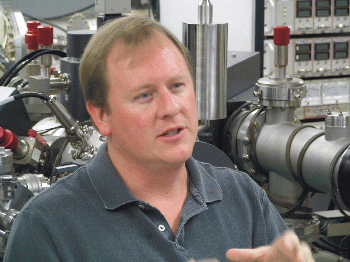
Greg Taylor
Within six months of turning LWA1 on, UNM Department of Physics Professor Greg Taylor and his team got the all sky imaging up and running.

Shortly thereafter, they started to search for transients, brief pulses of radio waves coming from the sky.

Ken Obenberger, a UNM graduate student, and colleagues searched for transients in more than 11,000 hours of all-sky images from the LWA at frequencies between 25 and 75 MHz.

In this data he identified 49 long (30 seconds or longer) transients.

"We would see a bright source appear in the sky and it would last for about a minute, and then it would go away," Obenberger said.

"Most of them would come on at one point and then fade away. Sometimes they were a bit extended and a little bit resolved by the telescope, but oftentimes, they weren't," he added.

Long Wavelength Array (LWA)
The University of New Mexico’s Long Wavelength Array (LWA) with the Very Large Array (VLA) in the background.

The research team didn't know what they were exactly and that situation went on for several months.

"When we found an event that streaked over 90 degrees across the sky (see Figure 01 below) we asked ourselves, 'could these be fireballs?'" Taylor asked.

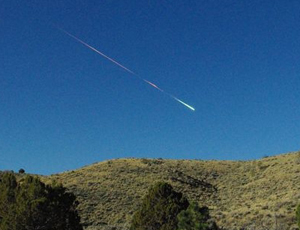
Fireballs are a class of meteor brighter than the planet Venus.

Figure 01: LWA1 image at 38 MHz of a rare fireball that streaked across the sky on Jan. 21, 2014 and left a glowing trail that lasted for over a minute. 

Emission from constant sources has been subtracted for clarity.

To investigate this possibility, the team utilized NASA's All Sky Fireball Network, an observatory consisting of 12 cameras located in the United States.

While most of the cameras are in other states, two are located in southern New Mexico.

The researchers compared the times and locations of the 49 transients with data from the Fireball Network.

They found that 10 of those transients corresponded both spatially and temporarily with fireballs. The optical always precedes the radio Obenberger says.

"You have this bright optical fireball, then slowly the radio emission ramps up. The show is over in the optical stage fairly quickly after a few seconds, but then we have this radio emission lasting for about a minute."

These detections suggest that fireballs emit a low frequency pulse, something that no other telescope has ever seen, and this discovery has provided researchers with new insight into the physics of meteors.

It'll be fun to learn more and it'll give us new information about meteors, their composition or something about the upper atmosphere. It's kind of a whole new ball game." Taylor explained.

More information: "Detection of Radio Emission from Fireballs." K.S. Obenberger, G.B. Taylor, J.M. Hartman, J. Dowell, S.W. Ellingson, J.F. Helmboldt, P.A. Henning, M. Kavic, F.K. Schinzel, J.H. Simonetti, K. Stovall, T.L. Wilson. arxiv.org/abs/1405.6772

Monday, April 21, 2014

Another Bolide Meteor explodes over Russia - Video

Why does Russia seem to get so many bright meteors?

Well at 6.6 million square miles it's by far the largest country in the world plus, with dashboard-mounted cameras being so commonplace (partly to help combat insurance fraud).

Statistically it makes sense that Russians would end up seeing more meteors, capture the event on video and share the experience with the rest of the world!

This is exactly what happened early this morning, April 19 (local time), when a bright fireball flashed in the skies over Murmansk, located on the Kola Peninsula in northwest Russia near the border of Finland.

Luckily not nearly as large or powerful as the Chelyabinsk meteor event from February 2013, no sound or air blast from this fireball has been reported and nobody was injured.

Details on the object aren't yet known… it could be a meteor (most likely) or it could be re-entering space debris.


The video above, some of which was captured by Alexandr Nesterov from his dashcam, shows the object dramatically lighting up the early morning sky.

One Russian astronomer suggests this bolide may have been part of the debris that results in the Lyrid meteor shower, which peaks on April 22-23.

Friday, February 21, 2014

Meteor: Massive explosion over Argentina

"This happened at an altitude of approximately 70 kilometers", said Prof Jorge Coghlan, the director of Observatorio AstronĂ³mico, Santa Fe, who added that as the "space rock penetrates the atmosphere; in a radius of forty kilometers it could be clearly heard".

However in this case the radius area was estimated in 300 kilometers.

The Fire Brigade of the town of El Trebol in central Santa Fe province had been warned by NASA that sometime in the morning a phenomenon of this kind was possible, "and most probably that is what happened".

Jorge Coghlan
The head of the local Fire Brigade said that according to reports from different offices the bang was heard in a radius of 250 to 300 kilometers, thus the fright and fears it could have been an earth tremor.

Marcos Escajadillo, head of Santa Fe province Civil Protection said that because of the impact and extension of the bang, "all emergency mechanisms went on alert.

Currently we are waiting for a report from the Space Activities National Committee, although at this stage we can confirm no impact on land".

"We have reports from an area of 120 kilometers and it all confirms it was a high altitude event. Radiation pressure generated the vibrations at surface level and in window glasses as if it had been a minor earthquake" added Prof Coghlan.

Prof Coghlan, the Director of Code, Center of Space Observers said that "an estimated 100.000 elements of this kind bombard the Earth every day but they are mostly so small that they are not detectable".

Authorities have not yet found any meteor fragments, but "it is possible that the orb disintegrated in the air," astronomer Prof Coghlan told local radio.

Residents in the area who reported hearing a loud explosion Tuesday said that the ground and also buildings shook.

Sunday, December 29, 2013

Mysterious Fireball Caught On Security Camera


Mysterious Fireball Caught On Security Camera

CCTV Video Footage shows a fiery object streaking across the sky in America's Midwest - but what was the object?

Friday, June 28, 2013

Russian Chelyabinsk meteor shockwave circled the Earth twice

The shock wave from an asteroid that burned up over Russia in February was so powerful that it travelled twice around the globe, scientists say.

They used a system of sensors set up to detect evidence of nuclear tests and said it was the most powerful event ever recorded by the network.

More than 1,000 people were injured when a 17m, 10,000-tonne space rock burned up above Chelyabinsk.

The study appears in the journal Geophysical Research Letters.

The researchers studied data from the International Monitoring System (IMS) network operated by the Comprehensive Nuclear-Test-Ban Treaty Organisation (CTBTO).

The detection stations look out for ultra-low frequency acoustic waves, known as infrasound, that could come from nuclear test explosions but the system can also detect large blasts from other sources, such as the Chelyabinsk fireball.

Alexis Le Pichon, from the Atomic Energy Commission in France and colleagues report that the explosive energy of the impact was equivalent to 460 kilotonnes of TNT.

This makes it the most energetic event reported since the 1908 Tunguska meteor in Siberia.

Friday, May 17, 2013

56,000 MPH Space Meteor Hits the Moon - Video


A NASA moon monitoring telescope captured the blast, which could be seen by the naked eye on Earth, on March 17th, 2013. 

The object was the size of a small boulder and may be part of a meteor swarm that also flew past Earth.

Credit: NASA

The object created a new crater 65 feet wide (20 meters). The crash sparked a bright flash of light that would have been visible to anyone looking at the moon at the time with the naked eye, NASA scientists say.

"On March 17, 2013, an object about the size of a small boulder hit the lunar surface in Mare Imbrium," Bill Cooke of NASA's Meteoroid Environment Office said in a statement.

"It exploded in a flash nearly 10 times as bright as anything we've ever seen before."


Thursday, May 16, 2013

NASA Mars HiRISE: Camera reveals Two hundred impacts each year

This image shows one of many fresh impact craters spotted by the UA-led HiRISE camera, orbiting the Red Planet on board NASA's Mars Reconnaissance Orbiter since 2006. 

Credit: NASA /JPL-Caltech /MSSS /UA

Scientists using images from NASA's Mars Reconnaissance Orbiter, or MRO, have estimated that the planet is bombarded by more than 200 small asteroids or bits of comets per year forming craters at least 12.8 feet (3.9 meters) across.

Researchers have identified 248 new impact sites on parts of the Martian surface in the past decade, using images from the spacecraft to determine when the craters appeared.

The 200-per-year planet-wide estimate is a calculation based on the number found in a systematic survey of a portion of the planet.

The University of Arizona's High Resolution Imaging Science Experiment, or HiRISE camera, took pictures of the fresh craters at sites where before and after images had been taken.

This combination provided a new way to make direct measurements of the impact rate on Mars and will lead to better age estimates of recent features on Mars, some of which may have been the result of climate change.

"It's exciting to find these new craters right after they form," said Ingrid Daubar of the UA, lead author of the paper published online this month by the journal Icarus.

"It reminds you Mars is an active planet, and we can study processes that are happening today."

These asteroids or comet fragments typically are no more than 3 to 6 feet (1 to 2 meters) in diameter.

Space rocks too small to reach the ground on Earth cause craters on Mars because the Red Planet has a much thinner atmosphere.

MRO has been examining Mars with six instruments since 2006. Daubar is an imaging targeting specialist who has been on the HiRISE uplink operation s team from the very beginning.

She is also a graduate student in the UA's department of planetary science and plans on graduating with her doctorate in spring 2014.

Leslie Tamppari
"There are five of us who help plan the images that HiRISE will take over a two-week cycle," she explained.

"We work with science team members across the world to understand their science goals, help select the image targets and compile the commands for the spacecraft and the camera."

"The longevity of this mission is providing wonderful opportunities for investigating changes on Mars," said MRO Deputy Project Scientist Leslie Tamppari of NASA's Jet Propulsion Laboratory in Pasadena, Calif.

Sunday, May 12, 2013

Our Earth and its Moon Have a Common Water Source

The Moon's water did not come from comets but was already present on Earth 4.5 billion years ago, when a giant collision sent material from Earth to form the Moon, new research shows. 

Credit: NASA/JPL

Researchers used a multicollector ion microprobe to study hydrogen-deuterium ratios in lunar rock and on Earth.

Their conclusion: The Moon's water did not come from comets but was already present on Earth 4.5 billion years ago, when a giant collision sent material from Earth to form the Moon.

Water inside the Moon's mantle came from primitive meteorites, new research finds, the same source thought to have supplied most of the water on Earth. The findings raise new questions about the process that formed the Moon.

By showing that water on the Moon and on Earth came from the same source, this new study offers yet more evidence that the Moon's water has been there all along.

Alberto Saal
"The simplest explanation for what we found is that there was water on the proto-Earth at the time of the giant impact," said Alberto Saal, associate professor of Geological Sciences at Brown University and the study's lead author.

"Some of that water survived the impact, and that's what we see in the Moon."

Erik Hauri
The research was co-authored by Erik Hauri of the Carnegie Institution of Washington, James Van Orman of Case Western Reserve University, and Malcolm Rutherford from Brown and published online in Science Express.


Journal Reference:
  1. Alberto E. Saal, Erik H. Hauri, James A. Van Orman, and Malcolm J. Rutherford. Hydrogen Isotopes in Lunar Volcanic Glasses and Melt Inclusions Reveal a Carbonaceous Chondrite HeritageScience, 9 May 2013 DOI: 10.1126/science.1235142

Wednesday, February 27, 2013

Russian Meteorite Impact: Meteor's Origin and Size Determined


A meteor that exploded over Russia earlier this month likely hit Earth after a long trip from beyond the orbit of Mars, scientists say.

Astronomers and the public were caught off guard by the Russian fireball, which damaged thousands of buildings and wounded more than 1,000 people when it detonated over the city of Chelyabinsk on Feb. 15.

But some YouTube-aided detective work suggests that the meteor's parent body belonged to the Apollo family of Earth-crossing asteroids, whose elliptical orbits take them farther than one Earth-sun distance (about 93 million miles, or 150 million kilometers) from our star at some point, researchers said.


Jorge Zuluaga and Ignacio Ferrin of the University of Antioquia in Medellin, Colombia, reached this conclusion after analysing several videos of the Russian meteor, especially one taken in Chelyabinsk's Revolutionary Square and another recorded in the nearby city of Korkino.

They also took into account the location of a hole in the ice of Lake Chebarkul, about 43 miles (70 km) from Chelyabinsk. Scientists think the hole was caused by a piece of the space rock that hit Earth on Feb. 15.

Using trigonometry, Zuluaga and Ferrin calculated basic elements of the fireball's path through Earth's atmosphere.

"According to our estimations, the Chelyabinski meteor started to brighten up when it was between 32 and 47 km up in the atmosphere," they write in their paper, which has been posted to the online astronomy preprint site ArXiv.org.

"The velocity of the body predicted by our analysis was between 13 and 19 km/s (relative to the Earth) which encloses the preferred figure of 18 km/s assumed by other researchers."

Ural Federal University scientist
The pair then entered these figures into a software program developed by the United States Naval Observatory called NOVAS (short for Naval Observatory Vector Astrometry), which calculated the likely orbit of the meteor's parent body.

Some other scientists agree that this orbit took the space rock relatively far from the sun at times — farther than Mars, in fact.

"It came from the asteroid belt, about 2.5 times farther from the sun than Earth," Bill Cooke, of NASA's Meteoroid Environment Office at the Marshall Space Flight Center in Huntsville, Ala., said in a statement. Cooke was not involved in Zuluaga and Ferrin's study.

Meanwhile, the size of the meteor's parent object has come into clearer focus, thanks to measurements made by a global network of infrasound sensors operated by the Comprehensive Test Ban Treaty Organization (CTBTO).

These sensors monitor extremely low-frequency sound waves, which are a common product of nuclear explosions.

As the Russian meteor burned through Earth's atmosphere, it generated the most powerful infrasound signal ever detected by the CTBTO network, researchers said, and this signal revealed a great deal about the asteroid's size, speed and explosive power.

"The asteroid was about 17 meters in diameter and weighed approximately 10,000 metric tons," Peter Brown, a physics professor at the University of Western Ontario in Canada, said in a statement.

"It struck Earth's atmosphere at 40,000 mph and broke apart about 12 to 15 miles above Earth's surface. The energy of the resulting explosion exceeded 470 kilotons of TNT."

That's 30 to 40 times more powerful than the atomic bomb the United States dropped on the Japanese city of Hiroshima during World War II.

The Russian fireball likely produced the most powerful such space rock blast since a 130-foot (40 m) object exploded over Siberia in 1908, flattening 825 square miles (2,137 square km) of forest.

Preliminary reports suggest that the Chelyabinsk fireball's parent asteroid was composed primarily of stone, with a smidge of iron thrown in.

"In other words, [it's] a typical asteroid from beyond the orbit of Mars," Cooke said. "There are millions more just like it."

The Russian meteor struck just hours before the 130-foot asteroid 2012 DA14 gave Earth a close shave, missing our planet by just 17,200 miles (27,000 km), but the two space rocks are unrelated, researchers say, making Feb. 15 a day of remarkable cosmic coincidences.

You can see the Arxiv paper on the Russian meteor here.

Monday, February 25, 2013

Russian Asteroid Impact: Chelyabinsk gripped by 'meteor fever'

Russia's Chelyabinsk region is gripped by a kind of meteor fever, with thousands combing through fields trying to find meteorite fragments.

Near the villages of Deputatsky and Pervomaysky, an hour's drive from Chebarkul city, whole families of meteorite hunters are hard at work. 

The meteorite passed over the area before reportedly crashing into the Chebarkul lake, and the snowy fields are covered with human footprints.

The nearby home of the Belizkaya family was filled with soot from their oven after the meteorite explosion, which caused the ceiling to crack. Initially frightened, now the family calls that day their "rebirth", and have so far found three 1cm-wide meteorite fragments.

"We came with all the family, we do it out of interest, really, this is such a memento of that event," says Elena Belizkaya of the hoard. "We'll keep it at home for now, but if there's a chance to sell it, we'll sell some, of course!"

meteorite hunters

Meteorite hunters require no particular expertise as the hunt is relatively simple - a meteorite's impact leaves a small crater similar to a mouse's hole.

If you find such a hole in a bank of snow you can be certain - it's either a mouse or a meteorite. The BBC team found four tiny stones within five minutes.

Most of those fragments found near Deputatsky are pea-sized, but some can be much bigger - more like golf balls. The biggest fragment we saw weighed about 100g.

It was found by a citizen of Chelyabinsk, who said he had received several offers from friends in Moscow. "It's like hunting or fishing," said one meteorite hunter.

"When you see an animal, your heart starts to beat fast, and when you're fishing - it's like pulling the fishing rod and thinking there's something extraordinary. This is the same - you see a tiny hole, try it, and here it is."

Space stones
Space stones Scientists from the meteorite laboratory at the Russian Academy of Science collecting samples in Chelyabinsk say the more meteorite hunters the merrier, because there are only a couple of days of good weather left for the search.

meteorite fragments

The mineral which the meteorite is made of - chondrite - is common and not of great interest. But size matters.

Any wind or snowfall will destroy meteorite traces, and small fragments will simply not be found until the spring, when the fields will be covered by tall grass.

The mineral which the meteorite is made of - chondrite - is common and not of great interest, says junior research associate Dmitry Sadilenko. But its size matters.

The Chebarkul meteorite is one of the largest on record - preliminary estimates suggest it was the size of a skyscraper. And the bigger the fragment found, the more it is worth.

What's more, according to Russia's Subsoil Law, there are no legal grounds for prohibiting people from collecting, selling and exporting meteorite fragments.

However, potentially lucrative finds are already raising eyebrows. The Internet is full of ads selling so-called fragments of the Chebarkul meteorite, with prices ranging from a few thousand to 500,000 roubles (£11,000).

Lucrative hole in the ice
The Chelyabinsk police department has already questioned one "businessman" - a resident of Emanzhelinka village - who has sold several fragments for 15,000 roubles.

He could be charged with fraud if the stones are found to be fake. Lucrative hole in the ice Although scientists from the Ural Federal University have declared Chebarkul Lake to be the location of the main meteorite fall - suggesting a fragment as wide as 50cm may be lying on the lake bed - the Chelyabinsk authorities say they cannot confirm this.

Chelyabinsk deputy governor Igor Murog told the BBC that the large ice-hole thought to have been made by the meteorite could equally have been made by a fisherman.

Meteorite hunters

Locals charge the price of an expensive Moscow taxi ride to take meteorite hunters to the Chebarkul lake ice hole. 

Meteor hunters, though, seem not to care about official statements: Many are drilling holes in the ice and lowering magnets attached to ropes into the water. For now they are finding mostly tiny fragments.

Even Chebarkul Mayor Andrey Orlov joined in the hunt, sending divers into the lake's cold water soon after the meteorite fall, only for their mission to be thwarted by silt on the lake-bed. The hunt will continue on Monday.

 He has announced a competition for business ideas as Chebarkul tries to profit from its status as the only city where meteorite fragments are known to have landed.

And locals are already cashing in, offering to shuttle visitors to the site of the now-famous ice-hole via horse and cart - for the price of an expensive Moscow taxi fare.

BBC map

Saturday, February 16, 2013

Russian Meteor Explosion Not Caused by Asteroid Flyby

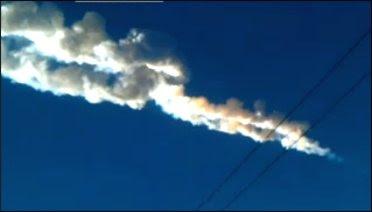
What appears to be a meteor trail over eastern Russia is seen in this image released Feb. 15, 2013, by the Russian Emergency Ministry. The meteor fall included a massive blast, according to Russian reports.

CREDIT: Russian Emergency Ministry

The meteor explosion over Russia that injured more than 500 people and damaged hundreds of buildings was not caused by an asteroid zooming close by the Earth today (Feb.15), a NASA scientist afirms.

NASA asteroid expert Don Yeomans, head of the agency's Near-Earth Object Program Office, said that the object which exploded over a thinly inhabited stretch of eastern Europe today was most likely an exploding fireball known as a Bolide or Meteoroid.

More than 500 people were reported injured, mostly by glass cuts when windows shattered during the blast, according to the Russian Emergency Ministry.

"If the reports of ground damage can be verified, it might suggest an object whose original size was several meters in extent before entering the atmosphere, fragmenting and exploding due to the unequal pressure on the leading side vs the trailing side (it pancaked and exploded)," Yeomans reported.

"It is far too early to provide estimates of the energy released or provide a reliable estimate of the original size."

Yeoman stressed that the bolide event was likely not associated at all with the incoming asteroid 2012 DA14, which will fly within 17,200 miles (27,000 kilometers) of Earth when it passes safely by our planet today.

"The asteroid will travel south to north," Yeomans said. "The bolide trail was not south to north and the separation in time between the fireball and 2012 DA14 close approach is significant."

Wednesday, April 25, 2012

Hunt is on for pieces of van-sized California meteor


Wanted: fragments of a minivan-sized meteor that exploded over northern California and Nevada on Sunday morning and may well have survived to strike Earth.

Meteorites – meteors that make landfall – can provide crucial information about the chemical composition of the early solar system.

"It's like getting sample return without having to go there," says Bill Cooke of NASA's Meteoroid Environment Office at the Marshall Space Flight Centre in Huntsville, Alabama.

However, meteorites are rare. Though meteors frequently streak across the sky, they tend to burn up before reaching the ground or they land in the sea. There's reason to think the recent meteor is different.

Apart from exploding over land, it created a sonic boom, so it must have stayed intact for long enough for it to get down into the denser air low in the atmosphere – just 16 kilometres above the Earth's surface, Cooke reckons – raising the chance that some of it hit the dirt.

Sudan similarity
He estimates it was about 4 metres long, about 70 metric tonnes and packing the energy of 4 kilotonnes of TNT. "That's about one-fourth the energy of the 'Little Boy' bomb dropped on Hiroshima," he says.

That makes the rock even bigger than 2008 TC3, a meteorite which was detected before it entered the atmosphere and became the first cosmic impact to be traced from space to landfall when astronomers found its scattered fragments in Sudan in 2008.

Cooke is also hoping someone took a video of the new meteor.

Astronomers used infrasound signals – low frequency sound that travels great distances – detected at two ground-based stations to pinpoint the spots where the new meteor entered the atmosphere and then exploded. They don't yet know where the fragments went.

Wednesday, March 14, 2012

Valuable Meteorite Crashes Into House: Oslo, Norway

A Norwegian family was shocked to find a valuable meteorite in their cottage house in the middle of Oslo.

The meteorite weighed around 585 grammes, which is around one pound, four ounces.

An astrophysicist from the University of Oslo investigated the meteorite and found it be genuine.

 "You can tell immediately that it's genuine from the burned crust, and you can also recognize it from how rough and unusual it is. It gives me goosebumps," Knut Jørgen Røed Ă˜degaard, astrophysicist at the University of Oslo stated.

According to researchers, such meteorites can a fetch lot of money, potentially worth more than $500,000. They are quite valuable to researchers as well as private collectors. Earlier, chunks of Mars have fetched $877 per gram.

"This family is very lucky," Serge Koutchmy, a researcher at the Paris Astrophysical Institute, reported. "First of all because the piece of meteorite did not cause much damage, and secondly, because it is worth a small fortune."

Sunday, March 4, 2012

Scotland & North England: 'Meteor' sight swamps switchboards


Police forces across the UK have received numerous calls after a large fireball, thought to be a meteor, was spotted in the sky.

Reports of a "bright light" and an "orange glow" were received by police across Scotland and the north of England around 9.40pm on Saturday. The Met Office tweeted: "Hi All, for anyone seeing something in the night sky, we believe it was a meteorite."

The Kielder Observatory also reported the sighting of a "huge fireball" travelling from north to south over Northumberland at 9.41pm. The Observatory posted on Twitter: "Of 30 years observing the sky #fireball best thing I have ever seen period."

Meteors are particles from space that burn up in a streak of light as they enter the Earth's atmosphere, whereas meteorites are larger objects that survive the trip and reach the surface of the Earth.

Dr David Whitehouse, an author and astronomer, said: "Judging by its brightness, it may have have been large enough to survive and hit the ground but until people work out its trajectory we won't have any idea where it might have come down."

Dr Whitehouse said the object was about the size of a fist and was probably the debris of a planet that never properly formed. He said: "It's a chunk of rock that's probably come from somewhere between Mars and Jupiter and has been in space for thousands of millions of years. There are tens of thousands of bits of rock and grains of sand orbiting between Mars and Jupiter. Some of it comes out of that orbit and some of it hits the Earth."

A spokesman for Strathclyde Police said the force had been "inundated" with calls about a bright object in the sky across the west of Scotland.

A Durham Police spokeswoman said a number of calls came in around 9.45pm from concerned members of public who had seen a "bright light or a fire in the sky" and believed it may have been incidents involving an aircraft.

"It has been confirmed with air traffic control that there are no incidents of aircraft in difficulty and nothing registered on radar," she said. "The sightings are believed to be either an asteroid burning out or similar which has been restricted to the upper atmosphere only."

Grampian Police said reports of people seeing a "flare or a bright object with a tail" were received from across the region. And Dumfries and Galloway Constabulary said numerous calls were made about a "large ball of fire in the sky" across Annandale and Eskdale. One user wrote on the force's Facebook page: "It was awesome to see! Really big and bright!"

Monday, October 10, 2011

NASA Herschel: Icy Comets seeded Earth oceans

New evidence supports the theory that comets delivered a significant portion of Earth’s oceans, which scientists believe formed about 8 million years after the planet itself.

The findings, which involve a University of Michigan astronomer, are published Oct. 5 online in Nature.

“Life would not exist on Earth without liquid water, and so the questions of how and when the oceans got here is a fundamental one,” said U-M astronomy professor Ted Bergin, “It’s a big puzzle and these new findings are an important piece.”

Bergin is a co-investigator on HiFi, the Heterodyne Instrument for the Infrared on the Hershel Space Observatory. With measurements from HiFi, the researchers found that the ice on a comet called Hartley 2 has the same chemical composition as our oceans.

Both have similar D/H ratios. The D/H ratio is the proportion of deuterium, or heavy hydrogen, in the water. A deuterium atom is a hydrogen with an extra neutron in its nucleus.

This was the first time ocean-like water was detected in a comet.

“We were all surprised,” Bergin said.

Six other comets HiFi measured in recent years had a much different D/H ratio than our oceans, meaning similar comets could not have been responsible for more than 10 percent of Earth’s water.

The astronomers hypothesize that Hartley 2 was born in a different part of the solar system than the other six. Hartley most likely formed in the Kuiper belt, which starts near Pluto at about 30 times farther from the sun than the Earth is. The other six hail from the Oort Cloud more than 5,000 times farther out.

The source of earth’s oceans has been a subject for debate among astronomers for decades. Until now, asteroids were thought to have provided most of the water. Now, however, Herschel has shown that at least one comet does have ocean-like water.

“The results show that the amount of material out there that could have contributed to Earth’s oceans is perhaps larger than we thought,” Bergin said.

Herschel, a European Space Agency mission with NASA participation, is an orbiting telescope that allows astronomers to observe at the far-infrared wavelengths where organic molecules and water emit their chemical signatures.

The paper is called “Ocean-like water in the Jupiter-family comet 103P/Hartley 2.”

Wednesday, May 4, 2011

Asteroids make life's raw materials

For the first time, rocks from an asteroid have been shown to power the synthesis of life's essential chemicals.

The asteroid in question fell to Earth on 28 September 1969, landing on the outskirts of the village of Murchison in Victoria, Australia. 


The discovery suggested that space was not the chemically sterile place it was once thought to be, and that organic chemistry was widespread. It hinted that the molecules life needed to get started could have been produced in space, before dropping to Earth.

But how did those molecules form? Raffaele Saladino of the University of Tuscia in Viterbo, Italy, and colleagues wondered if they could have been made deep inside the asteroids from which some meteorites break off. The team knew that a simple chemical present in space, called formamide, can be transformed into many biomolecules, so they used that as their starting point.

They obtained 1 gram of the Murchison meteorite, ground it to powder and removed all the organic molecules, leaving just the mineral. They mixed this with formamide and heated it to 140°C for 48 hours. 

The reaction produced nucleic acids - essential building blocks of DNA and RNA - as well as the amino acid glycine, carboxylic acids and a precursor to sugar (Origins of Life and Evolution of Biospheres, DOI: 10.1007/s11084-011-9239-0). This suggests the meteorite's parent asteroid was a chemical factory, Saladino says.

Crucially, the compounds produced are both metabolic and genetic, covering two key parts of primitive life, says Monica Grady of the Open University in Milton Keynes, UK, who was not involved in the study. "If you can catalyse both reactions in the same place, from the same starting material, that's obviously advantageous."

The ability to produce a range of essential molecules sets the meteorite mineral apart from Earth minerals, says Mark Sephton of Imperial College London. On Earth, the formation of each biomolecule tends to be catalysed by a different mineral, meaning they end up separated and less likely to form life.

Saladino's team also found that the meteorite mineral could stabilise RNA, thought by some to have been the first genetic material. RNA reacts with water and breaks down easily. Most minerals accelerate this process, but the team found that the Murchison mineral did not. "If RNA could be synthesised [inside the asteroid], this environment would stabilise it," Saladino says.

Wednesday, January 26, 2011

Wednesday, December 9, 2009

NASA: The Geminid meteor shower has intensified since its discovery

Wrap up warn and gather together all your family and friends because tonight the best meteor shower of 2009 is about to fall over North America on a long, cold December night.

"It's the Geminid meteor shower," says Bill Cooke of NASA's Meteoroid Environment Office. "and it will peak on Dec. 13th and 14th under ideal viewing conditions."

A new Moon will keep skies dark for a display that Cooke and others say could top 140 meteors per hour. According to the International Meteor Organization, maximum activity should occur around 12:10 a.m. EST (0510 UT) on Dec. 14th.

The peak is broad, however, and the night sky will be rich with Geminids for many hours and perhaps even days around the maximum.

Cooke offers this advice: "Watch the sky during the hours around local midnight. For North Americans, this means Sunday night to Monday morning."

Researchers are interested to see what the Geminids do in 2009. The shower has been intensifying in recent decades and they wonder if the trend will continue.

Geminids are pieces of debris from a strange object called 3200 Phaethon. Long thought to be an asteroid, Phaethon is now classified as an extinct comet. It is, basically, the rocky skeleton of a comet that lost its ice after too many close encounters with the sun. Earth runs into a stream of debris from 3200 Phaethon every year in mid-December, causing meteors to fly from the constellation Gemini: sky map.

When the Geminids first appeared in the late 19th century, shortly before the US Civil War, the shower was weak and attracted little attention. There was no hint that it would ever become a major display until now.

"The Geminids are strong-and getting stronger," says Cooke,

What's going on? Jupiter's gravity has been acting on Phaethon's debris stream, causing it to shift more and more toward Earth's orbit. Each December brings a deeper plunge into the debris stream.

Meteor expert Peter Brown of the University of Western Ontario (UWO) says the trend could continue for some time to come. "Based on modeling of the debris done by Jim Jones in the UWO meteor group back in the 1980s, it is likely that Geminid activity will increase for the next few decades, perhaps getting 20% to 50% higher than current rates."

A 50% increase would boost the Geminids to 200 or more meteors per hour, year in and year out. "That would be an amazing annual display," says Cooke.

Moreover, says Brown, "the proportion of large, bright Geminids should also increase in the next few decades, according to Jones' model." So the Geminids could turn into a "fireball shower."

Brown cautions that "other models of the debris stream come to different conclusions, in some cases suggesting that Geminids will decrease in intensity in the coming decades. We understand little about the details of the formation and evolution of Phaethon's debris despite many years of efforts." Enjoy Geminids!

Wednesday, September 23, 2009

62 New Meteor Showers Found: Don't Forget Perseids

Every now and again, biologists turn up a bonanza of new species deep in the ocean or in remote corners of the Earth. But astronomers usually have to make do with a trickle of new discoveries, spotting a rare supernova here or a couple of backwards planets there.

Now, researchers in Canada report finding an incredible 62 new meteor showers, displays of 'shooting stars' that recur every year when Earth passes through the trail of debris left behind by a comet or asteroid.

"I was surprised to find so many new ones," says team leader Peter Brown of the University of Western Ontario.

He credits the wealth of discoveries to the nature of his survey, which detects incoming debris about 10 times as small as can generally be seen by eye, catching objects about 0.1 millimetres across. The survey, based near London, Ontario, uses radar to detect the trail of ionised gases produced as the debris particles slam into the atmosphere at blistering speeds.

The survey measures the paths of the debris particles, allowing researchers to trace their orbits around the sun – and potentially track down their parent bodies. "The central reason for looking at these streams is to trace them back to their origins," Brown told New Scientist.