Showing posts with label Earth's atmosphere. Show all posts

Thursday, April 24, 2014

CTBTO detected 26 asteroid explosions in Earth's atmosphere over last ten years - Video


The B612 Foundation, a California-based nonprofit dedicated to raising awareness about the risks of an asteroid collision, has released this video visualising the 26 asteroids that have hit the Earth's atmosphere between 2000 and 2013.

The 26 asteroids were identified by listening devices manned by the Comprehensive Nuclear Test Ban Treaty Organization (CTBTO), a global detection network created to keep an ear out for unauthorised nuclear weapons testing. The impact explosions ranged in strength from one to 600 kilotons.

"To put that in perspective, the atomic bomb that destroyed Hiroshima in 1945, exploded with an energy impact of 15 kilotons," the B612 Foundation pointed out in a press release.

Between 2000 and 2013, CTBTO's a network of sensors that monitors Earth around the clock listening for the infrasound signature of nuclear detonations detected 26 explosions on Earth ranging in energy from 1 to 600 kilotons.

These explosions were not by caused by nuclear explosions, but rather by asteroid impacts.

While most of these asteroids exploded too high in the atmosphere to do serious damage on the ground, the evidence is important in estimating the frequency of a potential “city-killer-size” asteroid.

A list of the impacts shown in the video can be found on the B612 website here.

Friday, November 8, 2013

ESA GOCE Gravity research satellite re-enters Earth's Atmosphere

The European Space Agency says its GOCE research satellite crashed to Earth on Sunday night with 25% of it falling as debris.

European satellite met its fiery doom in Earth's atmosphere late Sunday (Nov. 10), succumbing to the same gravitational pull of the planet that it spent the last four years mapping like never before.


The European Space Agency's GOCE satellite fell from space Sunday at 7 p.m. EST (0000 Nov. 11 GMT) while flying on a path that would take it over Siberia, the Western Pacific Ocean, the eastern Indian Ocean and Antarctica, ESA officials said.

"As expected, the satellite disintegrated in the high atmosphere and no damage to property has been reported," ESA officials wrote in a statement.

GOCE was launched in 2009 to map the Earth's gravitational field. It ran out of fuel last month, ending the mission.

Monday, June 10, 2013

NASA AIM Spacecraft: Noctilucent Clouds Start Early this year - Video


Glowing electric-blue at the edge of space, noctilucent clouds have surprised researchers by appearing early this year. The unexpected apparition hints at a change in the "teleconnections" of Earth's atmosphere.

Every summer, something strange and wonderful happens high above the north pole. Ice crystals begin to cling to the smoky remains of meteors, forming electric-blue clouds with tendrils that ripple hypnotically against the sunset sky.

Noctilucent clouds (NLCs) are a delight for high-latitude sky watchers, and around the Arctic Circle their season of visibility is always eagerly anticipated.

News flash: This year, NLCs are getting an early start. NASA's AIM spacecraft, which is orbiting Earth on a mission to study noctilucent clouds, started seeing them on May 13th.

Cora Einterz Randall
"The 2013 season is remarkable because it started in the northern hemisphere a week earlier than any other season that AIM has observed," reports Cora Randall of the Laboratory for Atmospheric and Space Physics (LASP) at the University of Colorado. "This is quite possibly earlier than ever before."

The early start is extra-puzzling because of the solar cycle. Researchers have long known that NLCs tend to peak during solar minimum and bottom-out during solar maximum-a fairly strong anti-correlation.

"If anything, we would have expected a later start this year because the solar cycle is near its maximum," Randall says. "So much for expectations."

For sky watchers, this means it's time to pay attention to the sunset sky, where NLCs are most often seen. An early start could herald brighter clouds and wider visibility than ever before.

Monday, March 4, 2013

Russian Meteor Impact: What is known? Technical Details

The large fireball (technically, a "superbolide") observed on the morning of February 15, 2013 in the skies near Chelyabinsk, Russia, was caused by a relatively small asteroid approximately 17 to 20 meters in size, entering the Earth's atmosphere at high speed and a shallow angle.

In doing so it released a tremendous amount of energy, fragmented at high altitude, and produced a shower of pieces of various sizes that fell to the ground as meteorites.

The fireball was observed not only by video cameras and low frequency infra-sound detectors, but also by U.S. Government sensors.

As a result, the details of the impact have become clearer. There is no connection between the Russian fireball event and the close approach of asteroid 2012 DA14, which occurred just over 16 hours later.

New Fireball Data
U.S. Government sensor data on fireballs are now reported on the NASA Near-Earth Object Program Office website.

The February 15th event is the first entry on this new site, and it provides the following information about the fireball:

  • Date and time of maximum brightness: 15 Feb. 2013/03:20:33 GMT
  • Geographic location of maximum brightness: Latitude: 54.8 deg. N :: Longitude: 61.1 deg. E
  • Altitude of maximum brightness: 23.3 km (14.5 miles)
  • Velocity at peak brightness: 18.6 km/s (11.6 miles/s)
  • Approximate total radiated energy of fireball: 3.75 x 10^14 Joules. This is the equivalent of about 90 kilotons (kt) of TNT explosives, but it does not represent the total impact energy (see note below).
  • Approximate total impact energy of the fireball in kilotons of TNT explosives (the energy parameter usually quoted for a fireball): 440 kt.

Note that the total energy of a fireball event is several times larger than the observed total radiated energy.

The JPL fireballs website uses the following empirical formula derived by Peter Brown and colleagues to convert the optical radiant energy Eo into an estimate of the total impact energy E (see: Brown et al., The flux of small near-Earth objects colliding with the Earth. Nature, vol. 420, 21 Nov. 2002, pp. 294-296):.

E = 8.2508 x E_o ^0.885

During the atmospheric entry phase, an impacting object is both slowed and heated by atmospheric friction.

In front of it, a bow shock develops where atmospheric gases are compressed and heated. Some of this energy is radiated to the object causing it to ablate, and in most cases, to break apart.

Fragmentation increases the amount of atmosphere intercepted and so enhances ablation and atmospheric braking.

The object catastrophically disrupts when the force from the unequal pressures on the front and back sides exceeds its tensile strength.

This was an extraordinarily large fireball, the most energetic impact event recognized since the 1908 Tunguska blast in Russian Siberia.

The meteorites recovered from the Chelyabinsk fireball are reported to be ordinary chondrites, which have a typical density of about 3.6 g/cm^3.

Given the total energy of about 440 kt, the approximate effective diameter of the asteroid would be about 18 meters, and its mass would be roughly 11,000 tons.

NB: All estimates of total energy, diameter and mass are very approximate.

Thursday, January 17, 2013

CHINA's Openly Aggressive Strategy to Dominate Space

China is making increasingly aggressive plans to launch 20 spacecrafts this year,2013.

This will include the country's third lunar probe Chang'e-3 and manned spacecraft Shenzhou-10, China Aerospace Science and Technology Corporation (CASC) announced.

The country is scheduled to conduct a manned space docking test between orbiting target module Tiangong-1 and Shenzhou-10, the corporation said during an internal work conference.

The Chang'e-3 moon probe is expected to land and stay there during the second stage of the country's lunar probe program, it said.

According to CASC, by 2020, China will have more than 200 spacecrafts operating in orbit, accounting for about 20 percent of the world's total.

How many of the countries who are already under threat from China's expansionist plans will suffer as a consequence of their imposed domination of the space above the Earth's atmosphere?

What safeguards can be put in place to prevent their militarisation of Space and to make the Earth's atmospheric zone a de-militarised zone (DMZ)?

Wednesday, January 16, 2013

CHINA: Stench of Air Pollution Soars unabated

Residents of Beijing and many other cities in China were warned to stay inside in mid-January 2013 as the nation faced one of the worst periods of air quality in recent history.

The Chinese government ordered factories to scale back emissions, while hospitals saw spikes of more than 20 to 30 percent in patients complaining of respiratory issues, according to news reports.

At the time that this Jan. 14 image was taken by satellite, ground-based sensors at the U.S. Embassy in Beijing reported PM2.5 measurements of 291 micrograms per cubic meter of air.

Fine, airborne particulate matter (PM) that is smaller than 2.5 microns (about one thirtieth the width of a human hair) is considered dangerous because it is small enough to enter the passages of the human lungs.

Most PM2.5 aerosol particles come from the burning of fossil fuels and biomass (wood fires and agricultural burning). The World Health Organization (WHO) considers PM2.5 to be safe when it is below 25.

Also at the time of the image, the air quality index (AQI) in Beijing was 341. An AQI above 300 is considered hazardous to all humans, not just those with heart or lung ailments. AQI below 50 is considered good.

On January 12, the peak of the current air crisis, AQI was 775 the U.S Embassy Beijing Air Quality Monitor—off the U.S. Environmental Protection Agency scale—and PM2.5 was 886 micrograms per cubic meter.

› View image comparisons with annotations.

Image Credit: NASA/Terra - MODIS

Monday, June 25, 2012

NASA Shuttle Image: Lightning flashes, city lights, sunset, Aurora Australis

Lightning flashes, city lights, sunset, Aurora Australis, atmospheric glow and some stars, seen over Argentina on 4/23/2003

Image courtesy of the Image Science & Analysis Laboratory, NASA Johnson Space Center

Monday, June 18, 2012

NASA Maps Global View of Health-Sapping Air Pollution

In many developing countries, the absence of surface-based air pollution sensors makes it difficult, and in some cases impossible, to get even a rough estimate of the abundance of a subcategory of airborne particles that epidemiologists suspect contributes to millions of premature deaths each year.

The problematic particles, called fine particulate matter (PM2.5), are 2.5 micrometers or less in diameter, about a tenth the fraction of human hair. These small particles can get past the body’s normal defenses and penetrate deep into the lungs.

To fill in these gaps in surface-based PM2.5 measurements, experts look toward satellites to provide a global perspective.

Yet, satellite instruments have generally struggled to achieve accurate measurements of the particles in near-surface air.

The problem: Most satellite instruments can't distinguish particles close to the ground from those high in the atmosphere.

In addition, clouds tend to obscure the view and bright land surfaces, such as snow, desert sand, and those found in certain urban areas can mar measurements.

However, the view got a bit clearer this summer with the publication of the first long-term global map of PM2.5 in a recent issue of Environmental Health Perspectives.

Canadian researchers Aaron van Donkelaar and Randall Martin at Dalhousie University, Halifax, Nova Scotia, Canada, created the map by blending total-column aerosol amount measurements from two NASA satellite instruments with information about the vertical distribution of aerosols from a computer model.

Read more of this article here: NASA - Global View of Health-Sapping Air Pollution

Sunday, June 17, 2012

Earth Orbiting debris starting to impede Space Exploration programs

Japan’s H-2A rocket that blasted off on May 18 sent a Japanese satellite, Shizuku, and a South Korean satellite, Arirang-3, into orbit but it has also left behind space junk, the accumulation of which is starting to create big problems above Earth's atmosphere.

The amount of space debris has steadily increased since its start on Oct. 4, 1957, when the Soviet Union launched Sputnik 1, the first artificial satellite to enter Earth orbit.

Now that India and China are testing space systems, the "garbage problem" could rise at an explosive rate.

Countries are now trying to figure out ways to take care of the problem, but progress has been slow.

"We know that it will eventually impede the development of space, but if we just leave space debris out there anyway, then some day we won't be able to go into space anymore and our development there will hit a brick wall," said Seishiro Kibe, director of the Innovative Technology Research Center of the Japan Aerospace Exploration Agency (JAXA).

An estimated 22,000 pieces of debris with a diameter of 10 centimeters or more are floating around in space. Information, such as orbital path, size and origin, is known for about 16,000 of them.

There are also about 1,000 satellites in operation. The continued accumulation of space debris could interfere with the satellites' orbital paths, leaving them nowhere to operate.

Debris has always been a part of space development and will continue to be so but nations participating in space programs need to take responsibility for the disposal of there waste products, just as on Earth.

Read more of this article here: Space debris - AJW by The Asahi Shimbun

Wednesday, March 28, 2012

NASA Aqua MODIS: Science and Beauty Video


Beautiful images from the MODIS instrument on NASA's Aqua and Terra satellites are used by people all over the world every day but MODIS is about more than just pretty pictures.

The instrument's contributions to science include a better understanding of the Earth's cloud cover, aerosols, phytoplankton levels, and land cover.

Friday, March 16, 2012

Felix Baumgartner: First manned skydiving test flight

Felix Baumgartner prepares to jump in the first manned test flight for Red Bull Stratos over Roswell, New Mexico.

The Austrian lifted off aboard a helium balloon for the test jump. He rode inside a pressurised capsule to an altitude of 13.6 miles (21.8 kilometres), then jumped.

Baumgartner is aiming for nearly 23 miles (37 kilometres) this summer. The record is 19.5 miles (31.3 kilometres).

For comparison, commercial jets generally cruise at over 30,000 feet (9 kilometers).

Baumgartner reached speeds of up to 364.4 mph (586.4 kph) and was in free fall for three minutes and 43 seconds before pulling his parachute cords.

The entire jump lasted eight minutes and eight seconds...

Picture: EPA/Jay Nemeth / GLOBAL NEWSROOM

Saturday, March 10, 2012

Solar Storms: Electro-magnetic Radiation from the Sun

Caption: Artist illustration of events on the sun changing the conditions in Near-Earth space.

Credit: NASA 

Space weather starts at the sun. It begins with an eruption such as a huge burst of light and radiation called a solar flare or a gigantic cloud of solar material called a coronal mass ejection (CME).

But the effects of those eruptions happen at Earth, or at least near-Earth space. Scientists monitor several kinds of space "weather" events, geomagnetic storms, solar radiation storms, and radio blackouts – all caused by these immense explosions on the sun.

To read more go to: www.nasa.gov/mission_pages/sunearth/news/storms-on-sun.html

Thursday, January 26, 2012

CANADA Lego Man in Space - YouTube


A video posted on YouTube shows the amazing voyage of a Lego man sent into space on a homemade spacecraft by two Toronto students.

Mathew Ho and Asad Muhammad, both 17, used a weather balloon ordered online and a makeshift Styrofoam spacecraft to send the plastic astronaut 15 miles into the stratosphere, reports said.

Their high school principal Lecourgos Papathanasakis confirmed the "amazing voyage" but neither of the teens was immediately available for comment.

The accelerated video clip shows highlights of the Lego man during his 97-minute odyssey.


Ultimately, he is seen holding a Canadian flag with the curvature of the Earth and the blackness of space in the background.

Canadian media said the pair had fitted a box tethered to the balloon with four cameras and a cellphone enabled with a GPS (global positioning system) device to capture the journey.

They then added a home-made nylon parachute, using Asad's mother's sewing machine, so the Lego man would return to Earth safely.

The balloon was filled with helium purchased from a party supply store.

The whole enterprise cost less than £320.

The duo then consulted a website to calculate the estimated landing spot of the weather balloon based on launch coordinates, prevailing winds and other data before launching it from a soccer pitch in nearby Newmarket, Ontario.

At four miles in altitude, the balloon travelled out of cell phone range and the GPS signal also cut out, so they went home and waited until Ho's iPad beeped.

The Lego man had called home. It had re-entered the atmosphere, picked up the cell signal again and touched down in a field 75 miles from the launch point.


Michael Reid, an astrophysicist at the University of Toronto, said what Ho and Muhammad were able to achieve is extraordinary.

"There are people that are doing it, but I haven't seen many examples of 17-year-old kids doing it," Reid said. "It's a pretty impressive accomplishment."

Friday, January 13, 2012

Svalbard's Frozen antenna field sounding out the Tropopause

(Image: Vincent Fournier)

Svalbard - the most northerly outpost of Norway and home to some 3000 polar bears - is an isolated group of glacier-covered islands deep within the Arctic Circle.

As we know only too well, glaciers haven't been faring well in recent years.

But it isn't the state of the ice that is being monitored here.

Instead, the vital climate change research being carried out is aimed high in the sky, to the mysterious region of the atmosphere known as the tropopause.


Stand on the surface of the Earth and your head is in the troposphere. Near the poles the troposphere is at its thinnest: about 9 kilometres thick. At the equator it is more like 17 kilometres.

Above it is the stratosphere, and at the intersection between the two is the tropopause.


Monitoring the region is the SOUSY Svalbard Radar (SSR), an array of 96 Yagi-UDA antennas in Adventdalen on Spitsbergen Island, shown in the photo.  

SOUSY stands for sounding system: its job is to sound out the activity of the atmosphere, by measuring phenomena such as gravity waves and air turbulence.

We need to know what the tropopause is doing because greenhouse gases have very different effects above and below it.

"While increasing greenhouse gas concentrations contribute to warming the troposphere, the very same gases diffuse into the middle atmosphere where they act as refrigerants and therefore cause 'global cooling'," says Chris Hall of the University of Tromsø, Norway, who works on the SSR.

Since the altitude of the tropopause is affected both by warming from below and cooling from above it is particularly sensitive to radiative forcing, the amount of solar energy trapped in the atmosphere.

"The SOUSY radar monitors parameters such as tropopause height 24/7," says Hall. "A long-enough time series built up by this instrument helps us monitor and understand climate change in new ways."

Saturday, October 15, 2011

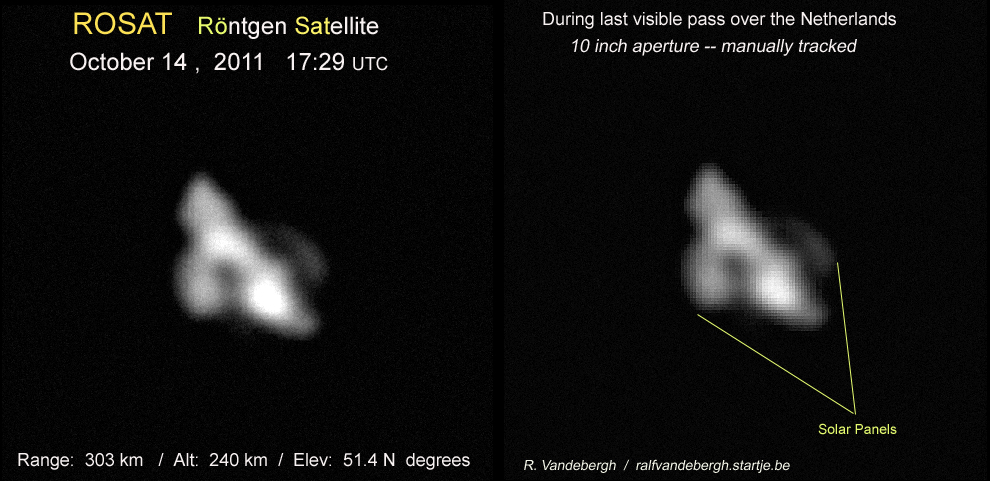
Final high-res capture of ESA's ROSAT, over Netherlands


Final high-res capture of ESA's ROSAT, during last visible pass over Netherlands.

Only 9 days before it's expected to re-enter earth's atmosphere and burn up.

Credit: Ralf van de Bergh

Monday, September 26, 2011

NASA SLS: New Deep Space Exploration System

NASA is ready to move forward with the development of the Space Launch System -- an advanced heavy-lift launch vehicle that will provide an entirely new national capability for human exploration beyond Earth's orbit.

The Space Launch System will give the nation a safe, affordable and sustainable means of reaching beyond our current limits and opening up new discoveries from the unique vantage point of space.

The Space Launch System, or SLS, will be designed to carry the Orion Multi-Purpose Crew Vehicle, as well as important cargo, equipment and science experiments to Earth's orbit and destinations beyond. Additionally, the SLS will serve as a back up for commercial and international partner transportation services to the International Space Station.

"This launch system will create good-paying American jobs, ensure continued U.S. leadership in space, and inspire millions around the world," NASA Administrator Charles Bolden said. "President Obama challenged us to be bold and dream big, and that's exactly what we are doing at NASA. While I was proud to fly on the space shuttle, tomorrow's explorers will now dream of one day walking on Mars."

NASA - NASA Announces Design for New Deep Space Exploration System

Wednesday, May 4, 2011

Asteroids make life's raw materials

For the first time, rocks from an asteroid have been shown to power the synthesis of life's essential chemicals.

The asteroid in question fell to Earth on 28 September 1969, landing on the outskirts of the village of Murchison in Victoria, Australia. 


The discovery suggested that space was not the chemically sterile place it was once thought to be, and that organic chemistry was widespread. It hinted that the molecules life needed to get started could have been produced in space, before dropping to Earth.

But how did those molecules form? Raffaele Saladino of the University of Tuscia in Viterbo, Italy, and colleagues wondered if they could have been made deep inside the asteroids from which some meteorites break off. The team knew that a simple chemical present in space, called formamide, can be transformed into many biomolecules, so they used that as their starting point.

They obtained 1 gram of the Murchison meteorite, ground it to powder and removed all the organic molecules, leaving just the mineral. They mixed this with formamide and heated it to 140°C for 48 hours. 

The reaction produced nucleic acids - essential building blocks of DNA and RNA - as well as the amino acid glycine, carboxylic acids and a precursor to sugar (Origins of Life and Evolution of Biospheres, DOI: 10.1007/s11084-011-9239-0). This suggests the meteorite's parent asteroid was a chemical factory, Saladino says.

Crucially, the compounds produced are both metabolic and genetic, covering two key parts of primitive life, says Monica Grady of the Open University in Milton Keynes, UK, who was not involved in the study. "If you can catalyse both reactions in the same place, from the same starting material, that's obviously advantageous."

The ability to produce a range of essential molecules sets the meteorite mineral apart from Earth minerals, says Mark Sephton of Imperial College London. On Earth, the formation of each biomolecule tends to be catalysed by a different mineral, meaning they end up separated and less likely to form life.

Saladino's team also found that the meteorite mineral could stabilise RNA, thought by some to have been the first genetic material. RNA reacts with water and breaks down easily. Most minerals accelerate this process, but the team found that the Murchison mineral did not. "If RNA could be synthesised [inside the asteroid], this environment would stabilise it," Saladino says.

Thursday, September 23, 2010

The sun joins the climate club - environment - 23 September 2010 - New Scientist

THE idea that changes in the sun's activity can influence the climate is making a comeback, after years of scientific vilification, thanks to major advances in our understanding of the atmosphere.

The findings do not suggest - as climate sceptics frequently do - that we can blame the rise of global temperatures since the early 20th century on the sun.

"There are extravagant claims for the effects of the sun on global climate," says Giles Harrison, an atmospheric physicist at the University of Reading, UK. "They are not supported."

Where solar effects may play a role is in influencing regional weather patterns over the coming decades. Predictions on these scales of time and space are crucial for nations seeking to prepare for the future.

Over the famous 11-year solar cycle, the sun's brightness varies by just 0.1 per cent. This was seen as too small a change to impinge on the global climate system, so solar effects have generally been left out of climate models.

However, the latest research has changed this view, and the next report by the Intergovernmental Panel on Climate Change (IPCC), due in 2013, will include solar effects in its models.

So far, three mechanisms have come to light (see diagram). The best understood is what is known as the top-down effect, described by Mike Lockwood, also at the University of Reading, and Joanna Haigh of Imperial College London. Although the sun's brightness does not change much during solar maxima and minima, the type of radiation it emits does.

During maxima the sun emits more ultraviolet radiation, which is absorbed by the stratosphere.This warms up, generating high-altitude winds. Although the exact mechanism is unclear, this appears to have knock-on effects on regional weather: strong stratospheric winds lead to a strong jet stream.

The sun's brightness does not change much during solar maxima, but the type of radiation it emits does

The reverse is true in solar minima, and the effect is particularly evident in Europe, where minima increase the chances of extreme weather. Indeed, this year's cold winter and the Russian heatwave in July have been linked to the sun's current lull, which froze weather systems in place for longer than normal.

The second effect is bottom-up, in which additional visible radiation during a solar maximum warms the tropical oceans, causing more evaporation and therefore more rain, especially close to the equator.

On its own, the effect may not be sufficient to cause noticeable differences. "It's too weak a forcing," says Tim Woollings of the University of Reading. But a study by Katja Matthes at the GFZ German Research Centre for Geosciences in Potsdam and colleagues suggests the two effects could work together to greater effect.

For example, observations show that monsoon rains in south-east Asia tend to be stronger during peak solar years. The researchers found that they were only able to reproduce this in models if they included both effects (Science, vol 325, p 1114).

The third solar influence on climate is extraterrestrial. Earth is bombarded by cosmic rays from exploding stars, which are largely deflected by the solar wind during solar maxima and to a slightly lesser degree in minima.

One theory held that cosmic rays cool the planet by helping to form airborne particles that water vapour condenses onto, increasing cloud cover. However, models suggest the effect is tiny (Nature, vol 460, p 332).

Just to be sure, though, the idea is being tested by the CLOUD experiment at CERN in Geneva, Switzerland. Initial results are expected in the next six months.

A theory that has more traction with climate scientists says the rays may change cloud behaviour rather than formation. Using weather balloon measurements, Harrison has shown that clouds have charged layers at their top and bottom, and he suggests that ions produced by cosmic rays might be responsible (Geophysical Research Letters, DOI: 10.1029/2010GL043605).

"The charge might make it easier for larger water droplets to form," he says, causing rain to fall sooner during solar minima. "But that's just one of many possibilities."

Monday, June 14, 2010

JAXA Hayabusa re-entry image: long exposure


In this long exposure photo released by Japan's Wakayama University Institute for Education on Space, two streaks of the Hayabusa probe, the first spacecraft to complete a round-trip journey to an asteroid, and its capsule streak across the sky near Glendambo in southern Australia as they re-enter the Earth's atmosphere

Picture: AP