Showing posts with label XS-1. Show all posts

Wednesday, February 12, 2014

DARPA Space Plane XS-1 Aims for 2017 Liftoff

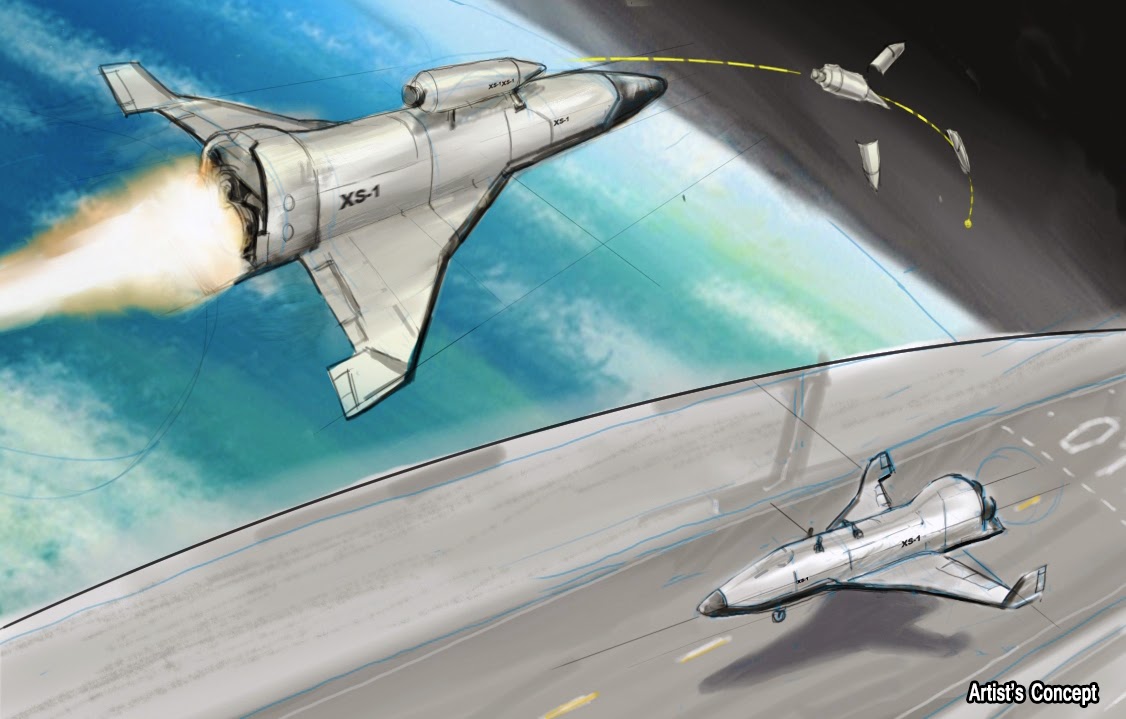
Artist's concept of DARPA's Experimental Spaceplane (XS-1), a proposed unmanned, hypersonic vehicle that the agency hopes will lower satellite launch costs substantially. 

Officials are targeting Mach 10 for the suborbital vehicle. 

Credit: DARPA

The United States military is making progress toward developing a new unmanned space plane, which it aims to begin flight-testing in 2017.

The Defense Advanced Research Projects Agency (DARPA) plans to award the first design contracts for the vehicle project, known as Experimental Spaceplane, (XS-1), in May or thereabouts, officials said.

Current schedules call for the vessel to get off the ground for the first time in late 2017 and make an orbital test flight the following year.

DARPA has high expectations for the XS-1 program, which it hopes can eventually launch 3,000- to 5,000-lb (1,361 to 2,268 kilograms) payloads to orbit for less than $5 million per flight — and to do it at least 10 times per year.

"The vision here is to break the cycle of escalating space system costs, enable routine space access and hypersonic vehicles," XS-1 program manager Jess Sponable said Feb. 5 during a presentation with NASA's Future In-Space Operations (FISO) working group.

Jess Sponable
"We're interested not just in launch, but also in seeing if we can find a way to enable more affordable, more routine, simpler hypersonic vessels," he added.

Changing the cost equation
DARPA first announced the ambitious XS-1 program last September.

It's viewed as complementary to another agency effort known as ALASA (Airborne Launch Assist Space Access), which seeks to launch 100-lb (45 kg) satellites to orbit for less than $1 million apiece using traditional airplanes outfitted with expendable upper stages.

ALASA (Airborne Launch Assist Space Access)
DARPA officials laid out their broad vision of the robotic XS-1 vehicle in a press release issued in September:

"XS-1 envisions that a reusable first stage would fly to hypersonic speeds at a suborbital altitude," they wrote.

"At that point, one or more expendable upper stages would separate and deploy a satellite into low-Earth orbit."

"The reusable hypersonic aircraft would then return to earth, land and be prepared for the next flight."

But DARPA is leaving the specifics of the XS-1 system — which aims to provide routine, aircraft-like access to space — up its potential builders, Sponable said.

"We don't care if it's vertical take-off, horizontal land, vertical-vertical, which brings in a lot of the entrepreneurs," he said in the FISO presentation.

"We don't care if they air-launch it, air-tow it, whatever. So we've left all those wide open."

The XS-1 program has enough money for one design contractor, which it plans to choose in 2015 after assessing the work done by the first-round awardees.

However, Sponable holds out some hope that more than one vehicle could make it to the flight-test stage.

"I would love for somebody from NASA or the Air Force out there to step forward and say, 'Hey, there's obviously more than one of these things that we want to go flight-test; let's fly more than one," he said.

Wednesday, September 18, 2013

DARPA: Experimental Spaceplane (XS-1) shooting for 'aircraft-like' operations in orbit

DARPA’s new Experimental Spaceplane (XS-1) program seeks to lower satellite launch costs by developing a reusable hypersonic unmanned vehicle with costs, operation and reliability similar to traditional aircraft. 

XS-1 envisions that a reusable first stage would fly to hypersonic speeds at a suborbital altitude. 

At that point, one or more expendable upper stages would separate and deploy a satellite into Low Earth Orbit. 

The reusable hypersonic vehicle would then return to earth, land and be prepared for the next flight.

Commercial, civilian and military satellites provide crucial real-time information essential to providing strategic national security advantages to the United States.

The current generation of satellite launch vehicles, however, is expensive to operate, often costing hundreds of millions of dollars per flight.

Moreover, U.S. launch vehicles fly only a few times each year and normally require scheduling years in advance, making it extremely difficult to deploy satellites without lengthy pre-planning.

Quick, affordable and routine access to space is increasingly critical for U.S. Defense Department operations.

To help address these challenges, DARPA has established the Experimental Spaceplane (XS-1) program. The program aims to develop a fully reusable unmanned vehicle that would provide aircraft-like access to space.

The vehicle is envisioned to operate from a "clean pad" with a small ground crew and no need for expensive specialized infrastructure.

This setup would enable routine daily operations and flights from a wide range of locations. XS-1 seeks to deploy small satellites faster and more affordably, while demonstrating technology for next-generation space and hypersonic flight for both government and commercial users.

"We want to build off of proven technologies to create a reliable, cost-effective space delivery system with one-day turnaround," said Jess Sponable, DARPA program manager heading XS-1.

"How it's configured, how it gets up and how it gets back are pretty much all on the table—we're looking for the most creative yet practical solutions possible."

DARPA seeks ideas and technical proposals for how to best develop and implement the XS-1 program. The agency has scheduled an XS-1 Proposers' Day for Monday, October 7, 2013.

The agency also plans to hold 1-on-1 discussions with potential proposers on the following day, October 8, 2013. Advance registration is required; more information is available at www.sa-meetings.com/ 

Registration closes on Tuesday, October 10 2013, at 12:00 PM EDT. For more information, please email DARPA-SN-14-01@darpa.mil.

The DARPA Special Notice describing the specific capabilities the program seeks is available at go.usa.gov/DNkF.

A Broad Agency Announcement (BAA) for XS-1 is forthcoming and will be posted on the Federal Business Opportunities website.