Showing posts with label beauty. Show all posts

Thursday, April 10, 2014

ESA Mars Express: Beauty from chaos - Osuga Valles

Osuga Valles
Beautiful streamlined islands and narrow gorges were carved by fast-flowing water pounding through a small, plateau region near the southeastern margin of the vast Vallis Marineris canyon system.

Images captured on 7 December 2013 by ESA’s Mars Express show the central portion of Osuga Valles, which has a total length of 164 km.

It is some 170 km south of Eos Chaos, which lies in the far eastern section of Valles Marineris.

Osuga Valles is an outflow channel that emanates from a region of chaotic terrain at the edge of Eos Chaos to the west (top in the main images).

Such landscape is dominated by randomly oriented and heavily eroded blocks of terrain.

Another example is seen at the bottom of this scene, filling the 2.5 km-deep depression into which Osuga Valles empties.

Osuga Valles Topography
Catastrophic flooding is thought to have created the heavily eroded Osuga Valles and the features within it.

Streamlines around the islands in the valley indicate that the direction of flow was towards the northeast (bottom right in the main colour, topographic and 3D images shown here) and sets of parallel, narrow grooves on the floor of the channel suggest that the water was fast flowing.

Differences in elevation within the feature, along with the presence and cross-cutting relationships of channels carved onto the islands, suggest that Osuga Valles experienced several episodes of flooding.

The perspective view, which is oriented with the direction of the water flow towards the top of the image, shows the details of the grooved valley floor and the channels carved into the islands more clearly.

Perspective view of Osuga Valles
Close to the northern-most (far right) part of the channel in the main images, two large irregular-shaped blocks appear to have broken away from the surrounding terrain, but do not seem to have experienced as much erosion as the rounded islands.

The floodwater eventually emptied into the deep depression of chaotic terrain at the bottom of the main images, but it is not yet known whether the water drained away into the subsurface or formed a temporary lake.

Wednesday, January 2, 2013

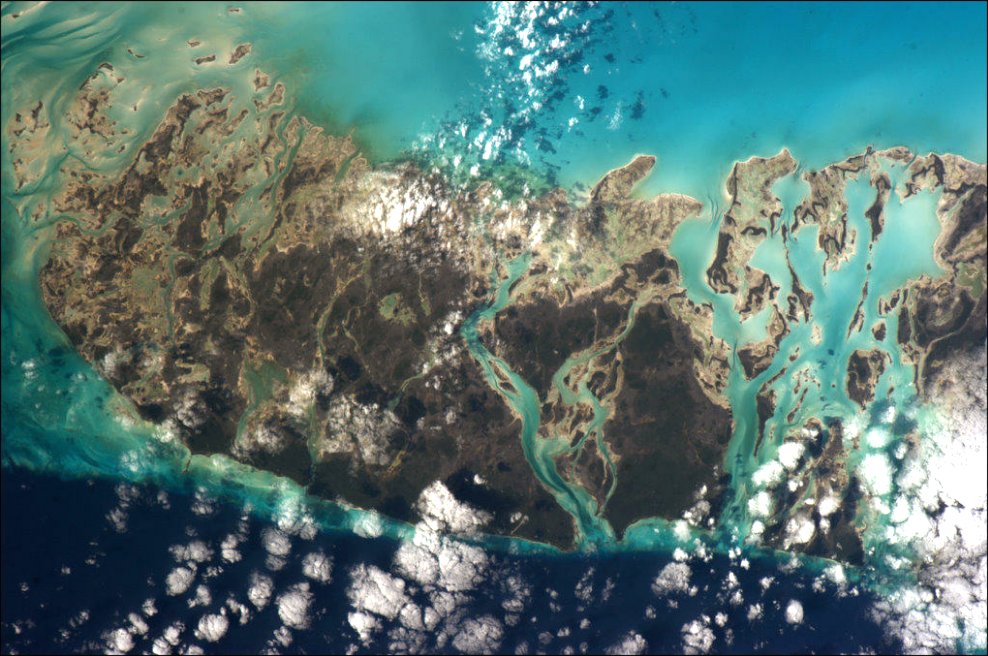
NASA Hadfield ISS Image: The Andros Islands

Andros Island, a lesser populated island with some great diving. At the bottom center you can see the island's runway.

Credit: NASA, Chris Hadfield

NASA Hadfield Image: The Beauty of the Bahamas

The beauty of the Bahamas is surreal; every blue that exists. Taken by Chris Hadfield on New Year's Day, 2013 from the Space Station.

Thursday, October 4, 2012

ESA Mars Express Image: Ice-coated beauty in Mars’ Silver Island

High-Resolution Stereo Camera (HRSC) nadir and colour channel data taken by ESA’s Mars Express have been combined to form a natural-colour view of Hooke Crater region in Argyre.

Centred at around 45°S and 314°E, this image has a ground resolution of about 22 m per pixel.

The image shows the western half of the 138 km-wide Hooke Crater, with wind formed dunes at its heart, while to the left of the crater, the ice-covered plains of Argyre Planitia are coated with a thin dusting of frozen carbon dioxide.

The very large Argyre impact basin brought materials from the deeper martian crust and mantle to the surface.

It provides scientists with one of the locations on Mars with a greater mixture of young/old and deep/surface terrains, providing a window into the planet’s past.

Credits: ESA/DLR/FU Berlin (G. Neukum)

Monday, August 31, 2009

NASA Shuttle Discovery: Beauty in the Night

Image Credit: NASA/Sandra Joseph and Kevin O'Connell

Billows of smoke and steam rise above Launch Pad 39A at NASA's Kennedy Space Center in Florida alongside space shuttle Discovery as it races toward space on the STS-128 mission.

The STS-128 mission is the 30th International Space Station assembly flight and the 128th space shuttle flight.

The 13-day mission will deliver more than 7 tons of supplies, science racks and equipment, as well as additional environmental hardware to sustain six crew members on the International Space Station.

The equipment includes a freezer to store research samples, a new sleeping compartment and the COLBERT treadmill.