Showing posts with label mineral. Show all posts

Wednesday, June 27, 2012

Panguite: New Prehistoric Mineral Discovered in Meteorite

Scientists from the California Institute of Technology (Caltech) have discovered panguite, a new mineral, embedded in a meteorite.

They believe that the mineral existed way before earth and other planets were formed.

The discovery was made while studying the Allende meteorite.

The Allende meteorite fell across the state of Chihuahua, Mexico in 1969.

More than 40 years later, the meteorite is still serving the scientific community as a rich source of information about the early stages of our solar system's evolution.

Scientists, analysing the Allende meteorite using a scanning electron microscope, were stunned to find a mineral prompting them to name it panguite. This mineral contains some amount of a new type of titanium oxide, never discovered before.

The panguite is named after Pan Gu, a giant from ancient Chinese mythology who, it is believed, established the world by separating yin from yang to create the earth and the sky.

"Panguite is an especially exciting discovery since it is not only a new mineral, but also a material previously unknown to science," said Chi Ma, scientist and director of the Geological and Planetary Sciences division's Analytical Facility at Caltech, in a statement.

Scientists claim that the Allende meteorite is the largest carbonaceous chondrite - a diverse class of primitive meteorites - ever found on our planet and is considered by many as the best-studied meteorite in history.

Till now, scientists have discovered nine new minerals, including panguite, in the Allende meteorite. Some of those minerals are allendeite, hexamolybdenum, tistarite, and kangite.

"The intensive studies of objects in this meteorite have had a tremendous influence on current thinking about processes, timing, and chemistry in the primitive solar nebula and small planetary bodies," said Professor George Rossman, scientist at the Caltech, in a statement.

Last year, another group of scientists discovered a new mineral called "Wassonite". Wassonite was discovered within the Yamato 691 enstatite chondrite meteorite.

Wassonite is a mineral formed from only two elements, sulphur and titanium, yet it possesses a unique crystal structure that has not been previously observed in nature, according to a Nasa report.

Caltech scientists are now studying panguite and other newly discovered refractory minerals. They believe that their study will help them know more about the conditions under which they were formed and subsequently evolved.

"Such investigations are essential to understand the origins of our solar system," said Ma.

Wednesday, May 2, 2012

Hubble Archive Image: Old star reveals Arsenic and Selenium

An ultraviolet spectrum taken from the Hubble Space Telescope public archives revealed arsenic and selenium in a 12 billion year-old halo star dubbed HD 160617.

"Arsenic and selenium elements were forged in an even older star, which has long since disappeared, and then-like genes passed on from parent to infant-they were born into the star we see today, HD 160617." reported Ian Roederer, along with co-author James Lawler.

The Big Bang produced lots of hydrogen and helium and a smidgen of lithium.

All heavier elements found on the periodic table have been produced by stars over the last 13.7 billion years. Astronomers analyze starlight to determine the chemical makeup of stars, the origin of the elements, the ages of stars, and the evolution of galaxies and the universe.

Now for the first time, astronomers have detected the presence of arsenic and selenium, neighbouring elements near the middle of the periodic table, in an ancient star in the faint stellar halo that surrounds the Milky Way.

Arsenic and selenium are elements at the transition from light to heavy element production, and have not been found in old stars until now.

Lead author of the Astrophysical Journal paper, Fellow Ian Roederer of the Carnegie Observatories explained: "Stars like our Sun can make elements up to oxygen on the periodic table. Other more massive stars can synthesize heavier elements, those with more protons in their nuclei, up to iron by nuclear fusion-the process in which atomic nuclei fuse and release lots of energy. Most of the elements heavier than iron are made by a process called neutron-capture nucleosynthesis."

"Although neutrons have no charge, they can decay into protons after they're in the nucleus, producing elements with larger atomic numbers. One of the ways that this method can work is by exposure to a burst of neutrons during the violent supernova death of a star."

"We call this process the rapid process (r-process). It can produce elements at the middle and bottom of the periodic table-from zinc to uranium-in the blink of an eye."

Roederer, with co-author James Lawler, looked at an ultraviolet spectrum from the Hubble Space Telescope public archives to find arsenic and selenium in a 12 billion year-old halo star dubbed HD 160617.

"These elements were forged in an even older star, which has long since disappeared, and then-like genes passed on from parent to infant-they were born into the star we see today, HD 160617."

The team also examined data for this star from the public archives of several ground-based telescopes and were able to detect 45 elements. In addition to arsenic and selenium, they found rarely seen cadmium, tellurium, and platinum, all of which were produced by the r-process.

This is the first time these elements have been detected together outside the Solar System. Astronomers cannot replicate the r-process in any laboratory since the conditions are so extreme. The key to modeling the r-process relies on astronomical observations.

"What I find exciting is that arsenic and selenium can be found in other stars, even ones like HD 160617 that we've been studying for decades," remarked Roederer.

"Now that we know where to look, we can go back and study these elements in other stars. Understanding the r-process helps us know why we find certain elements like barium on Earth, or understand why uranium is so rare."

Friday, March 23, 2012

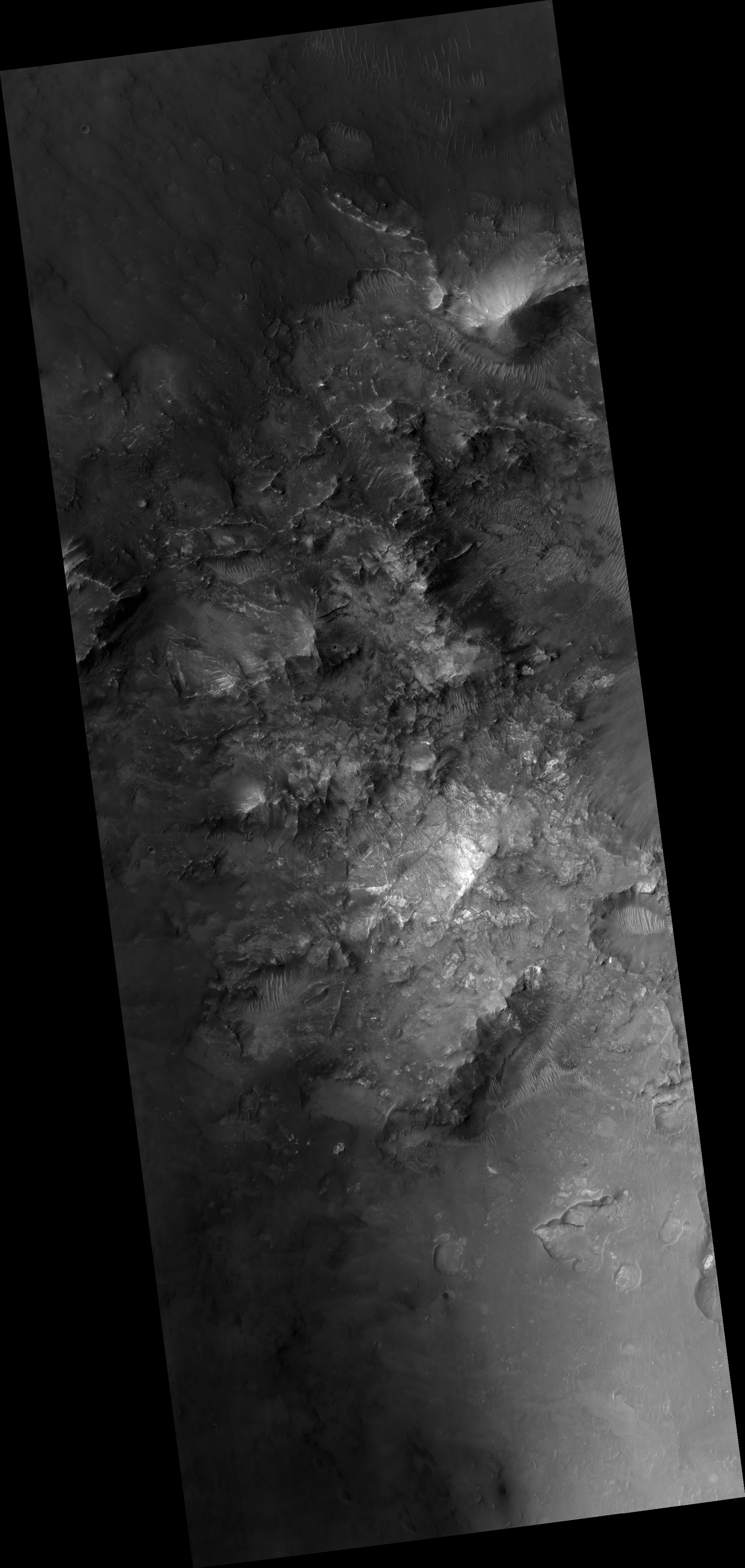
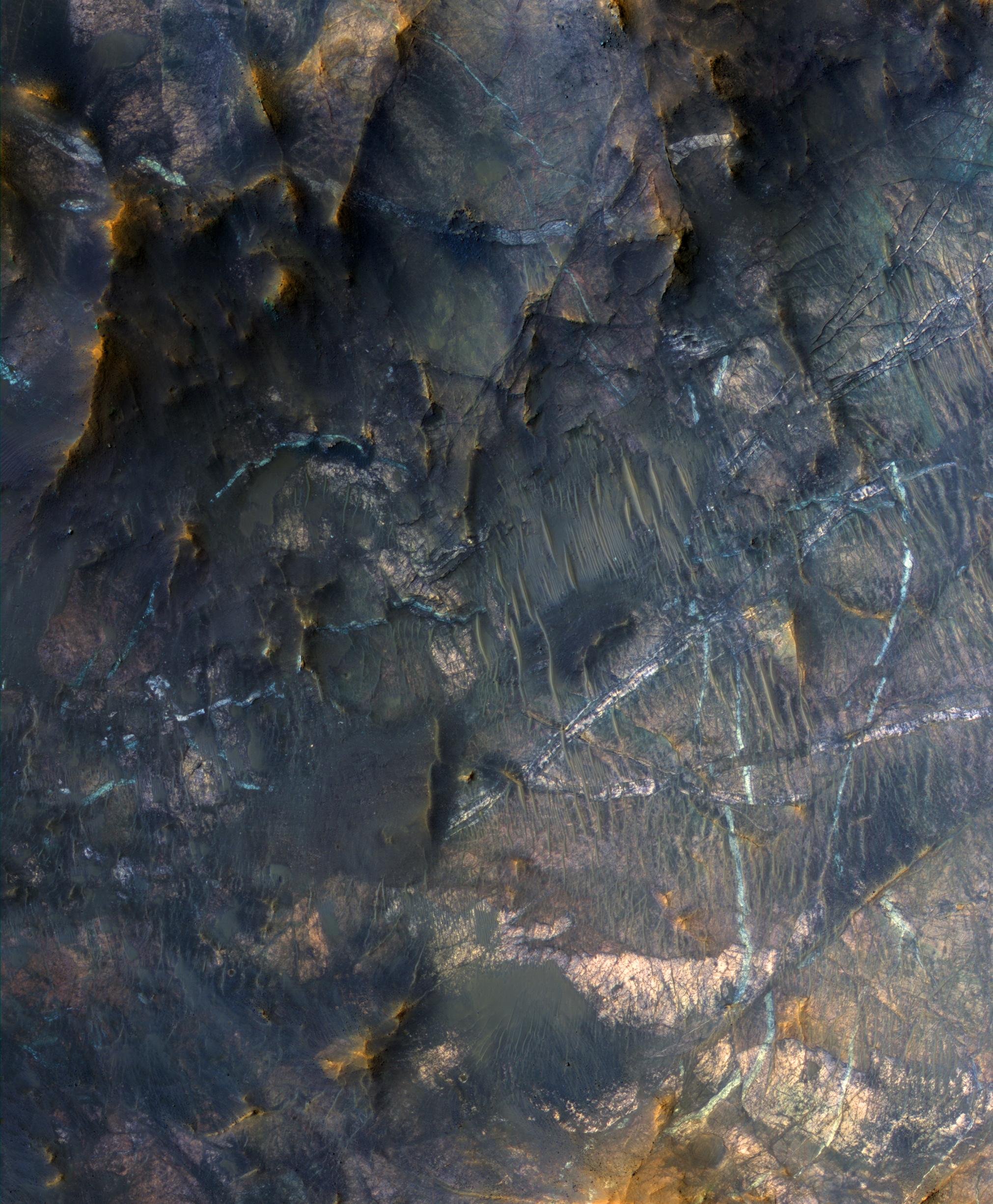
MARS HiRISE Image: Mineral Veins

The bright linear features cutting the bedrock in the center region of this image look like mineral veins.

Mineral veins are sheetlike bodies of minerals formed by water that flows through fractures.

The setting of this image is the central uplift of a large (approximately 50-kilometer diameter) impact crater, where deep, ancient bedrock was uplifted about 5 kilometers and fractured.

Heat from the impact melted ice in the Martian crust, creating a hydrothermal system. This could have been a habitable environment.

A small mineral vein was recently discovered by the Opportunity rover at Endeavour Crater.

This is a stereo pair with ESP_025766_2005.

Tuesday, December 13, 2011

NASA's Mars Rover Finds Mineral Traces Left by Water

NASA revealed that the Opportunity rover, which has been prowling the plains and craters of the Red Planet since 2004, had discovered, well, Martian patio tiles or rectangular formations that looked awfully similar.

Rectangles in the Martian soil are nothing to do with life, the rectangles are one more clue that biology might indeed be or at least have been possible on Mars.

Opportunity and its rover twin Spirit have spent much of their years of exploration looking for clues to water on Mars, which, of course, is a sine qua non for life as we know it.

The evidence has piled up, both in terms of topographic scars that could only have been left by flowing, pooling or upwelling water; and the presence of sulfates, hydroxides and other materials that form in the presence of water. Last August, the Mars Reconnaissance Orbiter (MRO) beamed back images suggesting that liquid water may flow seasonally on Mars even today.

"Since the MRO arrived at Mars, our overarching theme has been 'follow the water,'" said mission scientist Mike Meyer at the time of the announcement. "Now we may be catching Mars in the act."