While the crew slept the station moved away from a relic of a collision between the COSMOS 2251 and Iridium 33 satellites in February 2009
More than 500,000 pieces of debris, or “space junk,” are tracked as they orbit the Earth. They all travel at speeds up to 17,500 mph, fast enough for a relatively small piece of orbital debris to damage a satellite or a spacecraft.
The rising population of space debris increases the potential danger to all space vehicles, but especially to the International Space Station, space shuttles and other spacecraft with humans aboard.
NASA takes the threat of collisions with space debris seriously and has a long-standing set of guidelines on how to deal with each potential collision threat. These guidelines, part of a larger body of decision-making aids known as flight rules, specify when the expected proximity of a piece of debris increases the probability of a collision enough that evasive action or other precautions to ensure the safety of the crew are needed.
Orbital Debris
Space debris encompasses both natural (meteoroid) and artificial (man-made) particles. Meteoroids are in orbit about the sun, while most artificial debris is in orbit about the Earth. Hence, the latter is more commonly referred to as orbital debris.
Orbital debris is any man-made object in orbit about the Earth which no longer serves a useful function. Such debris includes nonfunctional spacecraft, abandoned launch vehicle stages, mission-related debris and fragmentation debris.
There are more than 20,000 pieces of debris larger than a softball orbiting the Earth. They travel at speeds up to 17,500 mph, fast enough for a relatively small piece of orbital debris to damage a satellite or a spacecraft. There are 500,000 pieces of debris the size of a marble or larger. There are many millions of pieces of debris that are so small they can’t be tracked.
Even tiny paint flecks can damage a spacecraft when traveling at these velocities. In fact a number of space shuttle windows have been replaced because of damage caused by material that was analyzed and shown to be paint flecks.
“The greatest risk to space missions comes from non-trackable debris,” said Nicholas Johnson, NASA chief scientist for orbital debris.
With so much orbital debris, there have been surprisingly few disastrous collisions.
In 1996, a French satellite was hit and damaged by debris from a French rocket that had exploded a decade earlier.
On Feb. 10, 2009, a defunct Russian satellite collided with and destroyed a functioning U.S. Iridium commercial satellite. The collision added more than 2,000 pieces of trackable debris to the inventory of space junk.
China's 2007 anti-satellite test, which used a missile to destroy an old weather satellite, added more than 3,000 pieces to the debris problem.
NASA - Space Debris and Human Spacecraft
Saturday, April 2, 2011
Friday, April 1, 2011
ESA Mars Express: Neighbouring volcanoes on Mars
Ceraunius Tholus and Uranius Tholus are two volcanoes in the Tharsis region of Mars. Ceraunius Tholus is 130 km across and rises 5.5 km above its surroundings.
The flanks of this volcano are etched with many valleys. Its neighbour, Uranius Tholus is a smaller volcano, with a base diameter of 62 km and a height of 4.5 km.
This image is derived from data acquired during three separate orbits of Mars Express, which took place between 25 November 2004 and 22 June 2006.
During the second orbit, Mars Express’s camera captured icy clouds drifting past the summit of Ceraunius Tholus.
In the finished mosaic image there is a sharp line because the clouds had long since dispersed by the time Mars Express crossed again and took the final strip of data needed for the image.
Credits: ESA/DLR/FU Berlin (G. Neukum)
The flanks of this volcano are etched with many valleys. Its neighbour, Uranius Tholus is a smaller volcano, with a base diameter of 62 km and a height of 4.5 km.
This image is derived from data acquired during three separate orbits of Mars Express, which took place between 25 November 2004 and 22 June 2006.
During the second orbit, Mars Express’s camera captured icy clouds drifting past the summit of Ceraunius Tholus.
In the finished mosaic image there is a sharp line because the clouds had long since dispersed by the time Mars Express crossed again and took the final strip of data needed for the image.
Credits: ESA/DLR/FU Berlin (G. Neukum)
Labels:
camera,
ESA,
Mars,
Mars Express,
neighbours,
volcanic
NASA Aquarius: SAC-D Artist's Concept
Artist's concept of the Aquarius/SAC-D spacecraft, a collaboration between NASA and Argentina's space agency, with participation from Brazil, Canada, France and Italy.
Aquarius, the NASA-built primary instrument on the spacecraft, will take NASA's first space-based measurements of ocean surface salinity, a key missing variable in satellite observations of Earth that links ocean circulation, the global balance of freshwater and climate.
The mission is scheduled to launch in June.
Technicians lower the cover over the shipping container holding the international Aquarius/SAC-D spacecraft at Brazil's National Institute for Space Research in Sáo José dos Campos, in preparation for its transport to California's Vandenberg Air Force Base for launch this June.
Images credit: NASA
Further information on the NASA Aquarius program
Aquarius, the NASA-built primary instrument on the spacecraft, will take NASA's first space-based measurements of ocean surface salinity, a key missing variable in satellite observations of Earth that links ocean circulation, the global balance of freshwater and climate.
The mission is scheduled to launch in June.
Technicians lower the cover over the shipping container holding the international Aquarius/SAC-D spacecraft at Brazil's National Institute for Space Research in Sáo José dos Campos, in preparation for its transport to California's Vandenberg Air Force Base for launch this June.
Images credit: NASA
Further information on the NASA Aquarius program
NASA PS-PVD: Plasma Spray-Physical Vapour Deposition
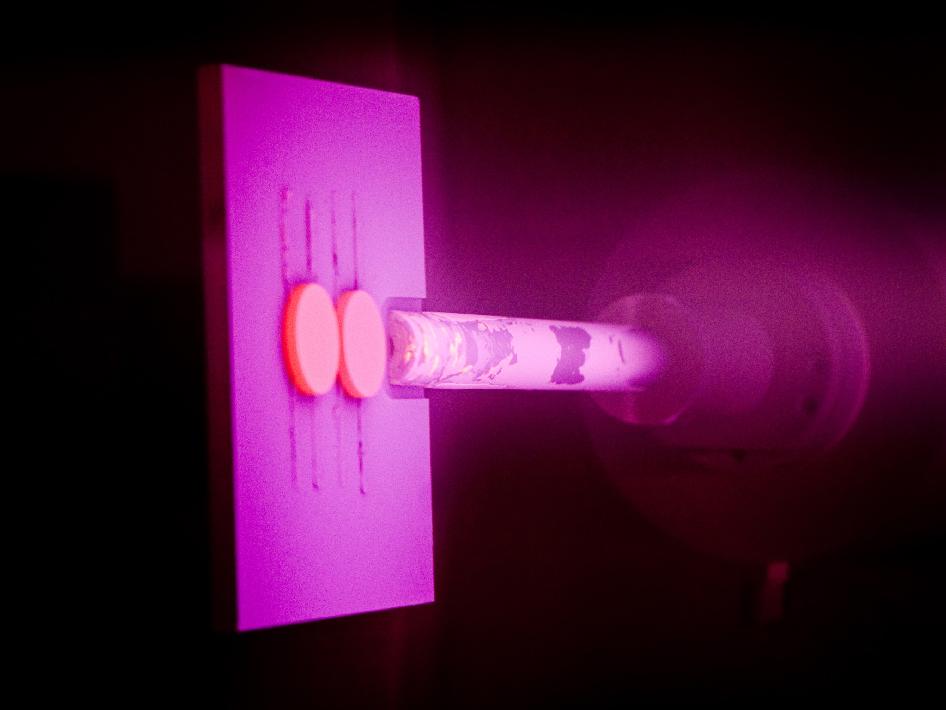
Inside the Plasma Spray-Physical Vapour Deposition, or PS-PVD, ceramic powder is introduced into the plasma flame, which vapourises it and then condenses it on the object, to form the ceramic coating.
The PS-PVD rig at NASA's Glenn Research Center uses new technology to create super thin ceramic coatings, which are being developed to protect high efficiency engines.
The coatings created in the PS-PVD rig are thinner and more complex than those previously available.
The PS-PVD rig uses a system of vacuum pumps and a blower to remove air from the chamber, reducing the pressure inside to fraction of normal atmospheric pressure. The plasma flame is extremely hot and reaches 10,000 degrees Celsius.
Ceramic powder is introduced from the torch into the plasma flame. The plasma vapourises the ceramic powder, which then condenses 5 feet away from the torch onto the component to form the ceramic coating.
Plasma, neither a gas, liquid or a solid, is the fourth state of matter and often behaves like a gas, except that it conducts electricity and is affected by magnetic fields. On an astronomical scale, plasma is very common.
The sun is composed of plasma, fire is plasma, fluorescent and neon lights contain small amounts of plasma. NASA’s PS-PVD rig is one of only two such facilities in the country and one of four in the world.
Image Credit: NASA/Marvin G. Smith (Wyle Information Systems LLC)
The PS-PVD rig at NASA's Glenn Research Center uses new technology to create super thin ceramic coatings, which are being developed to protect high efficiency engines.
The coatings created in the PS-PVD rig are thinner and more complex than those previously available.
The PS-PVD rig uses a system of vacuum pumps and a blower to remove air from the chamber, reducing the pressure inside to fraction of normal atmospheric pressure. The plasma flame is extremely hot and reaches 10,000 degrees Celsius.
Ceramic powder is introduced from the torch into the plasma flame. The plasma vapourises the ceramic powder, which then condenses 5 feet away from the torch onto the component to form the ceramic coating.
Plasma, neither a gas, liquid or a solid, is the fourth state of matter and often behaves like a gas, except that it conducts electricity and is affected by magnetic fields. On an astronomical scale, plasma is very common.
The sun is composed of plasma, fire is plasma, fluorescent and neon lights contain small amounts of plasma. NASA’s PS-PVD rig is one of only two such facilities in the country and one of four in the world.
Image Credit: NASA/Marvin G. Smith (Wyle Information Systems LLC)
NASA Messenger: Latest Mercury Images
Credit: NASA/JHUAPL/CIWNASA's
Messenger spacecraft acquired this image of Mercury's horizon as the spacecraft was moving northward along the first orbit during which MDIS camera instrument was activated, which occurred on March 29, 2011.
Bright rays from Hokusai can be seen running north to south in the image. The right side of this image is about 750 miles (1,200 kilometers) in extent.
This baffling structure on Mercury's surface, an impact crater surrounded by radiating cracks in the ground, is unlike anything seen elsewhere in the solar system.
Scientists are at a loss to explain what caused the troughs to form, but suspect that underground volcanism might be involved.
They aren't sure of the relationship of the central crater to the more than 50 grooves, and say it's even possible that the cracks occurred first, and a meteoroid just happened to land in the center.
Scientists suspect the core of the planet is slowly cooling and becoming smaller, causing the whole globe to shrink.
Many long and high cliffs on Mercury appear to be signs that the surface is crumbling as the planet buckles beneath it.
The right side of this image shows one such cliff running vertically for more than a hundred miles.
A spectrometer on Messenger has taken measurements of the light bouncing off Mercury's surface in different colors to help scientists understand what the soil is made of, and whether ice can exist on the closest planet to the sun.
The red and blue lines represent two different points on the planet's surface, and their divergence reveals that different minerals are present in each bit of land.
Earth has one, and so does Mercury, inexplicably.
Researchers don't know why this small, slowly spinning planet has a magnetic field around it, but measurements taken when Messenger flew through Mercury's magnetosphere have shed new light on the conundrum.
The data shows that Mercury's magnetic field has two poles, like Earth's, and hosts significant densities of charged particle plasma pulled off the sun.
Plains on the surface seem to have been formed when volcanic lava spilled over the rough surface and dried smooth.
Many craters appear to be filled with this material. These are strong clues that Mercury once had volcanic activity, although scientists don't see this going on now.
In the lower right corner of this picture is a crater within a crater, filled in with smooth plains material that scientists think might be volcanic in origin.
The last time humans sent a probe to Mercury, more than three decades ago, we were able to see less than half of the planet.
Messenger has already revealed another 30 percent of Mercury that the 1975 Mariner 10 mission didn't cover.
By combining images taken in different color filters, Messenger created this image of the hidden side of Mercury. Scientists can study the subtle color differences to detect changes in the surface material.
The pock-marked surface of Mercury is highly reminiscent of the moon. The planet has been continually bombarded by space rocks that leave their mark with craters.
But there are important differences between Mercury's craters and the moon's.
For one thing, some craters on Mercury seem to be shallower than similar-sized craters on the moon, although the scientists must investigate further Messenger data to see if this trend holds across the planet.
This image shows the littered surface of Mercury, where some craters are secondary, formed when material displaced in one impact lands nearby and forms another crater.
Scientists don't know exactly what creates and shapes the bright tails of particles that stream off the planet's surface. They believe some mechanism of interaction between the solar wind and Mercury's magnetosphere is responsible.
Messenger took sensitive measurements of the light emission from the tails of sodium and hydrogen to learn more about them. This image shows the strength of the hydrogen tail flowing out behind Mercury.
Mercury is so small, scientists long assumed it had no atmosphere. But Mariner 10 surprised experts by revealing a tenuous net of gas around the planet.
Mercury's thin atmosphere constantly escapes the weak gravity of the planet, but somehow, hydrogen and helium are constantly replenished.
Scientists suspect the solar wind draws the gases back to the planet, and hope MESSENGER measurements can provide further insight.
Mercury is so dense, scientists believe its heavy iron core accounts for two-thirds of the planet's mass, more than twice the ratio of core to mass for Earth, Venus or Mars.
Scientists aren't sure what caused this incredibly high density, but suggest it might have started off with more mass that got scraped off by collisions.
Researchers hope MESSENGER's geology measurements can shed light on how the planet formed, and how it got to be so dense.
Messenger spacecraft acquired this image of Mercury's horizon as the spacecraft was moving northward along the first orbit during which MDIS camera instrument was activated, which occurred on March 29, 2011.
Bright rays from Hokusai can be seen running north to south in the image. The right side of this image is about 750 miles (1,200 kilometers) in extent.
This baffling structure on Mercury's surface, an impact crater surrounded by radiating cracks in the ground, is unlike anything seen elsewhere in the solar system.
Scientists are at a loss to explain what caused the troughs to form, but suspect that underground volcanism might be involved.
They aren't sure of the relationship of the central crater to the more than 50 grooves, and say it's even possible that the cracks occurred first, and a meteoroid just happened to land in the center.
Scientists suspect the core of the planet is slowly cooling and becoming smaller, causing the whole globe to shrink.
Many long and high cliffs on Mercury appear to be signs that the surface is crumbling as the planet buckles beneath it.
The right side of this image shows one such cliff running vertically for more than a hundred miles.
A spectrometer on Messenger has taken measurements of the light bouncing off Mercury's surface in different colors to help scientists understand what the soil is made of, and whether ice can exist on the closest planet to the sun.
The red and blue lines represent two different points on the planet's surface, and their divergence reveals that different minerals are present in each bit of land.
Earth has one, and so does Mercury, inexplicably.
Researchers don't know why this small, slowly spinning planet has a magnetic field around it, but measurements taken when Messenger flew through Mercury's magnetosphere have shed new light on the conundrum.
The data shows that Mercury's magnetic field has two poles, like Earth's, and hosts significant densities of charged particle plasma pulled off the sun.
Plains on the surface seem to have been formed when volcanic lava spilled over the rough surface and dried smooth.
Many craters appear to be filled with this material. These are strong clues that Mercury once had volcanic activity, although scientists don't see this going on now.
In the lower right corner of this picture is a crater within a crater, filled in with smooth plains material that scientists think might be volcanic in origin.
The last time humans sent a probe to Mercury, more than three decades ago, we were able to see less than half of the planet.
Messenger has already revealed another 30 percent of Mercury that the 1975 Mariner 10 mission didn't cover.
By combining images taken in different color filters, Messenger created this image of the hidden side of Mercury. Scientists can study the subtle color differences to detect changes in the surface material.
The pock-marked surface of Mercury is highly reminiscent of the moon. The planet has been continually bombarded by space rocks that leave their mark with craters.
But there are important differences between Mercury's craters and the moon's.
For one thing, some craters on Mercury seem to be shallower than similar-sized craters on the moon, although the scientists must investigate further Messenger data to see if this trend holds across the planet.
This image shows the littered surface of Mercury, where some craters are secondary, formed when material displaced in one impact lands nearby and forms another crater.
Scientists don't know exactly what creates and shapes the bright tails of particles that stream off the planet's surface. They believe some mechanism of interaction between the solar wind and Mercury's magnetosphere is responsible.
Messenger took sensitive measurements of the light emission from the tails of sodium and hydrogen to learn more about them. This image shows the strength of the hydrogen tail flowing out behind Mercury.
Mercury is so small, scientists long assumed it had no atmosphere. But Mariner 10 surprised experts by revealing a tenuous net of gas around the planet.
Mercury's thin atmosphere constantly escapes the weak gravity of the planet, but somehow, hydrogen and helium are constantly replenished.
Scientists suspect the solar wind draws the gases back to the planet, and hope MESSENGER measurements can provide further insight.
Mercury is so dense, scientists believe its heavy iron core accounts for two-thirds of the planet's mass, more than twice the ratio of core to mass for Earth, Venus or Mars.
Scientists aren't sure what caused this incredibly high density, but suggest it might have started off with more mass that got scraped off by collisions.
Researchers hope MESSENGER's geology measurements can shed light on how the planet formed, and how it got to be so dense.
Subscribe to:
Posts (Atom)


