Showing posts with label AIA. Show all posts

Tuesday, January 20, 2015

NASA SDO: Sun Monitoring Satellite captures 100 millionth image

The Atmospheric Imaging Assembly on NASA's Solar Dynamics Observatory captured its 100 millionth image of the sun on Jan. 19, 2015. 

The dark areas at the bottom and the top of the image are coronal holes, areas of less dense gas, where solar material has flowed away from the sun. 

Credit: NASA/SDO/AIA/LMSAL

On Jan. 19, 2015, at 12:49 p.m. EST, an instrument on NASA's Solar Dynamics Observatory captured its 100 millionth image of the sun.

The instrument is the Atmospheric Imaging Assembly (AIA), which uses four telescopes working parallel to gather eight images of the sun, cycling through 10 different wavelengths -- every 12 seconds.

The Atmospheric Imaging Assembly (AIAimages the solar atmosphere in multiple wavelengths to link changes in the surface to interior changes. 

Data includes images of the Sun in 10 wavelengths every 10 seconds. 

Credit: NASA SDO, Lockheed Martin Solar Astrophysics Laboratory

The Helioseismic and Magnetic Imager extends the capabilities of the SOHO/MDI instrument with continual full-disk coverage at higher spatial resolution and new vector magnetogram capabilities.

Credit: NASA SDO, Lockheed Martin Solar Astrophysics Laboratory

Between the AIA and two other instruments on board, the Helioseismic Magnetic Imager (HMI) and the Extreme Ultraviolet Variability Experiment (EVE), SDO sends down a whopping 1.5 terabytes of data a day.

The Extreme Ultraviolet Variability Experiment measures the solar extreme-ultraviolet (EUV) irradiance with unprecedented spectral resolution, temporal cadence, and precision. 

EVE measures the solar extreme ultraviolet (EUV) spectral irradiance to understand variations on the timescales which influence Earth's climate and near-Earth space.

Credit: NASA SDO, Lockheed Martin Solar Astrophysics Laboratory

AIA is responsible for about half of that. Every day it provides 57,600 detailed images of the sun that show the dance of how solar material sways and sometimes erupts in the solar atmosphere, the corona.

In the almost five years since its launch on Feb. 11, 2010, SDO has provided images of the sun to help scientists better understand how the roiling corona gets to temperatures some 1000 times hotter than the sun's surface, what causes giant eruptions such as solar flares, and why the sun's magnetic fields are constantly on the move.

Friday, April 18, 2014

NASA SDO: Bright points in Sun's atmosphere mark patterns deep in its interior

Brightpoints in the sun's atmosphere, left, correspond to magnetic parcels on the sun's surface, seen in the processed data on the right. 

Green spots show smaller parcels, red and yellow much bigger ones. 

Credit: NASA/SDO

Like a balloon bobbing along in the air while tied to a child's hand, a tracer has been found in the sun's atmosphere to help track the flow of material coursing underneath the sun's surface.

New research that uses data from NASA's Solar Dynamics Observatory (SDO), to track bright points in the solar atmosphere and magnetic signatures on the sun's surface offers a way to probe the star's depths faster than ever before.

The technique opens the door for near real-time mapping of the sun's roiling interior – movement that affects a wide range of events on the sun from its 22-year sunspot cycle to its frequent bursts of X-ray light called solar flares.

"There are all sorts of things lurking below the surface," said Scott McIntosh, first author of a paper on these results in the April 1, 2014, issue of the Astrophysical Journal Letters.

"And we've found a marker for this deep rooted activity. This is kind of a gateway to the interior, and we don't need months of data to get there."

One of the most common ways to probe the sun's interior is through a technique called helioseismology in which scientists track the time it takes for waves – not unlike seismic waves on Earth—to travel from one side of the sun to the other.

From helioseismology solar scientists have some sense of what's happening inside the sun, which they believe to be made up of granules and super-granules of moving solar material.

The material is constantly overturning like boiling water in a pot, but on a much grander scale: A granule is approximately the distance from Los Angeles to New York City; a super-granule is about twice the diameter of Earth.

SDO contains three instruments; Helioseismic and Magnetic Imager (HMI), Atmospheric Imaging Assembly (AIA), and Extreme Ultraviolet Variablity Experiment (EVE) -- for observations leading to a more complete understanding of the solar dynamics that drive variability in the Earth's environment. 

Credit: NASA/Goddard Space Flight Center

Instead of tracking seismic waves, the new research probes the solar interior using the Helioseismic Magnetic Imager (HMI) on SDO, which can map the dynamic magnetic fields that thread through and around the sun.

Since 2010, McIntosh has tracked the size of different magnetically-balanced areas on the sun, that is, areas where there are an even number of magnetic fields pointing down in toward the sun as pointing out.

Think of it like looking down at a city from above with a technology that observed people, but not walls, and recording areas that have an even number of men and women.

Even without seeing the buildings, you'd naturally get a sense for the size of rooms, houses, buildings, and whole city blocks – the structures in which people naturally group.

More Information: 'Identifying Potential Markers of the Sun's Giant Convective Scale' Astrophysical Journal April 2014: Authors: Scott W. McIntosh, Xin Wang, Robert J. Leamon, and Philip H. Scherrer: doi:10.1088/2041-8205/784/2/L32

Saturday, July 28, 2012

NASA's High Resolution Coronal Imager (Hi-C) telescope

 AIA can see structures on the sun's surface with clarity of approximately 675 miles. (NASA)
Shown in green to enhance detail, these Hi-C images reveal detailed tangles of magnetic field. (NASA) 

A telescope launched July 11 aboard a NASA sounding rocket has captured the highest-resolution images ever taken of the sun's million-degree atmosphere called the corona.

Barbara Giles
The clarity of the images can help scientists better understand the behaviour of the solar atmosphere and its impacts on Earth's space environment.

"These revolutionary images of the sun demonstrate the key aspects of NASA's sounding rocket program, namely the training of the next generation of principal investigators, the development of new space technologies, and scientific advancements," said Barbara Giles, director for NASA's Heliophysics Division at NASA Headquarters in Washington.

Launched from White Sands Missile Range in New Mexico, the 58-foot-tall sounding rocket carried NASA's High Resolution Coronal Imager (Hi-C) telescope. Weighing 464 pounds, the 10-foot-long payload took 165 images during its brief 620-second flight. The telescope focused on a large active region on the sun with some images revealing the dynamic structure of the solar atmosphere in fine detail. These images were taken in the extreme ultraviolet wavelength. This higher energy wavelength of light is optimal for viewing the hot solar corona.

"We have an exceptional instrument and launched at the right time," said Jonathan Cirtain, senior heliophysicist at NASA's Marshall Space Flight Center in Huntsville, Ala. "Because of the intense solar activity we're seeing right now, we were able to clearly focus on a sizeable, active sunspot and achieve our imaging goals."

The telescope acquired data at a rate of roughly one image every 5 seconds. Its resolution is approximately five times more detailed than the Atmospheric Imaging Assembly (AIA) instrument flying aboard NASA's Solar Dynamics Observatory (SDO). For comparison, AIA can see structures on the sun's surface with the clarity of approximately 675 miles and observes the sun in 10 wavelengths of light. Hi-C can resolve features down to roughly 135 miles, but observed the sun in just one wavelength of light.

The high-resolution images were made possible because of a set of innovations on Hi-C's optics array. Hi-C's mirrors are approximately 9 1/2 inches across, roughly the same size as the SDO instrument's. The telescope includes some of the finest mirrors ever made for space-based instrumentation. The increase in resolution of the images captured by Hi-C is similar to making the transition in television viewing from a cathode ray tube TV to high definition TV.

Initially developed at Marshall, the final mirror configuration was completed with inputs from partners at the Smithsonian Astrophysical Observatory (SAO) in Cambridge, Mass., and a new manufacturing technique developed in coordination with L-3Com/Tinsley Laboratories of Richmond, Calif.

The high-quality optics were aligned to determine the spacing between the optics and the tilt of the mirror with extreme accuracy. Scientists and engineers from Marshall, SAO, and the University of Alabama in Huntsville worked to complete alignment of the mirrors, maintaining optic spacing to within a few ten-thousandths of an inch.

Wednesday, July 25, 2012

NASA SDO Images: Colourful Mapping of Sun's Plasma - YouTube


According to NASA it's pure science and not art, but when Nicholeen Viall, a solar scientist at NASA's Goddard Space Flight Center created a new data visualization technique, the resulting solar images were reminiscent of an impressionist's painting.

Using raw solar data from NASA's Solar Dynamics Observatory (SDO) and needing to represent it in a understandable manner, researchers often visualize the data through graphs and images. In the case of Viall's new technique, the result was not just informative but beautiful.

According to NASA, Viall wanted to look at SDO's in a different perspective. "SDO's Atmospheric Imaging Assembly (AIA), constructed for NASA by Lockheed Martin, provides images of the sun in 10 different wavelengths, each approximately corresponding to a single temperature of material.

Therefore, when one looks at the wavelength of 171 Angstroms, for example, one sees all the material in the sun's atmosphere that is a million degrees Kelvin.

By looking at an area of the sun in different wavelengths, one can get a sense of how different swaths of material change temperature.

If an area seems bright in a wavelength that shows a hotter temperature an hour before it becomes bright in a wavelength that shows a cooler temperature, one can gather information about how that region has changed over time."

The technique involved using 12 hours of data representing the history of cooling and heating at a particular spot on the sun.

Each colour pixel represents a moment in that 12 hour period. NASA says that the heat history holds clues to the mechanisms that drive the temperature and movements of the sun's atmosphere.

The images Viall's created show that over a 12-hour period the material appears to be cooling. For there to be cooling there must have been heating going in the process as well.

But Viall's images don't show the steady heating expected. The conclusion is that the heating happens so quickly that it doesn't show up in the images.

According to NASA this supports those theories that say nanobursts of energy help heat the corona.

Thursday, July 14, 2011

AIA Concerned by NASA, NOAA Cuts

The Aerospace Industries Association is concerned about the substantial cuts being made to the budgets of NASA and NOAA in the House Appropriations Subcommittee on Commerce, Justice and Science markup of the fiscal year 2012 appropriations bill.

"We recognize that tough economic times call for tough choices," said AIA President and CEO Marion C. Blakey. "However, cutting NASA and NOAA this deeply threatens American leadership in space and impairs our ability to make life-saving weather predictions."

The subcommittee's markup cuts NASA's space programs by 10 percent from the President's request and nearly 13 percent from the NASA authorization passed last October. AIA acknowledges that many NASA mission areas were adequately supported-but some suffered draconian cuts.

Given the current fiscal environment, AIA believes the $18.7 billion in funding proposed by the President provides the minimum required for these important programs.

AIA supports appropriations reflecting the policy priorities of the NASA Authorization Act of 2010 as closely as possible and opposes the termination of programs contrary to the priorities of the Authorization Act.

With the imminent retirement of the Space Shuttle, NASA must be adequately funded to continue our visible national commitment to space exploration, science, aeronautics and technology leadership-something that 58 percent of Americans recently polled by the Pew Research Center supported.

"Each ride to the space station that NASA buys from Russia is the annual equivalent of 1000 American aerospace jobs," Blakey said. "We should be paying Americans instead of Russians."

In addition, NOAA would get $1 billion less than the President's request-an 18 percent cut in a year when storms have already taken hundreds of lives and shown the need for accurate forecasts.

Wednesday, May 5, 2010

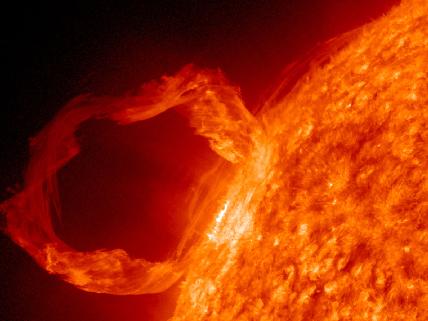
Solar Dynamics' Observatory: Ring of Fire

This new image from the SDO: Solar Dynamics Observatory’s Atmospheric Imaging Assembly (AIA) shows in great detail a solar prominence taken from a March 30, 2010 eruption. The twisting motion of the material is the most noticeable feature.

Launched on Feb. 11, 2010, SDO is the most advanced spacecraft ever designed to study the sun.

Click on the image to see more detial of the SDO Instruments

During its five-year mission, it will examine the sun's magnetic field and also provide a better understanding of the role the sun plays in Earth's atmospheric chemistry and climate.

Since launch, engineers have been conducting testing and verification of the spacecraft’s components. Now fully operational, SDO will provide images with clarity 10 times better than high-definition television and will return more comprehensive science data faster than any other solar observing spacecraft.