Showing posts with label deep. Show all posts

Friday, October 17, 2014

Geochemist: Helium and Lead isotopes provide insight into Earth's core

This map of the Samoan hotspot shows its division into three parallel volcanic lineaments. 

Credit: UCSB

A UC Santa Barbara geochemist studying Samoan volcanoes has found evidence of the planet's early formation still trapped inside the Earth.

Known as hotspots, volcanic island chains such as Samoa can ancient primordial signatures from the early solar system that have somehow survived billions of years.

Matthew Jackson, an associate professor in UCSB's Department of Earth Science, and colleagues utilized high-precision lead and helium isotope measurements to unravel the chemical composition and geometry of the deep mantle plume feeding Samoa's volcanoes.

Their findings appear today in the journal Nature.

In most cases, volcanoes are located at the point where two tectonic plates meet, and are created when those plates collide or diverge.

Hotspot volcanoes, however, are not located at plate boundaries but rather represent the anomalous melting in the interior of the plates.

Such intraplate volcanoes form above a plume-fed hotspot where the Earth's mantle is melting.

The plate moves over time, at approximately the rate human fingernails grow (3 inches a year), and eventually the volcano moves off the hotspot and becomes extinct.

Another volcano forms in its place over the hotspot and the process repeats itself until a string of volcanoes evolves.

"So you end up with this linear trend of age-progressive volcanoes," Jackson said. "On the Pacific plate, the youngest is in the east and as you go to the west, the volcanoes are older and more deeply eroded."

"Hawaii has two linear trends of volcanoes, most underwater, which are parallel to each other. There's a southern trend and a northern trend."

Because the volcanic composition of parallel Hawaiian trends is fundamentally different, Jackson and his team decided to look for evidence of this in other hotspots.

In Samoa, they found three volcanic trends exhibiting three different chemical configurations as well as a fourth group of a late-stage eruption on top of the third trend of volcanoes. These different groups exhibit distinct compositions.

"Our goal was to figure out how we could use this distribution of volcano compositions at the surface to reverse-engineer how these components are distributed inside this upwelling mantle plume at depth," Jackson said.

Each of the four distinct geochemical compositions, or endmembers, that the scientists identified in Samoan lavas contained low Helium-3 (He-3) and Helium-4 (He-4) ratios.

The surprising discovery was that they all exhibited evidence for mixing with a fifth, rare primordial component consisting of high levels of He-3 and He-4.

"We have really strong evidence that the bulk of the plume is made of the high Helium-3, -4 component," Jackson said.

"That tells us that most of this plume is primordial material and there are other materials hosted inside of this plume with low Helium-3, -4, and these are likely crustal materials sent into the mantle at ancient subduction zones."

The unique isotopic topology revealed by the researchers' analysis showed that the four low-helium endmembers do not mix efficiently with one another. However, each of them mixes with the high He-3 and He-4 component.

"This unique set of mixing relationships requires a specific geometry for the four geochemical flavors within the upwelling plume: They must be hosted within a matrix that is composed of the rare fifth component with high He-3," Jackson explained.

"This new constraint on plume structure has important implications for how deep mantle material is entrained in plumes, and it gives us the clearest picture yet for the chemical structure of an upwelling mantle plume."

More Information
Helium and lead isotopes reveal the geochemical geometry of the Samoan plume - M. G. Jackson, S. R. Hart, J. G. Konter, M. D. Kurz, J. Blusztajn & K. A. Farley Corresponding Author: Nature 514, 355–358 (16 October 2014) doi:10.1038/nature13794

Saturday, August 16, 2014

NASA Insight: Next Mars Lander Will Peer Deep Into Red Planet's History

A still from an animation shows NASA's new InSight Mars Lander lowering a drill onto Mars to analyze the planet's interior.

Credit: NASA/JPL

NASA's next Mars lander, now under construction, will probe the inner workings and early stages of the Red Planet's development billions of years ago.

The InSight mission (Interior exploration using Seismic Investigations, Geodesy and Heat Transport), a NASA Discovery Program spacecraft, is built to respond to highly focused scientific goals.

"Things are coming together," said Stu Spath, InSight program manager here at Lockheed Martin Space Systems Company, the aerospace firm building the Mars spacecraft for its 2016 liftoff.

NASA Phoenix Mars Lander
Powered descent
In many ways, InSight is a technological kissing cousin to the NASA Phoenix Mars Lander of 2008, which was equipped to investigate ice and soil on Mars's far-northern region.

InSight's will mirror the Phoenix mission in its blistering entry into the Martian atmosphere; parachute deployment; self-controlled, powered descent; and gentle meeting with the planet's surface on three outstretched landing legs.

"The lander structurally looks extremely similar to Phoenix," Spath told reporters. However the new craft's internal electronics, such as its power distribution unit and command and data handling hardware, have been updated.

Mars Atmosphere and Volatile Evolution mission (MAVEN)
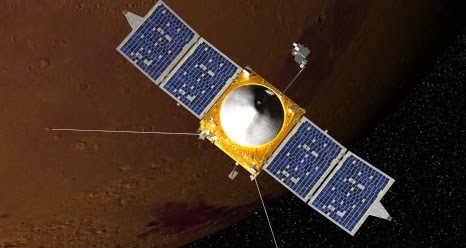
InSight's avionics draw from other spacecraft built by Lockheed Martin, Spath said. Specifically, it takes cues from the Mars Atmosphere and Volatile Evolution mission (MAVEN) en route to the Red Planet, the Juno craft headed for Jupiter, and the now-completed twin Gravity Recovery and Interior Laboratory (GRAIL) mission probes that were sent to the moon.

Stu Spath, InSight program manager at Lockheed Martin Space Systems Company, near the back shell for the Mars-bound Interior exploration using Seismic Investigations, Geodesy and Heat Transport (InSight) spacecraft.

Credit: Lockheed Martin

Two chief instruments
The InSight mission will last a Mars year, or roughly two Earth years.

That is 630 days longer than the Phoenix mission lasted, which means that the lander will have to endure a wider range of environmental conditions on the Martian landscape, Spath said.

InSight will study a different aspect of planetary history with instruments never previously used on Mars, Spath said.

The Mars lander's scientific payload consists of two chief instruments:

The Seismic Experiment for Interior Structure provided by the French Space Agency.

A Heat Flow and Physical Properties Package provided by the German Space Agency.

Additionally, the Rotation and Interior Structure Experiment (RISE), led by the Jet Propulsion Laboratory (JPL), will use the lander's X-band radio system to make ultra-precise measurements of planetary rotation.

Wind and temperature sensors from Spain's Centro de Astrobiologia and a pressure sensor will monitor weather at the landing site. A lander magnetometer will measure magnetic disturbances caused by the Martian ionosphere.

NASA's InSight lander mission would add to the number of successful touchdowns on the Red Planet.

Credit: NASA/JPL

Come together
"It is very exciting, seeing the flight hardware start to come together," said Bruce Banerdt, the principal investigator for the InSight mission to Mars at the Jet Propulsion Laboratory (JPL) in Pasadena, California.

"At the same time, this is a very nerve-wracking period in the project, as testing of our instruments and spacecraft subsystems uncover subtle design and manufacturing problems that inevitably occur, and that must be corrected in the short time, just over one and a half years, before launch," Banerdt told reporters.

The cost of the InSight mission, excluding the launch vehicle and related services, is capped at $425 million in 2010 dollars.

California to Mars
An upcoming milestone for the project, in aerospace lingo, is Assembly, Test, and Launch Operations (ATLO), Spath said.

That evaluation begins in early November. Next June, the InSight spacecraft will face a suite of critical tests, with ship and shoot dates in December of 2015 and March of 2016, respectively, Spath said.

After those tests, InSight won't see a speedy sendoff from Florida.

Rather, the lander will travel to Vandenberg Air Force Base in California, where a United Launch Alliance Atlas 5 rocket will give the craft a boost.

This will be the first interplanetary mission ever to launch from California, although in 1994, the joint Ballistic Missile Defense Organization/NASA Clementine spacecraft that studied the moon and an asteroid headed off from that launch area.

Once Mars-bound, InSight will fly a quick trip. After roughly 6.5 months in transit, the craft will stick a landing in the southern Elysium region of Mars in September 2016.

The specific touchdown zone is still under discussion, with Mars researchers making use of super-sharp imagery from the NASA Mars Reconnaissance Orbiter's High Resolution Imaging Science Experiment (HiRISE) to decide InSight's precise destination.

Friday, April 18, 2014

NASA SDO: Bright points in Sun's atmosphere mark patterns deep in its interior

Brightpoints in the sun's atmosphere, left, correspond to magnetic parcels on the sun's surface, seen in the processed data on the right. 

Green spots show smaller parcels, red and yellow much bigger ones. 

Credit: NASA/SDO

Like a balloon bobbing along in the air while tied to a child's hand, a tracer has been found in the sun's atmosphere to help track the flow of material coursing underneath the sun's surface.

New research that uses data from NASA's Solar Dynamics Observatory (SDO), to track bright points in the solar atmosphere and magnetic signatures on the sun's surface offers a way to probe the star's depths faster than ever before.

The technique opens the door for near real-time mapping of the sun's roiling interior – movement that affects a wide range of events on the sun from its 22-year sunspot cycle to its frequent bursts of X-ray light called solar flares.

"There are all sorts of things lurking below the surface," said Scott McIntosh, first author of a paper on these results in the April 1, 2014, issue of the Astrophysical Journal Letters.

"And we've found a marker for this deep rooted activity. This is kind of a gateway to the interior, and we don't need months of data to get there."

One of the most common ways to probe the sun's interior is through a technique called helioseismology in which scientists track the time it takes for waves – not unlike seismic waves on Earth—to travel from one side of the sun to the other.

From helioseismology solar scientists have some sense of what's happening inside the sun, which they believe to be made up of granules and super-granules of moving solar material.

The material is constantly overturning like boiling water in a pot, but on a much grander scale: A granule is approximately the distance from Los Angeles to New York City; a super-granule is about twice the diameter of Earth.

SDO contains three instruments; Helioseismic and Magnetic Imager (HMI), Atmospheric Imaging Assembly (AIA), and Extreme Ultraviolet Variablity Experiment (EVE) -- for observations leading to a more complete understanding of the solar dynamics that drive variability in the Earth's environment. 

Credit: NASA/Goddard Space Flight Center

Instead of tracking seismic waves, the new research probes the solar interior using the Helioseismic Magnetic Imager (HMI) on SDO, which can map the dynamic magnetic fields that thread through and around the sun.

Since 2010, McIntosh has tracked the size of different magnetically-balanced areas on the sun, that is, areas where there are an even number of magnetic fields pointing down in toward the sun as pointing out.

Think of it like looking down at a city from above with a technology that observed people, but not walls, and recording areas that have an even number of men and women.

Even without seeing the buildings, you'd naturally get a sense for the size of rooms, houses, buildings, and whole city blocks – the structures in which people naturally group.

More Information: 'Identifying Potential Markers of the Sun's Giant Convective Scale' Astrophysical Journal April 2014: Authors: Scott W. McIntosh, Xin Wang, Robert J. Leamon, and Philip H. Scherrer: doi:10.1088/2041-8205/784/2/L32

Wednesday, July 25, 2012

The Mantabot - YouTube


Batoid rays, such as stingrays and manta rays, are among nature’s most elegant swimmers. They are fast, highly maneuverable, graceful, energy-efficient, and can cruise, bird-like, for long distances in the deep, open ocean, and rest on the sea bottom.

“They are wonderful examples of optimal engineering by nature,” says Hilary Bart-Smith, an associate professor of mechanical and aerospace engineering in the University of Virginia‘s School of Engineering and Applied Science.

They are designing an “autonomous underwater vehicle” that someday may surpass what nature has provided as a model. The vehicle has potential commercial and military applications, and could be used for undersea exploration and scientific research.