Showing posts with label chimpanzees. Show all posts

Thursday, September 8, 2011

South African fossils: Between ape and human

Two fossil skeletons of early humans appear to mark a halfway stage between primitive "ape-men" and our direct ancestors.

A year of detailed study has revealed that the skeletons are a hodgepodge of anatomical features: some bones look almost human while others are chimpanzee-like.

The two fossils, an adult female and a juvenile male, were discovered in the Malapa cave system near Johannesburg, South Africa, in 2008.

Both about 1.2 metres tall, they are unusually complete and well-preserved and date from 1,977,000 years ago.

Excavated by Lee Berger of the University of the Witwatersrand in Johannesburg, and colleagues, they were given the name Australopithecus sediba.

Australopithecines were early hominids that lived between 4 and 2 million years ago: the best-known fossil example is a 3.2-million-year-old Australopithecus afarensis skeleton found in Ethiopia and nicknamed Lucy. Unlike chimpanzees and other apes, they walked on two legs, but their brains were still small. Not until Homo erectus evolved, around 1.8 million years ago, did larger brains appear.

Together with a large team of researchers, Berger has spent the last year intensively studying the two A. sediba skeletons. He says they are unusually advanced for an Australopithecus, and may show how the australopiths evolved into humans.
Brainy

One area of particular interest is the brain size. So far, the male skull has been excavated. It's also been named: South African schoolchildren chose the name Karabo, which means "answer" in the Setswana and Sotho languages of southern Africa.

Kristian Carlson of the University of the Witwatersrand and colleagues used synchrotron scans to build a detailed 3D image of the inside of the skull, allowing them to calculate the shape of Karabo's brain.

This was small even for an australopith, with a volume of just 420 cubic centimetres. A. afarensis, by contrast, averaged 459 cc, despite being an earlier species. That suggests there was no overall increase in brain size over the course of australopith evolution.

But Carlson says A. sediba's brain had been subtly reorganised. The orbitofrontal region, which sits just behind the eyes, is a different shape to those of other australopiths and apes, and may have been rewired into a more human-like design.

Carlson draws particular attention to an area called the inferior frontal gyrus, which has bulged out in A. sediba. In modern humans this area is important for language processing, hinting that A. sediba had advanced communication skills.

Carlson remains cautious, however, pointing out that spoken language relies on adaptations like vocal cords. Although neck bones were part of the find, they have not yet been studied in detail, so we don't know if A. sediba was built for speech.

We need to treat the brain studies with great caution, says Robert Barton of Durham University in the UK. "Interpretation of surface features of brains is fraught at the best of times," he says, "but on individual specimens that are merely impressions of the original brain and millions of years old to boot?"

Friday, January 22, 2010

ESA - Observing the Earth - Congo receives help from space after volcano eruption - images

ESA - Observing the Earth - Congo receives help from space after volcano eruption

Mount Nyamulagira
Congo receives help from space after volcano eruption
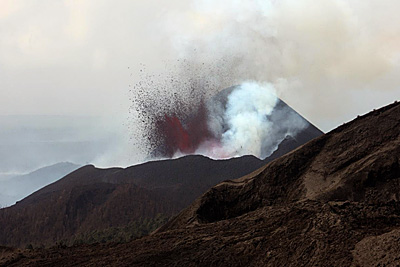
On 2 January, Mount Nyamulagira in the Democratic Republic of Congo erupted, spewing lava from its southern flank and raising concerns that the 100 000 people in the town of Sake could be under threat.

Fears were also triggered in Goma as rumours circulated that an eruption was imminent at the nearby Nyiragongo volcano, which devastated the city in 2002.

Following the eruption, scientists and local authorities have been using a long series of space images from ESA’s Envisat, together with seismic and helicopter data, to monitor the situation and calm fears of the local population.

Dr Nicolas d’Oreye of GORISK, which is in Congo assisting the Goma Volcano Observatory to collect and process satellite observations and field data, said the satellite images are very useful for managing the crisis.

"As well as helping to validate information from different datasets, the satellite images are providing invaluable information about the situation, such as the details about the lava flow and the fact that the Nyiragongo volcano is not showing any signs of abnormal activity.

Path of lava flow

Path of lava flow
"This has been of great importance for the local authorities and the Goma Volcano Observatory, who are holding daily crisis meetings, to reassure the local population and humanitarian agencies that Nyiragongo will be unaffected by the eruption of Nyamulagira."

Goma, the capital of the North Kivu province, is situated along the southern margin of the lava fields from these volcanoes. Lava from the Nyamulagira (height 3058 m) eruption has been flowing in a direction south and southwest of the volcano, raising concerns that lava could cover the Goma and Sake road within weeks, causing widespread chaos and threatening the local economy.

"Lava flows from Nyamulagira are usually not a direct threat for the population and the infrastructure except when it develops southwards, as it is in this case," explained Dr d’Oreye, a senior scientist at the Geophysics/Astrophysics Department of the National Museum of Natural History in Luxembourg. "In this situation, it is crucial to monitor the flow size, direction and speed for the authorities to be able to make timely decisions."

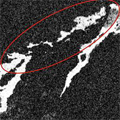
Lava flows can be mapped by comparing satellite radar images acquired before and after the eruption. In the images, old lava appears bright white. If an area appears white in before images and black in after images, then the ground has changed between acquisitions by the flow of new lava.

Friday, January 15, 2010

Chimps understand wildfire

The same chimps recently found to hunt with spears have also shown a nearly human understanding of wildfire.

Jill Pruetz, the Iowa State University primatologist whose nine-year observation of a group of savanna chimpanzees in the African nation of Senegal already led to one groundbreaking discovery earlier this decade: The chimps sharpen tree branches with their teeth and use them to stab small prey.

Now Pruetz is out with a new paper - co-authored with Associate Professor Thomas LaDuke of East Stroudsburg (Pa.) University - that will give evolutionary scientists new information to apply when considering how humans first understood fire.

Their conclusion: Chimpanzees can predict the movement of wildfire well enough to calmly avoid it without fear and without fleeing.

"Our argument is that if chimpanzees with a pretty small brain are intelligent enough to understand how fire behaves, then we should maybe rethink some of the early evidence of bipeds controlling fire," Pruetz said in an interview.

Her conclusions, published online this week by the American Journal of Physical Anthropology, are on the mark, University of Iowa paleoanthropologist Russell Ciochon believes.

Chimpanzees are the most closely related primate to humans, having split with them evolutionarily some 6 million years ago, he said. There is every reason to think that humans' early ancestors would have conceptualized fire similarly, Ciochon said. He agreed with Pruetz that conceptualizing fire is one evolutionary step away from controlling it and two steps away from starting it.

"This is a very interesting and very provocative article," he said.

The paper is based on Pruetz's observations from spring 2006, toward the end of Senegal's dry season, when twice in as many months she was with the chimps as they escaped a wildfire. Such fires are often set by people to clear fields for planting.

The fire's deafening roar could be heard 100 meters away, she said. The chimps did not flee, as one might expect, however. If they had, it would have required long travel in the open sun in 110-degree temperatures with scarce water supply.

Instead, she said the chimps reacted calmly. They monitored the fire, moved to keep out of its way, and in doing so, minimized the amount of energy they expended to stay safe.

As for herself, her gut told her to get out of there - but her brain told her she was better off staying with the chimps.

"I personally didn't like the idea," she said. "But I felt like I had to stick with the chimps to be safe, because I wasn't as good as they were at predicting how the fire would move."

Full article here ...........

Monday, August 3, 2009

Woman Contracts Gorilla HIV: Proof of Direct Connection between SIV and HIV /AIDS

A new strain of HIV has jumped from gorillas to humans.

So far, only one person, a 62-year-old French woman from Cameroon, has been reported to be infected with the virus.

It very closely resembles strains of Simian Immunodeficiency Virus (SIV) recently discovered in western gorillas in the wild.

"It would be surprising if there aren't many more" human cases, says David Robertson, a bioinformaticist at the University of Manchester, UK who analysed the virus's DNA along with colleagues in France.

"We don't think this is a direct gorilla-to-human transmission." It is more likely to be the result of eating 'Bush meat', plus transmission via sexual activity.

Drug hope

Until 2004, the infected woman lived in a suburb of Cameroon's capital city Yaoundé, where she didn't come into contact with apes or eat their meat, SIV's primary route to humans. This means that she probably acquired the infection from another human, likely through sexual contact.

AIDS

The woman hasn't yet shown any sign of a compromised immune system, the hallmark of AIDS but tests on laboratory-cultured human cells suggest that the virus can replicate in the same white blood cells as other strains of HIV. However, the new virus should be susceptible to anti-retroviral drugs that slow the growth of other strains of HIV, Robertson says.

SIV

Based on its genetic sequence, the virus appears most closely related to a number of SIV strains collected recently in gorilla faecal samples from forests in Cameroon. These viruses also resemble "group O" strains of HIV, which infect far fewer people than other strains of HIV, most of them in Cameroon.

Original source

The discovery of a gorilla virus in humans could suggest that some of these group O viruses came from gorillas, Robertson says, but it's also possible that the virus originated chimpanzees and was transmitted independently to gorillas and to humans.

"Until we do more sampling we're also guessing a little bit," Robertson concedes.

Wednesday, July 22, 2009

Chimps can Transmit SIV to Humans (HIV)

The discovery that chimpanzees can develop an AIDS-like illness after infection with simian immunodeficiency virus (SIV), may have implications for future AIDS research and the prevention of HIV infection.

Until now, it was thought that SIV infection in chimps did not result in disease. However, after following 94 wild chimps in Gombe Stream National Park in Tanzania for nine years, Beatrice Hahn, of the University of Alabama at Birmingham, and colleagues have shown that SIVcpz, the virus that jumped from chimps to humans as HIV-1, can and does cause an AIDS-like illness.


Over the 9 years of the study, SIVcpz infection caused an increased risk of mortality. "Up to 41 per cent in adults and 100 per cent in infants, and lower birth rates," says Hahn, "but we need longer-term follow-up to determine what proportion of infected animals develop an AIDS-like illness."

Unique opportunity
Hahn suspects that compared to HIV-infected humans, a greater proportion of SIV-infected chimps do not go on to develop fatal disease. "But this is not simple to test because chimpanzees don't just walk into clinics and give you a blood sample."

However, Hahn hopes that future research into animals which have long-term infection without developing an AIDS-like illness will yield insights that will enable us to better tackle HIV infection.

Unique Opportunity
The team believes that these findings provide a unique opportunity to compare the disease-causing mechanisms of two closely related viruses – SIVcpz and HIV-1 – in two closely related species. Such work has also already yielded information on mortality rates, prevalence and routes of spread of HIV and SIV.

Thursday, May 7, 2009

Alas poor Hobbit......we did not know you well!

Anthropology is comparing this small hobbit skull to that of it's square jawed Homo Sapien cousin and coming to differing views.

The tale of Homo floresiensis, aka 'the hobbit' is beginning to read less like a Tolkien epic and more like an Agatha Christie whodunit.

Two studies have added a new and interesting twist to the plot. One claims that the skeleton's ape-like feet push back its ancestry near the dawn of Homo. Another argues that the hobbit is a later offshoot of Homo erectus, dwarfed by aeons of island isolation, just like the British!

"Either answer is pretty damn exciting," says William Jungers, a palaeoanthropologist at Stony Brook University in New York, who led the analysis of the foot. "It's telling us something pretty amazing about human evolution."

The Hobbit skeleton

Researchers unearthed the hobbit's 18,000-year-old skeleton in Liang Bua Cave on the Indonesian island of Flores in 2003. Then in 2004 partial remains from at least a half dozen individuals were uncovered.

Much of the subsequent research has focused on the skull, which encased a 417 cubic-centimetre brain; about the size of a chimpanzee's and a third the size of a human adult brain.

Allegedly, island species, separated from their mainland kin, tend to shrink over evolutionary time, so the main thrust of the "hobbit as a separate species" arguments have focussed on its small brain. However another theory holds that the skull is simply that of a diseased Homo sapiens.