ESA - Observing the Earth - Congo receives help from space after volcano eruption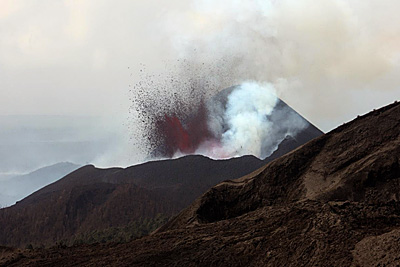 Congo receives help from space after volcano eruption
On 2 January, Mount Nyamulagira in the Democratic Republic of Congo erupted, spewing lava from its southern flank and raising concerns that the 100 000 people in the town of Sake could be under threat.
Fears were also triggered in Goma as rumours circulated that an eruption was imminent at the nearby Nyiragongo volcano, which devastated the city in 2002.
Following the eruption, scientists and local authorities have been using a long series of space images from ESA’s Envisat, together with seismic and helicopter data, to monitor the situation and calm fears of the local population.
Dr Nicolas d’Oreye of GORISK, which is in Congo assisting the Goma Volcano Observatory to collect and process satellite observations and field data, said the satellite images are very useful for managing the crisis.
"As well as helping to validate information from different datasets, the satellite images are providing invaluable information about the situation, such as the details about the lava flow and the fact that the Nyiragongo volcano is not showing any signs of abnormal activity.
 | |
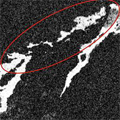
| Path of lava flow |
"This has been of great importance for the local authorities and the Goma Volcano Observatory, who are holding daily crisis meetings, to reassure the local population and humanitarian agencies that Nyiragongo will be unaffected by the eruption of Nyamulagira."
Goma, the capital of the North Kivu province, is situated along the southern margin of the lava fields from these volcanoes. Lava from the Nyamulagira (height 3058 m) eruption has been flowing in a direction south and southwest of the volcano, raising concerns that lava could cover the Goma and Sake road within weeks, causing widespread chaos and threatening the local economy.
"Lava flows from Nyamulagira are usually not a direct threat for the population and the infrastructure except when it develops southwards, as it is in this case," explained Dr d’Oreye, a senior scientist at the Geophysics/Astrophysics Department of the National Museum of Natural History in Luxembourg. "In this situation, it is crucial to monitor the flow size, direction and speed for the authorities to be able to make timely decisions."
Lava flows can be mapped by comparing satellite radar images acquired before and after the eruption. In the images, old lava appears bright white. If an area appears white in before images and black in after images, then the ground has changed between acquisitions by the flow of new lava.

 Saving Gorillas Starts With Understanding Their Human Neighbours


 Posts
Posts


