MSL’s Pu-238 fueled MMRTG in the laboratory. Credit: NASA
Another blow was dealt to deep space exploration this past weekend.
The announcement comes from Jim Green, NASA's Planetary Science Division Director.
The statement outlines some key changes in NASA's radioisotope program, and will have implications for the future exploration of the outer solar system.
We've written about the impending plutonium shortage and what it means for the future of spaceflight, as well as the recent restart of plutonium production.
NASA is the only space agency that has conducted missions to the outer planets—even the European Space Agency's Huygens lander had to hitch a ride with Cassini to get to Titan—and plutonium made this exploration possible.
Probably the most troubling aspect of the announcement is the discontinuation of procurement by NASA of flight hardware for what was to be NASA's next generation nuclear power-source for exploration, the Advanced Stirling Radioisotope Generator, (ASRG).
An Advanced Stirling Converter prototype in the laboratory. Credit: NASA
The announcement states:
"With an adequate supply of Pu-238… NASA has decided to discontinue procurement of ASRG flight hardware."
"We have given direction to the Department of Energy… to end work on the flight units."
"The hardware procured under this activity will be transferred to the Glenn Research Center to continue development and testing of the Stirling technology."
The announcement cites the current budget-constrained environment that NASA and planetary space exploration finds itself up against.
What the exact future role is of NASA Glenn beyond basic research and development isn't entirely clear, but two ASRG units that were to be flight-ready for missions in 2016 are shelved for now.
The announcement does mention that NASA will continue to utilize flight-proven MMRTG's in the near term, which provide the same approximate power output as the ASRG, albeit with less efficiency.
Plutonium is vital for outer solar system exploration. As you get farther away from the Sun, solar energy ceases to become a viable alternative power source.
Pioneers 10 & 11, Voyagers 1 & 2, Galileo, and Cassini all utilized nuclear RTGs, as does the Mars Curiosity rover and New Horizons mission headed out explore Pluto in during its July 2015 flyby.
NASA's Juno spacecraft scheduled to reach Jupiter in 2016 will be the first-ever mission without an RTG to explore the outer solar system, and it must employ three enormous solar panels to do so.
A labeled cutaway of an ASRG. Credit:
Wikimedia Commons
And although the production of the Pu-238 isotope used in space exploration was a side-benefit of the Cold War, it isn't the same stuff as its isotopic cousin Pu-239, which is used in nuclear weapons.
Plutonium production in the United States ceased in 1989, and although the U.S. government announced earlier this year that NASA will restart the plutonium production pipeline for space exploration, production levels are only expected to reach 1 to 1.5 kilograms per year.
ESA employs 130 ton satellite dishes, dispersed in key areas all over the world to monitor the skies for transmissions. They boost faint signals from spacecraft and in reverse create high energy transmissions to relay commands.
Credit: ESA
In 18 years, messages beamed out into space from Earth by a new alien-messaging project Monday (June 17) will reach a distant star system known as Gliese 526.
Officials with the Lone Signal project — a newly launched website designed to send user-written notices to any extraterrestrials who may receive them — hope that their messages might open the first dialogue between Earth and other intelligent life forms.
One of the company's first message beamed to the Gliese 526 system, located 17.6 light-years from Earth was sent by famous futurist Ray Kurzweil and reads: "Greetings to Gliese 526 from Singularity University."
"As you receive this, our computers have made us smarter, the better to understand you and the wisdom of the universe…"
"This signal, in 19 hours, will go farther than the Voyager spacecraft has in 40 years," Jason Silva, the host of "Brain Games" on theNational Geographic Channelsaid.
He spoke to a crowd of fashion models, businessmen and a handful of scientists in downtown Manhattan honouring Lone Signal's launch on Monday.
Martin Pugh took this image of the Pencil Nebula, or NGC 2736, from his home in Yass, New South Wales, Australia over the course of two weeks in March, 2013. Pugh used a Takahashi FSQ106N telescope with a Paramount ME Software Bisque mount, SBIG STF8300/FW8300-8 Baader 36mm filters, and Maxim DL as well as CCDAutopilot software to capture the photo. He processed the image with Maxim DL/CCD, Photoshop CS, CCDStack and PixInsight. The total exposure time was 10 hours. CREDIT: Martin Pugh
The thin, woven filaments in this beautiful image resemble an artist’s etching into a canvas of glowing gas.
Martin Pugh took this image of the Pencil Nebula, or NGC 2736, from his home in Yass, New South Wales, Australia over the course of two weeks in March,2013.
The Pencil Nebula is located 800 light-years away and is five light-years long. The nebula, named for its elongated appearance, is an interstellar shockwave seen nearly edge-on.
The shockwave travels through space at an astonishing 310,685 mph (500,000 km/h).
Scientists say the nebula is part of the larger Vela supernova remnant that produced the initial shockwave. In the image, the red and blue regions mark the glow from hydrogen and oxygen atoms.
Tucked away in a vacuum chamber for several months, Europe's largest telecom satellite has faced the harsh conditions it will deal with once it is launched into space this summer.
Testing at Intespace in Toulouse, France, simulated conditions close to those Alphasat will experience in flight, including the intense cold of its transfer orbits in the early stages of the mission.
Not only was Alphasat's ability to control its temperature tested, but other features were also put through their paces to ensure everything can run under the extreme cold and hot conditions.
"If you were going to test a new car for extreme conditions, you would probably want to do the same thing: not only check the heating and air conditioning, but also make sure that the engine, brakes, ignition and radio work in low temperatures as well as high," explained Philippe Sivac, ESA's Alphasat acting project manager.
To monitor the satellite inside the large chamber, nearly 600 temperature sensors were attached in key locations. A satellite the size of Alphasat can also carry up to 400 flight thermal sensors.
Readouts are displayed in real time, together with the satellite's internal data to help build an overall picture for the team monitoring Alphasat around the clock.
Running Alphasat under very stable thermal situations showed that the thermal-mathematical model is well suited to predict the temperatures in orbit.
"Finally, the performance and functional tests show that all the electronics and software perform as expected even at extreme temperatures."
Several critical items related to NASA's next-generation James Webb Space Telescope currently are being tested in the thermal vacuum test chamber at NASA's Goddard Space Flight Center, Greenbelt, Md.
This image shows the Optical Telescope Element Simulator, or OSIM, wrapped in a silver blanket on a platform, being lowered into the Space Environment Simulator vacuum chamber via crane to be tested to withstand the cold temperatures of space.
The worst case of Lunar IBS recorded was never caught on film but has
been re-animated in this graphic representation. In Space no-one can
hear you fart!
In early expeditions, pressurised suit had to be vented at regular intervals to prevent a catastrophic build up of gases.
Light clocks A and B moving horizontally through space. According to length contraction, clock A should tick faster than clock B.
In a new study, scientists argue that there is no length contraction, and both clocks should tick at the same rate in accordance with special relativity.
Image credit: Sorli and Fiscaletti.
Philosophers have debated the nature of time long before Einstein and modern physics but in the 106 years since Einstein, the prevailing view in physics has been that time serves as the fourth dimension of space, an arena represented mathematically as 4D Minkowski spacetime.
In a new study, Sorli and Fiscaletti have shown that two phenomena of special relativity - time dilation and length contraction, can be better described within the framework of a 3D space with time as the quantity used to measure change (i.e., photon motion) in this space.
The scientists have published their article in a recent issue of Physics Essays. The work builds on their previous articles, in which they have investigated the definition of time as a “numerical order of material change.”
The main concepts of special relativity - that the speed of light is the same in all inertial reference frames, and that there is no absolute reference frame - are traditionally formulated within the framework of Minkowski spacetime.
In this framework, the three spatial dimensions are intuitively visualized, while the time dimension is mathematically represented by an imaginary coordinate, and cannot be visualized in a concrete way.
In their paper, Sorli and Fiscaletti argue that, while the concepts of special relativity are sound, the introduction of 4D Minkowski spacetime has created a century-long misunderstanding of time as the fourth dimension of space that lacks any experimental support.
They argue that well-known time dilation experiments, such as those demonstrating that clocks do in fact run slower in high-speed airplanes than at rest, support special relativity and time dilation but not necessarily Minkowski spacetime or length contraction.
According to the conventional view, clocks run slower at high speeds due to the nature of Minkowski spacetime itself as a result of both time dilation and length contraction.
But Sorli and Fiscaletti argue that the slow clocks can better be described by the relative velocity between the two reference frames, which the clocks measure, not which the clocks are apart of. In this view, space and time are two separate entities.
“With clocks we measure the numerical order of motion in 3D space,” Sorli reported. “Time is 'separated' from space in a sense that time is not a fourth dimension of space.
Instead, time as a numerical order of change exists in a 3D space. Our model on space and time is founded on measurement and corresponds better to physical reality.”
To illustrate the difference between the two views of time, Sorli and Fiscaletti consider an experiment involving two light clocks.
Each clock's ticking mechanism consists of a photon being reflected back and forth between two mirrors, so that a photon's path from one mirror to the other represents one tick of the clock.
The clocks are arranged perpendicular to each other on a platform, with clock A oriented horizontally and clock B vertically.
When the platform is moved horizontally at a high speed, then according to the length contraction phenomenon in 4D spacetime, clock A should shrink so that its photon has a shorter path to travel, causing it to tick faster than clock B.
But Sorli and Fiscaletti argue that the length contraction of clock A and subsequent difference in the ticking rates of clocks A and B do not agree with special relativity, which postulates that the speed of light is constant in all inertial reference frames.
They say that, keeping the photon speed the same for both clocks, both clocks should tick at the same rate with no length contraction for clock A.
They mathematically demonstrate how to resolve the problem in this way by replacing Minkowski 4D spacetime with a 3D space involving Galilean transformations for three spatial coordinates X, Y, and Z, and a mathematical equation (Selleri's formalism) for the transformation of the velocity of material change, which is completely independent of the spatial coordinates.
Video of Mock Discussion on Time and Space
Sorli explained that this idea that both photon clocks tick at the same rate is not at odds with the experiments with flying clocks and other tests that have measured time dilation. This difference, he says, is due to a difference between photon clocks and atom-based clocks.
“The rate of photon clocks in faster inertial systems will not slow down with regard to the photon clocks in a rest inertial system because the speed of light is constant in all inertial systems,” he said.
“The rate of atom clocks will slow down because the 'relativity' of physical phenomena starts at the scale of pi mesons.”
He also explained that, without length contraction, time dilation exists but in a different way than usually thought.
“Time dilatation exists not in the sense that time as a fourth dimension of space dilates and as a result the clock rate is slower,” he explained.
“Time dilatation simply means that, in a faster inertial system, the velocity of change slows down and this is valid for all observers.
GPS confirms that clocks in orbit stations have different rates from the clocks on the surface of the planet, and this difference is valid for observers that are on the orbit station and on the surface of the planet.
So interpreted, 'time dilatation' does not require 'length contraction,' which as we show in our paper leads to a contradiction by the light clocks differently positioned in a moving inertial system.”
He added that the alternative definition of time also agrees with the notion of time held by the mathematician and philosopher Kurt Gödel.
“The definition of time as a numerical order of change in space is replacing the 106-year-old concept of time as a physical dimension in which change runs,” Sorli said.
“We consider time being only a mathematical quantity of change that we measure with clocks. This is in accord with a Gödel view of time.
By 1949, Gödel had produced a remarkable proof: 'In any universe described by the theory of relativity, time cannot exist.'
Our research confirms Gödel's vision: time is not a physical dimension of space through which one could travel into the past or future.”
In the future, Sorli and Fiscaletti plan to investigate how this view of time fits with the broader surroundings.
They note that other researchers have investigated abolishing the idea of spacetime in favour of separate space and time entities, but often suggest that this perspective is best formulated within the framework of an ether, a physical medium permeating all of space.
In contrast, Sorli and Fiscaletti think that the idea can be better modeled within the framework of a 3D quantum vacuum.
Rather than viewing space as a medium that carries light, light's propagation is governed by the electromagnetic properties (the permeability and permittivity) of the quantum vacuum.
“We are developing a mathematical model where gravity is a result of the diminished energy density of a 3D quantum vacuum caused by the presence of a given stellar object or material body,” Sorli said.
"Inertial mass and gravitational mass have the same origin: diminished energy density of a quantum vacuum."
"This model gives exact calculations for the Mercury perihelion precession as calculations of the general theory of relativity.”
More information: Amrit Sorli and Davide Fiscaletti. “Special theory of relativity in a three-dimensional Euclidean space.” Physics Essays: March 2012, Vol. 25, No. 1, pp. 141-143. DOI: 10.4006/0836-1398-25.1.141
The Government is to grant nearly 6 million pound to co-fund major new British research that will develop commercial products and services using space technology and data from space-based systems.
The total value of the R and D, including contributions from the participating companies, is over £11.5 million.
The portfolio of projects includes participation by 21 partner companies, universities and research organisations, including 7 SMEs.
Minister for Universities and Science David Willetts said: "The UK space industry supports thousands of high-tech jobs in the UK and is an important driver of economic growth.
This 6 million investment will build on that success by helping some of the most innovative British businesses develop highly commercial, cutting-edge space technology that will be in demand in a growing global market."
Dr David Williams, Chief Executive of the UK Space Agency, said: "These initial major projects springing out of the National Space Technology Programme are great examples innovative and ambitious R and D in the UK space sector.
By investing in these projects, we are securing our future national capability across the range of vital applications and services that space technology can provide."
Iain Gray, Chief Executive of the Technology Strategy Board, said: "We are delighted to support these exciting new projects, which will enable the development, commercialisation and exploitation of space technologies to address challenges and provide growth opportunities across a wide range of emerging markets."
The four projects will:
Begin the development of the Next Generation Telecommunications satellite platform. The work is focused on developing the mechanical platform architecture for future European telecommunications satellites in the 3 to 6 tonne range. This project will also prepare UK companies to take leading roles in future European Space Agency programmes to develop telecommunication space technologies;
Develop a ruggedised and light-weight portable Ka-Band satcom terminal. This "suitcase" terminal will provide portable and mobile access to the latest generation of high bandwidth satellite broadband services;
Develop a system and service for measuring land carbon stocks and fluxes from Satellite Earth observation data. This service will provide much higher resolution services than are currently available and enable the monitoring and trading of carbon credits and similar commercial tools for tackling climate change;
Prepare the way for the planned UK NovaSAR Synthetic aperture radar mission by accelerating the technology development of an innovative S-Band Synthetic Aperture Radar instrument.
The investment forms the core part of the UK Space Agency's National Space Technology Programme (NSTP), which sees government investment of 10 million pounds to help UK industry exploit growth opportunities in the space sector and improve the UK's space technology capabilities.
Last month the UK Space Agency and the Technology Strategy Board announced investment of 2.5 million pounds through the NSTP in twenty-eight short-term, fast-track research and development projects.
The UK Space Agency has embarked on its biennial survey of the space industry and has contracted Oxford Economics to undertake the task.
The survey will cover the traditional providers of space technology (upstream) and those who exploit the technology (downstream).
However there are many companies whose business is partially or wholly dependent on space but who do not deal directly with space organisations or see themselves as part of the space industry. If you fit in this category, we are particularly keen to hear from you.
You are invited to answer the survey online, but if you would prefer a hard copy version to complete and return by email or post, please inform Pete Collings, tel: 0207 803 1411.
If you wish to discuss your involvement with the UK Space Agency, please contact George Pritchard, on 01793 418 060.
SETI Live provides data gathered by the Institute's Allen Telescope Array, which scans sections of space for radio frequency signals.
Web users can log on to the site and help analyze the data, sifting through signals for evidence of an extraterrestrial civilization.
"There are parts of the spectrum where our sophisticated signal processing system is overwhelmed because there are so many signals," said astronomer Jill Tarter, director of the Center for SETI Research, in an interview. "I'm hoping to put together this army of citizen scientists to help figure out which signals to follow up on."
Essentially, human eyes are needed to pick up on subtle patterns that might be overlooked by SETI computer algorithms.
"The people that will do the best at this are going to be people whose pattern skills are such that they can ignore the bright pattern that's so easy to detect and look to see that there's something else there, something fainter, and see if they can in fact discover this needle that's buried under the hay," Jill Tarter stated.
SETI Live came out of the TED Prize program, which awards $100,000 every year to an "exceptional individual" with "One Wish to Change the World."
Jill Tarter won the prize in 2009, revealing her wish to "to empower Earthlings everywhere to become active participants in the ultimate search for cosmic company." Her wish developed into SETI Live.
SETI Institute scientists have been searching for signs of intelligent alien life since the 1960s, but have yet to find anything. With the discovery of 700 extra-solar planets, the search for extraterrestrial life has become much more targeted in these regions of space.
The funding will help Clyde further work on miniaturised electric propulsion systems for very small spacecraft.
The other project involves developing attitude planning and control algorithms for low cost spacecraft.
Clyde has been working on tiny electric propulsion systems for very small spacecraft called "CubeSats" and nanosatellites with Southampton University's Mars Space Ltd.
Funding of £24,000 has been awarded for their joint work on a micro pulsed plasma thruster for CubeSats.
Clyde said the project would take the technology forward to a flight-ready prototype.
That project involves optimising algorithms for control of CubeSat attitude, furthering work already completed at Clyde.
Craig Clark, from Clyde Space, said: "We are up against organisations from all over the world, high technology companies that are doing similar things to us, so this funding will really help towards us maintaining a competitive edge."
At last Scotland is being seen as playing a leading role in the space sector after decades of being the engineers, scientists and innovators that break down technological barriers in other countries' space programs.
The space sector contributes £5.6 billion to the UK economy, as well as supporting 68,000 high-value jobs. Not only that, it has soared above the recent economic headwinds, growing an average of 9 per cent each year since 1999.
Scotland-based companies are playing a key role in that success story. Clyde Space is leading the design and manufacture of the UKube-1 satellite – the UK’s first satellite commissioned by the UK Space Agency.
Other examples include Star-Dundee, which sells its data-handling test products to almost every international space agency, while Selex Galileo, in Edinburgh, is tapping into the market for European satellites.
Commercial success also goes hand in hand with globally recognised academic excellence, with the recent launch of the Space Glasgow research cluster by the UK Science Minister David Willetts.
But don’t think that space research is something that can only be applied out in the great beyond. In fact, on 6 March, Glasgow will host the second Scottish Space Symposium, exploring the theme of “Bringing space down to earth”. Download a copy of the Program here
For example, use of space-based data will allow Network Rail to improve safety by monitoring landslides remotely via satellite rather than sending engineers to remote locations.
Edinburgh-based Ecometrica is also using satellite data to monitor CO2 levels, putting them at the vanguard of carbon trading and tariffs which the EU is investigating placing on businesses as a means of tackling climate change.
So the Scottish Space Symposium will explore how businesses can benefit from terrestrial applications in such key fields as communications and transport. Science fact, as opposed to science fiction.
Payloads for Vega's first mission include LARES, ALMASat 1, and seven CubeSats from universities across Europe. Credit: ESA/CNES/Arianespace
Scheduled for launch from French Guiana on Monday, Europe's first lightweight Vega rocket is packed with nine small research satellites, including a unique Italian craft designed to help make an elusive accurate measurement of a central tenet of Albert Einstein's theory of general relativity.
The 98-foot-tall booster is due for liftoff in a two-hour launch window opening at 1000 GMT (5 a.m. EST) Monday.
The four-stage launcher, developed with Italian leadership, will make its first flight from the Guiana Space Center, a European-run spaceport in French Guiana.
The Vega rocket will deploy its nine payloads at different altitudes, first releasing the Laser Relativity Satellite about 55 minutes after launch in a circular 901 mile-high orbit with an inclination of 69.5 degrees.
Another firing by the Vega's fourth stage, powered by a Ukrainian liqiud-fueled engine, will reduce the altitude of the orbit's low point to 217 miles before deploying Italy's ALMASat 1 technology demonstration satellite and seven two-pound CubeSats built by learning institutions across Europe.
The Vega's mission will conclude 81 minutes after launch.
Officials selected LARES as the main passenger for the rocket's qualification flight, which aims to prove Vega's flight and ground systems before it is entrusted with more costly payloads on subsequent missions.
Carved out of a single ball of tungsten, LARES is covered 92 laser retroreflectors, allowing a network of ranging stations around the world to track the spherical satellite in orbit.
By bouncing laser signals off reflectors on LARES, scientists can precisely compute its position in space.
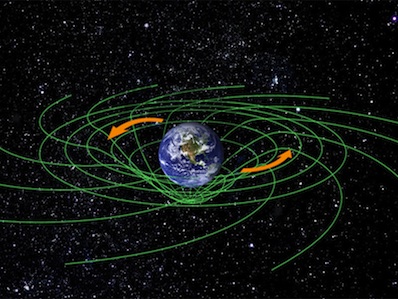
After comparing the actual location of LARES against predictions, researchers can measure the frame-dragging effect, part of Einstein's theory of general relativity which states that a rotating mass can distort space-time around it.
"Imagine the Earth as if it were immersed in honey. As the planet rotates, the honey around it would swirl, and it's the same with space and time," said Francis Everitt, a Standford University researcher who led the science team for NASA's Gravity Probe B mission, which confirmed the frame-dragging, or Lense-Thirring, effect at 37.2 milliarcseconds with a margin for error of about 19 percent.
Artist's concept of the frame-dragging effect around Earth. Credit: Stanford University
The frame-dragging effect manifests itself in minuscule changes in the orbits of satellites. Scientists observed two precursors to LARES, named LAGEOS 1 and LAGEOS 2, over several years to determine their orbital planes shifted 6 feet per year in the direction of Earth's rotation.
The LAGEOS tracking, coupled with a precise Earth gravity model, produced an estimation of the frame-dragging effect at 99 percent of the value predicted under general relativity.
The joint U.S.-Italian LAGEOS mission ultimately measured the effect with an accuracy of about 10 percent.
The objective of LARES is to refine the real effect of frame-dragging with an accuracy approaching 1 percent, according to the Italian space agency, which is funding the mission.
Better data on the frame-dragging effect around Earth will help astrophysicists study distant black holes, neutron stars and active galactic nuclei, whose immense gravity creates much stronger warping of space-time.
In a white paper outlining its ambitious space programme's five-year plan, the China National Space Administration (CNSA) said the Long March-5 rockets "will use non-toxic and pollution-free propellant".
Speaking at press briefing outlining the paper, CNSA spokesman Zhang Wei said the rockets would be capable of placing 25-tonne payloads into near-Earth orbit.
China holds up its space programme as a symbol of the nation's growing global stature and technical expertise, and of the ruling Communist Party's success in turning around the fortunes of the once poverty-stricken nation.
Morris Jones, an independent space expert based in Sydney, told AFP the announcement was significant.
"It's impressive that China's reached that stage with this next round of heavy-lift vehicles, so crucial to reaching their goal of building a space station by 2020," he said.
China's space agency said previously announced plans would go ahead over the next five years, among them establishing a launch pad on the southern island of Hainan, launching lunar orbiters and probes and researching a manned moon landing.
The white paper offered no timetable for plans to launch and dock the Shenzhou IX and X rockets onto China's Tiangong-1 experimental space module in 2012. At least one of these rockets is expected to be manned.
In November, the unmanned Shenzhou VIII spacecraft returned to Earth after completing two space dockings with Tiangong-1 in the nation's first ever hard-to-master "space kiss", bringing together two vessels in high speed orbit.
Appearing to try to allay international concerns about China's potential militarisation of space, the agency said China wanted to "utilise outer space for peaceful purposes" -- a claim Morris disputed.
"No nation that has a respectable major space programme has an entirely peaceful programme," he said, noting China had tested anti-satellite weapons by blowing up one of its own in 2007.
"The world over, space technologies are used for military communications and to deploy spy satellites. China's no different," Jones said.
This file photo was taken on Friday, Sept. 21, 2007, when Boris Chertok was speaking to reporters in Moscow.
Chertok, who died in Moscow Wednesday at the age of 99, was one of the founders of the Soviet space program and played a key role in many Soviet space achievements. (AP Photo/Sergei Grits, file)
Boris Chertok, a Russian rocket designer who played a key role in engineering Soviet-era space programs, has died, aged 99.
The state-controlled RKK Energiya rocket builder where he worked as a top consultant said Chertok died in Moscow on Wednesday after contracting pneumonia.
For many years, Chertok served as a deputy to the father of the Soviet space program, Sergei Korolyov.
He was closely involved in putting the world's first satellite in orbit on Oct. 4, 1957, and preparing the first human flight to space by Yuri Gagarin on April, 12 1961.
Chertok was born in Lodz, Poland, when it was still part of the Russian empire and his family moved to Moscow at the start of World War I.
After graduating from the Moscow Energy Institute in 1940, he started working as an aviation engineer.
When World War II ended, Chertok was selected to lead a group of Soviet experts to travel to Germany to tap the Nazi know-how in rockets. He first met Korolyov there, and the two worked closely together until Korolyov's death in 1966.
Chertok, who specialized in control systems for rockets and spacecraft, has published memoirs chronicling the rise of the Soviet space program from its early days to the moon race the Soviet Union lost to the United States.
"Each of these first rockets was like a beloved woman for us," Chertok said at a meeting with reporters.
"We were in love with every rocket, we desperately wanted it to blast off successfully. We would give our hearts and souls to see it flying."
Even the names of Chertok and other leaders of the space program were a tightly-guarded secret, and he only was permitted to travel abroad only in the late 1980s, after Soviet leader Mikhail Gorbachev liberalized the Soviet Union.
Chertok's voluminous work for the first time revealed to the public details of the endeavors which had been hidden by the veil of Soviet-era secrecy.
"I deeply regret the loss of this brilliant and genuinely humane person," said James Oberg, a NASA veteran who has written books on the Russian space program and who now works as a space consultant.
"A man like him should live forever," Oberg said in an emailed message. "He will do so, in his accomplishments and his books."
In recent years, Chertok has frequently appeared on national television and participated in events marking historic achievements. Chertok made stinging criticism of the Russian leadership for losing the nation's edge in space.
"The new elite consisting of the superrich and corrupt officials feeding on windfall energy revenues don't care about the national space program," he said in an interview published earlier this year.
It's Christmas, and you want to find the perfect gift for your loved one who is interested in astronomy or space exploration. Here are our top five Christmas gift ideas that any space enthusiast will surely love.
1. Apollo 11 Space Suit Hi-Fi Replica From Space Toys, you can get your loved one his own Apollo 11 NASA Space Suit. Made from heavy duty Nylon Cordura, quality is assured from the machining of aluminum hose fittings and neck ring to the anodizing of the aluminum fittings. Metal parts are also hand created while each suit is hand sewn. The helmet is also hand made from adding the gold to the visor to adding the cloth wrap cover. A real collector's item.
2. Project Mercury DVD This six-set DVD offers a view of America's first manned space project. It is a stunning documentary of Mercury's flight to two sub-orbital and four orbital missions to build experience in the new frontier of space, including footages from the development, training of the original seven astronauts, development and primate flights, plus coverage of each mission including preparation, ingress, launch, onboards and recovery. Enjoy more than 24 hours of material on six DVDs from Countdown Creations.
3. Zhumell Tachyon 25x100 Astronomical Binocular with Tripod Package Your space enthusiast will surely love this binocular and tripod set that offers a great astronomical viewing experience. The Zhumell Tachyon 25x100 Astronomical Binocular with Tripod Package includes Zhumell's Tachyon 25x100 astronomical binoculars and the Zhumell Heavy-Duty Tripod for an exciting bino-astronomy observation.
4. Beyond Earth Book lovers will be smitten with this National Geographic publication. Co-published with the Smithsonian Institution, this one of a kind book details almost 5,000 years of stargazing, with great illustrations, from the Chinese and Aztecs to the Hubble Space Telescope.
5. Discovery Discovery Star Theater V3 Home Planetarium Have your own planetarium at home for your loved one. Hundreds of twinkling stars and constellations projected onto your walls and ceiling will transform your room into a 360-degree planetarium. From Discovery, the Star Theatre V3 Home Planetarium is also educational as it provides astronomical facts, correctly positioned celestial bodies, and includes a built-in liquid-filled compass & glow light feature.
Volunteers from the African Space Research Programme work on the African Skyhawk jet in a suburb of Kampala, Uganda.
The programme aims to launch a Ugandan into space in the next decade.
Chris Nsamba says that at one time or another every successful scientist has been called a madman and in the rambling Ntinda suburb of Kampala it seems there were plenty of people who thought Nsamba was crazy when he embarked upon a project to send the first Ugandan into space - from the backyard of his mother's home.
Project Icarus is a volunteer theoretical engineering study to design an interstellar spacecraft. The project was launched on September 30th 2009 at the British Interplanetary Society HQ in London, and is a five year study.
The purpose of Project Icarus is four-fold:
1. To motivate a new generation of scientists in designing space missions that can explore beyond our solar system.
2. To generate greater interest in the real term prospects for interstellar precursor missions that are based on credible science.
3. To design a credible interstellar probe that is a concept design for a potential mission in the coming centuries so as to allow a direct technology comparison with Daedalus and to provide an assessment of the maturity of fusion based space propulsion for future precursor missions.
4. To allow a direct technology comparison with Daedalus and provide an assessment of the maturity of fusion based space propulsion for future precursor missions.
Specifically, Daedalus demonstrated that it is possible, by using current or credible extrapolations of existing technology, to launch an interstellar probe that could reach another solar system on timescales of a normal human lifetime.
The primary objectives of Project Icarus is to produce a completed set of technical reports which describe the engineering layout, functionality, physics, operation, expected performance and mission profile of an unmanned interstellar probe according to the requirements set out in the Project Icarus Terms of Reference document.
Project Icarus is an international project and we are slowly attempting to recruit representatives from all the permanently inhabited continents. They believe that humankind's first interstellar mission will be a global effort and are building a team that is representative of this.
If you feel that you have a unique skill that could add in some way to their efforts contact the Icarus team: info@icarusinterstellar.org
A quote from Sir Arthur Eddington, from Stars and Atoms ( (Oxford University Press, 1927, p. 41) ).
In ancient days two aviators procured to themselves wings. Daedalus flew safely through the middle air and was duly honoured on his landing. Icarus soared upwards to the sun till the wax melted which bound his wings and his flight ended in fiasco. In weighing their achievements, there is something to be said for Icarus. The classical authorities tell us that he was only "doing a stunt", but I prefer to think of him as the man who brought to light a serious constructional defect in the flying-machines of his day. So, too, in Science. Cautious Daedalus will apply his theories where he feels confident they will safely go; but by his excess of caution their hidden weaknesses remain undiscovered. Icarus will strain his theories to the breaking-point till the weak joints gape. For the mere adventure? Perhaps partly; this is human nature. But if he is destined not yet to reach the sun and solve finally the riddle of its constitution, we may at least hope to learn from his journey some hints to build a better machine. - Sir Arthur Eddington
"Stars and Atoms"
Starbrook image of Prospero streaking at 27,000 kph (17,000 mph) across the constellation of Pegasus
This week marks the 40th anniversary of Britain as a spacefaring nation.
On the 28th of October 1971, the UK launched Prospero - a science and technology demonstration satellite - on top of a Black Arrow rocket at Woomera, Australia.
This made the UK the 6th nation to demonstrate a working orbital launch capability.
In celebration of this anniversary, space scientists at UCL are attempting to re-establish contact with Prospero and UK space surveillance company Space Insight has captured a new image of the satellite.
This new image was taken just a month after Space Insight celebrated an anniversary of its own - 5 years of tracking objects like Prospero with their space surveillance sensor Starbrook.
The Starbrook image shows Prospero streaking at 27,000 kph (17,000 mph) across the constellation of Pegasus, in a near-polar orbit which varies in height from 500 to 1300 km (300 to 700 miles).
Since initial development five years ago, Space Insight's Starbrook sensors have played a key part in the UK's contribution to European and international space surveillance programmes and initiatives, including ESA's first co-ordinated space tracking campaign.
The UK Space Agency uses the company to provide a wide range of scientific and technical support.
Staff from the Agency and Space Insight are members of the UK delegation to the Inter-Agency Debris Committee, providing support to, and analysis of, technology and strategy options for the surveillance of space, contributing to observation campaigns and predicting satellite re-entry events.
During 1971, when Prospero was launched aboard the UK-developed and built Black Arrow rocket, there were just 3000 objects orbiting the Earth, owned by just a dozen countries.
Many of the satellites, like Prospero, were performing experiments to investigate the effects of the space environment, about which little was known at the time.
It would be another seven years before Don Kessler and Burton Cour-Palais would publish their seminal paper, 'Collision Frequency of Artificial Satellites: The Creation of a Debris Belt', in which they foresaw the rise of the space debris problem.
At that time, with just a few hundred satellites in Earth orbit, it was relatively straightforward and viable to track each one individually using radar or telescope.
Today, satellites and debris crowd all Earth orbits. Nearly 40,000 objects overall have been tracked in orbit, with many millions of mm-sized debris estimated.


 A labeled cutaway of an ASRG. Credit:







 Posts
Posts


