Showing posts with label material. Show all posts

Wednesday, July 30, 2014

Breathing Silk leaf maker claims material will aid space journeys - Video


Julian Melchiorri, a graduate of the Royal College of Art has developed a synthetic biological leaf.

Potential applications range from the material being used on buildings' facades, or even for support on space journeys for oxygen.

Julian Melchiorri said Silk Leaf, a man-made, biological leaf involves a material extracted directly from the fibers of silk.

Julian Melchiorri
Melchiorri said the synthetic biological leaf he developed, which absorbs water and carbon dioxide to produce oxygen, is like a real leaf, and could enable long-distance space travel, according to a report in Dezeen.

This material, he said, has an amazing property.

Choloroplast


"I extracted choloroplasts from plant cells, and placed them inside this silk material."

The material work and breathes as a leaf does. "It's very light…low energy-consuming." He also said, "My idea was to use the efficiency of nature in a man-made environment."

The synthetic leaf could, among other applications, be used to make long-distance space travel that much more imaginable.

The Dezeen report includes pictures of the leaf transformed into lighting and building applications.

He said he thought about applications on smaller and larger scales.

He imagined its being used as a free surface in interior design, or for outdoor applications.

"So facades, ventilation programs…You can soak up air from outdoors, pass it by way of these biological filters and then carry oxygenated air inside."

Artist Impression of Silk Leaf City
He also noted the leaf material may be applicable to space travel.

"NASA is researching different ways to produce oxygen for long-distance space journeys to let us live in space," he said.

"This material could allow us to explore space much further than we can now."

A CNET article called it "an oxygen factory for space travel."

Writing in CNET, Eric Mack brought the significance of the NASA idea to light in asking, "what if we could take those biological oxygen factories into space with us, but without all the land, sun, water, soil, and gravity that forests tend to require?"

The Silk Leaf project was developed by Melchiorri as part of the Royal College of Art's Innovation Design Engineering course in collaboration with Tufts University silk lab.

Saturday, September 7, 2013

Powerful jets discovered blowing material out of galaxy

Radio-Telescope Image of the galaxy 4C12.50, nearly 1.5 billion light-years from Earth. 

Inset shows detail of location at end of superfast jet of particles, where a massive gas cloud (yellow-orange) is being pushed by the jet. 

Credit: Morganti et al., NRAO /AUI /NSF

Astronomers using a worldwide network of radio telescopes have found strong evidence that a powerful jet of material propelled to nearly light speed by a galaxy's central black hole is blowing massive amounts of gas out of the galaxy.

This process, they said, is limiting the growth of the black hole and the rate of star formation in the galaxy, and thus is a key to understanding how galaxies develop.

Astronomers have theorized that many galaxies should be more massive and have more stars than is actually the case.

Scientists proposed two major mechanisms that would slow or halt the process of mass growth and star formation -- violent stellar winds from bursts of star formation and pushback from the jets powered by the galaxy's central, supermassive black hole.

Raffaella Morganti
"With the finely-detailed images provided by an intercontinental combination of radio telescopes, we have been able to see massive clumps of cold gas being pushed away from the galaxy's center by the black-hole-powered jets," said Raffaella Morganti, of the Netherlands Institute for Radio Astronomy and the University of Groningen.

The scientists studied a galaxy called 4C12.50, nearly 1.5 billion light-years from Earth. They chose this galaxy because it is at a stage where the black-hole "engine" that produces the jets is just turning on.

As the black hole, a concentration of mass so dense that not even light can escape, pulls material toward it, the material forms a swirling disk surrounding the black hole.

Processes in the disk tap the tremendous gravitational energy of the black hole to propel material outward from the poles of the disk.

At the ends of both jets, the researchers found clumps of hydrogen gas moving outward from the galaxy at 1,000 kilometers per second.

One of the clouds has much as 16,000 times the mass of the Sun, while the other contains 140,000 times the mass of the Sun. The larger cloud, the scientists said, is roughly 160 by 190 light-years in size.

"This is the most definitive evidence yet for an interaction between the swift-moving jet of such a galaxy and a dense interstellar gas cloud," Morganti said.

"We believe we are seeing in action the process by which an active, central engine can remove gas -- the raw material for star formation -- from a young galaxy," she added.

The scientists also said their observations indicate that the jets from the galaxy's core can stretch and deform clouds of interstellar gas to expand their "pushing" effect beyond the narrow width of the jets themselves.

In addition, they reported that, at 4C12.50's stage of development, the jets may turn on and off and so periodically repeat the process of removing gas from the galaxy.

In July, another team of scientists, using the Atacama Large Millimeter/submillimeter Array (ALMA), announced they had found gas being blown from a more-nearby galaxy, called NGC 253, by an intense burst of star formation.

"Both processes are thought to be at work, often simultaneously, in young galaxies to regulate the growth of their central black holes as well as the rate at which they can form new stars," Morganti said.

Morganti and her team used radio telescopes in Europe and the U.S., combining their signals to make one giant, intercontinental telescope.

Journal Reference:
R. Morganti, J. Fogasy, Z. Paragi, T. Oosterloo, M. Orienti. Radio Jets Clearing the Way Through a Galaxy: Watching Feedback in Action. Science, 2013; 341 (6150): 1082 DOI: 10.1126/science.1240436

Monday, February 4, 2013

Search for Near-Earth Objects and Asteroids Going Too Slow


Only a few near-Earth objects would fit NASA's proposed guidelines for a manned mission to an asteroid. CREDIT: Emily Lakdawalla/Ted Stryk

At the current rate that near-Earth asteroids are being detected, it will take astronomers 15 years to identify every one of significant size and even more than 10 times longer to characterize their materials, a new study suggests.

Astronomers should dramatically ramp up the sky surveys, not only to better prepare for threats to Earth but also to exploit asteroids' contents, scientists say.

These asteroids could be mined one day for valuable metals such as platinum and cobalt, yet at the current rate it will take 190 years to characterize their materials, Charlie Beeson, a doctoral candidate in astronomy at Harvard University, told an audience last month at the 221st annual meeting of the American Astronomical Society in Long Beach, Calif.

Increasing the breadth of existing sky surveys and using an orbiting mission to search for asteroids could speed up the cosmic hunt, Beeson said.


Like the moon, Earth is pockmarked with craters caused by asteroid impacts, suggesting that such strikes happen frighteningly often, Beeson reported.

For instance, during the Tunguska event in 1908 in Siberia, up to 80 million trees were wiped out in a mostly uninhabited 830-square-mile area (2,150 square kilometers) by an exploding space rock. The meteorite blast packed up to 1,000 times the power of the Hiroshima bomb, Beeson said.

But asteroids aren't just potential threats to Earth's safety, they are also potential sources of rich veins of platinum, cobalt, zinc, antimony and other valuable metals that might one day be harvested by manned missions. They could even be mined for hydrogen and oxygen for space travelers refueling their rockets, Beeson said.

Scientists have estimated that 20,000 asteroids lurk in the solar system, of which only 6,000 have been identified, Beeson said.

Monday, December 10, 2012

Hubble Image Hercules A: Huge black hole emits two beams of matter into space.

Hercules A, a galaxy which contains a massive black hole blasting out energy and matter.

This picture is a combination of visible light seen by the Hubble Space Telescope and radio waves, coloured pink in the image, detected by the Karl G. Jansky Very Large Array.

Image credit: NASA, ESA, S. Baum and C. O'Dea (RIT), R. Perley and W. Cotton (NRAO/AUI/NSF), and the Hubble Heritage Team (STScI/AURA)

In the heart of the galaxy Hercules A is a monster black hole: It’s about 600 times as massive as the black hole in the center of our Milky Way, making it about 2.5 billion times the Sun’s mass.

Material is actively funneling down into this black hole, forming a huge disk and blasting out the jets of material seen in the picture.

Focused tightly, those jets shoot across space at very high speed, slamming into material around them.

Eventually they lose energy and slow down, causing them to spread outward, forming the twin lobes shown.

Also when this happens, the material emits light in the radio part of the electromagnetic spectrum. The lobes of Herc A make it one of the brightest sources of radio waves in the entire sky.


The scale of this event is incredible.
Those lobes are well over 1.5 million light years across from edge to edge, 15 times the size of our entire galaxy, and they’re powerful, emitting a billion times the energy our Sun does at radio wavelengths.

The energy flowing out of Hercules A is beyond belief. The black hole blasts out 100 billion times as much energy in X-rays, as our Sun does in all wavelengths of light.

The black hole at the heart of Hercules A emits enough X-ray energy to easily vapourise our entire Earth and most of the Solar System.

Friday, March 30, 2012

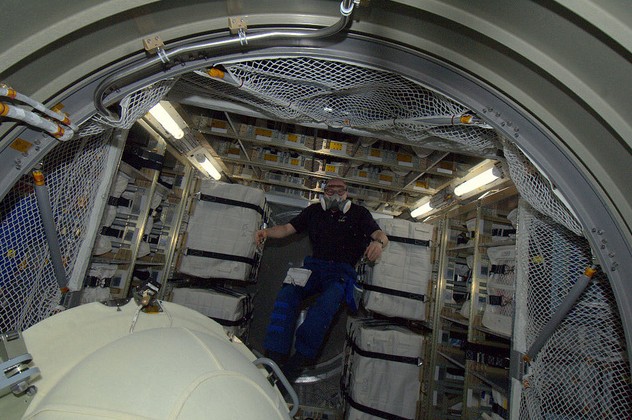
ESA Astronaut Andre Kuipers' floating inside the ATV-3

ESA Astronaut Andre Kuipers' first time floating inside the ESA ATV-3, Edoardo Amaldi. 

He is wearing a mask and protective glasses as a safety precaution, just in case the air is bad or there is hazardous material or dust floating around inside. Fortunately, all was ok.

Credit: ESA/NASA

Wednesday, November 30, 2011

WSU Researchers Use a 3D Printer to Make Bone-like Material - YouTube


It looks like bone. It feels like bone. For the most part, it acts like bone and it came off an inkjet printer.

A ceramic powder and 3D printer have been paired to create a bone-like material that could be used in surgery within the next decade.

The material, which has already been tested in vivo tests on rats and rabbits, could be created to order for dental and orthopedic procedures.

Once inserted in the body, it acts as a scaffold for new human bone cells to grow upon after just a week.

The manmade scaffold will eventually dissolve "with no apparent ill effects".

The material was created following a four-year effort by chemistry, materials science, biology and manufacturing researchers at Washington State University.

The main "ingredient" is calcium phosphate but silicon and zinc were added, which "more than doubled the strength of the main material," the team explained.

Inside the printer, an inkjet nozzle sprays a plastic binder liquid over a bed of the powder in layers of 20 microns.

Susmita Bose, co-author of the paper revealing the results of the project and professor in WSU's School of Mechanical and Materials Engineering says that custom-ordered replacement bone tissue could be in common use in the next ten years.

"If a doctor has a CT scan of a defect, we can convert it to a CAD file and make the scaffold according to the defect," she said.

Monday, November 14, 2011

iPhone: Amazing spray coating can make it waterproof [video]


NeverWet on Electronics and Conformal Coatings from Ross Nanotechnology on Vimeo.

Neverwet, a new spray coating, can turn almost anything waterproof. Like seriously waterproof, as in messy sauces, juice, ink and oil don’t just bead off — they shoot off the surface.

It’s also anti-corrosive, sending even bacteria and ice running and screaming for the hills.

While there are a host of water-resistant coatings and products available, most only offer hydrophobic properties and fall short of the litmus test to be considered “waterproof.”

Ross Technologies claims that their silicon-based product is superhydrophobic, meaning it repels liquids at a very high “contact angle” (175 degrees), which is the distance wedged between a water droplet and the surface. So the higher the contact angle, the rounder the water droplet.

The secret to how the patent-pending technology works is a proprietary arrangement of nanoparticles that turns water droplets into near-perfect spheres.

Originally, researchers at the company had set about developing a material that would prevent steel from corroding and realized that such a product might also work on a variety of surfaces, including fabrics.

They eventually came up with a separate coating that can be applied just about anywhere.


To demonstrate Neverwet’s mighty water, stain and dirt-repelling abilities, the company has produced a series of mini-infomercials where spilled water scurries away in terror, chocolate syrup simply slides off a treated shoe and a coated iPhone is shown to still work while submerged underwater — even after half an hour.

The company says that the coating is exceptionally durable, stating on their website that “NeverWet™ coatings have remained under seawater for over a year and reemerged completely dry.”
The final product isn’t scheduled to hit the market until sometime next year.

Sunday, June 5, 2011

Car Batteries That Can Multitask

THERE’S more than meets the eye in the battery-powered model car sitting in Emile Greenhalgh’s laboratory at Imperial College London.

The model has been modified by the researcher’s team to increase the amount of electrical energy it can store — but not by installing a bigger battery. Instead, the team added body components that double as capacitors, devices that hold an electrical charge until they are tapped.

“Although the energies they provide are fairly modest,” Dr. Greenhalgh, a composites expert, said, “they have shown that our material could be used to smooth the demands on the battery, thus enhancing its life.”


Designers of full-scale electric vehicles are working toward the same goal: battery reserves need to be extended because today’s technology typically delivers only enough power for about 100 miles of driving.

Larger batteries are not necessarily the solution, either. Even the most advanced designs weigh hundreds of pounds, reducing the vehicle’s range.

To help cut weight and increase driving distances, engineers are developing car frames and bodies made of carbon fibre-reinforced composites, plastic materials that can be 50 percent lighter than steel but provide superior strength and rigidity. Although used in a handful of exotic sports cars, carbon composites remain too costly for mass-market cars.

One potential solution is to build autos with carbon composites that can also serve as batteries. The dual-function materials could make E.V.’s and hybrid vehicles lighter as they simultaneously provide extra electricity.

“Structural power technology combines mechanical structure and energy storage capabilities,” said Dr. Greenhalgh, who heads a group at the college working on the concept. “This could allow us to have our cake and eat it too.”

To enable the composite materials to store electricity, the resin that binds the carbon fibres is laced with lithium ions; the fibres serve as conductive electrodes for this type of charge-holding capacitor.

It is different from a battery, which produces electricity from a chemical reaction. Another research group, at the Swedish Institute of Composites, is working on a structural battery.

Dr. Greenhalgh also leads a wider European Union project, which includes Volvo Cars, to study the innovative materials. “Volvo says that structural power technology will be key to the E.V.’s they’re developing,” he said.

Friday, April 1, 2011

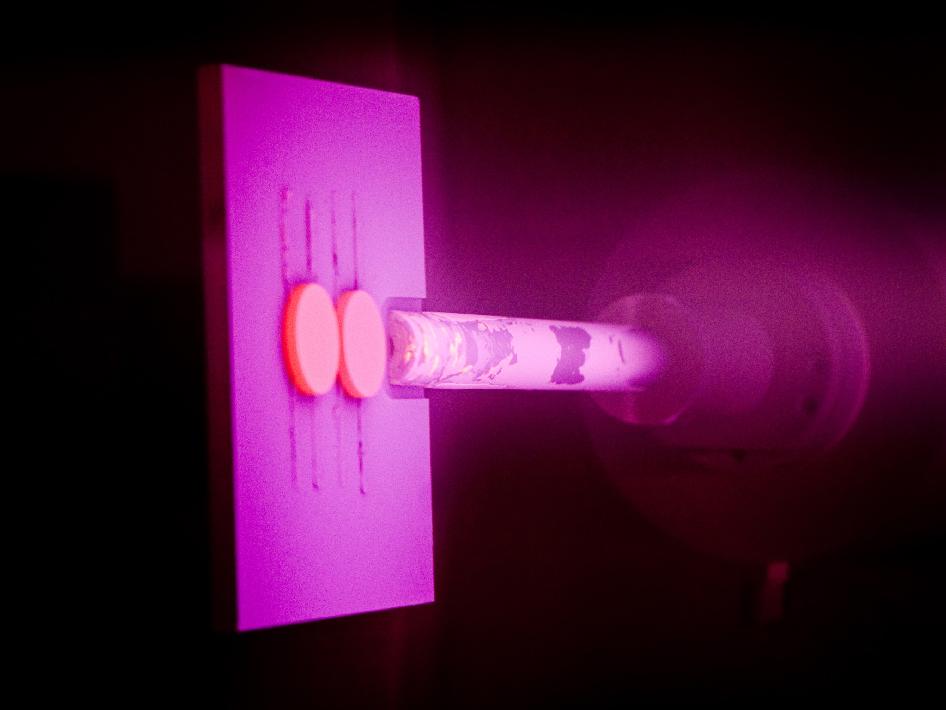
NASA PS-PVD: Plasma Spray-Physical Vapour Deposition

Inside the Plasma Spray-Physical Vapour Deposition, or PS-PVD, ceramic powder is introduced into the plasma flame, which vapourises it and then condenses it on the object, to form the ceramic coating.

The PS-PVD rig at NASA's Glenn Research Center uses new technology to create super thin ceramic coatings, which are being developed to protect high efficiency engines.

The coatings created in the PS-PVD rig are thinner and more complex than those previously available.

The PS-PVD rig uses a system of vacuum pumps and a blower to remove air from the chamber, reducing the pressure inside to fraction of normal atmospheric pressure. The plasma flame is extremely hot and reaches 10,000 degrees Celsius.

Ceramic powder is introduced from the torch into the plasma flame. The plasma vapourises the ceramic powder, which then condenses 5 feet away from the torch onto the component to form the ceramic coating.

Plasma, neither a gas, liquid or a solid, is the fourth state of matter and often behaves like a gas, except that it conducts electricity and is affected by magnetic fields. On an astronomical scale, plasma is very common.

The sun is composed of plasma, fire is plasma, fluorescent and neon lights contain small amounts of plasma. NASA’s PS-PVD rig is one of only two such facilities in the country and one of four in the world.

Image Credit: NASA/Marvin G. Smith (Wyle Information Systems LLC)

Friday, June 18, 2010

Mars Mystery over lack of organic material


"The importance of drilling below the Martian surface for rocks and soils that might retain preserved organics is certainly on the minds of future mission scientists," says Sherry L. Cady, PhD, Editor of Astrobiology and Associate Professor in the Department of Geology at Portland State University. "The possible 2018 joint

The ongoing search for evidence of past or present life on Mars includes efforts to identify organic compounds such as proteins in Martian soil, but their absence to date remains a mystery. A new theory to explain what happens to these carbon-based molecules is presented in an article published in Astrobiology

"There may be no 'safe haven' for these organic molecules on Mars," conclude Ilya Shkrob, Sergey Chemerisov, and Timothy Marin, from Argonne National Laboratory and Benedictine University, in Illinois, in their article entitled "Photocatalytic Decomposition of Carboxylated Molecules on Light-Exposed Martian Regolith and its Relation to Methane Production on Mars."

Unlike on Earth, where plants and other organisms convert carbon dioxide and water into organic compounds via photosynthesis, the authors propose that the opposite happens on the surface of Mars. The iron oxides that make up Martian soil and give the planet its distinctive red color are photocatalysts.

They use energy from ultraviolet light absorbed through the thin Martian atmosphere to oxidize carbon-containing organic molecules trapped in soil particles, converting them to carbon dioxide and gases such as methane.

The authors present study data to support this model and to explain why it might not be realistic to rely on the discovery of proteins, amino acids, and other carbon-containing compounds in the upper soil layers of Mars to determine whether life forms are or have been present on the planet.

"This is an interesting result and may be an important step in solving the enduring mystery of organics on Mars," says Christopher P. McKay, Senior Editor of Astrobiology and Research Scientist at NASA Ames Research Center. "We see organics in many places in the solar system but have not been able to detect them on Mars - the planet that we think had the most Earth-like conditions.

Why? Could it be our instrument approach has been wrong? Or could it be that there is some chemistry on Mars that is actively destroying organics? This work points toward this latter explanation. Mars may have a self cleaning

surface. If so, we may have to dig deeply to find any organic materials."

"The importance of drilling below the Martian surface for rocks and soils that might retain preserved organics is certainly on the minds of future mission scientists," says Sherry L. Cady, PhD, Editor of Astrobiology and Associate Professor in the Department of Geology at Portland State University. "The possible 2018 joint ESA-NASA mission is a case in point."