Showing posts with label white dwarfs. Show all posts

Wednesday, April 24, 2013

White Dwarfs hold the key to detecting Life on other Planets

Because it has no source of energy, a dead star—known as a white dwarf—will eventually cool down and fade away but circumstantial evidence suggests that white dwarfs can still support habitable planets, says Prof. Dan Maoz of Tel Aviv University's School of Physics and Astronomy.

Now Prof. Maoz and Prof. Avi Loeb, Director of Harvard University's Institute for Theory and Computation and a Sackler Professor by Special Appointment at TAU, have shown that, using advanced technology to become available within the next decade, it should be possible to detect biomarkers surrounding these planets—including oxygen and methane—that indicate the presence of life.

Dan Maoz
Published in the Monthly Notices of the Royal Astronomical Society, the researchers' "simulated spectrum" demonstrates that the James Webb Space Telescope (JWST), set to be launched by NASA in 2018, will be capable of detecting oxygen and water in the atmosphere of an Earth-like planet orbiting a white dwarf after only a few hours of observation time—much more easily than for an Earth-like planet orbiting a sun-like star.

Their collaboration is made possible by the Harvard TAU Astronomy Initiative, recently endowed by Dr. Raymond and Beverly Sackler.

Faint light, clear signals
"In the quest for extraterrestrial biological signatures, the first stars we study should be white dwarfs," said Prof. Loeb.

Prof. Loeb
Prof. Maoz agrees, noting that if "all the conditions are right, we'll be able to detect signs of life" on planets orbiting white dwarf stars using the much-anticipated JWST.

An abundance of heavy elements already observed on the surface of white dwarfs suggest rocky planets orbit a significant fraction of them.

The researchers estimate that a survey of 500 of the closest white dwarfs could spot one or more habitable planets.

The unique characteristics of white dwarfs could make these planets easier to spot than planets orbiting normal stars, the researchers have shown.

Their atmospheres can be detected and analyzed when a star dims as an orbiting planet crosses in front of it.

James Watt Space Telescope - JWST
As the background starlight shines through the planet's atmosphere, elements in the atmosphere will absorb some of the starlight, leaving chemical clues of their presence—clues that can then be detected from the JWST.

When an Earth-like planet orbits a normal star, "the difficulty lies in the extreme faintness of the signal, which is hidden in the glare of the 'parent' star," Prof. Maoz says.

"The novelty of our idea is that, if the parent star is a white dwarf, whose size is comparable to that of an Earth-sized planet, that glare is greatly reduced, and we can now realistically contemplate seeing the oxygen biomarker."

In order to estimate the kind of data that the JWST will be able to see, the researchers created a "synthetic spectrum," which replicates that of an inhabited planet similar to Earth orbiting a white dwarf.

They demonstrated that the telescope should be able to pick up signs of oxygen and water, if they exist on the planet.

Friday, August 17, 2012

White Dwarf stars death could nurture life on alien planets

A cosy place to call home (Image: NASACXC/SAOSTSCI/Science Photo Library)

>WHITE dwarfs may be dying, but their light could be just right to sustain life as we know it.

That could make habitable planets even more common than we think.

Many planet-hunting missions have focused on finding rocky exoplanets around sun-like stars, based on the notion that an exact Earth twin would be a prime breeding ground for alien life.

White dwarfs, by contrast, would seem unlikely hosts. These smouldering cores form when stars around the same mass as our sun reach the end of their lives. 

First the stars balloon to red giants, then they shed their outer gas layers and leave behind dim, ultradense orbs not much larger than Earth itself.

Still, previous work suggested that the stellar corpses could maintain habitable zones, regions where liquid water can exist on a planet's surface, for more than 8 billion years.

As our own solar system is 4.5 billion years old, a habitable world around a white dwarf should have plenty of time to give rise to some form of life.

Now a new study shows that an Earth-like planet in a white dwarf's habitable zone would get light at the right wavelengths to sustain photosynthesis. Crucially, such a world would not get too much damaging ultraviolet radiation, which can stop life in its tracks.

Luca Fossati at the Open University in the UK and his colleagues started by assuming that this hypothetical planet has an atmosphere similar to Earth's.

By simulating the conditions created by a white dwarf, the team calculated the amount of starlight that would reach the planet's surface.

They then compared the results with the wavelengths of light DNA absorbs, particularly UV waves known to damage DNA.

The researchers found that the planet would get just 1.65 times as much UV light as Earth does (arxiv.org/abs/1207.6210). "The dose is remarkably benign from an astrobiological perspective," says Fossati.

For the optical wavelengths that play roles in photosynthesis, the team found conditions almost identical to those on Earth.

Planets surrounding red dwarf stars have also been proposed as alternative sites for life, says Fossati, in part because these small, cool stars are the most common in our galaxy.

But they can experience intense stellar activity, including flares of radiation bigger than the ones that affect Earth. White dwarfs are less temperamental, and would provide life with a more stable home, says Fossati.

"The team's evaluation of habitable planets at white dwarfs is an excellent way to smash preconceptions about these systems," says Jay Farihi at the University of Leicester in the UK.

One lingering question is how an Earth-sized planet would come to be in the right orbit around a white dwarf star. In our solar system, the sun will expand into a red giant in about 5 billion years' time, and astronomers think it will pulverise everything well past Earth's orbit before it shrinks back down into a white dwarf.

While what look like planetary remnants have been seen around white dwarfs, no intact planets have been found so far. "That's the most tricky bit," says Fossati. "We don't yet know if a full planet could survive."

Friday, April 27, 2012

Nice but Dim: A bevy of stars found beyond our Milky Way

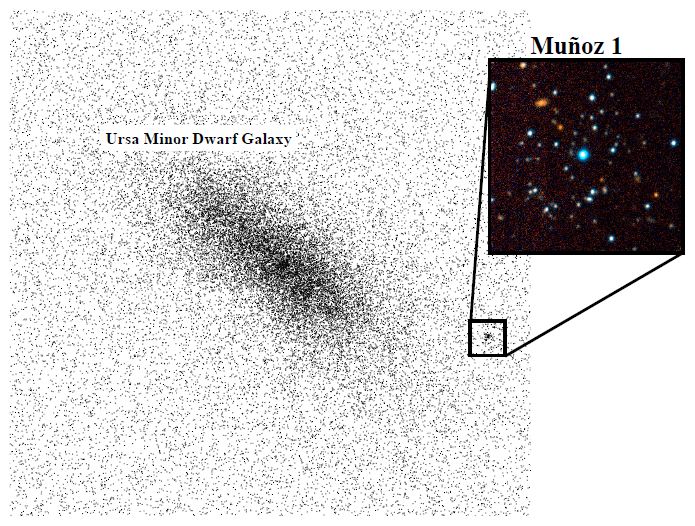
The Muñoz 1 globular cluster is seen to the right of the Ursa Minor dwarf galaxy in this image from the Canada-France-Hawaii Telescope MegaCam imager. Credit: Geha & Muñoz

A team of American, Canadian and Chilean astronomers have stumbled onto a remarkably faint cluster of stars orbiting the Milky Way that puts out as much light as only 120 modest Sun-like stars.

The tiny cluster, called Muñoz 1, was discovered near a dwarf galaxy in a survey of satellites around the Milky Way using the Canada-France-Hawaii Telescope (CFHT) and confirmed using the Keck II telescope, both of which are on Mauna Kea, Hawaii.

“What’s neat about this is it’s the dimmest globular cluster ever found,” said Ricardo Muñoz, an astronomer at the University of Chile and the discoverer of the cluster. A globular cluster is a spherical group of stars bound to each other by gravity so that they orbit around a galaxy as a unit.

“While I was working on the Ursa Minor dwarf galaxy I noticed there was this tiny little object close by,” Muñoz recalled. He made the discovery while he was a postdoctoral associate at Yale University.

Most globular clusters have in the range of 100,000 stars. Muñoz 1 has something like 500 stars. “This is very surprising,” he said.

“It’s ridiculously dim,” agreed Yale astronomer Marla Geha. “There are individual stars that would far outshine this entire globular cluster.” That puts Muñoz 1 head-to-head with the Segue 3 globular cluster (also orbiting the Milky Way) as the dimmest troupe of old stars ever found.

Muñoz 1’s discovery was the result of a survey done with the CFHT MegaCam imager in 2009 and 2010. It was then confirmed by spectroscopic study using the Deep Extragalactic Imaging Multi-Object Spectrograph (DEIMOS) on the Keck II telescope. The researchers will be publishing their results soon in The Astrophysical Journal Letters.

Monday, March 5, 2012

Antlia dwarf galaxy peppers the sky with stars

The myriad faint stars that comprise the Antlia Dwarf galaxy are more than four million light-years from Earth, but this NASA/ESA Hubble Space Telescope image offers such clarity that they could be mistaken for much closer stars in our own Milky Way.

This very faint and sparsely populated small galaxy was only discovered in 1997.

This image was created from observations in visible and infrared light taken with the Wide Field Channel of Hubble’s Advanced Camera for Surveys. The field of view is approximately 3.2 by 1.5 arcminutes.

Although small, the Antlia Dwarf is a dynamic site featuring stars at many different stages of evolution, from young to old.

The freshest stars are only found in the central regions where there is significant ongoing star formation. Older stars and globular clusters are found in the outer areas.

It is not entirely clear whether the Antlia Dwarf is a member our galactic neighborhood, called the Local Group.

It probably lies just beyond the normally accepted outer limits of the group. Although it is fairly isolated, some believe it has interacted with other star groups.

NGC 3109

Evidence comes from the small, spiral, irregular galaxy, NGC 3109, close to the Antlia Dwarf (shown visible in this second image).

Both galaxies feature rifts of stars moving at comparable velocities; a telltale sign that they were gravitationally linked at some point in the past.

Monday, February 13, 2012

Canes Venatici: New Subaru Telescope images capture 'stealth merger' of dwarf galaxies

NGC 4449 is located 12.5 million light-years from Earth and is a member of a group of galaxies in the constellation Canes Venatici. In size and morphology, it is very similar to one of the Milky Way's satellite galaxies, the Large Magellanic Cloud.

New images of a nearby dwarf galaxy have revealed a dense stream of stars in its outer regions, the remains of an even smaller companion galaxy in the process of merging with its host.

The host galaxy, known as NGC 4449, is the smallest primary galaxy in which a stellar stream from an ongoing merger has been identified and studied in detail.

"This is how galaxies grow. You can see the smaller galaxy coming in and getting shredded, eventually leaving its stars scattered through the halo of the host galaxy," said Aaron Romanowsky, a research astronomer at the University of California, Santa Cruz, and coauthor of a paper on the discovery that has been accepted for publication in Astrophysical Journal Letters and is available online at arxiv.org.

The study was carried out by an international team of astronomers led by David Martinez-Delgado of the Max Planck Institute for Astronomy in Heidelberg.

Suprime-Cam captured this image of the nearby dwarf galaxy NGC 4449 (lower left) and its companion (upper right), a dwarf galaxy that has been gravitationally pulled apart into a stellar stream. It shows individual stars composing the galaxies. 

R. Jay GaBany (Blackbird Observatory) produced the composite: blue hues in the center of the larger galaxy are brought about by a burst of recent star formation, while the red in its periphery and in its satellite indicates the presence of older, red-giant stars.
 
According to modern cosmological theory, large galaxies were built up from smaller progenitors through a hierarchical process of mergers. Astronomers can see many examples of mergers involving massive galaxies, but mergers of two dwarf galaxies have been hard to find.

"We should see the same things at smaller scales, with small galaxies eating smaller ones and so on," Romanowsky said. "Now we have this beautiful image of a dwarf galaxy consuming a smaller dwarf."

NGC 4449 is located 12.5 million light-years from Earth and is a member of a group of galaxies in the constellation Canes Venatici. In size and morphology, it is very similar to one of the Milky Way's satellite galaxies, the Large Magellanic Cloud.

The stellar stream in NGC 4449 was first detected by another group of astronomers as a mysterious, faint smudge in digitized photographic plates from the Digitized Sky Survey project, and it is also visible in archival images from the Sloan Digital Sky Survey. But if it had been just a bit fainter, more diffuse, or farther from the host galaxy, it could easily have been missed.

The authors of the new study called it a "stealth merger," where an infalling satellite galaxy is nearly undetectable by conventional means, yet has a substantial influence on its host galaxy.

Read more of this article here

Friday, January 20, 2012

Most Distant Dwarf Galaxy Detected

The gravitational lens B1938+666 as seen in the infrared when observed with the 10-meter Keck II telescope with Adaptive Optics on Mauna Kea, Hawaii.

In the center is a massive red galaxy 9.8 billion light-years from Earth that acts like a cosmic magnifying glass, distorting the light from an even more distant galaxy, 17.3 billion light-years away.

The result is a spectacular Einstein ring image of the background galaxy.

The team used distortions within the ring to find evidence for a low-mass dark galaxy, which is a satellite of the foreground lensing galaxy.

Using this gravitational lensing effect the mass of the dark galaxy was found to be 200 million times the mass of the Sun, which is similar to the masses of the satellite galaxies found around our own Milky Way, but is 9.8 billion light-years further away. Credit: D. Lagattuta / W. M. Keck Observatory.

Wednesday, October 12, 2011

Brown Drawf: Rogue Failed Star Is One of Smallest Ever Seen

Extreme brightness changes observed on a nearby tiny brown dwarf star may indicate a storm grander than any yet seen on an alien world, scientists say.
CREDIT: Jon Lomberg

Astronomers have discovered more than two dozen previously unknown failed stars, including one that ranks among the puniest of its kind, new research finds.

The newfound objects are brown dwarfs, strange bodies that are larger than planets but too small to trigger the internal nuclear fusion reactions required to become full-fledged stars.

Astronomers discovered the objects in two young star clusters using Japan's Subaru Telescope in Hawaii and the Very Large Telescope in Chile.

One of the brown dwarfs is just six times the mass of Jupiter, making it "one of the puniest free-floating objects known," researchers said in a statement.

Friday, November 13, 2009

Oxygen in White Dwarfs - Near Miss to Supernova

Oxygen on a planet might be a sign of life, but in two peculiar white dwarf stars it could indicate a narrow escape from a violent death. Their oxygen content marks them as failed stellar bombs – the remnants of stars that almost went supernova.

The new stars are among thousands of white dwarfs picked up by the Sloane Digital Sky Survey. Like all white dwarfs they are the dead, cooling cores left behind by mainstream stars, and are mainly made of helium. Usually the second most plentiful ingredient is carbon – but when a group of astronomers led by Boris Gänsicke at the University of Warwick, UK, analysed the spectrum of light from these two white dwarfs, they found that the objects hold far more oxygen than carbon.

"It's extreme – these things look very different from any white dwarfs we've seen before," says team member Danny Steeghs.

Creating so much oxygen requires a nuclear furnace fiercer than that needed for a carbon-rich mixture, so the stars that spawned these white dwarfs must have been hot and massive. Simulations suggest that they must have been almost too big to end their days gently – any larger, and they would have grown a core so massive and dense that it would inevitably have collapsed, releasing enough energy to blow the rest of the star apart in a supernova explosion.