Showing posts with label France. Show all posts

Wednesday, October 8, 2014

France Proceeding with Next Generation Communications despite budget cuts

French officials continue to debate whether to outsource the nation’s next-generation Syracuse military telecommunications system (above, Syracuse 3A satellite) to the private sector, as has been done in Britain and, to a lesser extent, in Italy and Germany; or to proceed with a conventional procurement. 

Credit: Thales Alenia artist's concept

The French Defense Ministry on Oct. 1 said its planned electronic-intelligence satellite and next-generation military telecommunications satellite systems have survived a rough arbitrage of France’s budget and would be under contract in 2015.

The budget package outlined Oct. 1 does not specify cost amounts. It further suggests that the Defense Ministry may have recourse to a sale-and-leaseback formula to generate near-term cash that will help meet the requirements of its priority programs.

Dossier Information
French officials continue to debate whether to outsource the nation’s next-generation Thales Syracuse military telecommunications system to the private sector, as has been done in Britain and, to a lesser extent, in Italy and Germany; or to proceed with a conventional procurement.

France has also been talking with Italian and British military planners about combining at least part of their future military satellite communications needs, perhaps with a jointly owned satellite that would act as a backup for these nations’ primary satellite telecommunications assets.

Meanwhile, France’s Ceres electronic-intelligence satellite system, planned as three spacecraft flying in formation in low Earth orbit, has been a French priority for several years but has struggled for traction in a harsh budget environment.

Here is a translated extract from the French Finance Bill 2014 "The program CERES 20 is to have an operational capacity to listen, that could allow the interception and location of electromagnetic emissions from space (detection and radar transmitters or telecommunications location). This need was formalized through the launch of the preparation stage of the operation CERES, June 27, 2007. The system cost is estimated at around 460 million euros."

"The financial effort applied to the French Ministry of Defence at work 2011-2013 triennial budget planning has resulted in a shift of the CERES program. Planning now assumes an operational implementation in 2020."

Adding to the problem has been France’s inability to interest other European nations in joining Ceres.

"In autumn 2007, the EMA and the DGA jointly proposed to the countries cooperating MUSIS, as well as Sweden and Switzerland to join the operation CERES. Only Greece and Sweden have responded positively to the preparatory work and contributed financially. At the end of the work, in May 2011, Sweden announced it would terminate its participation for budgetary reasons."

Airbus Defence and Space (EADS) and Thales Alenia Space, Europe’s two biggest satellite manufacturers, which both have a large presence in France, are already under contract for initial Ceres studies.

Both have also expressed interest in managing the future military telecommunications satellite program with France as the anchor customer.

Thursday, September 18, 2014

France raises heat on decision for next Ariane rocket

France's space agency on Thursday unveiled a revised proposal for an Ariane rocket ahead of a tough decision on launchers by the European Space Agency (ESA).

Ministers must decide whether they can afford to fund the development of two projects for Europe's next rocket.


These are an Ariane 6, promoted by France, that would be operational from the next decade and an intermediate launcher, the Ariane 5 ME, backed by Germany.

At a press conference in Paris, France's National Centre for Space Study (CNES) said the overhauled plans for the Ariane 6 resulted in a "simple design with great payload capacity," able to take between five and 10 tonnes into orbit.

It could be ready for launch in 2020, said CNES boss Jean-Yve Le Gall, a date that is a year or two earlier than was expected in July 2013.

"We are looking at a two-booster version, with costs of around 65 million euros [$83.85 million] per launch, and a four-booster version, at around 85 million euros per launch," said Le Gall.

"The per-kilo cost will be around 10,000 euros, roughly half that of Ariane 5 today," he said, referring to ESA's current workhorse.

CNES' previous design for the Ariane 6 had promised a 30-percent gain on Ariane 5 per-kilo launch costs.

"The industrial and institutional organisation of the project will be simplified, with the goal being to save costs," Le Gall pledged.

He admitted there would have to be "compromises" in Luxembourg, adding that around eight billion euros will be earmarked for launchers for the next decade.

"We tend to want everything, but the means to do so aren't always there," he said.

The presentation came a day after a preparatory meeting at ESA where the revised plans were approved by other figures in the space industry, including the head of launch operator Arianespace, Stephane Israel.

The December 2 meeting in Luxembourg will determine the outcome of a difficult political compromise in 2013 between ESA's major partners as nimble US firms such as SpaceX eye the market for satellite launches.

The German-backed Ariane 5 ME, standing for Midlife Evolution, would be a tweaked version of the Ariane 5.

It would in theory be ready by 2017 and yield operational costs over the existing ECA and ES models, which are highly reliable but need hefty subsidies.

In February, France's national auditor disclosed that French policymakers favoured dropping the ME to keep down development costs and prevent a feared delay to the Ariane 6.

Monday, June 16, 2014

France 'eyes EADS Airbus-Safran (Snecma) tie-up for launch rockets'

European aerospace group EADS Airbus and French rocket-maker (Snecma) Safran are looking at jointly making next-generation launch rockets to compete with US firm SpaceX, the French financial newspaper Les Echos said Sunday in a report on its website.

EADS Airbus chief Tom Enders and Safran (Snecma) boss Jean-Paul Herteman are to meet French President Francois Hollande in Paris early Monday, after which a deal is expected to be announced for their companies to jointly manufacture Europe's Ariane 6 rockets, Les Echos said.

The deal was being made because, "despite proven reliability, Ariane suffers from an overly fragmented industrial organisation... that badly hurts its competitiveness" while SpaceX "works in a totally integrated fashion", Les Echos reported.

The Ariane 6 rockets are designed to put single payloads into orbit and are to be cheaper than the heavier and bigger Ariane 5 rockets currently used, which carry two satellites at once.

SpaceX, a private US company, already sends up smaller, cheaper launch rockets and is steadily taking over some launches that NASA used to handle.

Friday, March 7, 2014

Mojave Crater on Mars is source of Mars rocks found on Earth

Mojave crater showing its well-preserved morphology and ray pattern. 

The direction of the red arrow indicates distant examples of secondary crater clusters shown in Figure 1B in the manuscript. 

Credit: Science/AAAS

A trio of researchers, two from France and one from Norway, has published a paper in the journal Science claiming to have found sufficient evidence to identify a specific crater on Mars as the origin of Mars rocks found on the Earth's surface.

In their paper Stephanie Werner (CEED Norway), Anouck Ody (France) and François Poulet describe their extensive research and how they came to their conclusions.

Scientists have known for many years that some of the meteorites that strike the Earth came from Mars. Such rocks are ejected from the surface of Mars when struck by meteorites themselves.

Mars rocks have been classified into three main categories depending on their chemical makeup: chassignites, nakhlites and shergottites.

The latter make up roughly three quarters of all such rocks found and have been studied extensively over the years.

In this new effort, the researchers contend that all shergottites come from a single source on Mars: Mojave Crater.

To establish Mojave Crater as the source, the researchers combined several types of data, each of which suggest the crater as a likely suspect, though there is one, the estimated age of the rocks, that is not quite as clear-cut as the others.

MRO-CTX image mosaic of Mojave’s crater interior. 

Credit: Science/AAAS

The researchers began by analyzing imagery of Mars surface taken by various spacecraft over the years—they were looking for reasonably recent formation, a large size and rays leading away from the crater indicating a blast capable of sending rocky debris into space.

Mojave Crater stood out as one of the best candidates for further study.

The team next examined data gathered by spacecraft that have orbited the Red Planet over the years, specifically those that had taken mineral scans (measures of wavelengths of light bounced back off of them) of the Mojave Crater and the area around it.

Analysis showed that the mineral composition of rocky material on the lip of the crater matched closely with the Mars rocks found on Earth.

The team also sought to determine the age of the crater by studying the surface area around it—the number of craters around it and their size allows for a model to be made based on techniques developed with the Apollo moon project.

Their study showed that the crater was likely formed approximately three million years ago. Finally, prior research has shown that the Martian rocks likely were in transit on average less than five million years, based on cosmic ray exposure.

THEMIS daytime image mosaic overlain by MOLA color-coded topography

Craters were counted for the plateau units (brown), channel units (blue-grey), and the continuous ejecta unit of Mojave Crater (red line). 

Credit: Science/AAAS

Prior research has shown that the plateau in which Mojave Crater exists is approximately 4.3 billion years, which suggests that rocks blasted from its surface should be near the same age. Unfortunately, that's where things don't match as well.

Most studies of Mars rocks have found them to be only 150 to 600 million years old.

The researchers suggest this anomaly can be explained by events (shock waves, etc.) that transpired on Mars that set their age clock back.

More information: The Source Crater of Martian Shergottite Meteorites, Science DOI: 10.1126/science.1247282

Tuesday, February 11, 2014

US NASA and France CNES sign deal for 2016 Mars lander - Video

This artist's concept depicts the stationary NASA Mars lander known by the acronym InSight at work studying the interior of Mars. 

Image credit: NASA/JPL-Caltech

The United States and France Monday unveiled plans to collaborate on a new Mars mission, two years after NASA withdrew from a European partnership to send a probe and lander to the Red Planet.

The project aims to send an unmanned lander to study the deep interior of the dry, dusty planet that is Earth's neighbour, and will be called InSight, short for the Interior Exploration Using Seismic Investigations, Geodesy, and Heat Transport.


The agreement was signed by NASA Administrator Charles Bolden and Jean-Yves Le Gall, president of the National Center of Space Studies of France (CNES) at the Mandarin Hotel in Washington.

The mission is scheduled to launch in March 2016 and would arrive on Mars six months later.

"The research generated by this collaborative mission will give our agencies more information about the early formation of Mars, which will help us understand more about how Earth evolved," said Bolden.

Not only would the lander return details about how Mars, a rocky planet like Earth, first formed, it would also probe the how tectonic activity and meteorite impacts shaped the Red Planet.

Other partners on the project's science instruments include; DLR, the German Aerospace Center, United Kingdom Space Agency, and the Swiss Space Office.

The deal comes two years after NASA, citing budget constraints, killed a partnership with European Space Agency (ESA) on project ExoMars.

Monday, July 15, 2013

Bastille Day - Paris 2013

French aerial display team Patrouille de France flew past the Eiffel tower as part of the traditional Bastille day military parade

Picture: REUTER

Saturday, March 2, 2013

CFH Telescope Image:The Lagoon Nebula, Messier 8

Credit: Canada-France-Hawaii Telescope/Coelum

The Lagoon Nebula, also called Messier 8, lies deeply embedded in the disk of our galaxy. 

Stars form within this giant region, and they gravitationally cluster in the heart of the nebula. 

Ultraviolet radiations from newborn stars ionize hydrogen gas, creating the pink emission.

Wednesday, January 23, 2013

French Scientists: 'Background' light of universe measured

The brightness of the background of light photons that has filled the universe since its formation has been measured for the first time, French researchers say.

Scientists at the country's National Center for Scientific Research say their findings could provide new insight into the size of the universe, the formation of stars and the evolution of galaxies.


The light emitted by all the objects in the universe, such as stars and galaxies, ever since its birth fills intergalactic space with an "ocean" of photons known as the "diffuse extragalactic background light," the researchers said.

The shine of our own galaxy makes it impossible to directly measure this fossil record of the light emitted in the universe, so astrophysicists made use of gamma rays, with energy more than 500 billion times greater than that of visible light, as an alternative, indirect method of measuring this light, a release from the center said.

These measurements made it possible to estimate for the first time the intensity of the starlight contained within all the universe at wavelengths ranging from the near infrared to the ultraviolet, including visible wavelengths, it said.

A better understanding of this diffuse light should yield information about the first stars, shedding light on their formation and on the evolution of galaxies, astronomers said.

Wednesday, November 21, 2012

ESA: France, Germany seek Ariane Launcher compromise

ESA, the European Space Agency, made progress towards a deal on budget and a successor to the Ariane 5 rocket at talks on space strategy.

Initiating a two-day meeting against a backdrop of financial constraints, many countries backed proposals to keep spending unchanged over the next few years.

Major ESA players France and Germany seemed to be bridging their differences over a future launcher.

"There is quite a strong view in the council in favour of flat cash," UK's Willetts told reporters, referring to a stable budget.

"My starting point is that... it ought to be able to be possible in tough times to deliver the efficiency savings," he said. "Other major players have made that point as well but as of this moment it is unresolved."

ESA spokesman Franco Bonacina said "progress has been made on certain things" but "for the problematic issues... the debate is still going on", and the outcome would come on Wednesday.

The meeting -- the first at ministerial level in four years -- takes place against a backdrop of money worries, a fast-shifting satellite market and the growing strength of the US private sector in near-Earth space.

ESA Director General Jean-Jacques Dordain told AFP last week he hoped ministers would back a three-year budget of 12 billion euros ($15 billion) but added he would be happy with "something around 10 billion euros".

It would mean a roughly stable budget compared with current levels, "but given the current situation, this is not small beer", he said.

One of the most crucial agenda items is deciding on a future rocket launcher to replace the ageing Ariane 5.

The new rocket should provide more flexible launch options for the swiftly-changing satellite market and wean itself off the 120 million euros a year that the Ariane 5 needs from ESA's budget each year.

France is pushing for a smaller, sleeker Ariane 6, which would require investment of about four billion euros, culminating in a maiden flight in 2021 if all goes well.

But industrialists fear that this timescale is way too long and will give the advantage to fleet-footed rivals in commercial satellite launches.

They prefer a German-backed option, an Ariane 5 ME (for "Midlife Evolution"), which would be ready by 2017 at a putative cost of two billion euros.

"I think we are probably heading towards a compromise, or some kind of understanding, between France and Germany," Willetts told reporters, in remarks confirmed by two other sources.

Those sources said the hoped-for compromise would approve the "ME" and over the next two years study how its technology could be used in a future Ariane 6 to save money.

Weighing on many minds is not just belt-tightening but also the rise of the US private sector.

The bogeyman is the US firm SpaceX, which last month sent an unmanned freighter, Dragon, to the International Space Station under a NASA initiative to delegate resupply missions to private corporations.

In other developments in Naples, ministers agreed to launch a dialogue with the European Union about clarifying what each institution will do in space.

The risk of turf battles has emerged with the EU's Galileo satellite navigation system, which is being launched by ESA.

ESA is an intergovernmental agency that is legally separate from the 27-nation EU; two of its members (Norway and Switzerland) are not part of the EU club, and Canada is an associate member.

Monday, August 20, 2012

NASA Mars Rover Curiosity: ChemCam Laser-Zapped it's First Rock Sample

This composite image, with magnified insets, depicts the first laser test by the French designed Chemistry and Camera, or ChemCam, instrument aboard NASA's Curiosity Mars rover. 

The composite incorporates a Navigation Camera image taken prior to the test, with insets taken by the camera in ChemCam.

The circular insert highlights the rock before the laser test. The square inset is further magnified and processed to show the difference between images taken before and after the laser interrogation of the rock.

The test took place on Aug. 19, 2012.

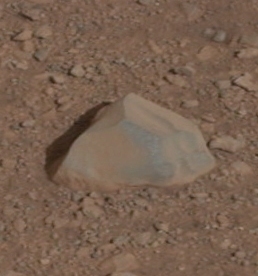
In the composite, the fist-sized rock, called "Coronation," is highlighted.

Coronation is the first rock on any extraterrestrial planet to be investigated with such a laser test.

The widest context view in this composite comes from Curiosity's Navigation Camera. The magnified views in the insets come from ChemCam's camera, the Remote Micro-Imager.

The area shown in the circular inset is 6 centimeters (2.4 inches) in diameter. It was taken before the rock was hit with the laser.

The area covered in the further-magnified square inset is 8 millimeters (about one-third of an inch) across.

It combines information from images taken before and after the test, subtracting the "before" image from the "after" image to make the changes in the rock visible.

ChemCam hit Coronation with 30 pulses of its laser during a 10-second period. Each pulse delivered more than a million watts of power for about five one-billionths of a second.

The energy from the laser excited atoms in the rock into an ionized, glowing plasma. ChemCam also caught the light from that spark with a telescope and analyzed it with three spectrometers for information about what elements are in the target.

This initial use of the laser on Mars served as target practice for characterizing the instrument but may provide additional value.

Researchers will check whether the composition changed as the pulses progressed. If it did change, that could indicate dust or other surface material being penetrated to reveal different composition beneath the surface.

ChemCam was developed, built and tested by the U.S. Department of Energy's Los Alamos National Laboratory in partnership with scientists and engineers funded by France's national space agency, Centre National d'Etudes Spatiales (CNES) and research agency, Centre National de la Recherche Scientifique (CNRS).

Friday, April 27, 2012

Nice but Dim: A bevy of stars found beyond our Milky Way

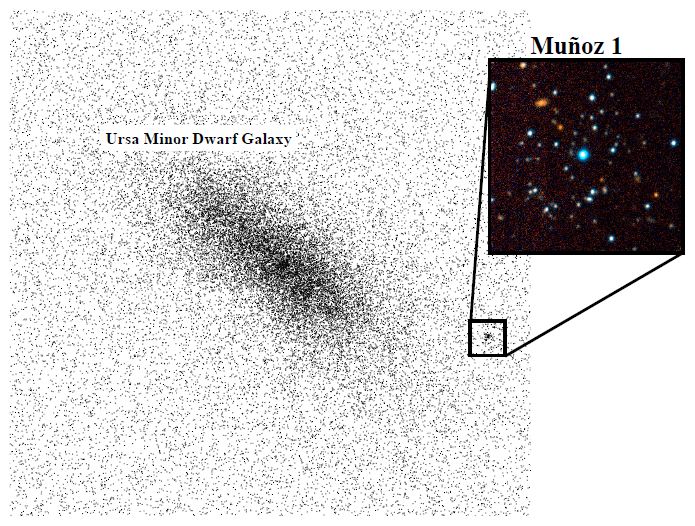
The Muñoz 1 globular cluster is seen to the right of the Ursa Minor dwarf galaxy in this image from the Canada-France-Hawaii Telescope MegaCam imager. Credit: Geha & Muñoz

A team of American, Canadian and Chilean astronomers have stumbled onto a remarkably faint cluster of stars orbiting the Milky Way that puts out as much light as only 120 modest Sun-like stars.

The tiny cluster, called Muñoz 1, was discovered near a dwarf galaxy in a survey of satellites around the Milky Way using the Canada-France-Hawaii Telescope (CFHT) and confirmed using the Keck II telescope, both of which are on Mauna Kea, Hawaii.

“What’s neat about this is it’s the dimmest globular cluster ever found,” said Ricardo Muñoz, an astronomer at the University of Chile and the discoverer of the cluster. A globular cluster is a spherical group of stars bound to each other by gravity so that they orbit around a galaxy as a unit.

“While I was working on the Ursa Minor dwarf galaxy I noticed there was this tiny little object close by,” Muñoz recalled. He made the discovery while he was a postdoctoral associate at Yale University.

Most globular clusters have in the range of 100,000 stars. Muñoz 1 has something like 500 stars. “This is very surprising,” he said.

“It’s ridiculously dim,” agreed Yale astronomer Marla Geha. “There are individual stars that would far outshine this entire globular cluster.” That puts Muñoz 1 head-to-head with the Segue 3 globular cluster (also orbiting the Milky Way) as the dimmest troupe of old stars ever found.

Muñoz 1’s discovery was the result of a survey done with the CFHT MegaCam imager in 2009 and 2010. It was then confirmed by spectroscopic study using the Deep Extragalactic Imaging Multi-Object Spectrograph (DEIMOS) on the Keck II telescope. The researchers will be publishing their results soon in The Astrophysical Journal Letters.

Friday, March 16, 2012

China Blocks More EADS Airbus Buys In EU Tax Row

China suspended approval for the purchase of 10 more Airbus jets as its fight with the European Union emissions charges escalates.

Chinese airlines sought approval to buy the A330 jetliners from the Toulouse, France-based plane manufacturer, but a continuing row over EU's Emissions Trading Scheme (ETS) put the $14 billion deal at risk as Beijing on Thursday suspended a purchase approval.

Under the ETS, airlines operating at an EU airport must hold carbon-offsetting credits as part of an effort to lower carbon emissions 20 percent by 2020.

The scheme has imposed on airlines billions of dollars in added costs.

Chinese authorities already withheld approvals for the purchase of 45 Airbus airliners.

Tensions over the ETS have sparked fears of an aviation trade war, as U.S., Indian and Russian airlines have all expressed dismay over the cap and trade rules.

Airlines are particularly exercised by the fact that the ETS scheme charges them for the entirety of a flight instead of just the fraction that occurs within EU airspace.

"There is a hellish battle going on behind the scenes," a senior French government official told the Journal. "We knew [the emissions levies] would provoke strident protests," the official said. "Now we're facing a real threat."

Chinese officials denied the reported block, saying the government hopes to reach a resolution via negotiations.

Some industry monitors fear Russia and India may react by imposing additional charges on airlines that fly through their airspace, even if they do not land within its territory.

"The threat of retaliation creates uncertainty in the business environment," said Victoria Moores, spokeswoman for the Association of European Airlines in Brussels. "We want to see concrete steps toward de-escalating this."

Thursday, March 1, 2012

A bad day on Venus gets even worse

Contrary to its alluring name, Venus is the planet from hell, with an atmosphere so hot, toxic and heavy that any visitor would risk being simultaneously melted, suffocated and crushed.

But not just that: the second planet from the Sun turns on its axis so slowly that, for any survivor, a Venusian day would seem interminable, for it is the equivalent of 243 days on Earth.

To make things worse, a day on Venus is getting even longer, French astronomers have discovered.

A team from the Paris Observatory analysed data from a spectrometer aboard a European orbiter, the Venus Express.

Called VIRTIS, the gadget measures infrared and visible light and is used to scan the planet's surface beneath the thick, roiling atmosphere.

The astronomers were stunned when they checked landmarks against the last mapping of Venus, carried out between 1990 and 1994 by the US probe Magellan.

At a given point in the Venusian day, landmarks were a full 20 kilometers (12 miles) behind where they should have been.

The team, publishing in the journal Icarus, say they have been over the observations again and again.

"After eliminating possible sources of error, we believe that the duration of the Venusian day must have changed over the 16 years," they said in a press release.

Their calculation is that an extra six and a half terrestial minutes have been added to the Venusian day during this time.

"On the astronomical scale, this is a major change," said VIRTIS investigator Pierre Drossart.

Pierre Drossart is depicted here in an ESA Video on the Venus Express, along with his ESA collegues, explaining the thinking behind the Venus Express mission.

The astronomers' hypothesis is that friction by Venus' atmosphere is braking the movement of the terrain below.

That sounds bizarre until one realises that the atmosphere is 100 kms (60 miles) thick, with extremely dense clouds of 96 percent carbon dioxide, driven by superwinds reaching some 350 kilometres (210 miles) per hour.

Atmospheric pressure at the surface is 92 times that of Earth -- the equivalent of being more than 900 metres (3,000 feet) below the ocean.

"A braking effect from the atmosphere also occurs erratically on Earth, but the discrepancy is only a matter of a few tenths of a second and it is imperceptible," Drossart told AFP.

So will Venus eventually stop spinning -- or even go into reverse rotation?

"It's difficult to say, given that we only have two points of measurement," said Drossart.

"But theoretical models suggest that this is probably just a cyclical phenomenon. If the atmosphere speeds up, the planet slows. Then the energy goes into reverse, in a pendulum effect."

Tuesday, December 27, 2011

Massive Blue Stars: Ambient molecular gas

Credit: Canada-France-Hawaii Telescope/Coelum

Young massive bright blue stars illuminate the ambient molecular gas of NGC 7129 (top right), a spent star formation region in this image posted on Dec. 21.

The star cluster NGC 7132 (lower left) has existed far longer, and already freed itself from a nascent shroud of gas.

Friday, September 2, 2011

Artist's concept of the Aquarius/SAC-D spacecraft, a collaboration between NASA and Argentina's space agency, with participation from Brazil, Canada, France and Italy. 

Aquarius, the NASA-built primary instrument on the spacecraft, will take NASA's first space-based measurements of ocean surface salinity, a key missing variable in satellite observations of Earth that links ocean circulation, the global balance of freshwater and climate.

Image credit: NASA


NASA's Aquarius instrument has successfully completed its commissioning phase and is now "tasting" the saltiness of Earth's ocean surface, making measurements from its perch in near-polar orbit.

"This marks the end of the long odyssey to design, build and launch this mission, and the start of a new journey of scientific exploration," said Aquarius Principal Investigator Gary Lagerloef of Earth and Space Research, Seattle.

"Scientists from around the world are ready and waiting to study this important new satellite measurement for ocean and climate research."


Aquarius will make NASA's first space observations of the salinity, or concentration of salt, at the ocean surface, a key variable in satellite studies of Earth.

Variations in salinity influence the ocean's deep circulation, outline the path freshwater takes around our planet and help drive Earth's climate.

The Aquarius science team will spend the coming months analyzing and calibrating the measurements and releasing preliminary data.

With the Aquarius instrument commissioning now complete, the SAC-D Instruments Flight Operations Teams, together with the SAC-D Mission Flight Operations Team in Argentina, are now engaged in commissioning the other seven SAC-D instruments.

Once all the observatory instruments are commissioned, a maneuver will be conducted to place Aquarius/SAC-D in its final orbit, 408 miles (657 kilometers) above Earth.

Friday, July 22, 2011

CFHT News: Elliptical galaxies much younger than previously thought

The standard model for elliptical galaxies formation is challenged by a new result uncovered by an international team of astronomers from the Atlas3D collaboration.

Team members from CNRS, CEA, CFHT (Canada-France-Hawaii-Telescope), and the Observatoire de Lyon published in the scientific journal Monthly Notices of the Royal Astronomical Society the first results from their study on two elliptical galaxies exhibiting features characteristic of a fairly recent merging, suggesting they are five times younger than commonly thought.

The common belief on the mass assembly history of massive elliptical galaxies based on their stellar population leads to an age between 7 and 10 billion years old. A different story is shaping up based on ultra-deep images of two galaxies observed with the MegaCam camera mounted on the Canada-France-Hawaii Telescope (CFHT, CNRC/CNRS/University of Hawaii).

Astronomers from CNRS, CEA, CFHT, and the Observatoire de Lyon, all members of the Atlas3D international collaboration, established that the formation of the two studied elliptical galaxies (NGC 680 & NGC 5557) originated from a merger of two giant spiral galaxies that took place only 1 to 3 billions years ago.

Such age estimate is based on the presence of ultra faint filaments in the distant outskirts of the galaxies. These features called tidal streams in the astronomers parlance are typical residuals from a galaxy merger.


They are known not to survive in this shape and brightness for more than a few billion years, hence the new age estimate of the resulting elliptical galaxies. These structures were detected for the first time thanks to a very-deep imaging technique boosting the capabilities of CFHT's wide-field optical imager MegaCam.

The Atlas3D team conducts a systematic survey of more than one hundred nearby elliptical galaxies. If the current result based on the first two galaxies is confirmed on the larger sample, i.e. faint extended features are frequently detected, the standard model for elliptical galaxies formation should be revisited.

Wednesday, June 22, 2011

ESA Galileo - Europe's GPS system in big cash boost

Sufficient savings have been found in Europe's Galileo sat-nav project for at least six additional spacecraft to be bought for the system before 2014.

The European Commission says it has about 500m euros (£440m) "in its pocket" which it will use to make the extra purchase.

It would take Europe's version of GPS from 18 operational satellites in the next few years to 24.

This should make a big difference to Galileo's performance.

It should also hasten the eventual completion date.

The announcement was made at the Paris Air Show by European Commission Vice President Antonio Tajani, who has overall responsibility in Brussels for the flagship EU space project.

"It is possible to reduce not only the cost but also the timing," he said. "And by reducing the timing, we reduce the cost. This is a very good cocktail - cost and timing together."

Mr Tajani was at Le Bourget aerodrome to sign the last two industrial contracts needed to make Europe's satellite-navigation venture a reality.

The combined valued of these two agreements is 355m euros. They are both concerned with ground operations.

One (281m euros) is with Thales Alenia Space of France, who will be tasked with looking after Galileo's timing and navigation data, ensuring it is properly formatted for transmission by the satellites.

The other contract (73.5m euros) is going to Astrium-UK. Their work will ensure the good "housekeeping" of the satellites, including the maintenance and correct positioning of the spacecraft in orbit.

But it was the news that Mr Tajani had managed to find major economies in the project that dominated discussions at Le Bourget.

BBC News - Europe's Galileo sat-nav in big cash boost

ESA Galileo: EU Govs Trim Galileo Cost Overruns

European governments on June 22 announced that they have been able to trim the huge cost overruns in Europe’s Galileo satellite navigation program and said the belt-tightening demonstration should make it easier to secure additional funds needed to complete the program.

Meeting here at the Paris air show to sign the final two ground segment contracts for the Galileo network, European Commission and European Space Agency (ESA) officials said they are confident enough about Galileo’s progress to order six more satellites following a competition between two consortia likely to be organized late this year.

Officials said the competition — a second Galileo face-off between OHB Technology of Germany and Astrium Satellites of France, Germany and Britain — would be designed to squeeze the bidders to a price of about 40 million euros ($56 million) per satellite for the six-satellite order.

Galileo is designed as a constellation of 30 satellites in medium Earth orbit and an elaborate ground network to provide the same positioning, navigation and timing services as the U.S. GPS, Russian Glonass and Chinese Beidou/Compass systems.

Galileo had been budgeted at 3.4 billion euros, but it became clear more than a year ago that this would be far from enough to complete development. As a result, only 18 Galileo satellites were ordered, and launch vehicles for just 14 of them were put under contract.

In February, the executive commission of the 27-nation European Union, which is financing Galileo, issued a Galileo midterm assessment that said finishing the system would cost an additional 1.9 billion euros. These monies would need to be found in negotiations during the commission’s next multiyear budget cycle, which begins in 2014.

Commission Vice President Antonio Tajani said during a press briefing here that a broad effort at cost containment had concluded that a round of cost-saving efforts had reduced the overrun to 1.4 billion euros. Tajani said the lower figure would make it easier for the commission to argue for the funds needed to complete Galileo.

That effort at cost savings extended to the current Galileo budget. The commission has this 3.4 billion euros at its disposal but must spend it before 2014 or it returns to European Union governments.

The commission and ESA, which is acting as Galileo prime contractor, did not know how much of this money would be left over from the approved Galileo budget until they had negotiated the final two Galileo ground segment work packages.

These two contracts, totaling 354.5 million euros, were announced June 22. Thales Alenia Space will build the Galileo Mission Segment — a global network of sensor stations to monitor Galileo signals and uplink navigation information to the spacecraft — under a contract valued at 281 million euros.

European Governments Trim Galileo Cost Overruns | SpaceNews.com

Monday, January 31, 2011

ESA ISS News: France Ready To Back ISS Extension

The French government stands ready to endorse extending the operational life of the international space station to 2020 and beyond but is insisting on new ways of financing the work with its European partners, the head of the French space agency, CNES reported.

In a briefing on CNES priorities for the coming year, CNES President Yannick d’Escatha did not spell out the mechanism France would like to see adopted to determine how much of the station’s annual operating charges each European nation would pay.

Among the members of the European Space Agency (ESA), France has been second only to Germany in its financing of the station’s assembly and initial operations. Germany, which remains committed to using the station as fully as possible now that it is built, had proposed spending 3.8 billion euros ($5.2 billion) between 2011 and 2020 for station work.

That figure would include Europe’s obligatory contribution to the station’s annual maintenance, as well as the cost of building and operating experiments at the station.

France rejected that figure as too high, and the two nations, along with Italy and the other ESA governments taking part in the station, are now negotiating both a figure and a formula for payment.

Monday, February 22, 2010

NASA Astronaut Soichi - Paris Picture from ISS


Stunning picture of Paris, France taken by NASA astronaut Soichi from the ISS new Cupola observation window.