Showing posts with label 1. Show all posts

Sunday, August 3, 2014

$248 Billion for Manufacture and Launch of 1,155 Satellites Over Next Decade

Surface Water Ocean Topography (SWOT) Satellite Mission. 

The proposed SWOT mission is a collaboration between NASA and CNES.

In the commercial space sector, business analysts and consultants Euroconsult anticipates a total of 350 satellites to be launched over the decade, most of which will be for the replacement of capacity existing in-orbit.

According to Euroconsult's newly released research report, Satellites to be Built and Launched, 115 satellites will be launched on average yearly over the next decade (2014-2023).

In comparison with last year's forecast, the number of satellites is stable while market value is growing, thus translating the growing economic importance of the sector, for both governments and commercial satellite companies.

Governments all over the world will be responsible for more than 75% of the $248 billion in revenues expected from the manufacturing and launch of these 1,155 satellites.

Governments' dominance of the space industry continues to increase as established space countries replace and expand their in-orbit satellite systems and more countries acquire their first operational satellite systems, usually for communications and broadcasting or for Earth observation and imagery intelligence.

Nearly 90% of the government market value will remain concentrated in the 10 countries with an established space industry, but growth in the government market will derive from new satellite systems in 35 nascent space countries, creating a market of $2 billion on average per year to be provided principally by foreign suppliers as local industry capabilities develop simultaneously.

Rachel Villain
According to Rachel Villain, Principal Advisor at Euroconsult and editor of the report, "governments in established space countries continue to drive innovation for satellite systems with benefits to local industries and the foreign governments to which they export."

In the commercial space sector, Euroconsult anticipates a total of 350 satellites to be launched over the decade, most of which will be for the replacement of capacity existing in-orbit.

These satellites will be equally divided between the geostationary orbit (GEO) and lower altitude orbits (MEO and LEO); 83% of market value remains concentrated in the geostationary orbit, the destination of 300+ satellites operated by 30 commercial companies for communications and broadcasting services.

Still, the constellations to be launched in non-geostationary orbits for communications services and Earth observation imagery should represent a market of $1 billion per year on average over the decade.

Technology advances in satellite payloads and higher competition in launch services allow the continuous improvement of CAPEX efficiency of commercial GEO satellites for communications and broadcasting services.

Electric propulsion will definitively be part of the economic equation, even if only five all-electric commercial satellites are now under construction.

Sunday, April 13, 2014

The Bloodhound: Design team predict the impact of the 1,000 mph supersonic car

The Bloodhound SSC

Credit: Curventa and Siemens

A new paper from the Swansea University, College of Engineering team working on the BLOODHOUND SSC (Supersonic car) project has been published on the aerodynamic characteristics of travelling at 1,000mph.

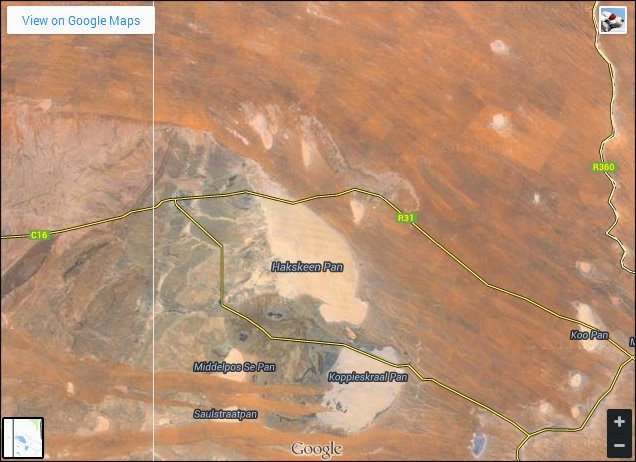
Simulations have looked at how the car will cope with the supersonic rolling ground, rotating wheels and resulting shock waves in close proximity to the test surface at the record attempt site in Hakskeen Pan, South Africa.

Where, in 2015, it will make high speed test runs of up to 800mph, with the full 1,000mph attempt scheduled for 2016.

For a ground vehicle to travel at over 1,000mph (approximately Mach 1.3), the designers have created the most advanced fusion of space, aeronautical and Formula 1 engineering ever attempted.

In the words of the UK Institution of Mechanical Engineers, 'the BLOODHOUND supersonic car (SSC) is the most exciting and dynamic engineering challenge going on today.'

Clearly, the aerodynamic challenges associated with developing a land–based vehicle capable of safely travelling at transonic speeds are great.

Drag minimisation and vertical aerodynamic force control are of paramount importance for a safe record attempt on the constrained distance of 12 miles available at the record attempt site in Hakskeen Pan, South Africa.


Computational fluid dynamics (CFD) has been chosen as the primary tool to guide the aerodynamic design of the vehicle.

Dr Ben Evans
Dr Ben Evans and Chris Rose's work on the computational fluid dynamics of the project, developing models of the aerodynamic flows that BLOODHOUND experience, helps guide the vehicle design.

On working on the project, he said, "These computational models have already influenced significant design aspects of BLOODHOUND including the front wheel configuration, the shape of the nose, the jet engine intake shaping, rear wheel fairings and wing shape and size."

"The CFD modelling continues to be one of the dominant tools used to develop the surface geometry of BLOODHOUND."

The sheer audacious ambition of increasing the current LSR by over 30% meant that the BLOODHOUND design team had to start from scratch and not only design a new type of LSR vehicle, but also develop a whole new way of thinking.

Their investigations into the issue of how to keep the vehicle grounded led to an unexpected discovery that the problem was more difficult to deal with at the rear of the car, rather than keeping the nose down at the front.

More information: "Simulating the aerodynamic characteristics of the Land Speed Record vehicle, BLOODHOUND SSC" by the Dr Ben Evans and Chris Rose is a forthcoming article published by the Journal of Automobile Engineering. The article will be freely accessible here.

Sunday, March 9, 2014

Sun's energy influences 1,000 years of natural climate variability

This is a composite created from three images received from MODIS instruments carried on NASA's Terra and Aqua polar orbiting satellites. 

The images were received at the Dundee Satellite Receiving Station at 1151, 1205 and 1342 UTC on 7th Jan. 2010. 

Credit: NASA

Changes in the sun's energy output may have led to marked natural climate change in Europe over the last 1000 years, according to researchers at Cardiff University.

Scientists studied seafloor sediments to determine how the temperature of the North Atlantic and its localised atmospheric circulation had altered.

Warm surface waters flowing across the North Atlantic, an extension of the Gulf Stream, and warm westerly winds are responsible for the relatively mild climate of Europe, especially in winter.

Slight changes in the transport of heat associated with these systems can led to regional climate variability, and the study findings matched historic accounts of climate change, including the notoriously severe winters of the 16th and 18th centuries which pre-date global industrialisation.

The study found that changes in the Sun's activity can have a considerable impact on the ocean-atmospheric dynamics in the North Atlantic, with potential effects on regional climate.

Predictions suggest a prolonged period of low sun activity over the next few decades, but any associated natural temperature changes will be much smaller than those created by human carbon dioxide emissions, say researchers.

The study, led by Cardiff University scientists, in collaboration with colleagues at the University of Bern, is published today in the journal Nature Geoscience.

Paola Moffa-Sanchez
Dr Paola Moffa-Sanchez, lead author from Cardiff University School of Earth and Ocean Sciences, explained: "We used seafloor sediments taken from south of Iceland to study changes in the warm surface ocean current."

"This was done by analysing the chemical composition of fossilised microorganisms that had once lived in the surface of the ocean."

"These measurements were then used to reconstruct the seawater temperature and the salinity of this key ocean current over the past 1000 years."

The results of these analyses revealed large and abrupt temperature and salinity changes in the north-flowing warm current on time-scales of several decades to centuries.

Cold ocean conditions were found to match periods of low solar energy output, corresponding to intervals of low sunspot activity observed on the surface of the sun.

Using a physics-based climate model, the authors were able to test the response of the ocean to changes in the solar output and found similar results to the data.

Ian Hall
"By using the climate model it was also possible to explore how the changes in solar output affected the surface circulation of the Atlantic Ocean," said Prof Ian Hall, a co-author of the study.

"The circulation of the surface of the Atlantic Ocean is typically tightly linked to changes in the wind patterns."

"Analysis of the atmosphere component in the climate model revealed that during periods of solar minima there was a high-pressure system located west of the British Isles."

"This feature is often referred to as atmospheric blocking, and it is called this because it blocks the warm westerly winds diverting them and allowing cold Arctic air to flow south bringing harsh winters to Europe, such as those recently experienced in 2010 and 2013."

The study concludes that although the temperature changes expected from future solar activity are much smaller than the warming from human carbon dioxide emissions, regional climate variability associated with the effects of solar output on the ocean and atmosphere should be taken into account when making future climate projections.

More information: Solar forcing of North Atlantic surface temperature and salinity over the past millennium, Nature Geoscience, DOI: 10.1038/ngeo2094

Thursday, July 29, 2010

More Than 1,300 Space Shuttle Workers Get Layoff Notices

More than 1,300 space shuttle workers received layoff notices this week from United Space Alliance – a NASA contractor that is cutting 15 percent of its 8,100-person workforce ahead of the shuttle fleet's retirement next year.

Layoff notices were issued to 1,394 USA employees in all, company spokesperson Kari Fluegel told SPACE.com.

The layoffs take effect Oct. 1 and were announced earlier this month by USA officials.

"Our workforce has known for several years that the Space Shuttle Program has been scheduled to end, but layoffs are always difficult for everyone involved," said Virginia Barnes, USA president and chief executive, said in a July 6 statement. "We are committed to making this transition as smooth as possible."

Shuttle program ending
The Houston-based United Space Alliance is a partnership between Boeing Co. and Lockheed Martin that has operated the space shuttle fleet for NASA since 1995.

Fluegel said 902 layoff notices were issued to USA workers in Florida, which is home to NASA's Kennedy Space Center in Cape Canaveral that serves as both launch site and home port for the agency's three shuttles.

Another 478 layoffs were issued for Texas, which is home to NASA's shuttle mission operations, with 14 more in Alabama, where NASA's Marshall Space Flight Center is based.

About one-third of those recieving layoffs in each division nominated themselves for the cutbacks, Fluegel said.

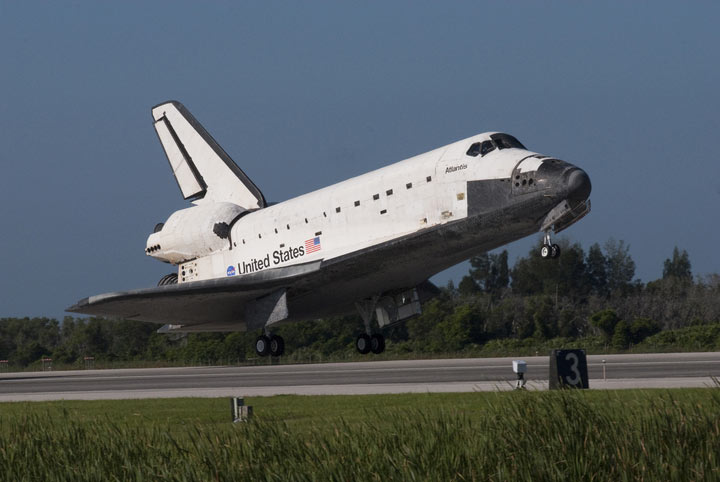
NASA's space shuttle fleet is set to retire next year after 30 years of launching astronauts into low-Earth orbit. The shuttles began flying in 1981 and have flown on 132 missions so far.

Two final shuttle missions are currently scheduled (in November and February, respectively) to complete the International Space Station, which has been under construction since 1998 by a consortium of 16 countries.

Congress is discussing the possible addition on a third and final shuttle mission. If approved, that extra flight would likely launch next summer, NASA officials have said.

Fluegel said that if the extra shuttle flight is approved, it will not affect the impending Oct. 1 layoffs. But there could be repercussions for more layoffs ahead.

"This plan wouldn't be affected at all, but it would affect the timing, obviously, of when we would do layoffs, and how we'd do layoffs, next year," Fluegel said.