Showing posts with label Cigar Galaxy. Show all posts

Friday, August 15, 2014

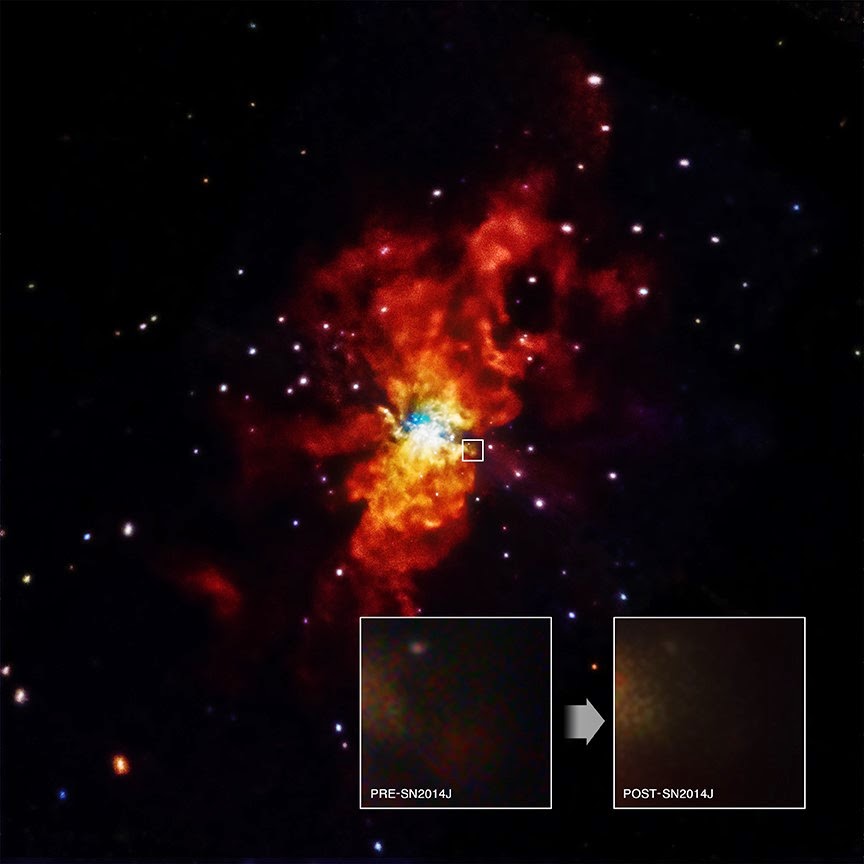
NASA Chandra: Supernova SN 2014J Explosion

Image Credit: NASA/CXC/SAO/R.Margutti et al

New data from NASA’s Chandra X-ray Observatory has provided stringent constraints on the environment around one of the closest supernovas discovered in decades.

The Chandra results provide insight into possible cause of the explosion, as described in our press release.

On January 21, 2014, astronomers witnessed a supernova soon after it exploded in the Messier 82, or M82, galaxy.

Telescopes across the globe and in space turned their attention to study this newly exploded star, including Chandra.

Astronomers determined that this supernova, dubbed SN 2014J, belongs to a class of explosions called “Type Ia” supernovas.

These supernovas are used as cosmic distance-markers and played a key role in the discovery of the Universe’s accelerated expansion, which has been attributed to the effects of dark energy.

Scientists think that all Type Ia supernovas involve the detonation of a white dwarf.

One important question is whether the fuse on the explosion is lit when the white dwarf pulls too much material from a companion star like the Sun, or when two white dwarf stars merge.

This image contains Chandra data, where low, medium, and high-energy X-rays are red, green, and blue respectively.

Raffaella Margutti
The boxes in the bottom of the image show close-up views of the region around the supernova in data taken prior to the explosion (left), as well as data gathered on February 3, 2014, after the supernova went off (right).

The lack of the detection of X-rays detected by Chandra is an important clue for astronomers looking for the exact mechanism of how this star exploded.

The non-detection of X-rays reveals that the region around the site of the supernova explosion is relatively devoid of material.

This finding is a critical clue to the origin of the explosion. Astronomers expect that if a white dwarf exploded because it had been steadily collecting matter from a companion star prior to exploding, the mass transfer process would not be 100% efficient, and the white dwarf would be immersed in a cloud of gas.

If a significant amount of material were surrounding the doomed star, the blast wave generated by the supernova would have struck it by the time of the Chandra observation, producing a bright X-ray source.

Since they do not detect any X-rays, the researchers determined that the region around SN 2014J is exceptionally clean.

A viable candidate for the cause of SN 2014J must explain the relatively gas-free environment around the star prior to the explosion.

One possibility is the merger of two white dwarf stars, in which case there might have been little mass transfer and pollution of the environment before the explosion.

Another is that several smaller eruptions on the surface of the white dwarf cleared the region prior to the supernova.

Further observations a few hundred days after the explosion could shed light on the amount of gas in a larger volume, and help decide between these and other scenarios.

A paper describing these results was published in the July 20 issue of The Astrophysical Journal and is available online.

More Information: "No X-rays from the very nearby Type Ia SN2014J: constraints on its environment" The first author is Raffaella Margutti from the Harvard-Smithsonian Center for Astrophysics (CfA) in Cambridge, MA, and the co-authors are Jerod Parrent (CfA), Atish Kamble (CfA), Alicia Soderberg (CfA), Ryan Foley (University of Illinois at Urbana-Champaign), Dan Milisavljevic (CfA), Maria Drout (CfA), and Robert Kirshner (CfA). 

Monday, March 22, 2010

Distant Star Factory


Arp 220 is a nearby example of a merged starburst galaxy similar to SMM J2135-0102. Located 250 million light-years from Earth, Arp 220 is the aftermath of a collision between two spiral galaxies.

The collision, which began about 700 million years ago, has sparked a crackling burst of star formation, resulting in about 200 huge star clusters in a packed, dusty region about 5,000 light-years across (about 5 percent of the Milky Way's diameter).

The star clusters are the bluish-white bright knots visible in the Hubble image. Credit: NASA, ESA, the Hubble Heritage-ESA/Hubble Collaboration, and A. Evans (UVa/NRAO/Stony Brook)


Astronomers have combined a natural gravitational lens and a sophisticated telescope array to get the sharpest view ever of "star factories" in a galaxy over 10 billion light-years from Earth. They found that the distant galaxy, known as SMM J2135-0102, is making new stars 250 times faster than our Galaxy, the Milky Way.

They also pinpointed four discrete star-forming regions within the galaxy, each over 100 times brighter than locations (like the Orion Nebula) where stars form in our Galaxy. This is the first time that astronomers have been able to study properties of individual star-forming regions within a galaxy so far from Earth.

Read the full article here

Monday, January 4, 2010

Suzaku Spies Treasure Trove Of Intergalactic Metal

Suzaku Spies Treasure Trove Of Intergalactic Metal

Recently astronomers used the Suzaku orbiting X-ray observatory, operated jointly by NASA and the Japanese space agency, to discover the largest known reservoir of rare metals in the universe.

Suzaku detected the elements chromium and manganese while observing the central region of the Perseus galaxy cluster. The metallic atoms are part of the hot gas, or "intergalactic medium," that lies between galaxies.

"This is the first detection of chromium and manganese from a cluster," says Takayuki Tamura, an astrophysicist at the Japan Aerospace Exploration Agency who led the Perseus study. "Previously, these metals were detected only from stars in the Milky Way or from other galaxies. This is the first detection in intergalactic space."

The cluster gas is extremely hot, so it emits X-ray energy. Suzaku's instruments split the X-ray energy into its component wavelengths, or spectrum. The spectrum is a chemical fingerprint of the types and amounts of different elements in the gas.

Monday, October 5, 2009

The Cold Cold Heart of Darkness

The Heart of Darkness

Some of the coldest and darkest dust in space shines brightly in this infrared image from the Herschel Observatory, a European Space Agency mission with important participation from NASA.

The image is a composite of light captured simultaneously by two of Herschel's three instruments -- the photodetector array camera and spectrometer with its spectral and photometric imaging receiver.

The image reveals a cold and turbulent region where material is just beginning to condense into new stars. It is located in the plane of our Milky Way Galaxy, 60 degrees from the center.

Blue shows warmer material, red the coolest, while green represents intermediate temperatures. The red filaments are made up of the coldest material pictured here -- material that is slightly warmer than the coldest temperature theoretically attainable in the universe.

Saturday, July 25, 2009

Cosmic spokes and pummelled planets: 1,000 Years Old

The explosion of a massive star more than 1000 years ago created this colourful remnant, called E0102. It sits some 190,000 light years away in a nearby galaxy called the Small Magellanic Cloud.

The ejected remains seem to form a cylinder that we see end-on. The highest-energy X-rays are shown in blue, and the lowest in orange. A star not visible in this image is responsible for illuminating the green cloud of gas and dust on the lower right.

This image is a composite taken by the Hubble Space Telescope and the orbiting Chandra X-ray Observatory, in celebration of the 10th anniversary of Chandra's deployment after launching into space aboard the space shuttle Columbia.

(Image: X-ray: NASA/CXC/MIT/ D. Dewey et al./SAO/J. DePasquale; Optical: NASA/STScI)

Friday, April 10, 2009

The Cosmic Hand; Constellations and Galaxies of Stars

The ultra-dense remains of a massive star light up surrounding gas and dust to create what appears to be a cosmic hand. This pulsar, seen in bright blue at the base of the "palm", is called B1509. The star is so dense that the electrons and protons in its atoms have combined to form neutrons. B1509 spins some 7 times a second and measures just 19 kilometres in diameter. The magnetic field at its surface is 15 trillion times stronger than the Earth's magnetic field. The field drives a wind of electrons and charged atoms that illuminates finger-like structures that extend north.

The pulsar's reach extends to a neighbouring gas cloud called RCW 89, where the wind lights up knots of gas, making them glow brightly in X-rays (visible in orange and red in the upper-right). The temperature in the cloud seems to vary in a circular pattern, which could mean the pulsar is precessing like a spinning top. B1509 sits some 17,000 light years away from Earth, and is estimated to be about 1700 years old. This image was captured by the orbiting Chandra X-ray Observatory. (Image: NASA/CXC/SAO/P Slane et al)


The Cigar Galaxy, or M82, earns its name when viewed in optical and infrared light (left). But X-rays (right) paint a different picture. M82, which sits some 12 million light years away, is one of the most active nearby galaxies, making it a popular subject of study.

Violent starbursts, likely triggered by the gravitational tugs of a neighbouring galaxy, light up the starry disc near its centre. These intense bursts of new star formation blast out plumes of hot gas that glow in the X-ray part of the spectrum (blue). It took 52.5 hours of observing time to create these images, which were taken by the European Space Agency's orbiting XMM-Newton satellite. (Images: ESA)


The chaotic structure of the spiral galaxy NGC 7793 makes it difficult to identify individual spiral arms, though it is possible to discern some rotation. NGC 7793 sits some 12.5 million light years away from Earth. It is one of the brightest members of the Sculptor Group, a cluster of galaxies that is one of the closest neighbours to our Local Group of galaxies. The Very Large Telescope in the Atacama Desert in Chile snapped this image. (Image: ESO)


A nascent bar sits at the centre of NGC 3359, a delicate spiral galaxy that sits some 49 million light years away in the constellation Ursa Major. Bars are elongated, rectangular bodies of stars, gas and dust that are often seen in spiral galaxies, though it is not yet clear how they fit into galaxies' evolution. Although NGC 3359 is several billion years old, this bar seems to be just 500 million years old.

The galaxy's arms are dotted with light-red patches, hydrogen-rich regions that are sites of intense star formation, similar to those seen in the Orion Nebula in the Milky Way. This image was taken by the Gemini North telescope on Mauna Kea in Hawaii. NGC 3359 can be seen with amateur telescopes. (Image: Gemini Observatory Legacy Image)


A stellar nursery is not uniformly bright, a fact highlighted by this image of NGC 3582, a nebula that sits some 10,000 light years away in the constellation Carina. Here, dark dust clouds share space with glowing gas that is energised by the ultraviolet light of young stars. Wispy structures in the clouds are created by radiation from these young stars, as well as by the explosions of short-lived, massive neighbours. This image was taken by the Gemini South telescope on Cerro Pachon in the Chilean Andes. (Image: Gemini Observatory Legacy Image)


This trio of galaxies, which together form a system called Arp 274, seem to be heading toward a cosmic collision. In fact, the two large spirals (middle and right) already seem to be entangled. But their proximity is just an illusion – the galaxies lie at different distances from Earth and are far enough from one another that astronomers do not think they interact. Two foreground stars in the Milky Way can also be seen on the right.

All three galaxies show colourful evidence of new star formation. The energised gas of stellar nurseries (pink) and clusters of young, massive stars (blue) dot the arms of the two spiral galaxies and encircle their compact companion (left). Older stars appear yellow.

Arp 274 sits 400 million light years away in the constellation Virgo. The Hubble Space Telescope snapped the ensemble in early April, after it was chosen by the public from six candidate targets. (Image: NASA/ESA/M. Livio/Hubble Heritage Team/STScI/AURA)


Organic molecules mixed with dust glow green in this infrared image of M33 captured by the Spitzer Space Telescope. M33, also called the Triangulum Galaxy, sits some 2.9 million light years away from Earth. The spiral is a member of the Milky Way's Local Group, a band of dozens of galaxies that travel as an ensemble because they are gravitationally bound. Star-forming regions appear orange-red in this image. Cool material, possibly carried outwards by winds from giant stars or supernovae, glows at infrared wavelengths beyond what optical telescopes detect as the galaxy's edge. (Image: NASA/JPL-Caltech/University of Arizona)


NASA's Galaxy Evolution Explorer captured this ultraviolet image of the nearby planetary nebula NGC 3242, also called "Jupiter's Ghost" (blue and white region at centre). It may sit as little as 1400 light years away in the constellation Hydra. As sun-like stars run out of fuel, they swell into red giants. These bloated stars jettison their outer layers of gas, eventually exposing a dense core of carbon and oxygen called a white dwarf. The ultraviolet light released by the white dwarfs lights up the surrounding gas, creating planetary nebulae. Although sun-like stars live for billions of years, planetary nebulae only last some 10,000 years. Astronomers are not sure whether the wispy white cloud that curves around the blue nebula is a chance passerby or gas that was ejected while the star was still a red giant. (Image: NASA/JPL-Caltech)