Showing posts with label OSIRIS Narrow Angle Camera. Show all posts

Monday, August 18, 2014

ESA Rosetta: Comet 67/P Surface Variations

Image of 67P/Churyumov-Gerasimenko shows the diversity of surface structures on the comet's nucleus. Image courtesy ESA/Rosetta/NAVCAM.

Credit: ESA

A new image of comet 67P/Churyumov-Gerasimenko shows the diversity of surface structures on the comet's nucleus. It was taken by the Rosetta spacecraft's OSIRIS narrow-angle camera on August 7, 2014.

At the time, the spacecraft was 65 miles (104 kilometers) away from the 2.5-mile-wide (4-kilometer) nucleus.

In the image, the comet's head (in the top half of the image) exhibits parallel linear features that resemble cliffs, and its neck displays scattered boulders on a relatively smooth, slumping surface.

In comparison, the comet's body (lower half of the image) seems to exhibit a multi-variable terrain with peaks and valleys, and both smooth and rough topographic features.

A 3-D version of the image is shown below

This anaglyph image of comet 67P/Churyumov-Gerasimenko can be viewed using stereoscopic glasses with red–green/blue filters.

The two images used to make the anaglyph were taken on 7 August 2014 from a distance of 104 kilometres with Rosetta's OSIRIS narrow-angle camera

They are separated by 17 minutes.

Credits: ESA /Rosetta /MPS for OSIRIS Team

Launched in March 2004, Rosetta was reactivated in January 2014 after a record 957 days in hibernation.

Rosetta's OSIRIS narrow-angle camera
Composed of an orbiter and lander, Rosetta's objectives are to study comet 67P/Churyumov-Gerasimenko up close in unprecedented detail, prepare for landing a probe on the comet's nucleus in November, and track its changes as it sweeps past the sun.

Comets are time capsules containing primitive material left over from the epoch when the sun and its planets formed.

Rosetta's lander will obtain the first images taken from a comet's surface and will provide the first analysis of a comet's composition by drilling into the surface.

Rosetta also will be the first spacecraft to witness at close proximity how a comet changes as it is subjected to the increasing intensity of the sun's radiation.

Observations will help scientists learn more about the origin and evolution of our solar system, and the role comets may have played in seeding Earth with water.

Monday, August 4, 2014

ESA Rosetta: Amazing new photo of comet 67/P

OSIRIS narrow angle camera view of 67P/C-G from a distance of 1000 km on 1 August 2014. 

Credits: ESA/Rosetta/MPS for OSIRIS Team MPS /UPD /LAM /IAA /SSO /INTA /UPM /DASP /IDA

As the ESA's Rosetta spacecraft closes to within 1000 km of comet 67P/Churyumov-Gerasimenko, the Rosetta science team has released a new image and made the first temperature measurements of the comet's core.

The temperature data show that 67P is too hot to be covered in ice and must instead have a dark, dusty crust.

The new image was acquired on August 1st at 02:48 UTC by the OSIRIS Narrow Angle Camera onboard Rosetta at a distance of approximately 1000 km. It shows the rough surface of the double-lobed core in amazing detail.

Thermal observations of comet 67P/Churyumov-Gerasimenko were made by Rosetta's visible, infrared and thermal imaging spectrometer, VIRTIS, between 13 and 21 July, when Rosetta closed in from 14 000 km to the comet to just over 5000 km.

At these distances, the comet covered only a few pixels in the field of view and so it was not possible to determine the temperatures of individual features.

But, using the sensor to collect infrared light emitted by the whole comet, scientists determined that its average surface temperature is about -70°C.

Although -70°C may seem rather cold, importantly, it is some 20–30°C warmer than predicted for a comet at that distance covered exclusively in ice.

"This result gives us the first clues on the composition and physical properties of the comet's surface," says VIRTIS principal investigator Fabrizio Capaccioni from INAF-IAPS, Rome, Italy.

Other comets such as 1P/Halley are known to have very dark surfaces owing to a covering of dust, and Rosetta's comet was already known to have a low reflectance from ground-based observations, excluding an entirely 'clean' icy surface.

The temperature measurements provide direct confirmation that much of 67P's surface must be dusty, because darker material heats up and emits heat more readily than ice when it is exposed to sunlight.

"This doesn't exclude the presence of patches of relatively clean ice, however, and very soon, VIRTIS will be able to start generating maps showing the temperature of individual features," adds Dr Capaccioni.

As Rosetta approachs and later orbits the comet, the sensor will study the variation of daily surface temperatures in order to understand how quickly the surface reacts to solar illumination.

In turn, this will provide insight into the thermal conductivity, density and porosity of the top tens of centimetres of the surface—important data to help select a target site for Rosetta's lander, Philae.

Friday, August 1, 2014

ESA Rosetta Image: Coma surrounds comet 67P/Churyumov-Gerasimenko

The coma of comet 67P/Churyumov-Gerasimenko as seen by OSIRIS camera on board ESA Rosetta

The coma covers an area of 150 kilometers across. 

This image was taken on July 25th, 2014 with an exposure time of 330 seconds. 

 The hazy circular structure on the right and the center of the coma are artifacts due to overexposure of the nucleus. 

Credit: ESA/Rosetta/MPS for OSIRIS Team MPS /UPD /LAM /IAA /SSO /INTA /UPM /DASP /IDA

Less than a week before ESA Rosetta's rendezvous with comet 67P/Churyumov-Gerasimenko, images obtained by OSIRIS, the spacecraft's onboard scientific imaging system, show clear signs of a coma surrounding the comet's nucleus.

While the OSIRIS' view of the coma covers an area of 150 kilometers across, its outskirts might reach much farther.

"Even though it sounds like a contradiction, imaging the comet's coma from nearby is more difficult than from far away", says OSIRIS Principal Investigator Holger Sierks from the Max Planck Institute for Solar System Research (MPS) in Germany.

At the end of April, for example, OSIRIS had witnessed a distinct rise of cometary dust production from a distance of more than two million kilometers.

At that time, one pixel in OSIRIS' images corresponded to a region in space covering 2500 square kilometers at the nucleus.

ESA Rosetta's OSIRIS camera
The reflected light from all dust particles seen in this column worked together to create a signal.

Now, as the resolution of OSIRIS images increases, a much smaller region and thus far less dust particles contributes to one pixel.

Nevertheless, a new image dating from July 25th clearly reveals an extended coma shrouding 67P's nucleus.

"Our coma images cover an area of 150 by 150 square kilometers", says Luisa Lara from the Instituto de AstrofĂ­sica de AndalucĂ­a.

However, most likely these images show only the inner part of the coma, where particle densities are highest. Scientists expect 67P's full coma to actually reach much farther.

Another challenge for OSIRIS is the bright nucleus that outshines the surrounding coma.

While OSIRIS is designed to deal with a controlled overexposure in the region of the nucleus, the stray light from this strong source causes artifacts by the optical system.

In the current image, the hazy bright circular structure to the right of the comet's nucleus is such an artifact. The center of the image located around the position of the nucleus is obscured by overexposure.

The nucleus of comet 67P/Churyumov-Gerasimenko as seen from a distance of 1950 kilometers on July 29th, 2014. 

One pixel corresponds to approximately 37 meters. 

The bright neck region between the comet’s head and body is becoming more and more distinct. 

Credit: ESA/Rosetta/MPS for OSIRIS Team MPS /UPD /LAM /IAA /SSO /INTA /UPM /DASP /IDA

In the next weeks, the OSIRIS team will study how the comet's activity has developed so far in approach.

To this end, data obtained from different distances and with different exposure times need to be correlated.


Meanwhile, new images of the comet's nucleus confirm the collar-like appearance of the neck region which presents itself brighter than most parts of the comet's body and head.

The reason for this feature is still subject to discussion. Possible explanations range from differences in material or grain size to topological effects.

Rosetta is an ESA mission with contributions from its member states and NASA.

Rosetta's Philae lander is provided by a consortium led by DLR, MPS, CNES and ASI.

Rosetta will be the first mission in history to rendezvous with a comet, escort it as it orbits the Sun, and deploy a lander to its surface.

Tuesday, June 24, 2014

ESA Rosetta: 67P/Churyumov-Gerasimenko comet has quietened

ESA Rosetta’s target comet, 67P/Churyumov–Gerasimenko, seen on 4 June 2014 by the OSIRIS Narrow Angle Camera

The comet’s activity has declined since April–May, showing the unpredictable nature of these objects. 

The image shows a quarter of the full field of OSIRIS and was taken with an exposure time of 67 seconds.

Credits: ESA/Rosetta/MPS for OSIRIS Team MPS /UPD /LAM /IAA /SSO /INTA/UPM/DASP/IDA

An image snapped earlier this month by ESA Rosetta spacecraft shows its target comet has quietened, demonstrating the unpredictable nature of these enigmatic objects.

The picture was captured on 4 June by Rosetta's scientific camera, and is the most recent full-resolution image from the narrow-angle sensor.

It has been used to help fine-tune Rosetta's navigation towards comet 67P/Churyumov-Gerasimenko, which was 430 000 km away at the time.

Strikingly, there is no longer any sign of the extended dust cloud that was seen developing around nucleus at the end of April and into May, as shown in our last image release.

Indeed, monitoring of the comet has shown a significant drop in its brightness since then.

Holger Sierks
"The comet is now almost within our reach - and teaching us to expect the unexpected," says the camera's Principal Investigator Holger Sierks from the Max Planck Institute for Solar System Research in Germany.

"After its onset of activity at the end April, our images are currently showing a comet back at rest."

While it is not uncommon for comets to display varying levels of activity, it is the first time that scientists have witnessed changes in dust production from such a close distance.

A comet's 'coma' develops as it moves along its orbit progressively closer to the Sun, the increasing warmth causing surface ices to sublimate and gas to escape from its rock-ice nucleus.

As the gas flows away from the nucleus, it also carries a cloud of tiny dust particles out into space, which slowly expands to create the coma.

The warming continues and activity rises as the comet moves ever closer to the Sun. Eventually, pressure from the solar wind causes some of the material to stream out into a long tail.

As comets are non-spherical and lumpy, this process is often unpredictable, with activity waxing and waning as they warm.

The observations made over the six weeks from the end of April to early June show just how quickly the conditions at a comet can change.

Since Rosetta's instruments were reactivated earlier this year after a long hibernation, the scientific and navigation cameras have been regularly acquiring images to help define Rosetta's trajectory to the comet.

Using this information, the spacecraft has been making a series of manoeuvres that will slowly bring it in line with the comet before their rendezvous in the first week of August.

Four manoeuvres have been completed already - the most recent was yesterday - with six more to go. The last in the sequence is planned for 6 August, when Rosetta will be 100 km from the comet and will embark on a series of complex manoeuvres to bring it closer still.

But today, even six weeks and about 165 000 km out, Rosetta's science instruments have already started collecting data on the comet's environment and its evolution.

For example, Rosetta is capable of measuring the coma and determining the rates at which water and gases such as carbon dioxide are being produced, and how those rates change with time.

These measurements will provide insight into the chemical makeup of the comet's surface and interior.

The plasma environment of the comet can also be assessed as the coma develops and interacts with particles in the solar wind.

Later, as it gets even closer, Rosetta will start collecting gas and dust particles from the coma, and analysing them in its miniaturised onboard laboratories.

"It's great to have started regularly receiving science data, especially after a long 10 year journey towards our destination," says Matt Taylor, ESA's Rosetta project scientist.

"The variable activity of the comet shows it definitely has personality, which makes us all the more eager to get there to learn just how it ticks."

Today, the roughly 4 km-wide comet scales to about one pixel in the narrow-angle camera - meaning no details of the nucleus can be discerned. But within a few weeks, Rosetta will be close enough to see far more: by early July, it should span five pixels and by the start of August, 500 pixels.

Monday, March 31, 2014

ESA Rosetta Image: Comet 67P/Churymov-Gerasimenko in the constellation Ophiuchus

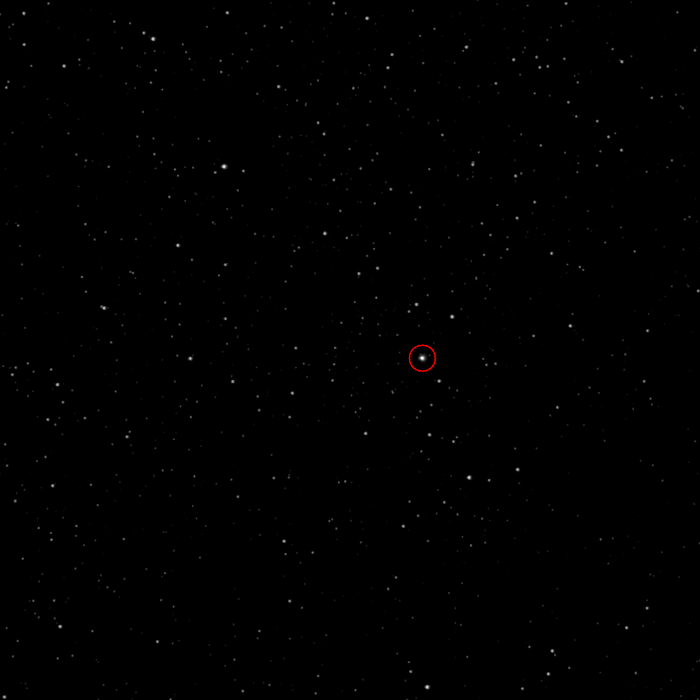
The OSIRIS Narrow Angle Camera aboard ESA's Rosetta probe captured this image on March 21, 2014, showing Comet 67P/Churyumov–Gerasimenko in the constellation Ophiuchus.

Credit: ESA

The ESA's Rosetta spacecraft opened its eyes in January after a 10-year voyage across the solar system and a long hibernation in deep space.

For the first time since its wakeup call, Rosetta spied its destination.

ESA released images Thursday (March 27) showing Rosetta's glimpse of its target, Comet 67P/Churyumov–Gerasimenko.

The "first light" images were captured on March 20 and 21 by the OSIRIS wide-angle camera and narrow-angle camera aboard Rosetta, from more than 3 million miles (5 million kilometers) away from the comet.


"Finally seeing our target after a 10 year journey through space is an incredible feeling," Holger Sierks, the OSIRIS principal investigator from the Max Planck Institute for Solar System Research in Germany, said in a statement.

Holger Sierks
"These first images taken from such a huge distance show us that OSIRIS is ready for the upcoming adventure."

The light from the faraway, 2.5-mile-wide (4 km) comet doesn't even fill up a single pixel.

To create the image, researchers had to obtain a series of 60–300 second exposures.

It took 37 minutes for each image to reach Earth and about an hour for each to download, ESA officials said.

ESA's Rosetta, a solar-powered probe, is on track to enter orbit around the icy body in August 2014. By then, Rosetta should have a 2-meter (6.5 feet) per pixel view of Comet 67P/Churyumov–Gerasimenko, complete with surface features.

A robotic lander called Philae, which is piggybacking on Rosetta, is scheduled to touch down on the comet in November 2014.

Securing itself with a harpoon and ice screws, Philae will drill samples and conduct experiments with its 10 science instruments, as Rosetta looks on from above.

If all goes as planned, Rosetta and Philae will continue their observations through December 2015.