Showing posts with label quiet. Show all posts

Tuesday, July 22, 2014

The sun has gone quiet: Sunspots and CME

The Sun by the Atmospheric Imaging Assembly of NASA's Solar Dynamics Observatory

Credit: NASA

The sun has gone quiet. Almost too quiet.

A few weeks ago it was teeming with sunspots, as you would expect since we are supposed to be in the middle of solar maximum-the time in the sun's 11-year cycle when it is the most active but now, there is hardly a sunspot in sight.

In an image taken Friday by NASA's Solar Dynamics Observatory, there is a tiny smidgen of brown just right of center where a small sunspot appears to be developing. But just one day before, there was nothing. It was a totally spotless day.

So what's going on here? Is the "All Quiet Event" as solar physicist Tony Phillips dubbed it, a big deal, or not?

"It is weird, but it's not super weird," said Phillips, who writes about solar activity on his web site SpaceWeather.com.

"To have a spotless day during solar maximum is odd, but then again, this solar maximum we are in has been very wimpy."

Phillips notes that this is the weakest solar maximum to have been observed in the space age, and it is shaking out to be the weakest one in the past 100 years, so the spotless day was not so totally out of left field.

"It all underlines that solar physicists really don't know what the heck is happening on the sun," Phillips said.

"We just don't know how to predict the sun, that is the take away message of this event."

Sunspots are interesting to solar observers because they are the region of the sun where solar activity such as solar flares (giant flashes of light) and coronal mass ejections (when material from the sun goes shooting off into space) originate.

They are caused by highly concentrated magnetic fields that are slightly cooler than the surrounding surface of the sun, which is why they appear dark to us.

Those intense magnetic fields can get twisted up and tangled, which causes a lot of energy to build up. Solar flares and coronal mass ejections occur when that energy is released in a very explosive way.

Alex Young, a heliophysicist at Goddard Space Flight Center, said it is hard to say what is and isn't unusual when it comes to the sun.

"We've only been observing the sun in lots of detail in the last 50 years," he said.

"That's not that long considering it's been around for 4.5 billion years." And it's not like astronomers have never seen the sun this quiet before.

Three years ago, on Aug. 14, 2011 it was completely free of sunspots and, as Phillips points out, that year turned out to have relatively high solar activity overall with several X-class flares.

So in that case, the spotless sun was just a "temporary intermission," as he writes on his web site.

Whether this quiet period will be similarly short-lived or if it will last longer remains to be seen.

"You just can't predict the sun," Phillips said.

Tuesday, June 24, 2014

ESA Rosetta: 67P/Churyumov-Gerasimenko comet has quietened

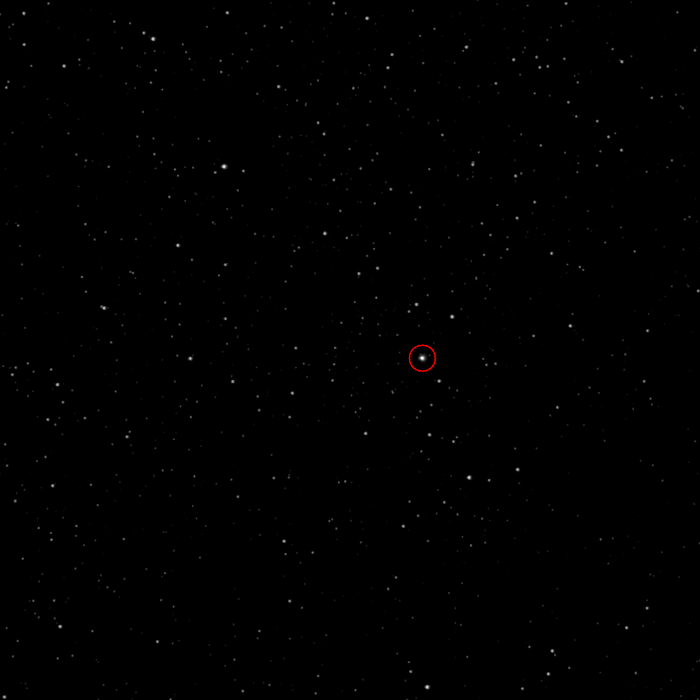
ESA Rosetta’s target comet, 67P/Churyumov–Gerasimenko, seen on 4 June 2014 by the OSIRIS Narrow Angle Camera

The comet’s activity has declined since April–May, showing the unpredictable nature of these objects. 

The image shows a quarter of the full field of OSIRIS and was taken with an exposure time of 67 seconds.

Credits: ESA/Rosetta/MPS for OSIRIS Team MPS /UPD /LAM /IAA /SSO /INTA/UPM/DASP/IDA

An image snapped earlier this month by ESA Rosetta spacecraft shows its target comet has quietened, demonstrating the unpredictable nature of these enigmatic objects.

The picture was captured on 4 June by Rosetta's scientific camera, and is the most recent full-resolution image from the narrow-angle sensor.

It has been used to help fine-tune Rosetta's navigation towards comet 67P/Churyumov-Gerasimenko, which was 430 000 km away at the time.

Strikingly, there is no longer any sign of the extended dust cloud that was seen developing around nucleus at the end of April and into May, as shown in our last image release.

Indeed, monitoring of the comet has shown a significant drop in its brightness since then.

Holger Sierks
"The comet is now almost within our reach - and teaching us to expect the unexpected," says the camera's Principal Investigator Holger Sierks from the Max Planck Institute for Solar System Research in Germany.

"After its onset of activity at the end April, our images are currently showing a comet back at rest."

While it is not uncommon for comets to display varying levels of activity, it is the first time that scientists have witnessed changes in dust production from such a close distance.

A comet's 'coma' develops as it moves along its orbit progressively closer to the Sun, the increasing warmth causing surface ices to sublimate and gas to escape from its rock-ice nucleus.

As the gas flows away from the nucleus, it also carries a cloud of tiny dust particles out into space, which slowly expands to create the coma.

The warming continues and activity rises as the comet moves ever closer to the Sun. Eventually, pressure from the solar wind causes some of the material to stream out into a long tail.

As comets are non-spherical and lumpy, this process is often unpredictable, with activity waxing and waning as they warm.

The observations made over the six weeks from the end of April to early June show just how quickly the conditions at a comet can change.

Since Rosetta's instruments were reactivated earlier this year after a long hibernation, the scientific and navigation cameras have been regularly acquiring images to help define Rosetta's trajectory to the comet.

Using this information, the spacecraft has been making a series of manoeuvres that will slowly bring it in line with the comet before their rendezvous in the first week of August.

Four manoeuvres have been completed already - the most recent was yesterday - with six more to go. The last in the sequence is planned for 6 August, when Rosetta will be 100 km from the comet and will embark on a series of complex manoeuvres to bring it closer still.

But today, even six weeks and about 165 000 km out, Rosetta's science instruments have already started collecting data on the comet's environment and its evolution.

For example, Rosetta is capable of measuring the coma and determining the rates at which water and gases such as carbon dioxide are being produced, and how those rates change with time.

These measurements will provide insight into the chemical makeup of the comet's surface and interior.

The plasma environment of the comet can also be assessed as the coma develops and interacts with particles in the solar wind.

Later, as it gets even closer, Rosetta will start collecting gas and dust particles from the coma, and analysing them in its miniaturised onboard laboratories.

"It's great to have started regularly receiving science data, especially after a long 10 year journey towards our destination," says Matt Taylor, ESA's Rosetta project scientist.

"The variable activity of the comet shows it definitely has personality, which makes us all the more eager to get there to learn just how it ticks."

Today, the roughly 4 km-wide comet scales to about one pixel in the narrow-angle camera - meaning no details of the nucleus can be discerned. But within a few weeks, Rosetta will be close enough to see far more: by early July, it should span five pixels and by the start of August, 500 pixels.