Showing posts with label mammals. Show all posts

Monday, August 19, 2013

AUG Signals Radar System detects and monitors large mammals and alerts drivers

IN THE wilds of Canada and Skandanavia, thousands of motorists have serious life-threatening collisions involving moose and large mammals.

Collisions with large mammals weighing in at 1,000 Kg will cause serious damage to vehicles and inevitable human fatalities.

A new roadside radar system could prevent collisions by detecting and keeping track of large animals, whilst at the same time, warning drivers when it would be wise to slow down and be alert to potential collisions.

Abir Mukherjee of AUG Signals in Toronto says existing set-ups, which use light beam tripwires, are not reliable.

"With a tripwire system, when an animal crosses it into the road, it will alert," he says. "But after a fixed time, the system goes off. Then the system doesn't know where the animal is."

The Large Animal Detection System (LADS) sends out a 360-degree radar signal every second, then monitors the reflections to work out what animals are there. Its software allows it to ignore small animals and vegetation in the radar's path.


The detector has been running as a pilot project on Canada's Highway 416 near Kemptville, Ontario, since last year. LADS has an effective radius of 700 metres and works in harsh weather and heavy snow.

When it detects an animal, lights flash on street signs to alert drivers. It also records data on the number and speed of vehicles.

Mukherjee will present a paper on LADS at the IEEE Sensors conference in Baltimore, Maryland, in November.

Wednesday, September 21, 2011

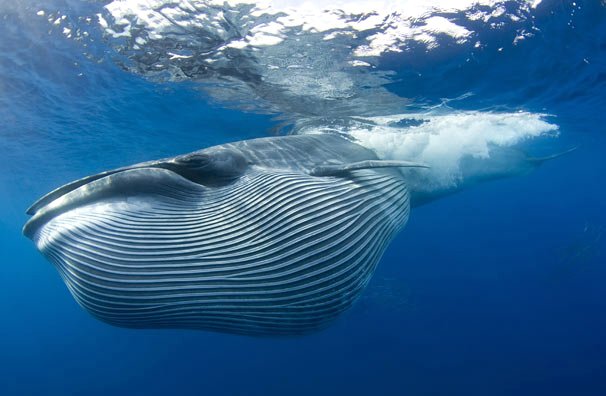
Bryde's Whale in the tropical Pacific Ocean


Bryde's whales are baleen whales, one of the "great whales" or rorquals.Seen here with a mouthful of water and krill or plankton.

These whales opportunistically feed on plankton (e.g., krill and copepods), and crustaceans (e.g. pelagic red crabs, shrimp), as well as schooling fish (e.g., anchovy, herring, sardine, mackerel, and pilchard).

Bryde's whales use several recognisable feeding methods, including skimming the surface, lunging, and bubble nets.

They prefer tropical and temperate waters over the polar seas that other whales in their family frequent.

They are largely coastal rather than pelagic. Bryde's whales are very similar in appearance to sei whales and almost as large.

"Bryde" is sometimes misheard as "brutus whale". The name comes from the Norwegian consul to South Africa, Johan Bryde, who helped set up the first whaling station in Durban, South Africa in 1908.

They inhabit tropical and subtropical waters worldwide.

Bryde's whales are considered medium-sized for balaenopterids, dark gray in color with a white underbelly.

Monday, November 8, 2010

"Blue Eyes" by Michael McEvoy

"Blue Eyes" by Michael McEvoy - a moray eel in Indonesia

"Hitting Sailfish" by Alexander Safonov

"Hitting Sailfish" by Alexander Safonov - a sailfish attacking schooling fish in Port St Johns, South Africa

"Inner Glow" by Ross Gudgeon

"Inner Glow" by Ross Gudgeon - a jellyfish in Ningaloo Reef, Australia.

The enormous gape of a playful Leopard seal - Bartosz Strozynski

A dramatic picture of a leopard seal snapping its jaws directly at the lens of Bartosz Strozynski, landing him the gold award for animal behaviour.

"I was playing with the seal," said 35 year-old Bartosz from Poznan in Poland. "They are curious and they do try to test you in the water.

This one saw his reflection in my lens and must have thought I was another leopard seal. So she displayed her teeth as a warning."

Picture: Bartosz Strozynski / BARCROFT MEDIA

Underwater Traps for Turtles and Sea Mammals

"Underwater Sadness" by Ramon Dominguez - a sea turtle caught in a net in the Sea of Cortez, Mexico.

A tragic vision in such a beautiful setting and so well captured by Ramon!

Wednesday, August 26, 2009

YouTheria: Predictive Animal Database for Endangered species

A new animalia database that allows users to explore the factors that predispose different mammalian species to extinction – from human encroachment to slow reproductive rate – could be useful in planning conservation schemes, its developers say. Anyone can access the online system, YouTHERIA, which allows users to manipulate parameters including habitat ecology, litter size and diet, and test their own hypotheses.

It relies on a vast database of all known and recently extinct mammals, called PanTHERIA, which lists details of the species' ecology, behaviour, diet, geographical range and habitat, based on more than two decades of published research. The database also records the extent to which each of the 5000-odd species is being impacted by humans and habitat degradation.

Warning signs

Analysis of the database has already highlighted a set of key characteristics – slow reproductive rate being one – which predispose mammals to extinction.

"For example, the Seychelles flying fox isn't declining in abundance now because its habitat is intact," says Andy Purvis, a biodiversity researcher at Imperial College London, who helped produce the tools. "But our database suggests that its slow reproductive rate will predispose it to extinction if and when its habitat is disturbed."

Purvis also recommends that conservationists focus on protecting the tundras of Siberia and Canada, where mammals predisposed to extinction because of slow reproduction, are currently thriving in healthy habitat.

Until now, the database has been restricted to the team of biologists who developed it, but Kate Jones at the Zoological Society of London and colleagues have made it freely available to other researchers, hoping that they will contribute to the data.

Encyclopedia of Life, another collaborative database of species, launched two years ago, has already seen contributions from 2 million people from 200 countries. This week it reached its 150,000th entry.

Journal reference: Ecology, DOI: 10.1890/08-1494.1