Showing posts with label dolphins. Show all posts

Sunday, January 15, 2012

Pollution endangers Rare Chinese white dolphin: DNA bank

An endangered Chinese white dolphin (Sousa chinensis chinensis) swims off the coast of Hong Kong in August 2011.

A Hong Kong conservation group has set up a DNA bank for the rare Chinese white dolphin, also known as the pink dolphin, in a bid to save the mammals facing a sharp population decline.

There are about 2,500 Chinese white dolphins in the busy insutrialised Pearl River Delta region, the body of water between Macau and Hong Kong, with the majority of the mammals in Chinese waters and the rest in Hong Kong.

But experts say their number has dropped significantly in the past few years due to overfishing, an increase in maritime traffic, water pollution, habitat loss and coastal development.

In a bid to save the dwindling population, the Ocean Park Conservation Foundation Hong Kong said it had joined hands with a Chinese university to set up a DNA bank, which will also spearhead a genetic research project.

"We hope to offer the scientific community a standardised genetic analysis platform to assess the sustainability of Chinese white dolphin populations," Judy Chen, the foundation chairwoman said in a statement.

"The collected data will provide important reference to governments in the region for developing critical strategies of Chinese white dolphin conservation," she added.

The biological samples of these dolphins will be sent to the DNA bank to investigate the environmental impacts on the mammal, the statement said.

The Chinese white dolphins, a sub-species of the Indo-Pacific humpback dolphins, are unique for their pink skin. They are listed as "near threatened" by the International Union for Conservation of Nature.

The mammal was the official mascot at the handover ceremony when the former British colony returned to Chinese rule in 1997, while dolphin watching is a favourite tourist attraction in Hong Kong.

Its population in Hong Kong has dropped from an estimated 158 in 2003 to only 75 in 2010, according to the Hong Kong Dolphin Conservation Society.

Wednesday, September 21, 2011

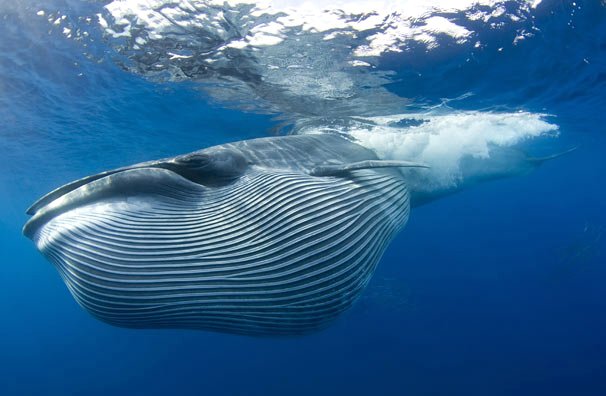
Bryde's Whale in the tropical Pacific Ocean


Bryde's whales are baleen whales, one of the "great whales" or rorquals.Seen here with a mouthful of water and krill or plankton.

These whales opportunistically feed on plankton (e.g., krill and copepods), and crustaceans (e.g. pelagic red crabs, shrimp), as well as schooling fish (e.g., anchovy, herring, sardine, mackerel, and pilchard).

Bryde's whales use several recognisable feeding methods, including skimming the surface, lunging, and bubble nets.

They prefer tropical and temperate waters over the polar seas that other whales in their family frequent.

They are largely coastal rather than pelagic. Bryde's whales are very similar in appearance to sei whales and almost as large.

"Bryde" is sometimes misheard as "brutus whale". The name comes from the Norwegian consul to South Africa, Johan Bryde, who helped set up the first whaling station in Durban, South Africa in 1908.

They inhabit tropical and subtropical waters worldwide.

Bryde's whales are considered medium-sized for balaenopterids, dark gray in color with a white underbelly.

Wednesday, July 27, 2011

Electric sense in dolphins: cetaceans with a seventh sense

One extra sense isn't quite enough for Guiana dolphins. In addition to echolocation, they can sense the electric fields of their prey – the first time this has been seen in true mammals.

Wolf Hanke at the University of Rostock in Germany and colleagues were intrigued by thermal images showing intense physiological activity in the pits on the upper jaw of the dolphins, Sotalia guianensis

Fish, some amphibians and primitive egg-laying mammals such as the duck-billed platypus use similar pits to pick up electric fields generated by nearby animals.

By examining the structures in a dead dolphin, and training a live one to respond to an electric field comparable to that generated by a fish, the team showed that dolphins also have electro-sensory perception.

"Electroreception is good for sensing prey over short distances, where echolocation isn't so effective," says Hanke. Other species of dolphin, and even whales, may be similarly gifted, he says.

"Most people don't realise that whales also feed on the floor of the ocean, so it is possible that they also use electrosensing."

Hanke points out that the electro-sensory organs are derived from whiskers in ancestral animals. These mechanoreceptor organs, like the hair cells in the human ear, mechanically transmit the stimulus of touch or sound waves. 

The adaptation in Guiana dolphins is fairly new, Hanke says, and he suspects that "it is relatively easy to evolve, to change mechanoreceptor organs into electroreceptors".


Journal reference: Proceedings of the Royal Society B, DOI: 10.1098/rspb.2011.1127

Friday, March 25, 2011

The Finless porpoise - Neophocaena phocaenoides

You are probably aware of most river dolphins but today it's time to learn more about the lesser known 'river pig' or finless porpoise (Neophocaena phocaenoides).

The charming finless porpoise is very much a coastal species, predominantly found in salt water areas of the Indo-Pacific region. However, a small and endangered population of the porpoise inhabits the infamous Yangtze River and its tributaries.

Very little is known of the species, as is common with most of the cetaceans covered in this series of blogs, but the plight of the baiji (Yangtze river dolphin) from the Yangtze River has drawn obvious attention towards the oddly named “river pig”.

As its name suggests, it is the "finless" porpoise

Much debate has occurred over recent years over the genetic distinction of a number of sub-species of finless porpoise. Many populations are geographically isolated and this has led to the rise of the currently recognised three sub-species. Of which, the Chinese population of freshwater dwelling porpoises is one – Neophocaena phocaenoides asiaeorientalis.

As with other species of porpoise, N. phocaenoides is not known to be overly acrobatic and shies away from boats and human disturbance. The tragedy of the Yangtze River population is that the levels of human disturbance and boat traffic in the region are so high that many individuals now readily approach boats. They have therefore become more vulnerable to the usual suspects of by-catch in fishing gear and direct boat collision.

Unfortunately, their ‘cute’ looks and approachable behaviour have also led to the river population being exploited for the aquarium trade. In conjunction with all the same impacts that pushed the baiji to extinction in recent years, this represents some the most irresponsible of practices the aquarium trade takes part in worldwide.

The finless porpoise is one of the only species of cetacean not to have a dorsal fin.

However, the lack of action and consequent tragic loss of the baiji has spurned more rapid action in conserving the finless porpoise population of the Yangtze River. The Tian-e-Zhou Oxbow Nature Reserve, an area of wetland in the Yangtze basin near Shishou City, was originally intended for the baiji.

More recently it has been adopted as a ‘safe haven’ for the finless porpoise in which 28 individuals live. Chinese conservationists wish to follow this example, in the fight to conserve the river dwelling populations, by using other sanctuaries and reserves that were previously set up for the baiji.

The Tian-e-Zhou population is by no means a strong population and with the only other ‘stronghold’ of finless porpoises in China (in Poyang Lake) coming under threat from dredging activities, their future looks bleak.

Chinese conservationists have, however, insisted that the population can be saved if sufficient action is taken immediately. Sand dredging in Poyang Lake has provided a quick and sizeable cash injection into the area.

Whilst the lake holds a quarter of all finless porpoises found in China, the boats are the primary cause of an extremely high porpoise death toll. If sufficient protection is put in place for the porpoises and the dredging activities are more strictly controlled, the future of the Poyang finless porpoises may well be restored.

As with many other species of cetacean, their future may rely on tourist revenue replacing the income streams created from the impacting practices, such as sand dredging and fishing.

Thursday, August 5, 2010

WDCS International - Whaling Feature


Every year in the Faroe Islands, a territory of Denmark, hundreds of pilot whales and other species including bottlenose dolphins, Atlantic white-sided dolphins and northern bottlenose whales, are hunted for their meat.

The techniques used are intensely stressful and cruel. Entire family groups are rounded up out at sea by small motor boats and driven to the shore. Typically, once they are stranded in shallow water, blunt-ended metal hooks are inserted into their blowholes and used to drag the whales up the beach, where they are killed with a knife cut to their major blood vessels.

Many of you visiting this site will have seen the graphic images of whales being slaughtered, and are deeply concerned. You might well have received an email from a friend or colleague, asking you to forward a petition. Please be careful in how you deal with such e-mail petitions.

At least one that has been circulating contains no contact information, nor a way to make sure that your signature is being forwarded to anyone who could have an impact. In particular, if the email you received contains a web address imprinted on the photos, please consider carefully whether to visit the site. There have been concerns raised about potential malicious software and/or high risk off-site links from that site.

WDCS International - Whaling Feature

Friday, April 30, 2010

Satellites, DNA and dolphins

Satellites, DNA and dolphins ScienceBlog.com

Using DNA samples and images from Earth-orbiting satellites, conservationists from Columbia University, the Wildlife Conservation Society, the American Museum of Natural History, and Fundación AquaMarina, are gathering new insights about the franciscana -- a poorly known coastal dolphin species of eastern South America -- in an effort to understand populations and conserve them.

The study, one of the first to combine molecular data along with range-wide environmental information for a marine species, is helping researchers to understand how seemingly monotonous marine environments actually contain significant habitat differences that are shaping populations of this threatened species, which averages between 5-6 feet in length and around 80-90 pounds in weight. According to findings published in the most recent edition of Molecular Ecology, genetic differences between dolphins from different sites correlate to measurable differences in water temperature, turbidity and chlorophyll levels, a tantalizing indication of how largely hidden oceanographic variables could drive population structure of marine animals.

The authors of the study are: Martin Mendez of Columbia University, the American Museum of Natural History (AMNH), and the Wildlife Conservation Society; Howard Rosenbaum of the Wildlife Conservation Society; Ajit Subramaniam of Lamont Doherty Earth Observatory at Columbia University; Charles Yackulic of Columbia University; and Pablo Bordino of Fundación AquaMarina and the Wildlife Trust Alliance.

"The availability of both genetic and environmental data provided us with a rare opportunity to examine how ecological factors affect population structure in a marine species," said Martin Mendez, the study's lead author. "In this instance, the study subject is possibly the most endangered cetacean in South America, so delineating populations and the factors that create them certainly plays an important role in conservation measures."

As a result of the study, the researchers recommend that the genetically distinct population of franciscanas to the north of Buenos Aires -- probably created in part by oceanographic conditions?should be protected as part of a larger effort to save the species.

Wednesday, October 28, 2009

US Military Using Dolphins in Iraq

Dolphins possess the most sophisticated sonar system known to man, and are used by the US Navy to locate mines in deep water. This bottlenose dolphin was clearing shipping lanes during the war in Iraq in 2003.

Picture: Getty