Showing posts with label whales. Show all posts

Thursday, January 10, 2013

Autonomous Marine Robots detect and identify endangered whales

Dave Fratantoni, a scientist in the WHOI Physical Oceanography Department, does some work on the whale-detecting glider (Photo: Nick Woods, Woods Hole Oceanographic Institution)

Every year between November and January, endangered North Atlantic right whales are thought to use an area off the coast of Maine known as the Outer Fall as a breeding ground.

They are “thought to” because the ocean conditions at that time of year can make it difficult to locate them.

Two autonomous marine robots called gliders have now been used as a real time whale-detection system for researchers and to warn boats in the area to slow down to avoid striking the marine mammals.

Employed as part of an oceanographic research project led by Mark Baumgartner and Dave Fratantoni from the Woods Hole Oceanographic Institution, the two torpedo-shaped ocean-going robots are about six foot (1.8 m) long and come equipped with an iridium satellite antenna, underwater microphone, digital acoustic monitoring (DMON) instrument and specialized software that allows them to detect, classify and tally calls from four species of baleen whales – sei, fin, humpback, and right.

Used by oceanographers for around a decade, the gliders are able to move up, down and laterally through the water in a sawtooth pattern by changing their buoyancy and using their short wings to provide lift. They are also battery-powered, making them very quiet.

The two gliders were deployed on November 12 and surveyed the area for two weeks, surfacing every two hours to get a GPS position and transmit data to shore via satellite.

The scientific team arrived on November 28 with the gliders continuing their survey operations for another week, alerting the scientists to the presence of whales in the research area in real time.

“We found our first right whale on the first day that we were surveying in decent weather conditions because the gliders were up there doing the leg work for us, to tell us where the animals were in real time,” says Baumgartner.

Monday, April 23, 2012

White Orca adult whale spotted for first time in wild off Russian coast

Scientists have made what they believe to be the first sighting of an adult white orca, or killer whale.

The adult male, which they have nicknamed Iceberg, was spotted off the coast of Kamchatka in eastern Russia.

It appears to be healthy and leading a normal life in its pod.

White whales of various species are occasionally seen; but the only known white orcas have been young, including one with a rare genetic condition that died in a Canadian aquarium in 1972.

The sightings were made during a research cruise off Kamchatka by a group of Russian scientists and students, co-led by Erich Hoyt, the long-time orca scientist, conservationist and author who is now a senior research fellow with the Whale and Dolphin Conservation Society (WDCS).

"We've seen another two white orcas in Russia but they've been young, whereas this is the first time we've seen a mature adult," he reported.

"It has the full two-metre-high dorsal fin of a mature male, which means it's at least 16 years old - in fact the fin is somewhat ragged, so it might be a bit older."

Orcas mature around the age of 15, and males can live to 50 or 60 years old, though 30 is more commonplace.

"Iceberg seems to be fully socialised; we know that these fish-eating orcas stay with their mothers for life, and as far as we can see he's right behind his mother with presumably his brothers next to him," said Dr Hoyt.

The cause of his unusual pigmentation is not known. The captive white orca, Chima, suffered from Chediak-Higashi syndrome, a genetic condition that causes partial albinism as well as a number of medical complications.

It is possible that an attempt may be made to take a biopsy from Iceberg; but with researchers reluctant to do so unless there is a compelling conservation reason, they are hoping instead for closer observations including a detection of eye colour.

The project Dr Hoyt co-leads, the Far East Russia Orca Project, has pioneered visual and acoustic monitoring in the inhospitable Kamchatka seas, and has produced a number of papers on the communication of killer whales.

This may lead to improved understanding of the animals' complex social structure, which includes matrilineal family clans, pods consisting of several families, and much larger "super-pods".

A related project aims to study and conserve habitat for all whales and dolphins around the Russian coast.

In recent years a white humpback whale nick-named Migaloo has drawn intense interest in Australia, while the Arctic beluga is naturally white.

The most famous white whale, though, is the fictional sperm whale that drove Captain Ahab to his eventually fatal fury in Moby Dick.

Wednesday, January 11, 2012

The Dependent link between Fishermen, whales and sharks

A whale shark approaches a local fisherman to be hand-fed brine shrimp in shallow waters off Oslob, Philippines.

Local fisherman display their unusual hand-to-mouth relationship with giant 25ft long whale sharks.


Picture: Shawn Heinrichs / Barcroft Media

We would also like to say 'Hi' to Kay Engman, Art Associate for Science Journal for American Association for the Advancement of Science.

Wednesday, September 21, 2011

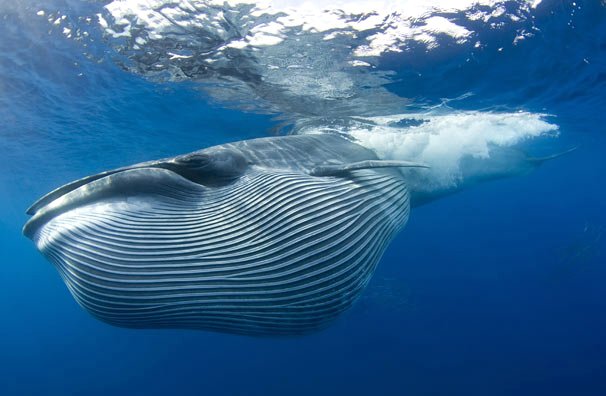
Bryde's Whale in the tropical Pacific Ocean


Bryde's whales are baleen whales, one of the "great whales" or rorquals.Seen here with a mouthful of water and krill or plankton.

These whales opportunistically feed on plankton (e.g., krill and copepods), and crustaceans (e.g. pelagic red crabs, shrimp), as well as schooling fish (e.g., anchovy, herring, sardine, mackerel, and pilchard).

Bryde's whales use several recognisable feeding methods, including skimming the surface, lunging, and bubble nets.

They prefer tropical and temperate waters over the polar seas that other whales in their family frequent.

They are largely coastal rather than pelagic. Bryde's whales are very similar in appearance to sei whales and almost as large.

"Bryde" is sometimes misheard as "brutus whale". The name comes from the Norwegian consul to South Africa, Johan Bryde, who helped set up the first whaling station in Durban, South Africa in 1908.

They inhabit tropical and subtropical waters worldwide.

Bryde's whales are considered medium-sized for balaenopterids, dark gray in color with a white underbelly.

Thursday, September 30, 2010

Zeppelin offers rare views of whales

Zeppelin offers rare views of whales

Pilot Katharine Board often sees pods of blue, gray and killer whales as she flies along the California coast.

Compared with other pilots, she has a unique vantage point — low and slow — from the only operational zeppelin in the United States.

Board's airship — Eureka — a modern model of an aircraft that is a throwback to the 1930s, gives her a clear and steady view of the sea giants.

"The great thing about moving slowly and low — we fly 1,000 feet above the ground and our cruising speed is 40 mph — is that you really get to see the world," Board said.

Many associate zeppelin flight with the tragedy of the German passenger airship Hindenburg, which exploded into flames May 6, 1937, at New Jersey's Lakehurst Naval Air Station, killing 36 people. Since then, there have been many safety improvements.

Recently, Farmers' Insurance, the company that sponsors the zeppelin, donated a day of flying to a group of scientists so they could film and photograph an orca pod in Washington's Puget Sound.

"It's a balance between business and doing things that are really special," said Brian Hall, owner of Airship Ventures, which owns the zeppelin. "There are so many cool things we've done before with this platform." 

Hall's airship has gone on research flights to examine biota in salt ponds and harmful algal blooms and to seek out pipeline gas leak evidence.

Hall purchased his airship in 2006 after flying in a zeppelin in Germany. Eureka began flying in 2008 after months of negotiating permits to allow a zeppelin to fly again in American airspace.

The 246-foot-long zeppelin took off recently from an airfield in Everett, Wash., and hovered to the U.S.-Canadian border — an hour's flight away.

Saturday, June 27, 2009

Save the Whale: Stop the Japanese 'Slaughter-driven Research"

The International Whaling Commission has backed an ambitious Australian plan for non-lethal whale research (Image: John W. Warden / Rex Features)

The International Whaling Commission has backed an ambitious Australian plan for non-lethal whale research (Image: John W. Warden / Rex Features)


The International Whaling Commission(IWC) may be shifting towards a more conservation-oriented role after this week backing an ambitious Australian plan for non-lethal whale research.

"It's part of a move by the IWC from being a whalers' club to being a whale conservation body," says Patrick Ramage, director of the International Fund for Animal Welfare (IFAW). "There's a bit of a sea change going on at the commission."

Presented by Australian environment minister Peter Garrett, the AU$1.5-million ($1.2 million) plan aims to demonstrate the value of non-lethal methods for tracking and researching whales. It contrasts with Japan's controversial "research" programme, which has been described as a front for commercial whaling.