Mars in the UAE’s sights.
Credit: NASA
The
United Arab Emirates has announced plans to launch a
mission to Mars by 2021.
A first for the Arab world, the mission and accompanying
Space Agency are a big deal for the UAE, scientifically and politically.
Investing in space activities is not new territory for the UAE. Its investments in space-related technology has already exceeded some US$5.4 billion, developing satellite data, mobile satellite communications and earth mapping and observation facilities.
This is not surprising when we live in an age where space hardware is important for a range of practical everyday uses such as telecommunications and navigation.
Accordingly, many countries have invested in purchasing satellites and their launches, data from space, and other space infrastructure.
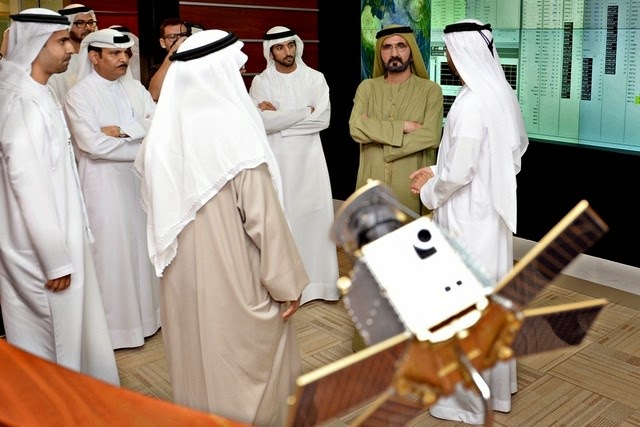
UAE Vice President and Ruler of Dubai Sheikh Mohammed bin Rashid yesterday launched the executive phases for the building of Khalifa Sat, the first satellite to be fully built and manufactured by UAE experts and due to be in orbit by 2017.
Next level space missions
The current plans indicate that the UAE will develop its own spacecraft construction and perhaps also launching capabilities.
While many countries participate in space activities through the purchase of hardware and launches from external providers, the ability to develop, build and launch their own craft domestically lifts a country to the next level of the space faring elite.
The announcement also implies that the UAE plans to pursue hugely expensive space activities with a primarily scientific purpose.
UAE already has a prestigious and respected scientific and technological institute, the
Emirates Institution for Advanced Science and Technology (EIAST).
The UAE Mars project has a practical purpose in that it is intended to further inspire UAE technology growth and the education of forthcoming scientists.
However a country is also making a more bold statement when it moves from space-related activity for purely practical purposes, to the more lofty goals of exploration, inspiration and science.
Power, prestige and politics
The leap from practical to primarily scientific space activity is noteworthy. This is partly because a space programme is a way for states to assert their prestige.
There is historical precedent that undertaking space activities for exploration
garners prestige and indicates power: financial strength, technological capabilities and also ideologically the capability to be at the forefront of an area of research that taps into humanity’s biggest goals.
The origins of putting human-made objects into space were during the Cold War between the US and the USSR, often referred to as the first space race.
Independent Players
Non-state players are increasingly active in space, including several (such as
Mars One) that have planned manned missions to Mars.
Realistically, the UAE’s Mars mission has a political subtext on several levels.
Domestically, it is timed to shore up nationalistic sentiment as it approaches its 50th anniversary of the country’s formation.
Regionally, the project indicates forward and technologically focused leadership within the Middle East region and globally, the mission marks the entry of an Arab nation into the elite club of countries with such ambitious space programs.
Three of the 16 Emirati engineers assigned to the DubaiSat-1 project work on the satellite in Daejeon, South Korea.
Success is not guaranteed
Determined participation is no key to success. Scientifically, Mars missions have proved to be expensive and complex.
Many have tried and many have failed, including the
UK’s budget Mars rover, the Beagle 2, which reached Mars in 2003 but failed upon landing on the Martian surface.
Therefore it remains to be seen what exactly the plans are for the UAE’s Martian spacecraft, what is proposed and what it will achieve.
 |
| Hellas-Sat 3 /EuropaSat spacecraft |
Computer artwork showing Hellas-Sat 3 /EuropaSat spacecraft. Courtesy: Thales Alenia Space.
UAE is no stranger to Space programs and has been an active participant in
a number of Satellite program, in cooperation with European corporations and other space agencies, notably the
European Space Agency (ESA).
Politically, the planned programme to Mars and also the creation of an UAE Space Agency makes a powerful statement.
It puts the Middle East on the map with regards to space exploration for scientific purposes. It could also drive the creation of a Middle East space programme, akin to that of the European Space Agency.
This does not undermine the scientific value or importance of the project proposed by the UAE.
The space science research community is well-networked transnationally, and a well-funded project to the red planet by the UAE should be welcomed.




 Posts
Posts


