Showing posts with label Space mission. Show all posts

Sunday, July 27, 2014

U.A.E. propose a Mission to Mars

Mars in the UAE’s sights.

Credit: NASA

The United Arab Emirates has announced plans to launch a mission to Mars by 2021.

A first for the Arab world, the mission and accompanying Space Agency are a big deal for the UAE, scientifically and politically.

Investing in space activities is not new territory for the UAE. Its investments in space-related technology has already exceeded some US$5.4 billion, developing satellite data, mobile satellite communications and earth mapping and observation facilities.

This is not surprising when we live in an age where space hardware is important for a range of practical everyday uses such as telecommunications and navigation.

Accordingly, many countries have invested in purchasing satellites and their launches, data from space, and other space infrastructure.
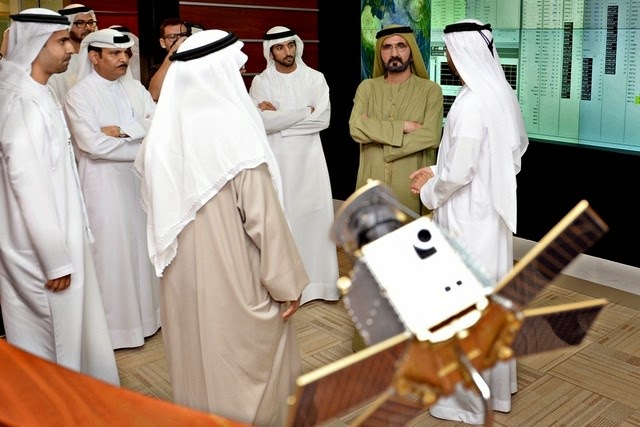
UAE Vice President and Ruler of Dubai Sheikh Mohammed bin Rashid yesterday launched the executive phases for the building of Khalifa Sat, the first satellite to be fully built and manufactured by UAE experts and due to be in orbit by 2017.

Next level space missions
The current plans indicate that the UAE will develop its own spacecraft construction and perhaps also launching capabilities.

While many countries participate in space activities through the purchase of hardware and launches from external providers, the ability to develop, build and launch their own craft domestically lifts a country to the next level of the space faring elite.


The announcement also implies that the UAE plans to pursue hugely expensive space activities with a primarily scientific purpose.

UAE already has a prestigious and respected scientific and technological institute, the Emirates Institution for Advanced Science and Technology (EIAST).

The UAE Mars project has a practical purpose in that it is intended to further inspire UAE technology growth and the education of forthcoming scientists.

However a country is also making a more bold statement when it moves from space-related activity for purely practical purposes, to the more lofty goals of exploration, inspiration and science.

Power, prestige and politics
The leap from practical to primarily scientific space activity is noteworthy. This is partly because a space programme is a way for states to assert their prestige.

There is historical precedent that undertaking space activities for exploration garners prestige and indicates power: financial strength, technological capabilities and also ideologically the capability to be at the forefront of an area of research that taps into humanity’s biggest goals.

The origins of putting human-made objects into space were during the Cold War between the US and the USSR, often referred to as the first space race.

SpaceX Dragon spacecraftMars One configuration
Independent Players
Non-state players are increasingly active in space, including several (such as Mars One) that have planned manned missions to Mars.

Realistically, the UAE’s Mars mission has a political subtext on several levels.

Domestically, it is timed to shore up nationalistic sentiment as it approaches its 50th anniversary of the country’s formation.

Regionally, the project indicates forward and technologically focused leadership within the Middle East region and globally, the mission marks the entry of an Arab nation into the elite club of countries with such ambitious space programs.

Three of the 16 Emirati engineers assigned to the DubaiSat-1 project work on the satellite in Daejeon, South Korea.

Success is not guaranteed
Determined participation is no key to success. Scientifically, Mars missions have proved to be expensive and complex.

Many have tried and many have failed, including the UK’s budget Mars rover, the Beagle 2, which reached Mars in 2003 but failed upon landing on the Martian surface.

Therefore it remains to be seen what exactly the plans are for the UAE’s Martian spacecraft, what is proposed and what it will achieve.

Hellas-Sat 3 /EuropaSat spacecraft
Computer artwork showing Hellas-Sat 3 /EuropaSat spacecraft. Courtesy: Thales Alenia Space.

UAE is no stranger to Space programs and has been an active participant in a number of Satellite program, in cooperation with European corporations and other space agencies, notably the European Space Agency (ESA).

Politically, the planned programme to Mars and also the creation of an UAE Space Agency makes a powerful statement.

It puts the Middle East on the map with regards to space exploration for scientific purposes. It could also drive the creation of a Middle East space programme, akin to that of the European Space Agency.

This does not undermine the scientific value or importance of the project proposed by the UAE.

The space science research community is well-networked transnationally, and a well-funded project to the red planet by the UAE should be welcomed.

Tuesday, July 22, 2014

Russia Launches Foton M4 Satellite: Live Animals on Two-Month Space Mission

A Russian Soyuz rocket launched a group of animals to space on July 18.

Credit: Roscosmos

A high-flying package of live animals, plant seeds, and materials samples shot into space Friday (July 18) aboard a retrievable Russian Foton satellite, launching a two-month mission focusing on microgravity research into biological and physical sciences.

The workhorse launcher fired its kerosene-fueled engines and lifted off from the Baikonur Cosmodrome in Kazakhstan at 2050 GMT (4:50 p.m. EDT), rocketing into a clear sky over the historic spaceport.

Launch occurred at 2:50 a.m. local time at Baikonur.

The three-stage Soyuz 2-1a rocket, a modernized version of the venerable launch vehicle, put the Foton M4 space capsule in orbit less than 10 minutes later.

The Russian Federal Space Agency, or Roscosmos, declared the launch a success on its website.

Foton M4 space capsule
The more than 15,000-pound Foton M4 space capsule launched by the Soyuz rocket is due to spend up to 60 days in orbit, hosting 22 experiments supplied by Russian and German institutions probing questions in biological and materials sciences.

When the mission is complete, the spacecraft will break apart and its spherical landing capsule, fitted with a heat shield, will return to Earth with a parachute-assisted landing in Russia.

The re-entry capsule's design is based on the Vostok spacecraft that carried Yuri Gagarin into orbit in 1961 on the first human spaceflight.

It carries experiments to study the effects of the harsh environment of space on organisms, manufacturing materials, plus other investigations.

According to information posted on the Roscosmos website, the Foton M4 space capsule carries nearly 1,900 pounds of research hardware inside and outside the capsule.

A joint Russian-German experiment will study the growth of semiconductor crystals in microgravity, an investigation scientists hope will lead to advancements in solar cells, light emitting diodes, transistors and other applications in the electronics industry.

"The goal is to produce crystals with the highest possible quality," said a statement by DLR, the German space agency.

Polizon-2 furnace
Three types of materials will be heated up inside a Russian-made Polizon-2 furnace housed inside the Foton M4 spacecraft.

Once melted, the samples will crystallize as scientists study the influence of magnetic fields and vibrations on their growth.

The materials samples will be divided among Russian and German scientists at the end of the mission.

The gecko habitat on Earth before launching to space.

Credit: Roscosmos

Geckos and plant seeds are also flying inside the pressurized Foton M4 space capsule.

Researchers will monitor the effects of microgravity on the adult geckos, including their sexual behaviour and embryonic development, according to Roscosmos.

Scientists will have a continuous video recording of the gecko habitat aboard the spacecraft.

Dried seeds and silkworm eggs inside the Foton space capsule will be studied to determine their response to cosmic radiation, and the satellite carries several experiments for research into microbes.

The mission marks the 16th flight of a recoverable Foton spacecraft since 1985.

The Foton M4 mission carries several upgrades to extend the duration of its flight, including solar panels to generate electricity and a new propulsion module to adjust its altitude.

Roscosmos says landing in southern Russia is scheduled for September.

Thursday, December 5, 2013

Space mission to Venus might help explain origin of the Moon

The Moon's gravity field as mapped by NASA's Gravity Recovery and Interior Laboratory. 

Credit: NASA/JPL-CALTECH/MIT/GSFC

Robin Canup, a space scientist with the Southwest Research Institute in Colorado has published a Comment piece in the journal Nature proposing that a mission to Venus be considered to help better understand the development of our moon.

She suggests that current theories that describe how the moon came about rely too heavily on Mars data, which could be obscuring the real story.

Tim Elliot and Sarah Stewart offer their own opinions on the matter in a companion News & Views piece in the same journal.

Robin Canup
The general consensus among modern space scientists is that our moon came to exist as the result of a Mars size planet impacting the Earth—that impact, the thinking goes, would have caused a lot of debris (made up mainly of material from the impactor) being pushed into space which over would have coalesced over time into a disk and then eventually, into the moon as we know it today.

The problem with this theory, as Canup notes, is that evidence is mounting that indicates the moon, at least on its surface, is far more like the Earth than the theory suggests.

Silicate samples brought back from manned missions, for example have the same isotope composition as those found here on Earth.

It's possible the impacting body had a nearly identical composition to the Earth, but that seems unlikely considering the differences in composition between Earth, and say Mars.

That's part of the reason Canup argues, that we need to go to Venus. We don't have isotopic samples from that planet.

If we did go there and retrieve samples and then found them similar to those here on Earth, it would go a long way towards explaining why the Earth and Moon seem to be so similar.

Meanwhile, space scientists are left to consider other theories to explain not just how the moon was created and developed but how it and the Earth evolved together resulting in the relationship we have today.

Some have suggested that perhaps the impact was actually between two Earth-like bodies, or maybe, the Earth was spinning a lot faster way back when which would have resulted in a small impact causing a lot of Earth debris to be flung into space, leading to the formation of the moon.

The main point Canup seems to be making is that if we want to understand our own planet better, we need to understand the moon as well and to do that, we need more data—starting with surface samples from Venus, she notes, would be a great way to begin.

More information: Planetary science: Lunar conspiracies, by Robin Canup, Nature 504, 27–29 (05 December 2013) DOI: 10.1038/504027a