Showing posts with label Proba-2. Show all posts

Sunday, November 2, 2014

ESA PROBA-2: Five Years in Space: One Satellite, Three Missions

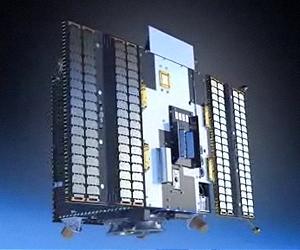
This artist's view shows Proba-2 fully operational in its final orbit. Its front side is continuously oriented toward the Sun, displaying instruments used for solar observation. 

LYRA (LYman alpha Radiometer) can be seen as the three vertical circles on the right. 

Just below it is SWAP (Sun Watcher using Active pixel system detector and image Processing), the grey surface in the right bottom corner.

In the center of the white panel, we can see the SPC (Solar Panel Concentrator), the two vertical triangle mirrors, and below it, the DSS (Digital Sun Sensor), the yellow grey box with a circular hole.


On the satellite's left side can be seen one of its three TPMUs (Thermal Plasma Measurement Units), the circular shape behind the solar panel, and the two extended DSLP (Dual Segmented Langmuir Probe) antennas extending from each corner of the solar array to study the space environment.

Credit: ESA

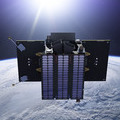
ESA's Proba-2 celebrates five years in orbit today. From technology demonstrator to solar observatory and now space weather platform, the mission has provided triple value to European scientists.

The second PRoject for OnBoard Autonomy (PROBA) mission was launched in 2009 as part of ESA’s programme for proving new technology in space.

Orbiting at about 725 km, this minisatellite, smaller than a cubic metre, carries four solar and space weather experiments and supports 17 technology demonstrations, providing companies with the flight experience that is essential for European industry to remain competitive.

In the first phase of its life, into early 2010, Proba-2 was extremely successful in verifying, under harsh space conditions, new technologies that will make future European missions more capable and efficient.

These included a new type of lithium-ion battery, an advanced data and power management system, combined carbon-fibre and aluminium structural panels, and new models of reaction wheels.

ESA’s Sun-watching Proba-2 minisatellite shows the aftermath of 18 February’s ‘coronal mass ejection’. 

Acquired at 0445 GMT, a little more than three hours after the initial eruption, the image demonstrates the Sun’s magnetic field reconnecting in the form of loops. 

Look down and left of the centre of the solar disc to clearly see this distinctive belt of loops.

Credit: ESA


Afterwards, Proba-2 continued as a solar observatory, a science mission studying the Sun and the plasma environment surrounding the satellite.

Information from the four solar and space weather sensors are helping scientists to understand our star’s corona and magnetic fields and the mechanisms responsible for solar eruptions.

This information is crucial to understanding ‘space weather,’ the conditions above Earth that can affect spaceborne and ground-based systems and services, or even endanger property and human health.

The importance of Proba-2 data for European space weather services meant that ESA’s Space Situational Awareness programme has been managing the mission since July 2013.

This programme is developing precursor space weather services. In particular, the solar data are used by the Solar Weather Expert Service Centre coordinated by the Royal Observatory of Belgium in Brussels.

This centre generates solar weather data products and services for various users throughout Europe, including industry, satellite operators and owners of sensitive ground infrastructure, such as power grids.

Monday, June 9, 2014

ESA Space Weather reports for Venus

This image is part of the Venus space weather report issued 5 June 2014.

During May-August 2014, ground controllers flying ESA's Venus Express will receive daily reports on solar activity issued by experts at ESA’s Space Weather Coordination Centre (SSCC), at the Space Pole in Belgium.

Credit: ESA

The weather updates will deliver the best information from a variety of sources, including ESA’s Proba-2 and solar-orbiting ESA and NASA spacecraft, to the control team as rapidly as possible.

For the first time, ESA is providing regular space-weather reports for a spacecraft orbiting another planet.

When your spacecraft is surfing deep into the atmosphere of an alien world, you need the latest information on conditions that could affect your trajectory.

If that planet is Venus, that means knowing what’s happening on our Sun in real time, because solar activity can greatly influence conditions like atmospheric density and the radiation environment at Earth’s closest neighbour.

Since May, ground controllers flying Venus Express have been receiving daily reports on solar activity issued by experts at ESA’s Space Weather Coordination Centre (SSCC), at the Space Pole in Belgium.

Surfing the Venus atmosphere 
The centre was established by the Agency’s Space Situational Awareness (SSA) programme office, and it began delivering precursor space-weather services for terrestrial clients in last year.

Now that Venus Express has completed its eight-year scientific mission, the reports are especially important as the control team take the satellite through an extraordinary multi-week ‘aerobraking’ campaign.

Artistic vision of Venus Express during the aerobraking manoeuvre, which will see the spacecraft orbiting Venus at an altitude of around 130 km from 18 June to 11 July. 

In the month before, the altitude will gradually be reduced from around 200 km to 130 km. 

If the spacecraft survives and fuel permits, the elevation of the orbit will be raised back up to approximately 450 km, allowing operations to continue for a further few months. 

Eventually, however, the spacecraft will plunge back into the atmosphere and the mission will end.

Aerobraking means lowering the spacecraft so that for part of each orbit it dips down very low and skims through the very uppermost reaches of the Venusian atmosphere,” notes Adam Williams, Deputy Spacecraft Operations Manager.

“We know that the current state of our Sun can affect Venus’ atmosphere, which could in turn impact the planned orbit of Venus Express as it passes through the atmosphere.”

Adam says that the team do not expect to replan any of the aerobraking orbits based on ‘typical’ solar activity levels.

“The space weather reports will, however, allow us to better understand anomalous behaviour that we may subsequently observe on the spacecraft.

“And in extreme cases, we would be more ready to react to a serious situation. For example, if our startrackers were to be overloaded by radiation.”

Monday, November 4, 2013

ESA Proba-2 views hybrid Solar eclipse - Video


Three partial solar eclipses are seen in this movie from ESA's Proba-2 Sun-watching satellite as it dipped in and out of the Moon's shadow during yesterday's 'hybrid' solar eclipse.

A hybrid eclipse comprises a total solar eclipse and an 'annular eclipse', depending on an observer's viewing location on Earth.

During a total solar eclipse, the Moon moves in front of the Sun as seen from Earth, their alignment and separation such that the much closer Moon appears large enough to block out the light from the much more distant Sun.

But from some locations, the apparent size of the Moon is slightly smaller than that of the Sun, leaving a bright ring around the dark disc of the Moon.

Meanwhile, from its vantage point in Earth orbit, Proba-2 saw several partial eclipses.

Proba-2 orbits Earth about 14.5 times per day, dipping in and out of the Moon's shadow around the time of a solar eclipse.

The video was produced from images taken by Proba-2's SWAP imager, which snaps the Sun in ultraviolet light.

Stormy active regions on the Sun's face are revealed, including sunspots, the roots of some large solar flares and 'coronal mass ejections' that are occasionally directed towards Earth.

Thursday, December 22, 2011

ESA Proba-2 tracks Comet Lovejoy through Sun’s fiery corona

ESA’s Proba-2 micro-satellite joined a flotilla of spacecraft observing deep-frozen Comet Lovejoy’s plunge through the million degree corona enshrouding the Sun, providing a close-up extreme ultraviolet view of the comet passing just 120 000 km from the Sun’s surface – and then, surprisingly, surviving.

Lovejoy had not been predicted to endure its swing by the Sun, but is now headed back out to the colder outer reaches of the Solar System, and should be visible from Earth’s northern hemisphere in mid-January.

Proba-2’s SWAP imager took part in a coordinated effort to track Comet Lovejoy as it came closest to the Sun on 16 December, working along with the ESA/NASA SOHO solar watchdog, Japan’s Hinode mission, NASA’s twin STEREO spacecraft and its Solar Dynamics Observatory.

SWAP showed the comet as a bright streak in the solar corona, with interactions between the comet tail causing brief coronal brightening and wiggles in the comet’s tale.

This was only the second time ever that a comet has been observed through an extreme-ultraviolet (EUV) solar telescope. The instrument’s observations – interrupted briefly as Proba-2 crossed behind Earth – show the comet going behind the Sun and then emerging back into view from the other side.

Comets are drawn to the gravitational pull of the Sun like moths to a flame – SOHO has identified thousands of Sun-grazing comets over the last 16 years. But up until now, what happens when a comet draws closest to the Sun has been a mystery.

Comets in the Sun’s neighbourhood usually seen with ‘coronagraph’ telescopes that block out the bright solar disc to observe the faint solar corona they are tuned for. This makes detailed images of comets nearing the Sun very hard to obtain.

It turns out however that EUV imagers that detect the extreme ultraviolet corona from the solar disk can also show the comet. Since the dust and other material making up a comet’s tail do not radiate at EUV wavelengths, this came as a surprise.

Thursday, December 1, 2011

ESA Proba-1 Images of Earth from Space

The Pyramids of Giza, nearby Cairo in Egypt.

The Mysterious and Mystical Uluru or Ayres Rock in Australia.

Thursday, August 25, 2011

ESA Proba-2: Ffuel tank refilled from ‘solid gas’

Proba-2 is flight-testing a total of 17 technology demonstrators for future ESA missions. 

It also serves as a scientific platform for solar and space weather observations.

Credits: ESA/Pierre Carril

Sometimes all it takes is fresh air to get a new lease of life. ESA’s Proba-2 microsatellite is a good example: an influx of nitrogen has replenished its fuel tank, in the process demonstrating a whole new space technology.

On 16 August a telecommand was sent from ESA’s Redu ground station in Belgium to boost the gases in Proba-2’s unusual ‘resistojet’ engine.

Used to maintain the microsatellite’s orbit at 600 km altitude, this experimental engine runs on xenon gas heated before ejection to provide added thrust.

The command added nitrogen gas to the fuel tank, bringing its pressure close to its launch level.


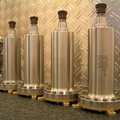
cool-gas generators
“What makes this repressurisation unique is that the added gas was not stored in a pressurised state but produced from a solid material at room temperature, the first of four ‘cool-gas generators’ on Proba-2,” explained Laurens van Vliet of Dutch research organisation TNO, which developed the technology.

“Nitrogen, like xenon, is an inert, non-reactive gas, so the resistojet can work just as well with a xenon–nitrogen mixture.”

The bottle-shaped cool-gas generators are filled with a rigid solid material that, once triggered, produces more than 250 times its own volume in pure nitrogen gas.

Integrating TNO's four cool-gas generators aboard Proba-2

Credits: TNO


To read more on this subject visit the ESA Proba-2 portal

Friday, June 10, 2011

ESA Proba-2: Massive Solar Activity

ESA’s Proba-2 small Sun-watcher catches spectacular solar flare

ESA’s Proba-2 small Sun-watcher was among the flotilla of satellites on watch as the Sun erupted spectacularly this week.

After years of relative quietness, the Sun is waking up. Tuesday 7 June saw a medium-class M2.5 solar flare, associated with a proton storm, a coronal mass ejection that glanced past Earth on Thursday 9 June and an accompanying burst of radio energy.


ESA’s Proba-2 satellite was launched in November 2009, during the most inactive period of the solar cycle, but now the Sun is growing more active as it progresses towards ‘solar max’, expected in 2013.

Friday, January 7, 2011

ESA Proba-2: Eclipse images

ESA’s Proba-2 microsatellite experienced a conjunction of the spheres on Tuesday, as the Sun, Moon and Earth all lined up in front of it.

Click on the picture to view the transition

As people on the ground observed the 4 January partial solar eclipse, Proba-2 provided a privileged top-of-atmosphere view – at least briefly.

Shortly after the Moon partially blocked Proba-2’s view of the Sun, the Sun-watching satellite flew into Earth’s shadow. At that point – when the video seen here goes dark – the Sun, Moon, Earth and Proba-2 were all on the same line in space.


Proba-2

Proba-2
“This is a notable event,” said Bogdan Nicula of the Royal Observatory of Belgium (ROB), who calculated where and when this double-eclipse would happen. “It is a nice exercise to model the orbit and relative positions of all three celestial bodies.”

The images making up this video were observed by Proba-2 with its SWAP imager – designed and operated by ROB – which operates at extreme-ultraviolet (EUV) wavelengths to monitor the swirling layer of the solar corona just above the Sun’s surface.

Thursday, July 1, 2010

ESA Proba-2 Tracks Sun Surging Into Space


Proba-2 is an experimental ESA micro-satellite carrying four solar physics and space weather instruments and a total of 17 new technology payloads.


Proba-2 is a small but innovative member of ESA's spacecraft fleet, crammed with experimental technologies. In its first eight months of life it has already returned more than 90 000 images of the Sun.

Less than a cubic metre in volume, Proba-2 carries a new generation of miniaturised science instruments, focused on the Sun and space weather, as well as 17 state-of-the-art technology payloads.

Launched on 2 November 2009, Proba-2 began routine operations in February. A workshop at ESA's ESTEC research and technology centre in the Netherlands on 22 June highlighted the microsatellite's initial achievements.

"We're getting very good results," remarked John Jorgensen of Technical University of Denmark, which contributed the mission's Micro Advanced Stellar Compass, a miniaturised startracker.

"This kind of platform works very well to provide in-flight demonstration of new technologies."

Thursday, May 13, 2010

ESA: Sun-watching Proba-2 keeps small eye on Earth

While ESA’s Proba-2 keeps its main instruments trained on the Sun, it is also looking back to its homeworld. This wide-angle view of Earth comes from an experimental camera that is smaller than an espresso cup.

The Exploration Camera (X-Cam) is carried on the underside of Proba-2, one of 17 new technologies being tested by the mini-satellite. Observing in the visible and near-infrared with a 100° field-of–view, its monochrome images resemble what an astronaut might see if elevated to Proba-2’s 800 km orbit.

The image shows southern Argentina including Buenos Aires (top left) and the Rio Negro river.

Proba-2's small X-Cam
X-Cam was designed by Swiss company Micro-Cameras & Space Exploration. It is the latest in a series of miniature cameras built by the company for previous ESA missions including Proba-1, SMART-1 and Rosetta.

“X-Cam has a lot of components, capability and embedded intelligence we need to test,” said Stephane Beauvivre of Micro-Cameras & Space Exploration.

Proba-2
“It’s really designed for exploration, which means we won’t know what scene we’re looking at, how far away it is and what exposure time is best. Rather than relying on trial and error, the camera’s intelligence makes sophisticated ‘automatic’ exposures, offering onboard quality control to deliver the best possible images. It also includes a lot of memory, which we need to check will stand up to prolonged radiation exposure.

Thursday, January 28, 2010

ESA Proba-2 Sun Observation Video


Description
Packed with novel devices and science instruments, Proba-2 is demonstrating technologies for future ESA missions while providing new views of our Sun. The team behind the small satellite now declared themselves extremely happy with its first three months in orbit and unveiled Proba-2’s first solar observations.

Tuesday, November 17, 2009

ESA spacecraft performing well in orbit

The European Space Agency's Proba-2 spacecraft platform is in its second week in orbit and scientists say its operational health is excellent.

The mini-spacecraft and the ESA's SMOS satellite were launched aboard the same rocket Nov. 2 from the Plesetsk cosmodrome in northern Russia. Proba-2 is designed to demonstrate 17 advanced satellite technologies while observing the sun and the plasma environment in orbit, the space agency said.

The next step for Proba-2, which is expected to reach operational status within two months, is the commissioning of its many new technological payloads. The mini-satellite is among the smallest ever flown by ESA.

SMOS, ESA's full-sized Soil Moisture and Ocean Salinity spacecraft, will require more time to check and calibrate its equipment, the ESA said.

Wednesday, October 21, 2009

ESA: SMOS and Proba-2 satellites

As preparations for the launch of SMOS and Proba-2 continue on schedule, the engineers and technicians at the Russian launch site say goodbye as both satellites are encapsulated within the half-shells of the Rockot fairing.

Volker Liebig, ESA’s Director of Earth Observation Programmes, said, “Today, with the encapsulation of the SMOS satellite in the launcher fairing, we have made an important step towards the launch of this key environmental mission, which will investigate two parameters of the complex climate system. I am looking forward to the launch in a few days!”

Proba-2 encapsulated by SMOS launch adapter

The small Proba-2 satellite had already been mated to the Breeze-KM, which is the upper stage of the Russian Rockot, and sealed from view by the SMOS launch adapter above. In launch configuration, Proba-2 sits underneath the SMOS satellite, for injection into orbit after SMOS.


Proba-2 is the second in ESA’s Project for Onboard Autonomy series. Although it is less than a cubic metre, incorporates a total of 17 technology developments and four scientific experiments that focus on solar and space weather.

Michel Courtois, ESA's Director of Technical and Quality Managment, said, "The encapsulation of the Proba-2 satellite was an emotional moment for the project team in Plesetsk. After five years of hard work, our satellite is one step closer to launch, ready to show the importance of in-orbit demonstration of new technologies."